Scene Alchemy Essentials Checklist – Part 4 — The Writing Coach Episode 174

In this episode of The Writing Coach podcast, writing coach Kevin T. Johns continues his review of the Scene Alchemy Essentials Checklist tool and discusses:

  • Using the four internal and four external literary elements
  • Avoiding infodumps
  • Ensuring your protagonist struggles to achieve their goals
  • And why, even when your character achieves their scene goal, something else should go wrong

Listen to the episode or read the transcript below:

The Writing Coach Episode #174 Show Notes

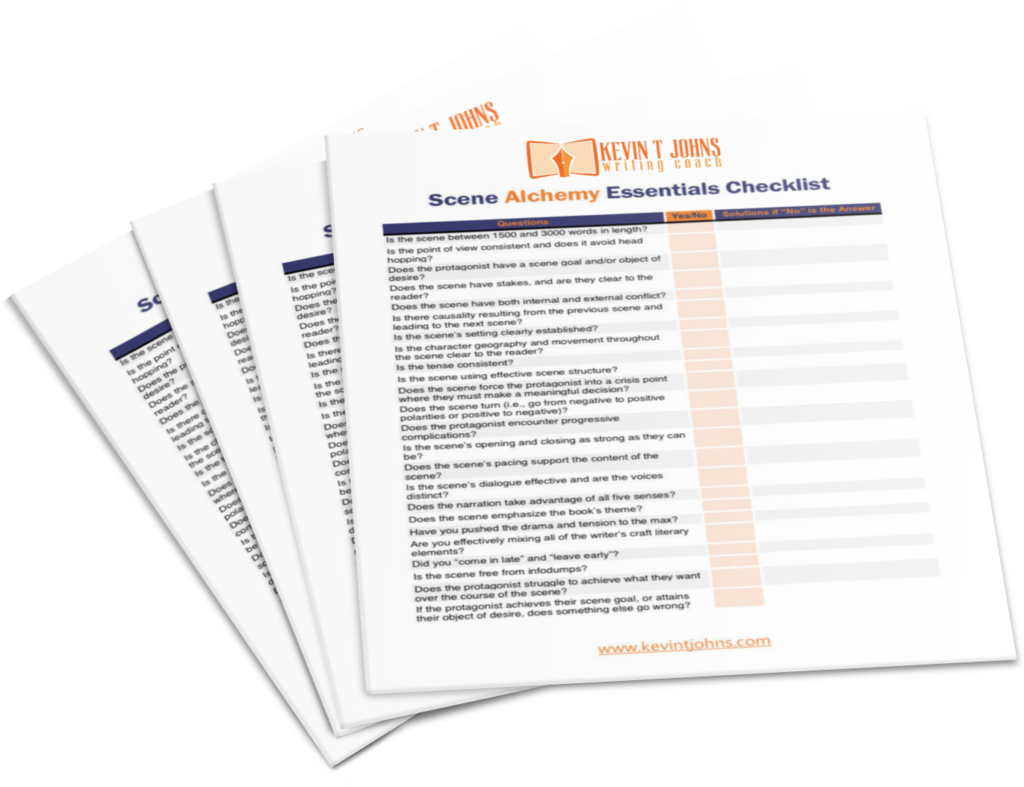
Download the FREE Scene Alchemy Essentials Checklist Now!
The Writing Coach Episode #174 Transcript

Hello, beloved listeners and welcome back to The Writing Coach podcast. It is your host, as always, writing coach Kevin T. Johns here.

This is part four, the final part in a podcast series, where we have been going over the questions in my new tool, “The Scene Alchemy Essential Checklist.”

Te goal of this checklist is to allow you to analyze the scene that you’ve already written and take something from okay or average and polish it up into literary gold. If you missed the first three parts of this series, don’t forget to go back and check those out. We’ve got over 20 questions we are using to analyze our scenes, but in this episode, we are going to go over the final questions in the checklist.

With that said, it is that time again: it’s that time of the year when I am opening the doors to my FIRST DRAFT group coaching program. We are welcoming in a new cohort. We want you in there by the first of October.

The first week of October, we’re kicking things off inside of FIRST DRAFT. We’ve got weekly question and answer sessions with me live. We’ve got weekly Hot Seat sessions. We’ve got positivity partner exchanges, over twenty writers craft training courses, and for each of them, we’ve got sketch notes, transcripts, and so much more.

FIRST DRAFT is a treasure trove of Writer’s Craft training materials, But it’s also an opportunity to get personalized coaching from me, as well as join a community of creative artists dedicated to writing.

Join the latest cohort of FIRST DRAFT now!

Now let’s continue our exploration of the Scene Alchemy Essentials Checklist.

Last episode, I skipped one because it was a bit of a more complicated one and we were nearing the end of the episode. Let’s tackle it ow. The question is:

Are effectively mixing all the writers craft literary elements?

I like to see each of these literary elements included in every scene that you write for the most part. Now the thing is, there’s eight literary elements. That’s what I was saying it’s a bit more of a complicated one. But after saying that, I realized I already did an episode on the elements. So if you skip back about 10 episodes to Episode 164 of the Writing Coach podcast, you will see me go over those eight literary elements in detail.

That said, let’s go over them briefly again.

Now, to remind you of what we are talking about, I break the literary elements up into four external elements and four internal elements. The four external elements are environmental description. This is information about where the scene is taking place, the setting of the scene. Next up are physical actions and blocking, This is where people are located in that environmental space in relation to each other and to other objects, as well as what they do with their bodies over the course of a scene. Next external element is dialogue. This one’s pretty obvious. It’s what the characters say. The final external literary element is point of view character sense descriptions. We touched on senses earlier on another one of the questions, but sense descriptions are what the scene’s point of view character sees, hears, smells, tastes, and touches over the course of a scene. That’s a reminder that we don’t want to just default to sight even though that’s our natural instinct. That’s our four external literary elements are.

The four internal literary elements are internal thoughts and feelings. This is the internal experience of novels, the insight into our point of view characters’ minds, their souls. This is what differentiates fiction novels from every other art form. Next internal literary element is narrative exposition. This is the contextual information a reader needs in order to understand the story. Next up, big voice narration. This is when as a narrator or as a writer, you step back from say that close POV and you share some more general morals or observations or wisdom with the reader about life. Finally, our last internal literary element is recipes, rules, instructions, lists and rituals. This is specific instructional information contained within the context of the story that you’re telling.

We just covered eight literary elements, let’s go over them again, real quick. Environmental description, physical actions in blocking, dialogue, point of view, character, sense descriptions, internal thoughts and feelings, narrative exposition, big voice narration, and rules, recipes, instructions, lists and rituals.

What I see is writers tend to hit big on one, two, or three of these literary elements and forget the others. We might get a ton of internal narration and emotions, but we have no idea where the scenes taking place. Or we have a great dialogue scene, but people aren’t moving, and we don’t know how they’re interacting with their physical environment. When you’re analyzing your scene, take a look and say, am I mixing in all of these different literary elements into my scene?

Something I’d like to see you do is take that even further make sure you’re mixing them in together as though you were shuffling cards in the deck. I don’t want an entire page of narration, and then an entire page of sense descriptions; mix these things together over the course of your scene.

All right, next up:  

Is the scene free from info dumps?

This is largely applicable to the first act of your book, and especially the first couple of scenes. I see it time and time and time again. As writers, we’re so scared to just drop our readers into the story, we feel like we need to give them our character’s life history, we feel like we need to give all this backstory and exposition and world-building. And what it becomes is just a big giant, ugly pile of info dumping and exposition. And that is the last thing you want to do if you want to pull the reader into the story.

Take a look at your scenes and say how much of this is really just exposition, and how much of it is absolutely necessary? If it is absolutely necessary exposition, is there a more palatable way to get it into the scene, as opposed to just dumping it in one of these big thick paragraphs of exposition?

In his book, Writing the Breakout Novel Workbook, Donald Mass has a really great exercise concerning first-act info dumps, which I think is fantastic. I would highly encourage you to use this technique when analyzing the first act of your manuscript. What he says is: look for any examples of backstory or flashbacks in the first act of your book, and then remove them, take those flashbacks, that backstory and drop it into Act Three. If it works in the context of Act Three, great! Get it in there and make that revelation about the past important to the latter portion of the book. If it doesn’t really fit in that latter portion of the book, just delete it because you probably don’t actually need it at all.

So that’s what this question is about. Are you avoiding info dumps? Take a look at that first act in particular, but the book as a whole, and look for giant chunks of exposition that either aren’t necessary or that could be communicated in a better way.

Next question:

Does the protagonist struggle to achieve what they want over the course of the scene?

This question is a culmination of a number of issues that we’ve talked about over these last few episodes. Largely this idea of does the character have a scene goal? Does the character have an object of desire within that scene? And then, do they encounter progressive complications and obstacles that get in the way of them achieving that scene goal?

You’d be surprised how often I read draft scenes in manuscripts where the character doesn’t have a scene goal. They’re just kind of floating through the scene, learning things or talking about things or having things happen to them. Or, if they do have a scene goal, they achieve it. And they achieve it way too easily.

We don’t like it when characters are just handed their goals. We want to see them struggle and then learn to overcome those obstacles and goals. That’s what makes a hero. That’s the lesson learned from storytelling: yeah, life is going to be hard, but you can overcome that if you persevere and if you develop a community, if you develop skills, if you get the right tools. That’s the message that we’re telling people. And when we have characters who are just handed their goals without struggle, it zaps the storytelling of drama of conflict and energy.

It also feels completely divorced from real life because real life is so damn hard. We all struggle every day to do well at our jobs, or to learn new information, or to be a parent, or to be a community member, or whatever those things are in our lives . . . to make money, to put food on the table. None of that is easy. And so when characters easily achieve their scene goals, it doesn’t feel real to life, and it doesn’t feel meaningful.

Let me give you two examples of this. Rey is one of the characters in the Disney Star Wars sequel movies. In that series, right from the start, Ray is an incredible pilot. We have no explanation at all for why she’s a great pilot, she just is. She also has an immediate affinity with the force, she’s just instantly able to use the force and instantly able to use a lightsaber. She is seemingly a better mechanic than Han Solo, a better sword fighter than Luke Skywalker . . . every single skill that the characters in the original trilogy struggled to attain she is handed at the beginning of her story, and so it never really feels like she struggles or grows or even changes because there is no change arc to go on when you start the scene or the story as already having achieved all the goals someone could want. Rey walks through the Star Wars trilogy being cool, being awesome, and it all ends up feeling meaningless because she didn’t really struggle for any of it.

Same thing with a more recent example in Star Wars. Just last week, an episode of the series, Ahsoka came out, and for the first six episodes of this show, the MacGuffin, the story goal for the character Sabine has been to rescue this character, Ezra, who’s been missing in another galaxy. Now in this episode, Episode 6, Sabine makes it to this other galaxy. And then she’s captured by the bad guys, and the bad guy to say, “Oh, we’re gonna let you go look for Ezra because you’ll never find him. He’s probably dead and leaving here means you will surely be dead as well.” Sabine is like, “I don’t care. I’ve come this far. I’m going to go find him.”

She heads out into this terrible deadly terrain, and she gets attacked by some bad guys. She easily kills all five of them. That’s her one challenge along the way: five bad guys who she easily beats. She then runs into some aliens who lead her directly to Ezra. It doesn’t feel like she struggled at all, it doesn’t feel earned.

We’ve spent this whole series building up this idea that it’s going to be so difficult to get to Ezra. And then, within 20 minutes of an episode, Sabine fights some bad guys, some faceless bad guys, some forgettable stormtroopers-type people, and then she goes and finds what she was looking for.

It’s underwhelming and it’s not dramatic. And it doesn’t feel like life.

Like we talked about, life is hard. Achieving big goals is hard. And so we just hand things to characters, throw some simple challenges in their way — it’s not good enough. They need to struggle, they need to have a hard time achieving those scene goals.

So take a look at your scenes and say, “Is my character achieving what they want too easily? How can I make things more difficult? Can I add complications?” If there’s already complications, “Can I make them progressive? Can I make the stakes bigger?” If there are already escalating stakes and progressive complications, “How can I make the protagonist suffer more? How can I make them have to give up something in order to achieve this goal?”

All right, we are at the final question. We’ve spent four episodes going over this worksheet but the final question in the Scene Alchemy Essentials Checklist. This is the question:

If your protagonist achieves their scene goal or attains their objective desire, does something else go wrong?

Now, this was another problem with this week’s episode of Ahsoka. At the end of the episode, Sabine finds Ezra, and they hug and it’s like “we finally found each other,” the end. Again, there’s nothing dramatic about that; great, they found each other.

And when you’re writing a book, at the end of every chapter, your reader is always looking for an excuse to close the book and go live their lives or go to bed. You’ve got to keep them on the edge of their seats, you’ve got to keep them wondering what’s going to happen next.

And one of the best ways to keep them turning those pages is to prevent your protagonist from achieving their scene goals. They keep struggling and then not getting the thing that thereafter. That said, once in a while, we do need characters to achieve their scene goals. If you’re writing a mystery, and your detective goes to a crime scene, looking for evidence, you need them to find some evidence to push the story forward to the next part of the investigation. But if all they do is find that evidence and go great, we’re lacking drama, we’re lacking conflict. What if they find a piece of information or a piece of evidence, but that evidence points to their own best friend? Right?

So this is what we’re talking about when we say if a character achieves their scene goal, does something else go wrong? Is there still drama? Is there still conflict in the story? Take a look at those scenes where your character, even if they do struggle, and then attain their scene goal, look for a way for something else to go wrong.

I think this is how Cathy Yardley breaks it down, she says, here’s the three ways to end a scene: 1) Your character doesn’t get what they want. 2) Your character doesn’t get what they want, and something else goes wrong. Or 3) The character does get what they want, and something else goes wrong. Did you notice anything there? Cathy Yardley is saying either they don’t get their goal, which is which is drama and conflict, or they don’t get their to their goal and something else goes wrong, which is an escalation of the conflict, or they get what they were after but something else goes wrong. We have got to get the conflict in there. Nowhere in there does she say “your character gets what they were after in that scene, the end happily ever after.” That guarantees a reader closes the book and says. “Well, maybe I’ll pick it up in a couple of days or whatnot.”

All right, so That is the Scene Alchemy Essentials Checklist and you can get it right here.

This too is the result of me reading drafts of writer’s scenes for the last decade. These are the twenty or so things that I’m looking for every time I’m reviewing a client’s pages in order to help improve them, help turn them into literary gold.

And that is what we’re doing every single week inside of the FIRST DRAFT group coaching program and community.

Our doors are open right now. I’m releasing this Monday, September 25, 2023. By the end of this week, we need you inside of FIRST DRAFT.

It’s an incredible program that is going to help you overcome some of the biggest challenges that writers face when trying to complete the first draft of their book.

You probably know already the amazing content within this program—there are a ton of supports, a ton of community interactions, and an amazing bounty of training resources for you there—but what you might not know is just how much fun and focused productivity we have within this program.

Some people are worried this is going to be too intense for them. They’re worried they’re not going to have the time to contribute to the program or to achieve their writing goals. But this program is reasonably paced. This is not about all-nighters. This is not National Novel Writing Month.

As much fun as people have with National Novel Writing Month and as much as it’s helped writers get started writing a book or maybe complete the first draft of a book, it’s not a sustainable process. And while you learn a tlot, you don’t necessarily add to your Writer’s Craft toolkit. You gain the experience of knowing “Oh, this part was harder, this part was easier,” but you don’t gain the knowledge of how to fix the problems or how to prepare for the obstacles so that you’re able to overcome them when they come along the way.

That’s why most people FIRST DRAFT for a one-time payment of $1,400 For a six-month membership in the program. If you broke it out over monthly payments, it would be something like 233 bucks a month. Not hugely expensive. But what it does is it gets you the accountability, it gets you the community, gets you the coaching, and it gets you the support to stay on track month after month after month, so that you don’t have to put your life on hold, so that you don’t have to sacrifice time with the kids, or fall behind in the day job, or all the other responsibilities that you have in your life already on top of trying to get a book written.

Tis is not about pulling your hair out. This is not about stress. It’s about fun. It’s about education. And it’s about steady progress towards achieving your literary goals.

FIRST DRAFT is about achieving a well-written first draft of your book that reads like a third draft, that was actually fun to write and didn’t feel like banging your head against the wall for six months straight.

I want you to join FIRST DRAFT now.

We’re welcoming a new cohort of writers into the program this week.

We kick things off the first week of October. We start going through those twenty writers craft courses, we start learning, we start growing, we start setting goals and tracking progress. It’s an incredible program, lot of fun, and we want you there.

If you are nervous about it, if you’re unsure, if you’ve never joined a program like this before and you are not sure if it’s going to be a good fit for you: choose the month-to-month option.

You can join for $350 a month and check it out for one month. If the program isn’t for you, then you leave at the end of the month. There’s no commitment for long term engagement. You’re paying month to month and you can leave anytime.

But what I find is most people discover how much they love the program, and they make that upgrade to the six-month one-time payment at a later date. So if you’re unsure of whether you want to go for the six-month commitment or not right now, just go in for a month. Check it out for a month. I am so confident that you are going to absolutely love this program and that you are going to kill it with the writing of your manuscript.

I want you to get in there, so sign up now.

That is it for this episode. This brings our series of examinations of the Scene Alchemy Essentials Checklist to an end. Thank you so much for listening. I hope you found these last four episodes helpful. Remember to hit that subscribe button, and I will see you on the next episode of The Writing Coach.
Scene Alchemy Essentials Checklist – Part 3 — The Writing Coach Episode 173

In this episode of The Writing Coach podcast, writing coach Kevin T. Johns continues his review of the Scene Alchemy Essentials Checklist tool and discusses the importance of:

  • Dialogue
  • Sense Descriptions
  • Theme
  • Pushing drama, emotion, and tension to the max
  • Coming into scenes late and leaving them early

Listen to the episode or read the transcript below:

The Writing Coach Episode #173 Show Notes

Download the FREE Scene Alchemy Essentials Checklist Now!

The Writing Coach Episode #173 Transcript

Hello, beloved listeners and welcome back to The Writing Coach podcast. It is your host, as always, writing coach Kevin T. Johns here.

I this episode, we are continuing our exploration of my new tool, “The Scene Alchemy Essential Checklist.”

This checklist allows you to go over any scene you’ve written and ask yourself over 20 questions about it, so that you can transform an average scene into a piece of literary gold.

This is our third episode now going through the checklist. It’s got a lot of questions, and it’s got a lot of craft insight. That’s why we’re spending several episodes talking about it.

Let’s do a quick recap of the questions we’ve covered so far in the first two parts of this podcast series.

Is the scene between 1500 and 3000 words in length?

Is the point of view consistent, and does it avoid head hopping?

Does the protagonist have a scene goal and/or object of desire?

Does the scene have stakes, and are they clear to the reader?

Does the scene have both internal and external conflict?

Is there causality resulting from the previous scene and leading to the next scene?

Is the scene’s setting clearly established?

Is the character geography and movement throughout the scene clear to the reader?

Is the tense consistent?

Is the scene using effective scene structure?

Does the scene force the protagonist into a crisis point where they must make a meaningful decision?

Does the scene turn (i.e., go from negative to positive polarities or positive to negative)?

Does the protagonist encounter progressive complications?

Is the scene’s opening and closing as strong as they can be?

Does the scene’s pacing support the content of the scene?

Okay, so that brings us to:

Is the scene’s dialogue effective and are the voices distinct?

Now dialogue is obviously a complex and also very fun aspect of fiction writing, I have an entire course inside my FIRST DRAFT group coaching program on dialogue so I’m not going to dive into too much of it here other than to say that dialogue should move your story forward. It shouldn’t be expository. It should reveal character. It should have a sense of musicality or rhythm to it. It should use interesting or unique language. And it should have both surface text and subtext.

Now there’s a lot of things that you can watch out for in your dialogue writing, I often recommend trying to avoid long monologues or speeches by breaking up any piece of dialogue that has more than five sentences in it. How you can do that is you can use dialogue tags, you can use a piece of narration, you could use a piece of physical action or environmental description—any of these elements we can get in here to break up the dialogue.

The simplest approach, actually, to breaking up dialogue, and also ensuring that other characters in the scene have an opportunity to speak, is to simply have them say what the other character just said. If someone says, “The world is going to blow up! We need to get it out of here right now!” You can have the other character say, “Right now? This minute?” They’re not actually contributing a lot more to the scene, but what you are doing is 1) emphasizing an important plot point, 2) keeping that other character in the exchange and making it feel like a back-and-forth, and 3) it’s a chance to break up what could perhaps be a longer chunk of dialogue that starts to have that speech feeling or that monologue feeling. We’re not writing Hamlet folks. We are writing modern, contemporary fiction, and so we probably want to avoid those long speeches.

Another topic that maybe I’ll touch on quickly are those LY suffix adverbs. It’s a controversial subject. I think, ultimately, you just have to find for yourself what your level of comfort is when it comes to using adverbs. Stephen King says “The road to hell is paved with adverbs.” Whereas JK Rowling uses LY suffix adverbs in her dialogue tags constantly and is one of the most successful authors in the world. How you approach LY adverbs in your dialogue tags is up to you.

All right, so make sure that the dialogue in your scenes is top-notch.

Does the narration take advantage of all five senses?

As people and as writers, we tend to default to sight. If I asked you right now to write a scene about a library, you would probably describe the stacks, the books, the checkout counter, maybe you might describe the quiet sound, but there are so many other opportunities for description. There’s touch; how do the books feel? What does the carpet feel like underfoot when you step inside? What does the library smell like? Is it the smell of old books? Or is it the smell of a newly freshly painted wall? We experience life through a variety of senses.

In your drafting, especially in your first draft, you’re probably just going to default to what things look like. When you come back now—when you’re looking to take an average scene and make it extraordinary—that’s a great opportunity to ask yourself, “Is there a smell I could describe in this scene? Is there a taste I could describe? Is there the sound of birds chirping or of a fire alarm going off?”

We’ve got to get all these other sense descriptions into our story to really bring it alive. As well as to just provide a variety of descriptions and not always just be telling the reader the wall was white, the cup was red, that sort of thing.

Does the scene emphasize the book’s overall themes?

Now when it comes to themes, we can get pretty complex, but on the most basic level, generally, we have four or five topics that a book is dealing with that are the themes that are going to come back again and again throughout the story. We also have our controlling idea, which is the message of our story, and it’s usually the lesson that our protagonist learns or it’s the little piece of wisdom, that you as an author, are embedding into your narrative to share with the reader to give a little wisdom about what it’s like to be human and what it’s like to live life.

Every scene you write is ideally going to contribute to either the controlling idea, one of those half-dozen themes that you’re dealing with throughout the story, or both of those things.

Theme can be really useful when you don’t know what the characters should be talking about, or you don’t know how to describe a certain moment; return to your theme. If you’re writing a comedy or a romance, perhaps one of the themes in your book is misunderstandings. Characters are often misunderstanding things or getting confused about things. If you have two characters, and you just need them to spend some time together, what should they talk about? Well, maybe they should talk about confusion, or maybe one character should say something and the other characters should be confused by it.

We can do this thematic patterning as well from a character perspective. Perhaps you have a character who’s a construction worker and so whenever he talks, or whenever he has ideas, his ideas are always about breaking things down and building them back up again. Or maybe you have a character who’s a dentist, and they’re always talking about how we need to polish things up. We can use certain words or thematic concepts or ways of coming at things to distinguish character voices, as well as continue to provide thematic elements to our book.

What theme does is provide cohesion to our narrative. I see so many times in the manuscripts of first-time authors or in just the first draft of manuscripts where the book covers so many topics. There are so many things that it feels a bit unruly, and it feels like a bit of a mess to the reader. The more you can narrow down what the book is really about thematically, and the more you can hit on those thematic elements again and again, the more it gives a sense of unity to the narrative, the more it makes it feel like the book is about something that it’s not just all over the place.

This thematic unity also helps distinguish books within a series or distinguish your book from other books in your genre. There 1000 vampire books out there, but are there 1000 vampire books with a theme that’s education makes us better people? Probably not. But maybe that’s what your vampire book is about, so you’re coming back to this idea of what is a good person? What is education? How can it help us make us better people in the context of a vampire book?

Maybe you’re writing a romance series and maybe book five of your romance series is set on a ski hill. We have this theme of descent or this theme of ascent, or a theme of cold, crisp air, or of the colour white or of things freezing and melting. We can use all these thematic elements so that the reader is like, “Oh, yeah, Book Six. That’s the ski book. That’s the snow book. That’s different from Book Two, where they the character went on a vacation and fell in love in Jamaica, and everything was hot, and relaxing and fun.”

Again, identify the themes of your book, make sure you know what they are, or as they emerge in the drafting and revisions, getting more and more clear on what they are, then ask yourself anytime you’re looking at a scene, “How exactly does this scene contribute to the theme of the book? How does this support the lesson I’m trying to teach the reader or the character? How does this become an essential element to the larger hole that exists within?”

Now here’s a pretty fun one. Ask yourself, when you’re reviewing a scene:

Have you pushed the drama and the tension to the maximum?

I find so often as writers, we hold back. We don’t make things as interesting or as dramatic or as over the top as they can be. And obviously, there’s a fear of pushing into melodrama or pushing too far into melodrama and into that point of histrionics. But I can tell you personally, as a fan of literature, and as a fan of storytelling, as someone who reads a lot of rough manuscripts, writers are almost never going too far with their drama. They’re almost always holding back and not going big enough with it.

Which is fine. That’s what revisions are for. But when you are revising, get in there and push things to the max.

If you have a scene where one of the complications in the scene is your character stubbing their toe. Well, what if we push that, and they don’t stub their toe? Instead, they trip, and they break their leg. That’s a heck of a lot more dramatic. And it’s also going to have larger impacts on the narrative as a whole because the protagonist is probably going to be in a cast for the next six weeks or whatever in the book. Whereas if the character just bumps their toe, that’s not as dramatic, not as interesting, and probably has little ramifications on the rest of the book.

So really push things to the max and then see what it does for your narrative.

I have a bit of a theater background. I’ve been in half a dozen plays and studied theater in university. My wife went to a theater high school. So I have a little bit of experience with theater and something that we do in theater is called a “grotesque rehearsal.” This is when we’re getting near performance day, and the dress rehearsals are locked down. We then do a grotesque, which is where we push our performance over the top to the point that it’s silly and grotesque.

We go so far with our performance, and what we actually discover through the grotesque is how much we’re holding back, how far we can actually push our performance as actors before it does become a caricature, before it does become too melodramatic, or histrionic.

There is a wide girth of performance and of drama and conflict that you can bring to your storytelling or to your performance as an actor that you really don’t discover until you do push it too far.

So rather than playing it safe, rather than having things feel realistic, try pushing things to their absolute maximum and see what happens. I think it’s always easier to inch your way back from going too far than it is to have this book that’s kind of emotionally or intellectually safe and just doesn’t push the limits anywhere.

Take a look at your scene and say, “Am I really going to the max with everything that’s going on in this scene?”

I’m going to skip a question now because it’s a more complicated one, so we will return to it in the next episode. For now, I want to move on to a really simple piece of advice I heard at a comic book convention probably 25 years ago. I was attending a talk by one of my favourite writers and what he said is, when you’re writing a scene:

Come in late and leave early.

This advice can be SO useful.

Often, I see writers creating scenes that are so slow to get started, or we have these big recap paragraphs at the beginning. We’ll be halfway through the first page, and I’ll put a little note that says “This is where the scene actually begins.”

Come in late. We don’t need to see the boring part. We don’t need to see the person walking up to the other person to start the conversation. We can start with the conversation already underway. We also don’t have to linger with a character throughout the day until they go to bed at night. We can end the scene at the most dramatic point so that we create those cliffhangers and those open loops. We can leave the scene at the point of maximum conflict and interest.

Too often, writers stick around a little too long in the scene. You’re trying to wrap things up, but when we wrap things up, it gives the reader an excuse to close the book and go to bed. So come in late with the scene already underway, in medias res, and leave early leave at a dramatic moment that makes the reader think, “I absolutely have to turn the page and keep reading the next scene or the next chapter in this book.”

FIRST DRAFT

Now this is part three of our “The Scene Alchemy Essential Checklist” series, and if you’re enjoying this series, I really think you would love my FIRST DRAFT group coaching program.

We are bringing in a new cohort of writers for the first week of October and I’d love for you to be a part of it.

Inside this coaching program we have weekly question and answer live calls. We have weekly hotseat sessions. We have so much more, but what I want to focus on right now is that we have 20 writers craft online courses that address every single one of these issues that we’ve been talking about in this series. I’m just touching on them briefly here, but if you want to get into point of view, if you want to get into scene structure, if you want an hour-long course on dialogue, if you want to learn the mechanics of writer’s craft while also making major progress on your writing, and being part of a community of creatives who have access to a writing coach with over ten years of experience. I’ve worked with writers for decades. I’ve worked with thousands of them. I can help you write your book in a more effective manner and have more fun doing it.

I would love for you to be part of this cohort of the FIRST DRAFT group coaching program, so click here. There’s a sales page there with all the information you need about the program.

Get signed up today.

We have a monthly option where you can take things a month at a time, or if you want to take the leap and make the big commitment, we have a six-month membership where you can get in at reduced pricing. You get great savings with that six-month membership, so go check it out now.

Thank you for listening to this episode. This was Part Three of our Scene Alchemy Essentials Checklist series. We’ll be wrapping things up in the next episode, where we’ll go over all the last questions in the checklist.

Remember to hit that subscribe button on your podcatcher of choice so that you don’t miss that next episode and so that I can see you there on . . . The Writing Coach.

Scene Alchemy Essentials Checklist – Part 2 — The Writing Coach Episode 172

In this episode of The Writing Coach podcast, writing coach Kevin T. Johns continues his review of the Scene Alchemy Essentials Checklist tool and discusses the importance of:

  • Scene Goals
  • Proper Tense
  • Scene Structure
  • Decision Points
  • Polarity Shifts
  • Progressive Complications
  • Openings and Closings
  • Pacing

Listen to the episode or read the transcript below:

The Writing Coach Episode #172 Show Notes

Download the FREE Scene Alchemy Essentials Checklist Now!

The Writing Coach Episode #172 Transcript

Hello, beloved listeners and welcome back to The Writing Coach podcast. It is your host, as always, writing coach Kevin T. Johns here.

Last episode, I introduced a super cool new tool called “The Scene Alchemy Essential Checklist.”  

This checklist is a list of over 20 questions you can ask yourself when analyzing a scene, and if you can’t answer “yes” to all of these questions, then there’s probably an opportunity for you to improve your scene.

If you’ve ever sat down and looked at your work and looked at the scene and said, “I have no idea how do we improve this?” That is what this tool is all about. Get your copy here.

Last week on the show, we covered the first five or six questions of the checklist. This week, we are going to continue that discussion. But I have to say something: last week, I missed one of the questions, and it is one of the most important questions a writer can ask themselves about their scene. And that question is:

Does the protagonist have a scene goal or an object of desire?

In Western storytelling, most of the time, we are looking for agency-driven characters. We want characters to be driving the story. We don’t want things happening to our characters. We want them to happen because our character has taken action, and what’s driving that action, what’s motivating them, is the scene goal.

That scene goal could be anything, but sometimes it’s a specific object of desire. Let’s think about Indiana Jones and the Raiders of the Lost Ark, the big opening sequence. What’s Indie’s sequence goal? Get in there, get that golden idol and get out in one piece. Much more often, though, the scene goal can be to convince someone of something, or to find evidence, or to have a good date.

The point is that every time you write a scene, your point of view character’s actions need to be clearly driven by some internal desire and not just reacting to things that are happening to them. When that happens, I call it “pinball syndrome.” It feels like your character is in a pinball machine, and they’re just being knocked around by the paddles of fate. It really saps the story of energy, and it makes everything feel coincidental or overly determined and fated. We really want our characters to have desires and to take action to try to achieve them. And, of course, run into trouble trying to get to them. That is the question I missed last week. Make sure you’re asking yourself, “Does the protagonist have a scene goal?”

Is the scene’s tense consistent?

Are you writing in present tense? Or are you writing in past tense? And are you remaining consistent throughout your narrative?

Both past and present tense have different benefits and drawbacks. I would argue there’s an immediacy to present tense; there’s a very modern feel to writing in the present tense. I think it’s great for things like Young Adult or maybe action novels where things are happening in the moment and we’re reacting with the energy or emotions of a teenager or a person in that action situation or whatnot.

Whereas I find third person so much better for a sense of legend, a sense of this is something that happened in the past that is now being related via a storyteller. For example, I couldn’t imagine Lord of the Rings written in present tense. It’s this feeling of an ancient time.

Both present and past can work. You want to choose the one that makes the most sense for the story that you’re telling. And then you want to make sure you’re being consistent throughout the narrative.

Are you using effective scene structure?

We hear so much about macro-level story structure, the hero’s journey, the three-act structure, four structure, the Elizabethan five acts structure. Everyone’s heard about this stuff, but we don’t hear nearly as much about scene structure There’s a few different ones that I like to recommend.

There’s James Scott Bell’s LOCK method where you look at your scene’s lead, their objective, the conflict that they encounter, and some sort of knockout ending to the keep the reader reading.

There’s also Cathy Yardley’s GMCD method where you identify your character’s goal, you identify what their motivation is, you add in conflict, and then there’s a disaster, something goes wrong at the end of the scene so that we keep that tension up.

There is Shawn Coyne’s Five Commandments of Storytelling, which are inciting incident, progressive complications, crises, climax and resolution.

I tend to use a structure where the character takes an action towards a goal, encounters progressive complications that push them to a decision point, they act on that decision point, and then we get a thrust-and-twist cliffhanger ending.

You’ll notice that all of these different structures largely are trying to get at the same thing. We have a character who’s motivated to achieve a goal. They run into complications in the process and are forced to react. That is scene structure. Make sure you familiarize yourself with it, but also that you execute on it in your scenes.

Does the scene force the protagonist into a crisis point where they must make a meaningful decision?

I just mentioned decision points in the story structure that I like to use. Decision points are fascinating. The second you force your character to make an important decision, the scene comes alive with energy. There’s so much built in conflict and tension to having a decision that has opposing sides.

In The Story Grid, Shawn Coyne lays out the “best bad choice” decision point. The best bad choice is when neither option is good. Your character is faced with two bad options, and they’re forced to pick one. The other is “irreconcilable good,” which means one good choice precludes the other good choice. You have two children, and you get to choose which one lives, but the other one dies. That is an irreconcilable goods decision point.

What you’ll find is the second you put those decision points into your story it ups the drama, it ups the tension, it also gives our character that agency we’ve been talking about because they’re taking action, they’re making a decision, and then they’re acting on it. Of course, not making a decision or choosing not to act can be a decision itself.

But looking at one of your scenes, ask yourself, “Is my character being forced to make an important decision here? And if not, can I add decision?” It will almost always improve your scene.

Does the scene turn?

This is something Shawn Coyne talks about a lot in The Story Grid, this idea of scenes going from negative polarities to positive polarities, positive to negative, negative to double negative, positive to double positive. The point is that the valiance of the scene shifts somewhere along the way. It starts in one polarity: happy, and it ends in another: sad.

Why are these turns important? They’re important because story is about change, and if there isn’t a change in polarity within any given scene, it’s likely that scene is pure exposition.

We’ve all been there: we read 20 pages, and then we close the book and we go, “You know, I just read 20 pages, and I don’t feel like anything happened.” How do you read 20 pages of a book in which nothing happens? Well, it’s because nothing has changed. When things change, the reader goes, “Oh, okay, that moment in the story was important because things are different now.” So when we’re asking ourselves, if the scene turns, if the scene shifts in polarity, what we’re really asking ourselves is, does this scene matter? Does the scene actually change the trajectory of the story? Because if it doesn’t, that scene can probably be cut.

Does the protagonist encounter progressive complications?

This goes back to our scene structure question where we’re asking ourselves, does our character ever goal are they taking action to get it, and then are they encountering barriers, challenges, and obstacles in the way.

My favorite examples of progressive complications takes place in Moana. Moana tries to get past a barrier reef that serves as a bit of a wall around her community, her Island. She gets on a boat, and she attempts to get across this barrier. That’s her scene goal: get across the barrier. What’s the complication? A giant wave hits her knocks her off of her boat. Great, that’s drama. That’s great conflict. But what the writers of Moana do is they add progressive complications. Next, she’s swimming in the water and a wave hits her in the face. Now she’s underwater, and she’s dragged down to the bottom of the ocean by the current. We have our first complication, a wave knocks her off the boat, we have our next complication, a wave knocks her deep underwater. We see the second complication is more complicated or has greater stakes than the first one. That’s why we’re talking about progressive complications, not just a bunch of complications, but complications that get worse than the one that preceded it.

Once Moana finds herself at the bottom of the ocean, her foot gets stuck under a rock, and she’s going to drown. So again, by adding progressive complications, the writers of that scene have created excellent drama. They keep ratcheting it up by throwing more and more problems at Moana.

Ultimately, it forces her into a meaningful decision point: am I going stay underwater and drown or am I going to yank my foot out from under this rock and probably severely hurt my ankle in the process? Of course, what happens is she yanks her foot out, and she washes up on shore with a bloody leg.

There’s a great little scene about a character who’s motivated to achieve a goal and then who encounters progressive complications that force her into a meaningful decision. That’s storytelling, that’s drama and conflict. That’s what good scene writing is all about. When you’re sitting down, and you’re analyzing your work, ask yourself, “Are there enough complications in here? And are the complications progressing? Are they getting more and more intense?”

Are the scene’s opening and closing as strong as they can be?

Next up is a really easy one because you can do it via sweeps. In the revisions process, sometimes people think you need to revise the way you write, in terms of sitting down and writing scene one and sitting down and writing scene two. And then when it’s revisions time, you sit down and you revise scene one, and then you revise scene two. But it doesn’t have to be like that. You can go through the whole book, looking for just a couple of elements. I think this question is a really great one that you can do that sweeps process, with in that’s “Are the scenes opening and closing as strong as they can be?”

Take a week and go through your manuscript and say, is the opening to every single scene gripping? Does it hook the reader? Does it make them want to keep reading? And do we have great endings to those scenes that make the reader want to keep reading? What are you doing to ensure that when the reader reaches the end of that scene they don’t close the book and go to bed? What sort of open loop? What sort of question? What sort of cliffhanger? What sort of shocking revelation can you have at the end of your scenes to make the reader keep reading late into the night?

A really simple piece of advice to keep in mind when it comes to beginnings and endings to scenes is to come in late and leave early. Quite often, we have recap paragraphs at the beginning of chapters where the author is bringing the reader up to speed on what happened in between scenes. Or perhaps we have a character parking their car and walking up to a house and going inside and then having a conversation. Where the drama in the scene located is when they’re inside talking so start there. Come into the scene late.

Don’t start the scene when the character wakes up in the morning; start when they arrive at work and the interesting thing happens.

The same thing with endings. Sometimes we stick around in a scene a little too long, and we’re getting a little boring, perhaps, or just spending a little too much time in that moment. Look at your scenes and ask yourself, if I cut off the last paragraph, if I cut off the last three paragraphs of this scene, will it actually be a more dramatic ending? Will it accomplish that goal that we want of having the reader turn pages and keep reading?

Does the scene’s pacing support the content of the scene?

Pacing is the speed at which the reader moves through the story. We can control this with showing and telling. You’ve probably heard the advice: show, don’t tell. That’s not actually good advice. The better advice is: show the dramatic stuff, tell the boring stuff.

We don’t need to hear James Bond getting up, brushing his teeth, going to the bathroom, eating cereal and putting on a tie. We need to see James Bond in battle with the bad guy. And so when they’re in battle, slow the scene down by using lots of language, by giving us all the details of the moment. But when it comes to breakfast, speed on through: “James Bond woke up, ate breakfast and headed out the door.” That’s all we need. We don’t need to know that he ate Cheerios that morning because it’s not interesting and it’s not dramatic.

When you’re looking at a scene, try to find the most dramatic parts, the most interesting parts, those decision points that we’ve been talking about, those polarity shifts, those moments of revelation because those are the golden nuggets.

We’re talking about scene alchemy, here; we’re talking about turning words into gold.

With any given scene you’re looking at it in the revisions process, you’re like a gold prospector. The scene is a pile of dirt—no offence to your writing. But when you take that pile of dirt, and you sift it, what you’re doing is you’re looking for those dramatic, exciting, cool, interesting, shocking moments. Those are the little pieces of gold that you’re looking for. And once you found them, once you’ve drafted the scene, and you said, “Oh, this part was much more exciting than I thought,” that’s where you want to dedicate your word count. That’s where you want to show. That’s where you want to get into details. And some of the other parts of the scene that perhaps aren’t as interesting, aren’t as dramatic, well, maybe you pull back on the word count there so that we move through the boring stuff quickly and get to the good stuff.

All right, that is it for our second look at “The Scene Alchemy Essential Checklist.”  We’ve still got several questions to go, so we will tackle those on our next episode. I really want you to grab the scene checklist. I think you’re going to find it super helpful in analyzing and improving your scene-by-scene writing. Get it here.

Thank you so much for tuning in. Remember to hit that subscribe button so that you can hear the next episode, where we will continue to walk through the various questions included in “The Scene Alchemy Essential Checklist.”  

I will see you there, on the next episode of The Writing Coach.
Scene Alchemy Essentials Checklist – Part 1 — The Writing Coach Episode 171

In this episode of The Writing Coach podcast, writing coach Kevin T. Johns introduces his new Scene Alchemy Essentials Checklist tool and discusses the importance of:

  • Scene length
  • Point of View
  • Stakes
  • Internal and External Conflict
  • Causality
  • Setting

Listen to the episode or read the transcript below:

The Writing Coach Episode #171 Show Notes

Download the FREE Scene Alchemy Essentials Checklist Now!

The Writing Coach Episode #171 Transcript

Hello, beloved listeners. And welcome back to The Writing Coach podcast. It is your host, as always, writing coach Kevin T. John’s here.

I am recording this early in September. Story Plan Intensive is underway. We’ve got a great group of writers in the program and an even greater group of writers in the group coaching. So excited to be working with all of you this month.

We are getting ready to open the doors to my group coaching program, FIRST DRAFT, later in the month. We’re going to open it up for a cohort of writers, so if you’re interested in hearing about FIRST DRAFT and what we have to offer, head on over to www.kevintjohns.com/firstdraft. But FIRST DRAFT is not what we are going to be talking about today.

I am super excited because today I am sharing with you a new gift, a new giveaway, that you can pick up on my website. It is called “The Scene Alchemy Essential Checklist.” You can download that checklist here.

Now, so many writers come to me, and they’ve written scenes, or they’ve written books, and they know it’s not good enough, but they don’t know how to make it better. They want it to be gold, but it’s bronze. And so that’s where “The Scene Alchemy Essential Checklist” comes in. It is a series of over 20 questions you can ask yourself about any given scene in your book. And if you can answer “yes” to as many questions as possible, you can transform that scene, that mediocre scene, that okay scene, into literary gold, into a top-notch scene. Now, there are a lot of questions, as I said, so we are going to tease them out over the next couple of episodes of the podcast so that you can effectively use the checklist to improve your work.

That said, these are big issues, and we’re only going to be able to touch on them quickly here. In FIRST DRAFT, we do have training courses that cover every question in this checklist. So, if you do want a longer course and more training on these issues, again, check out FIRST DRAFT. But for now, I think we’ll be able to talk through each question in the checklist to the point where you are going to understand why the question is being asked and then execute on improving your scene by getting the answer to that question to a “yes.” Does that make sense? I hope it makes sense. It’s going to. It’s going to, so go download the checklist and then listen to this episode, and we are going to have you rocking and rolling in no time.

Now, the first question on the scene alchemy essentials checklist is:

Is the scene between 1500 and 3000 words in length?

What I find is that scenes under 1500 words might be lacking something. You might not have got enough physical description in the scene, you might not have got enough environmental description, and you might not have pushed the conflict far enough. What I like to think of is a scene is like a wet washcloth, and when you’re revising a scene, you really want to twist that washcloth and get every little drop of drama and emotion out of that scene. If your scene is less than 1500 words, there’s a chance you’re not getting all the juice out of it that you might be able to get.

If the scene is over 3000 words long, you might be losing the reader’s attention, and the scene’s energy might be starting to lag. Can there be super incredible, dramatic, exciting scenes over 3000 words? Absolutely. Of course. Can there be scenes that are super effective at less than 1500 words? Of course, but what this checklist does is allow us to do a little check for ourselves and say, hey, if it is over 3000 words, are we sure it’s maintaining the reader’s interest? If it’s under 1500 words, are we really getting the most out of the scene that we can get?

I like to think about shooting a movie. I guess not everyone has worked on a movie set, but I think people have a general sense of how movies work. Say we’re shooting a diner scene, someone has to build an entire diner. They spend weeks building it, getting the set together, and filling it with props. And on the day of the shoot, everyone’s showing up, and we’re lighting the diner. And we’re figuring out where the actors are going to be in the diner, or we’re figuring out where the extras are going to be.

Or we’re using an existing diner, which means a crew of a couple hundred people are probably travelling to this location. We need to find parking, we need to shut down local traffic, and we need to make sure we have generators on site so we’re not blowing the electrical power grid.

The point is that shooting a diner scene is a ton of work. And so you can bet in cinema, if they’re going to spend days and time and money to create that scene, they are going to make sure they get every production dollar they can out of that scene.

Whereas because novelists have an infinite budget, I find sometimes my clients aren’t using their scenes and their location for all that they’re worth. If you are going to write down a scene, ask yourself if this was a scene in a movie, would it be worth 200 people driving somewhere to shoot? Or would it be worth spending a month building the set and filling it with props? Make sure that your scenes are as robust and as effective as they can be. Don’t shortchange yourself by writing too short a scene.

Okay, that’s question number one. As you can see, we have got a lot of questions to cover. We’re going to do a couple of episodes here. Question number two:

Is the point of view consistent, and does the scene avoid head-hopping?

 Now, this is probably the number one issue I encounter when first-time novelists come to work with me. They’ve written a manuscript or they’ve started a manuscript, they hand it over to me for review, and literally, the first thing I’m looking for is the point of view. Is it third-person limited? Is it first-person limited? Usually, it’s not. Usually, it’s some sort of quasi-omniscient slash third-person slash head-hopping. And it can take a lot of work to rein that in or even to understand the concept of point of view.

It may sound easy, but it’s not. Beginner writers really can struggle with it, and even advanced writers and that is why it’s here on the checklist. I’ve seen writers so many times fall into first person and not even realize they’ve done it, or much more often, accidentally head-hop or accidentally fall into omniscient narration in a third-person limited book.

The head hopping thing, it’s so hard for beginner writers to get their head wrapped around. Is that a Freudian slip? They have a hard time getting their head wrapped around head-hopping. The reality is that readers hate head-hopping. Literary agents hate head-hopping, and editors hate head-hopping. Publishers hate head-hopping and the dog on the street who uses the book as toilet paper! I don’t know. The point is, No one likes head hopping except beginner writers because they want the reader to see what everyone’s thinking and everyone’s feeling. But that’s not effective storytelling. It distances us from the protagonist. It can be super confusing because we don’t know who is saying or thinking what. There are some other elements in this checklist, like polarity shifts, that become almost impossible to track if we are not limited to a single character’s POV or if we are not at least locked into a consistent, omniscient point of view. And again, even omniscient is not an excuse to be willy-nilly head-hopping.

So, after you write a scene, get out “The Scene Alchemy Essential Checklist” and review your point of view. Make sure you are sticking with the book’s chosen point of view, and make sure you are not head-hopping.

Next up:

Does the scene have stakes, and are they clear to the reader?

Stakes are the consequences of our protagonist or point of view character not attaining or achieving what they’re trying to achieve. Quite often, we have scenes where characters want something, but as authors, we fail to articulate for the reader what it is they want or what it is they’re trying to get out of any given scene. And more importantly, we’ve also not made it clear to the reader what the stakes are. So we need to lock that down. Because the tension, the drama, the conflict exist in relation to the results.

If we’re writing a romantic comedy and a girl is going to ask a guy on a date, if we don’t understand what the consequence of him saying “No” to that date, as well as the consequence of saying him “Yes,” then we don’t understand the drama of the scene. Stakes are important for establishing what’s at risk at any given moment in a book and for emphasizing the significance of every little moment.

 Look at your scenes and say, are there stakes? Are they significant? And if they are, have they been made clear to the reader? Sometimes, as authors, what seems very clear to us is not always clear to the reader. Ask yourself, if a reader reads this scene cold, would they understand what’s at stake?

Does the scene have both internal and external conflict?

Drama is about conflict. But that does not have to be a person escaping a burning building; that’s external conflict, but conflict can also be a person asking themselves if they’re deserving of love or not, or if they should choose to be alone, or if they should choose to join a group or reject that group. Internal drama and internal conflict can be just as exciting as external conflict.

You’ve probably heard the distinction between commercial fiction and literary fiction. The clear demarcation between these two kinds of big categories of books is that commercial fiction tends to focus on external conflict characters doing things out in the real world, trying to rescue people from burning buildings, or trying to go on a date and have sex or physical external elements of the story. Whereas literary fiction is much more internally focused, the conflicts are within our characters.

When we look at something like Mrs. Dalloway, all of the conflict in that story, for the most part, is happening inside the characters’ heads. We have a World War I shell-shocked veteran in that book, and the war is over. He’s not dodging bombs, he’s not firing guns from the trenches of World War I. That’s external conflict, but that’s not what Mrs. Dalloway is about. It’s about the internal struggles he’s dealing with because of shell shock and of the traumas and horror of World War I.

Now, you might think, “Oh, okay, so literary fiction is all internal and commercial fiction is all external.”

Not at all. We want both in every story. Yes, if you’re writing a vampire story, it’s probably going to lean more on external conflicts than it is on internal. But the story still needs internal drama, it needs to feel like people are going through emotional and intellectual challenges. And in the same way, on the literary side of things, yeah, we might be able to get away with a scene of someone looking at a window and thinking for an entire scene, but you can’t get away with a whole book of that. People still need to go out and do things. The Life of Pi is a literary book, but we still get tigers and boats and desert islands and all of these things, right?

Most of the people I work with tend to be writing commercial fiction, in which case, they almost always have good external conflict already. If not, here’s the chance to look at that scene and get that external conflict in there. But like I said, often with my commercial clients, it’s already there. So we want to ask ourselves, what’s the internal conflict? What’s going on inside of our characters? It might be just as interesting as what’s going on outside.

Is there causality resulting from the previous and leading to the next scene?

How we want our story to unfold is to feel like a series of dominoes falling. We want every scene to feel like it couldn’t have happened without the previous one happening. And we want scene three to feel like it couldn’t have happened unless scene two happened. We want that causality, most of the time, throughout the entire book. That’s what creates a page-turner. That’s what creates great pacing. When people say, “I couldn’t put the book down,” it’s because every scene leads to the next scene, and every conflict leads to the next conflict. And that’s how we want to pull readers through a book.

When you’re sitting down to look at a scene, and you’re saying, “Is the causality here?”, a way to ask yourself this question, another way to phrase it, is to say, “If I took this scene out of the book, would it significantly change the book?” If not, then that scene probably shouldn’t be in there. It’s probably slowing down the pacing. It’s probably just providing exposition or a character moment. Or maybe you’re going on a little tangent. We want our stories structured so that if we take any one given scene out, the whole narrative falls to pieces because every scene should be set up by the preceding scene, and every scene should lead into the next scene.

All right, let’s look at our last question for this episode. Our last question from “The Scene Alchemy Essential Checklist” is:

Is the scene’s setting clearly established?

Again, this is something that I see people miss a lot or just save till revisions, which I think is perfectly fine.

I don’t necessarily dig writing environmental descriptions in my novels, at least certainly not during a first draft. I want to focus on the adventure, I want to focus on the emotion, I want to focus on the drama. But that can’t exist in black space.

We need to understand where the scene is taking place. Are we inside? Are we outside? Are we on a boat? Are we in an airplane? If we’re in an airplane? Are we in the cockpit? Are we in the bathroom? Are we in the area where the stewardesses get food ready? Or are we sitting in a seat looking out a window? The environment in which a character interacts with the external world and with other characters matters. So, in revisions, I get in there, and I start fleshing out those environments.

Environments can be so important to the point where they can become characters themselves. You think of any sitcom you’ve ever watched. Let’s talk about Friends. Those apartments in Friends and the Central Perk location feel almost as essential to the show as the characters. it would feel weird if they suddenly had a new coffee shop, just as weird as it would feel if they replaced Monica with a new actress. Location and environment matters.

If you are the type of writer who already gets that established when you’re in your first draft, awesome. But so many of us can come back in revisions, and we can pull out the scene this checklist, and we can remind ourselves to ask ourselves, “Is the scene’s environment clearly established?” so that we can really build that world for the reader and so that we can clearly have our characters existing in a place and time. The second it starts feeling like the characters are just heads floating in space, we’ve lost the physicality of the scene.

Often, I see writers opening scenes with these kind of recap paragraphs that will say, “It was two days before the letter finally arrived in the mail.” And while I’m hearing that, I’m like, where’s this happening? Who is this narrator? It’s just a voice floating in black space. Much more often, I would prefer you start the scene with a character clearly rooted in a specific place and time. Absolutely, we’re going to go into some exposition at some point, and we’re going to go into some internal narration, but before we do that, tell me where this scene is taking place. Tell me about the environment that is taking place in.

All right. I hope you found that helpful. That was the first six questions in the “The Scene Alchemy Essential Checklist.” It’s a free resource that I’m giving away, and you can get it here.

Thank you so much for tuning in. We are going to continue to go through that checklist, so make sure you hit that subscribe button so that I can see you on the next episode of The Writing Coach.
The Pantser-Planner Ouroboros — The Writing Coach Episode 170

In this episode of The Writing Coach podcast, writing coach Kevin T. Johns examines the benefits of both discovery writing and story planning and then suggests they are both part of the same creative cycle.

Listen to the episode or read the transcript below:

The Writing Coach Episode #170 Show Notes

Register for the September 2023 Edition of Story Plan Intensive now!

The Writing Coach Episode #170 Transcript

Hello, beloved listeners, and welcome back to The Writing Coach podcast. It is your host, as always, writing coach Kevin T. Johns here.

We are nearing the end of August. We are nearing the end of the summer, which is an exciting time for everyone. The kids are going back to school, and people are getting geared up to make that final rush towards the end of the year to get all the things accomplished that they wanted to get accomplished. And, on September 4, the first Monday of September, we are starting the latest round of STORY PLAN INTENSIVE.

STORY PLAN is my four-week program. It’s an email program, you sign up, and I send you emails every day, Monday to Friday, with links to training videos to help you develop your writer’s craft knowledge. Then on Fridays, you get a homework assignment designed to stimulate creativity and help you plan and plot your book. By the end of the program, in less than one month’s time, you’re going to have an incredible outline for your book If you want to participate, and I hope that you do, register now.

Oh, did I mention it’s free?

Yep, just sign up with your email address, and you’ll get four weeks of training videos on me.

In today’s episode of the podcast, I want to talk about pantsers and planners.

If you’ve spent any time in the writing world, you’ve probably seen arguments, or you’ve seen it established as a dichotomy that you have these pantsers and you have these planners and never the two should mix.

Well, on this episode, I’m going to talk a little bit about my thinking on pantsers and planners and hopefully give you a new perspective on this entire concept. Is it really a dichotomy? Or is it actually something much more similar to an ouroboros, to a snake eating its own tail, that circular, cyclical symbol that you might be familiar with.

What is a Pantser?

Now, if all of this is new to you and this has sounded crazy, let’s establish some definitions upfront. So what is a pantser? Well, pantsers are also called organic writers, or they’re called discovery writers, and what this style of writer does is they sit down, and they write, and they make the story up as they go along. They don’t know where it’s going, they don’t know what’s going happen. They’re just putting fingers to the keyboard and seeing what sort of magic happens.

Probably the most famous example of this, or the most outspoken, perhaps, of this style, is Stephen King. In his book On Writing he talks about how he is a discovery writer. That’s a hugely popular book. He’s a hugely popular writer. So I think a lot of people who pants feel like Stephen King saying that that’s how he writes really justifies that approach as valid, which it absolutely is.

That said, what did we open this podcast with? We opened it with me promoting a course on planning, so you could probably guess where my biases lay. I certainly think planning is effective.

What is a Planner?

The planner thinks about their story and plots it and plans it (at least to some extent) ahead of time before they actually start writing or drafting the book. They have a plan. They have a general sense of what is going to happen in the story and where it’s going to go. When it comes time to write, they sit down, and they execute on the pre-planned story.

I really want to focus on the benefits right now and demonstrate how both of these approaches can have really creative and beneficial aspects to them.

Benefits of Pantsing

On the pantser side of things, there’s something creatively freeing about just sitting down and writing and doing whatever the heck you want, free from structure and free from rules. So many people become artists or use art as their creative expression, and as their rejection of the mainstream. Many writers are rebels and many artists want to smash the rules or think of a new way of coming at life or coming at story. Making it up as they go along seems very conducive to that sort of approach to freedom and creativity and art.

Pantsers often also enjoy the surprises that come along from discovery writing In the same way that a reader doesn’t know where the story is going, the discovery writer doesn’t know either. It makes the drafting process perhaps more pleasurable because you get these fun little surprises the same way that a reader does.

Pantsers also feel like there’s probably a more direct channel for them between wherever creativity comes from and the page. There’s a sort of unfiltered nature to it. Whether you believe imagination and creativity come from your brain, or whether you believe it comes from the muse, or whether you believe in the collective unconscious, or whatever metaphysical belief or physical belief you have about creativity, sitting down and just letting words flow really does feel like an unfiltered pathway from that magical source of arts and creativity and getting those words onto the page.

Pantsing also provides a lot of flexibility for the writer. You can take the story, wherever you want to take it. If you’re writing a romantic comedy and halfway through it you decide the characters are goning get on the spaceship and go to the moon, you can do that. You can do whatever you want. You’re not bound by any structure and you’re not bound by any conventions. If you’re getting bored with the story going in one direction, you can really easily just take it in another because you have that flexibility.

Discovery writing is also perhaps quicker in terms of you just sit down and start doing it. There’s no education process involved. There’s no planning process involved. You’re not organizing scenes so that they fit a certain structure. If you’re someone who just wants to create, who just wants to sit down and get to it and write, then certainly pantsing is the way to get there.

Another thing that planning requires that pantsing doesn’t is really a sense of what it is you want to say? What is the theme of your book? What is the controlling idea? What message are you sharing with the reader about the world, or about life, or about humanity? The reality is we don’t always know what it is we want to say. We have a story that we want to tell, and in the discovery writing it, in the finding of the story, we can also find that theme. So while a planner who can perhaps feel locked up and not ready to start because they haven’t figured out what the story really has to say, the discovery writer says, “Hey, I don’t care that I don’t know what I have to say. I’m going to find it along the way.”

All of these elements are reasons why someone might want to discovery write, or why people who have experimented with pantsing or experimented with discovery writing have really enjoyed the process.

I understand all of that, and I get it. That said, what I have found is the most effective way of writing is to plan ahead.

Benefits of Planning

One of the benefits of planning ahead is that it really ensures that you’re starting from a solid foundation. Unlike the mystery and perhaps the insecurity that comes from discovery writing, if you plan ahead, you know that the story is going to be good at a basic level before it even begins. You’re able to write with that confidence that this story does have character arcs, that this story is adhering to genre conventions, that the story is paced properly because you’re writing it within the context of an established popular macro-level story structure. We can base things on the thematic elements because we know what it is we want to say.

We also understand the world that the story is taking place in because the world-building has been established ahead of time. We know how magic works in this world, or we know what 1890s England was like or what it’s like to be hunting a buffalo on the plains of America. We’ve done perhaps the research, we’ve done the thinking, the planning on the world building ahead of time and so all of that is going to be coherent when we sit down and actually start writing.

I mentioned that what discovery writers often find efficient about discovery writing is you can just sit down and write. I don’t know if that’s actually the case. I mean, it’s certainly the case you can do it, but if it’s efficient, I’m not convinced. Because if you’re discovery writing, what’s happening is you are planning the story, figuring out the story, you’re figuring out all those things we just talked about (the world building, the genre, the character arcs) as you go, as well as writing. You’re doing two things at once. You’re creating and you’re writing at the same time.

Whereas I find it much more efficient to do that thinking ahead of time, to have the world built to understand what the character arc is going to be, so that when I sit down to write, or you sit down to write, you’re just executing on the scene. You already know what the scene needs to be, and you know where it exists within the larger context of the story. To me, that way is more efficient because I’m sitting down and I’m writing, I’m not trying to do the creative brainstorming, research, thinking work, AND writing at the same time.

You are also able to do things like establish setups and pay offs. Much of storytelling is putting something in the story and then ensuring it pays off later on down the road. The most obvious example of this is foreshadowing. If we are going to have twists and turns and surprises in our story (which we hopefully will), the reader needs to feel like those twists and turns and surprises didn’t come out of nowhere; we need to foreshadow them. Of course, this is a difficult challenge because if we foreshadow too obviously, it’s not going to be a surprise because the reader will have seen it coming. But we, for the most part, need to get something in there so that they feel like they should have seen the twist coming.

All of this can happen in the first draft if we’ve planned ahead and know where things are going. If we are being surprised ourselves by the twists and turns of the story, we’ve then created an extra level of work for ourselves where, in revisions, we will need to go back and foreshadow and set up those twists and turns.

I think that’s an example of something that’s consistent across the board in that planning ahead makes the revisions process was easier.

What I sometimes say in my marketing for STORY PLAN INTENSIVE is that you’ll be able to write a first draft that reads like a third draft of a discovery-written book. It’s because all of these things, the pacing, the coherent world-building, the foreshadowing, the setups and the payoffs, the character arcs, the structure, all of these things have been determined ahead of time, so when you get to the end of that first draft, you’re way ahead of where the discovery writers are because they now need to go back and reverse engineer all of those things via a second or a third draft.

The Creative Ouroboros

I think what that demonstrates is this ouroboros idea that I’m talking about. In that both discovery writers and planners ultimately end up in the exact same spot.

In order to have a coherent, popular story that people like, there needs to be change. There needs to be character arcs. You need to adhere to the conventions of the genre in a way that’s pleasing to the reader. The story needs to have story structure.

At the very least, the discovery writer still needs to go back and ask, “What’s the beginning of the story? What’s the middle and what’s the end?” Stories need structure. Stories need theme. They need thematic patterning and symbols and thematic elements that hold the story together and give it a sense of unity.

And, of course, the world-building needs to be coherent. There needs to be a realism to settings and there needs to be a realism to the physics of the world that we’re writing the story in.

So ultimately, whether it’s first draft, second draft, third draft, planners and pantsers end up in the same spot, which is a story that ideally executes on all of those story craft fundamentals.

Planners start with the fundamentals, and then draft a super, super solid, first draft.

Pantsers sit down and write a fairly messy first draft, but then reverse engineer through the second and third draft to ensure they have all of those fundamentals that need to be there in the story. And ultimately, perhaps in the third draft, get to where the planners were in the first draft.

We all get to the same place eventually.

STORY PLAN INTENSIVE for pantsers?

One of the reasons I wanted to talk about this is because you’ve heard me talk about STORY PLAN INTENSIVE. This is my program for planning your next book. These are all the things you can do to set yourself up for success in drafting a first draft and that ideally is going to get to a third draft so much quicker than if you discovery wrote the piece.

But I think because I often present the program in that way, the only people who sign up are people who are at that exact stage of their writing. They say, “Hey, I want to plan a book and so I’m going to sign up for this program that helps me do it in less than a month’s time.” What I want to emphasize is, however, that for all you discovery writers out there, if you are midway through a first draft and you’re struggling, and you’re feeling lost, and you’re not moving forward as effectively as you think you can, or you’re worried that the story is just not holding together, then now is a perfect time to join STORY PLAN.

What you’re going to be able to do is learn a bunch of craft fundamentals, and then apply them to what you’ve already written so that you can figure out where you need to go next, figure out the rest of the story based on what you’ve discovered and written so far.

If you’ve discovery written or pantsed a first draft, and now you’re at the revision stage, and you’re thinking, “I don’t even know where to start. I don’t know what to do. I just sat down and wrote 100,000 words, and now I’m supposed to just sit down and make it better. How do I make it better?” Well, join STORY PLAN! This is the perfect opportunity for you to either learn writer’s craft fundamentals, or refresh yourself on all of them, and then apply them as an analytical tool to your existing manuscript.

I like to talk about the “homework assignments” in STORY PLAN. And it perhaps makes it makes it sound like I’m testing you, like “Did you pay attention in class this week about what I taught?” But that’s not really what these homework assignments are about. What they are is exercises meant to stimulate creativity based on the craft lessons that we discussed that week. They’re really exercises to help you determine where your story needs to go.

If you’ve already completed a draft, the exercises can be used to reverse-engineer your story to get it where it needs to go and where it needs to be. STORY PLAN is not just a creativity-stimulating and planning tool. It’s also an analytical tool that you can use to guide your revisions on a manuscript that was discovery written.

All right? If you are a pantser if you’re out there and you’ve been making up your story as it went along, or if you wrote an entire first draft and you know it needs to improve, you know it can get better, but you’re not sure where to start, tou’re not sure what questions you should be asking of the manuscript, join STORY PLAN now.

It is not just for planners ready to plan their next book. It’s for any creative writer, looking to refresh and polish up on the fundamentals of Writer’s Craft and ensure that the elements that need to be in there in order for your book to be popular with the mass audience have been inserted where they need to go.

We start off in just a week’s time. The first week of September is when the emails start going out, so don’t waste any more time. Get signed up for the September round, and I will help you either plan your next book in 30 days or less, or produce an incredible analysis of your existing manuscript by the end of September.

Pantsers are welcome. Planners are welcome. Creating art is an organic process, regardless of what you call yourselves. We’re all in this creative ouroboros, this circle of creativity and drafting and revisions, and regardless of where you are in that cycle, I’d love to have you as part of the September round of STORY PLAN INTENSIVE.

All right, thank you my friends. As always, thank you for subscribing and listening to the podcast. I look forward to working with you in September on your story.

I will also see you on the next episode of The Writing Coach.
Three Stories About Teaching — The Writing Coach Episode 169

In this episode of The Writing Coach podcast, writing coach Kevin T. Johns shares three experiences that changed the way he thought about the invisible art of teaching.

Listen to the episode or read the transcript below:

The Writing Coach Episode #169 Show Notes

Get Kevin’s FREE book: NOVEL ADVICE: MOTIVATION, INSPIRATION, AND CREATIVE WRITING TIPS FOR ASPIRING AUTHORS.

Click the above image to get the book for free now!

The Writing Coach Episode #169 Transcript

Hello beloved listeners and welcome back to The Writing Coach podcast. It is your host, as always, writing coach Kevin T. John’s here.

It is mid-August, and we are nearing the end of the summer. And you know what that means . . . it means it’s time for a new round of STORY PLAN INTENSIVE. This is my free four-week program to help you plot an outline for your next book in 30 days or less.

We do this via daily training videos, weekly homework assignments, and a community of writers coming together to inspire you and keep you accountable.

Registration is open now head on over to www.kevintjohns.com/story-plan to get signed up for the September 2023 edition of STORY PLAN INTENSIVE. Get signed up today. We get started the first Monday of September. I’d love to see you inside of that incredible program.

On today’s podcast, I’d like to cover three related stories about teaching.

The first is swimming-related. My daughter had some sort of incident when she was younger when she is young now, but a year or two ago, somehow, she got a nosebleed at the swimming pool and became convinced that if she ever put her head and underwater, her nose would bleed. And so last year, we got her some swimming lessons. And we were trying to get her confidence back up. But she just would not let go of the side of the pool. Her swimming instructor was getting increasingly frustrated with her until one day, her swimming instructor pulled me aside and said, “She’s just too disruptive for the program. This kid just isn’t going to swim. And I highly recommend you find her a different teacher or pull her out of the program.” So basically, the swim teacher, who was, to be fair, probably a 17-year-old kid herself, advised that my daughter was never going to learn to swim, at least not with her, and to pull her out of the program.

Then, earlier this summer, we decided to give it a shot again. We went to a different private pool location that teaches swimming to kids and we got her signed up. And she just instantly resonated with this teacher, this new teaching swimming instructor.

She only did five days for one hour a day . . . or not even that. I think it was like 40 minutes a day for five days. I came to the last lesson to kind of see how things were going, and not only was she sticking her head underwater, but by the end of the session, she swam! She swam a good two or three meters.

This kid who months earlier a swimming instructor had said was never going to swim was now suddenly swimming with just five pretty short lessons in one week.

What was the difference? Did my daughter change that much psychologically or physically between a few months ago and last month?

Probably not.

I would say the difference was the teacher. She had a swimming instructor whom she got along with and who liked her and supported her, and wanted her to be there.

It was just such a great example to me of the role teachers play, and how important good teachers are and what a difference they can make. And also how a poor teacher, or teacher who doesn’t like a student or doesn’t resonate with the student, can completely make it seem as though that student is incapable. It was just a reminder of something I’ve seen so many times in life: that teachers can make a really big difference.

My wife is a teacher, and I was a teaching assistant and taught some stuff in university. I always spent a lot of time with people who taught. I had an uncle who was a principal. Teaching was something I really took for granted.

When I realized I took it for granted was when I was first starting my coaching business. In fact, I don’t even think I was starting my coaching business. I think I was just trying to put together a website for my author brand for when my first book, The Page Turners came out. I had a friend who was great at design, greater at computers, and he did all that web stuff. I kept asking him to help me learn how to create a website, and he kept putting it off. Finally, he came over to visit, and I convinced him to sit down with me and teach me how to create a website.

He was really resistant to the idea, and he kind of reluctantly agreed to it. Then, as he was trying to explain things to me, he was sighing and getting frustrated. I was getting frustrated, too, because I knew he was an expert in this realm and he seemed to be withholding his expertise from me or really reluctant to share his expertise with me.

But that didn’t really make sense. I’ve known him all my life. He was the best man at my wedding. There was no real reason he would withhold something from me or make things intentionally difficult for me.

What I realized was he’s just a terrible teacher.

It was really a moment in my life where I realized, “Oh, teaching is a skill! Teaching is something that doesn’t come naturally to everyone!” He wasn’t being cruel. He wasn’t messing with me. He wasn’t withholding. He just had no idea how to explain to a beginner how to do what he did on the web.

Of course, there’s that saying out there, “Those who can’t do teach,” and it’s such nonsense.

One of the reasons it’s such nonsense is that it assumes teaching is easy, that teaching is the fallback. “Oh, that person couldn’t make it in that subject, so they fell back on teaching.”

What I realized at that moment was teaching is absolutely a skill. It’s a skill that you can learn, but it’s also a skill that you can be naturally talented in or not. Either way, it’s not easy. It’s not something to take for granted.

Not everyone knows how to teach.

Around the same time, I started teaching writing, but I also started doing other things as well. I was really looking for different ways to monetize my skill set around writing and publishing, so I was working as a ghostwriter, I was doing some copywriting for people, I had put together an online course The Novel Writer’s Blueprint, I was doing coaching, I had all these different things on the go.

Obviously, that’s not sustainable. That’s also not how you develop expertise in something unless you want to be a jack of all trades, which does have its own value at times. But I really wanted to focus in on something.

I was in a mastermind group, a group of other entrepreneurs and creative artists-type folks looking to try to build businesses around our passions and around our art forms. I was in this group, and I was saying to them, “I really don’t know what I should pursue. Should I pursue ghostwriting books for other people? Should I pursue these copywriting gigs? Should I really keep pushing the online course and creating more online courses? Or should I really focus on the coaching?”

I had no idea personally which way I should go, but the group responded and they said, “Kevin, it is absolutely so obvious what you should be doing”

I’m like, “It is?”

They say, “Totally.”

I didn’t understand. I thought any of these different job fields would fit me well. I could do well in them. I could make good money in each of them, so I didn’t know what to choose.

They said, “Kevin, it’s so obvious. When you talk about ghostwriting, when you talk about copywriting, when you talk about selling online courses, you seem enthusiastic, you seem happy about it. But when you talk about coaching, your eyes light up! You utterly come alive! That’s what you should pursue.”

I didn’t see it in myself. It took someone outside of me to say “Kevin, the thing that lights you up is teaching and coaching. It’s that coaching experience, not selling online courses, not copywriting for people. It’s working with writers to help them excel.”

So not only does teaching have a huge impact on people, and not only is teaching a skill that not everyone has, but I’m lucky to have been blessed with a talent and to have put in the effort to get better at teaching. But also, for some people, like me, teaching is a passion. I feel like it’s my vocation, I feel like the reason I was put on this earth was to help authors get their books out into the world, and to help writers improve.

And I don’t know why that is.

 Some people feel like they’re put on earth to be novelists. I love being a novelist. I love writing books, but I don’t feel like it’s necessarily my zone of genius. Where I feel at my best, where I feel alive, is when I’m working with writers, when I’m coaching writers, when I’m teaching writers craft. There’s almost never a coaching session, or a webinar, or any sort of these teaching writing opportunities that I’ve had, where it ends, and I don’t feel better afterwards than at the beginning. I mean, I’m talking about a job, where if I go to work, I feel even better after work, I feel happier, I feel more engaged, I feel more energetic.

That’s why I know that coaching writers is my calling.

That’s why I do what I do.

That’s why I have a podcast called The Writing Coach.

That’s why I run programs for writers, and in all of those programs, I’m coaching people, I’m giving them the opportunity to work with me in a group setting or one on one to achieve their goals.

As much as putting together an online course is fun and useful and frees up my time, where I really feel happy is working with writers.

All of which is to say, I’m a teacher. Teaching matters. It’s not easy, but it’s so rewarding. And I am so pleased that each week I get to turn on this podcast and think about topics to share with all you writers out there. And then, I get to hop on coaching calls and work with writers to develop their ideas and to make their stories better.

It is a blessing.

If you’d like to experience a bit of how I go about helping writers, I would really encourage you to head on over to www.kevintjohns.com/story-plan. That’s what is launching the first week of September. It’s my free program. It’s a great opportunity for you to get in there with no cost of entry, get the training, get the homework assignments, and really improve your craft while getting an outline written for a book, a rock solid outline, in 30 days or less.

Of course, as we talked about this whole podcast, teaching matters. Teaching is my passion. So while the program is free, every time I run it, I offer an upgrade where you can go and join group coaching.

With the group coaching, we do five weekly group coaching calls They are open Q&A calls. We get on and we talked about the training that week, and we talked about the homework assignments, and for the folks who join those coaching calls, they are also offered the opportunity to upgrade to have me read and critique their homework and share written advice and comments and tools and templates and things via reviewing their homework each week.

I really think it’s the best way to experience STORY PLAN.

The daily training videos are incredible. The homework assignments that come out each Friday are really going to help you develop ideas, make decisions, and get that outline written down and completed in a really concise way.

But we all run into troubles along the way. We all have blind spots. We all have things that we don’t know or ideas that we need to bounce off others. And that’s where coaching can come in. You can get on the coaching calls, you can ask me any questions you want about your book, or your outline or the program, and you get to rub shoulders with other authors going through the same process as you.

The great thing is that often they’re from a different genre or maybe a genre you’ve never read, so while you’re able to ask questions pertaining to your work, you’re also able to hear questions and answers related to work that you’re not familiar with or hear questions that you never would have even thought of asking. You do develop your skill set, you develop your further understanding of what writing is all about, and you might learn this trick or learn to ask that question that you would never have asked if you hadn’t been in a group with an author from a different genre than yours.

That’s one of the wonderful things about all my coaching programs: we never focus (not yet, anyway) on any one specific genre. We welcome people into my FIRST DRAFT ongoing group coaching program and my FINAL DRAFT program from all genres. It’s writers of all stripes, and they come together, and they support one another. I really think the diversity of interests, the diversity of people, and the diversity of topics that get discussed in these group coaching sessions are so valuable to everyone involved.

Alright, thank you for listening to my rant about teaching. I think it is an invisible craft that we really take for granted. I thought it was important to take a moment to think about those great teachers out there and for me to express my thanks for being able to work with the students and clients and writers that I interact with every day.

Thank you so much for tuning in. Remember, the September 2023 edition of STORY PLAN INTENSIVE registration is open now. head on over to www.kevintjohns.com/story-plan and get signed up.

Then hit subscribe to this podcast on your podcatcher of choice so that I can see you on the next episode of The Writing Coach.
Something to be Excited About — The Writing Coach Episode 168

In this episode of The Writing Coach podcast, writing coach Kevin T. Johns explains the excitement art can provide and the joy literature can bring to a reader’s life.

Listen to the episode or read the transcript below:

The Writing Coach Episode #168 Show Notes

Get Kevin’s FREE book: NOVEL ADVICE: MOTIVATION, INSPIRATION, AND CREATIVE WRITING TIPS FOR ASPIRING AUTHORS.

Click the above image to get the book for free now!

The Writing Coach Episode #168 Transcript

Hello, beloved listeners and welcome back to The Writing Coach podcast. It is your host, as always, writing coach Kevin T. John’s here.

If you are new to the program, I want you to head over to www.kevintjohns.com and click the link at the top that says “free book.” I’ve got a free book for you called Novel Advice: Motivation, Inspiration, and Creative Writing Tips for Aspiring Authors. Head over there and get that book. It’s on me.

Now on today’s podcast, I want to talk about what number of things. Mostly I want to talk about Amyl and the Sniffers, this band, because I’m so excited about them. And it’s about art, it’s ultimately about art. So bear with me here, writers; if I spend a bit of time talking about music and other things, it all comes back to writing and art.

Something about me personally is every once in a while in my life I discover an artist—it could be a writer, it could be a filmmaker, it could be a band—and for some reason, it just lights me up. I feel like it exists just for me and like every fiber of my body loves it. And often, it’s right away. It’s not very often, I learn to love something and then get excited about it. There’s this specific, obsessive excitement that certain pieces of art stimulate in me, and that instantly do it. They just strike me as amazing from the second I see it.

Recently, I’ve been listening or watching interviews by the music journalist Nardwuar. If you’re a Canadian listening to this, you almost certainly know who Nardwuar. For our American or European friends, Nardwuar is a music journalist based in Vancouver, Canada. He has a very unique persona. I don’t know how much of it is him and how much is a character he’s playing, but he wears kind of unique clothing and speaks in interesting ways, and does his interviews in that style. He comes across as really goofy and silly—he’s got a funny voice and wears funny clothes—but he also obsessively researches and prepares for his interview. As a result during his interviews, he’s constantly blowing people away by bringing up things like something that happened to the musician in high school and that the musician themselves haven’t thought about for 30 years, and yet, Nardwuar and his team were able to kind of dig up these interesting nuggets. They make for fascinating interviews. Nardwuar also brings presents for his interviewees and he gives them presents based on things that they would like and then gets them to talk about that.

Anyway, I really enjoy Nardwuar’s interviews, and what I’ve been doing lately is I’ll just watch a random interview and then I’ll go check out the band. I try to look for interviews with bands I’m not familiar with or that I don’t know very well. I watch the interview, and if they seem like cool, interesting people, I’ll then head over to YouTube and look up one of their songs and watch a music video.

I’ve been doing that for a little while and found some interesting bands or stuff, but nothing really all that exciting.

I saw him interviewing this band Amyl and the Sniffers from Australia, that I didn’t know. They seemed like fun people. They had mullets and interesting haircuts. They just seemed like cool, kind of punk rock people. My kind of people. I headed over to YouTube, and I looked up Amyl and the Sniffers, and the song “Guided by Angels” was the first song to come up. It was the music video for that song.

I clicked play, and it’s a bit of a cinematic opening. It’s one of these music videos where we have some silence before the song actually starts, where we have some diegetic sound. In this case, it’s some people getting into a car and then starting up the car. And then once the car starts moving, the drums and the bass kick in.

Instantly, I was like, “That’s my sound!” It was just the drums and the bass, and already I could tell it was something special. Even though they were playing a really simple riff, my attention was caught, and I was like, “Ohhhhh, what’s this?” Then the vocals and the guitar kick in and it’s amazing. I just absolutely love the song. I love the vocals, the guitar sounds great and garagey. I love the lyrics, love everything, and the video is amazing.

The band has three musicians, a bass player, a guitarist and a drummer, and then a lead singer. And throughout the video, the lead singer is just dancing her head off, singing her head off, and going nuts. By contrast, the rest of the band is just got them standing there, sometimes having like discussions in the background, and it’s such an amazing contrast. Someone in the comments posted “This is what it’s like if you do cocaine when all your friends are smoking weed.” That was their description of the video, and it’s pretty apropos.

The song includes the lyrics, “Energy, good energy, bad energy, I’ve got plenty of energy,” so it kind of seems appropriate that she, the singer, is showing a heck of a lot of energy in the video since they she touches on that in the song lyrics.

All of which is to say, it lit a fire within me. I just absolutely loved this band, loved the song, loved the video. I emailed it to half a dozen people and said, “You gotta check this out!” Then I went and listened to more songs from the band, and all of their songs were good. They were a solid band. It wasn’t some one-hit wonder thing. They’re really consistent in their sound. It’s this punk rock garage sound that I just absolutely love.

Then I went and I watched a few concerts of theirs. I love watching live bands are love watching bands play live. There’s a rawness to the songs, the kind of unproduced nature of them. And I often find I actually like live versions better. It goes back to something I talked about a lot on this podcast about ragged edges and the punk rock aesthetic. This idea that sometimes things are more interesting when they’re not perfect.

I’ve had the experience maybe a dozen times in my life, where I discover an artist, and it just lights me up. It’s one of the best feelings in the world. It really makes me want to live. In fact, here’s a story I’ve told many times, so I won’t tell it here. But I’ll summarize: basically, at one point in my life, I was very sick with pneumonia and very depressed, and kind of doing some suicidal ideation. I turned on the television, and I saw this band Tegan and Sara perform a song. And it made me want to live, it made me want to live and I call them my “pneumonia angels.”

It’s a similar thing here, this feeling that when I experience art that I truly love, it makes me want to live. When life seems dull, or when life seems boring, or when it seems like you’ve done it all or seen it all before, and then you find this new work of art, it makes everything feel new and fresh and revitalized.

Art makes life better.

That’s why I’m a writing coach. I want to improve the world through art.

Certainly, I try to do that through my own art. I try to write books that hopefully touch people the way Amyl and the Sniffers “Guided by Angels” touched me. But the thing is, if I’m a coach, it’s not just my books going out into the world. It’s the books of all the writers that I work with. And I can actually multiply my artistic impact tenfold or at least multiply my potential of helping give someone that feeling that I love so much. That feeling of experiencing a work of art that you’ve never experienced before and giving people that excitement and the joy to live that Amyl and the Sniffers gave me, or the feeling I got when I discovered David Lynch films as a young man, or when I discovered Virginia Woolf literature for the first time, or when I read my first Alan Moore comic books.

I feel so grateful to all of these artists who have improved my life in so many ways, and so that’s the project that I see me and my clients on. We are on this project of expressing ourselves artistically, but, more important in my mind, is really giving the reader that excitement, giving the person that feeling of “Wow, this story was incredible! I have to tell all my friends about it. I’ve got to keep living so that I can read the next one from this author.”

Warren Ellis is a comic book writer. In his newsletter this week, he was talking about “algorithmic culture.” It’s really interesting because ten years ago, social media was just beginning, the internet was wide open, and we were talking a lot about micro-cultures. We were talking about how, now that we don’t have mainstream television and mainstream culture being shoved down our throats, the internet has opened us up to micro-cultures. No matter what kind of weird little thing you’re into, you can find other people who are also into it and you can create a tribe. It was thought that the internet and that social media was really deconstructing mono-culture.

Now, the years later, what Warren Ellis was calling the “algorithm culture” has really brought us back to the monoculture where, thanks to social media algorithms, the same things get recommended again, and again and again.

I heard something like five of the top ten songs at one point this year, on the top 10 Billboard charts or whatever, were by Taylor Swift. A single artist had half the top ten songs. Is that because she’s really that great? Or is that because Tik Tok and Facebook and Twitter and the internet have shoved her down everyone’s throats?

In a world where you can’t hear anything but Taylor Swift, and in a world where all Disney makes is live-action remakes of their old films, it’s really artistically an extremely dull time. That’s all the more reason for writers to create new, interesting stuff, so that we can get that excitement back.

I took my daughter on her birthday to see The Little Mermaid remake. We went, and we saw it, and it was fine. But did it light a fire in me? Did it light a fire in her? No, we’d seen it all before, right?

It’s just there’s a dullness and a boring monotony to the algorithmic culture that we are in right now. So let’s break through that. Let’s write interesting stories. Let’s create art that speaks to people and gives them a reason to want to be alive. Because I’m sorry, but the sixth hit single this month from Taylor Swift is not going to get me wanting to get out of bed in the morning.

But you know what might?

Your book, your novel novella, your lyrics, if you’re listening to this and you’re a writer, I want you to get your words into the world so that I or someone else out there can get excited about your words and your story and not have to go just watch another Disney animated film remade into live action.

Now, if you’re interested in getting help doing that, if you want support from a writing coach like myself and a community of authors to help you get your work done, head on over to www.kevintjohns.com/firstdraft.

First Draft is my group coaching program focused on helping authors get an incredible first draft of their book done in six months or less. It has over twenty training courses for authors. It has a group forum where we chat and support one another. We have weekly question-and-answer live coaching calls, and we have weekly hotseats.

There is so much going on First Draft and the people in that program are partaking in the project that we have talked about on the podcast today. They are making art, they’re not talking about it. They’re not doing it in their spare time, or maybe when they feel like it, or when they feel inspired. No, they’re actively working to create a culture and to fight back against monoculture and to give people something to be excited about.

I’d love for you to be a part of that. Check it out.

That’s it for this episode. Thank you so much for tuning in. I will see you on the next episode of The Writing Coach.
When to Jump Projects — The Writing Coach Episode 167

In this episode of The Writing Coach podcast, writing coach Kevin T. Johns discusses the habit writers have of wanting to jump to a new project and provides advice about the right time to do it.

Listen to the episode or read the transcript below:

The Writing Coach Episode #167 Show Notes

Get Kevin’s FREE book: NOVEL ADVICE: MOTIVATION, INSPIRATION, AND CREATIVE WRITING TIPS FOR ASPIRING AUTHORS.

Click the above image to get the book for free now!

The Writing Coach Episode #167 Transcript

Hello, beloved listeners, and welcome back to The Writing Coach podcast. It is your host, as always, writing coach Kevin T. Johns here.

If you have not yet joined the Always Writing Facebook group, click here and my Facebook community for writers.

Now one of the reasons I’m mentioning Always Writing is that today’s topic was inspired by a question asked in the group by Ali ShawMoorhead. Ali, if you’re listening to this episode, shout out to you.

I’m not going to directly answer Ali’s question, but what she asked is something that gets asked to writing coaches like myself all the time by lots of different writers, so I’m going to answer it in general. I’ll paraphrase Ali’s question, which was basically, “I’ve been working on a book for a couple of years. I think I might have a better idea. Should I jump ship to this better idea?”

This is something that comes up during the drafting of almost every book that a first-time author is working on. You’re working on a book, and at some point along the way, you say, “Hmm, should I give up on this and try something different?”

Now the answer to the question—should you do that, should you jump ship and move from one project to another—is completely dependent on who you are as an author and what your goals are with your writing.

Do you want to be a professional author? Do you want to publish your work? Do you want to approach you’re writing as a potential income stream? Well, that’s one way to go about your writing, and you’re going to make certain decisions based on those goals.

If writing is a hobby to you, if writing is something you do for fun, or for yourself, then you’re going to have a different set of goals, and you’re going make different decisions. Do you want to publish a book? Or do you just want to play around with a manuscript and have fun being creative?

I’m going to answer this question based on the assumption that the folks listening to this podcast do at some point want to publish their material. They want to become a professional author at some point. Now, to answer the question, let’s first ask ourselves, why do people want to jump ship in the first place?

Why might an author want to give up on a book and move to a different project or pause one project and move to another? The reason is almost always that the person feels like something isn’t working in the current manuscript, and they think that a different book is more likely to be successful. But the problem is that the people acting on this feeling and making these decisions are sometimes midway through a first draft or a second draft. Writing a book is hard, and it takes many drafts to get it right. So if you’re 75% of the way through a first draft, and you’re thinking to yourself, “Man, I’m just not sure if this book is working or not,” it probably isn’t working. It’s a first draft! A first draft is about getting ideas out of your head onto the page so that we know what we have to work with so that we can start improving it and making it better. It’s through revisions that a book gets good.

If you’re in a first draft, or a second draft, or even a third draft, and you’re saying, “Oh, I just don’t think this book works, maybe I should try something else,” well, it doesn’t work because you haven’t put enough work into it yet. You haven’t done the revisions necessary. To get a book done, I often give people the number 10 drafts; you probably want to anticipate doing 10 drafts of your manuscript.

I was watching a video recently by Alex Hormozo, who is an entrepreneur and kind of does these business advice videos on YouTube, and he was saying that for the last year, his focus has been on his next book. What he’s been getting up at five in the morning and getting to work at six in the morning every day. And then from six until noon, every day, Monday to Friday, he works on his book. He works six hours a day on his book, and during this video, I was watching, he was saying, “Oh, yeah, I’m on draft 15 right now.” That’s what it takes. This guy is working six hours a day on his book, and he’s on draft 15, and I’m super confident its going be a great hit book because he’s willing to put in the effort, he’s willing to do the 15 drafts it might take to write an incredible book.

Another reason people often give up on a manuscript is that once you do get six drafts in, or seven drafts in, or 10 drops in, it stops being fun. It does.

Have you ever been a collector of something? When you first discover this thing, you’re so excited about it, you get this endorphin rush having it or seeing it, and you start pursuing other things, other collectibles to add to your collection, and you get this excitement from it. Then one day, maybe it’s a few months, and maybe it’s years, but eventually, at some point, you lose the excitement for that thing that you were collecting that you were so excited about.

It’s because of the hormone rush, that endorphin rush that you get from experiencing something new and exciting, eventually fades with time. And yeah, when you’re on draft 10 of a book, that endorphin rush isn’t there anymore. When people say, “Oh, well, this other idea seems so much more exciting, so much better,” it’s just because it’s giving them that endorphin rush that they’re after. It’s like that new collectible, after you finally got tired of the old collectible, and so now you want to jump ship. But you’re not actually pursuing success or long term goals; you’re pursuing the short term endorphin rush of trying something new.

Here’s the problem: there’s millions of people out there with a bunch of half-written manuscripts. Go on any writing group on Facebook, and there’s going to be people saying, “Oh, yeah, I’ve never published anything. But you know, I have three books on the go, right now.”

Anyone can write a part of a book, and anyone can write a first or second draft of a book, but there’s a heck of a lot fewer people out there who have stuck with it to the end, and then finished and published a book.

I really think that process of seeing a manuscript through to the end—and by the end I don’t just mean locking down the manuscript. I mean, actually hitting publish and finding out what it’s like to be an author and to publish a book and try to sell it—is its own experience that is completely worth going through.

If you’re going to write one or two drafts of a manuscript, and then give up and move to another book and write one or two drafts of that manuscripts, all you’re learning how to write a first or second draft of a book, and you’re learning it again and again. But a book takes many steps. And if you stick with a manuscript, you’re going to learn what it’s like to write a fifth draft, you’re going to learn what it’s like to write a seventh draft, you’re going learn eventually what it’s like to work with copy editors or with proofreaders, you’re going learn what it’s like to get feedback from beta readers, you’re going to learn what it’s like to be turned down by agents, or to negotiate a contract with publishers, you’re going learn what it’s like to market a book or to be interviewed about your career as an author.

None of those things happen if you don’t finish a book.

If you are just going to jump to a new manuscript, there are so many phases in the project that you’re not only not going to get to experience and learn about, you’re not even going to know they exist.

In my group coaching program, Final Draft—that’s my program for folks who graduate from First Draft and are looking to revise their manuscript through to completion—I have a course on how to publish and launch an independent book, a self-publishing course, essentially. That course has 19 videos. That’s 19 different steps that you’re going to take along the way to getting a book published via Amazon self-publishing.

So many writers think writing a first draft or the second draft is nearly done the process. No, you are just beginning the process! And then once the book is locked down, there are still 19 more steps to take to get that book out into the world, and probably 19 more to learn how to sell it and have fun marketing it.

I really think it’s worth it as a life experience as well as a part of your education as an author to actually see something through to completion and get it out into the world.

Now I do know some people believe that they are creatively inspired by jumping between projects. This isn’t necessarily giving up on one project, but it’s juggling multiple projects because they feel like they get an energy rush from going from one project to another.

The reality is in this world, we’re already forced to multitask all of the time. If you have a phone anywhere near you right now, you’re multitasking because you’re listening to this podcast, but you’re also probably monitoring your email inbox, your Twitter feed, and whatever else your smartphone is alerting you to.

We’re always multitasking, and time and time again, studies show that multitasking results in lower productivity and a worse quality of work. There is a huge sacrifice made when you multitask when you move from one project to another.

There’s a great book called Deep Work: Rules for Focused Success in a Distracted World by Cal Newport. I highly encourage you to check it out. It’s about the efficiency and effectiveness and the really great work we can do by rejecting multitasking, by rejecting distraction, and really focusing in on the work that is most important to us and what we want to achieve.

Now, some people say, “Oh, but I’m just I’m inspired by doing two things at the same time. And hey, if it takes twice as long, that’s all right by me.” The assumption being if you’re writing two books at the same time, it’s going to take twice as long. But research has shown it doesn’t take twice as long to write two books at the same time. Instead, it takes four times as long. There is a cost to be paid by constantly switching your attention between projects.

There is a huge sacrifice of time and energy and productivity by trying to juggle a whole bunch of balls in the air at once. Something else you’re sacrificing is the flow state that we’re able to get into when we’re deeply focused on a project and a certain piece of work.

We’ve all seen sports games where athletes somehow just get in the zone and just light it up. They’re hitting home runs, or they’re scoring baskets, or they’re scoring goals. They have these incredible games, and it’s like “What happened that game? How were they able to do that?” What happened was, they got into a flow state. They were so focused on what they needed to do that their body and their instincts and their subconscious and all of these things started taking over. We get into a flow state through focused attention, not by multitasking and not by jumping between projects.

Now something I see people say is that they’re not giving up on a manuscript, and they’re also not trying to juggle multiple manuscripts. What they’re doing is just “putting a project on hold for a while.” And they say, “I’m three drafts in, and I’m going put this book on hold. I’m going to go work on something else for a while, and then I’ll come back to it.”

Well, the thing I’ve seen is that it’s hugely unlikely that you will return to it, and even if you do return to it, it’s going to be a huge challenge to do.

Writing is not like riding a bike. You could not ride a bike, say, for a decade, get on the bike and do a half-decent job riding it. Your instincts remember how to do it. But writing a book, it’s much more like going to the gym If you go to the gym regularly, and it becomes a habit and your body’s used to it, it’s no big deal. But if you miss a couple sessions at the gym, if you take a month off, if you take six months off, you’re back to square one. You’re not hopping on that bike; you are dragging yourself into that gym, and it’s a long journey back up the hill to get back to where you were. So even if you do return, it’s going to be a slog.

I think of Bob Dylan who has a song where the lyrics say, “She’s got everything she needs. She’s an artist, she don’t look back.” And there’s also a documentary about Bob Dylan called Don’t Look Back. And I think we can see that in Bob Dylan’s career he was always pushing forward. He never wanted to do the same thing over again. Even when he’s playing his hits, he’s changing them. He’s making them different. He doesn’t want to look back, and I think most artists, at least myself, feel that way. You do something, you learn, and you grow, and you want to try something different. You want to try something new. You want to continue to expand your horizon

So if you put a manuscript on hold, go do another book, don’t kid yourself that you’re going to come back to this one. You are going to be a different person, you’re going to be a different artist. If you do finish this next book, it’s very unlikely you’re ever going to return to this one. Anytime you’re putting a project on hold, don’t kid yourself by saying, “I’m going to definitely come back to this.” Instead, know that you probably aren’t going to come back to it. And if you do, it’s going to be rather hard.

When might be a time when I would recommend putting a project on hold or trying to juggle multiple projects?

Well, in my Final Draft program is an excellent author named Helen Pilz. She has already published several books with publishers, but the current manuscript she’s working on, she wants to independently publish.

Last fall, she decided she wanted to write a sweet love story for Christmas and self-publish this little novella right before Christmas. And she asked me, “Do you think that’s a good idea?” I thought about it, and there was going to be a short-term sacrifice. I knew she wasn’t going to have the same level of energy, or attention, or time to work on her current manuscript. But I also knew that what she was going to learn from writing, drafting, editing, and then ultimately, self-publishing that novella was going to be worth the sacrifice to the overall project.

And so she was working under a very specific timeline. I think she had about two and a half months, maybe three months, to get that project done. And in that case, I said, “Hey, yeah, we can lose three months on the big project on the book, so that you can do this little short-term project that you’re going to gain a ton of experience and wisdom and knowledge on.”

And so there’s an example of where I would say, “Hey, yeah, it is okay to put your big project on hold momentarily,” but it’s very specific about why I was recommending Helen do that, and why Helen was willing to do it. And it had to do with experience, and it had to do with very short and defined deadlines. Helen was not doing one of these, “Oh, maybe I’ll come back to the manuscript.” No, she was saying, “I’m going to have to decrease the amount of time I work on this manuscript for a little while so that I can gain the experience of going through the self-publishing process with this novella.”

Going back to where we started, every writer is different, and every project is different. We all have different goals in what we’re trying to achieve with our writing.

But at the end of the day, when people come to me and say, “Should I give up on this book?” my answer is almost never “Yes.”

I really do believe that seeing a book through to completion, and even knowing that it’s not going to be amazing, or it’s not going to be perfect, or it’s not going to be a best seller—just because a book is not going to be on the New York Times top 10 best selling books, doesn’t mean it’s not a process worth going through and not a learning from experience—you’re going to infinitely gain from it as a writer,

When you realize that there are 50 steps to getting a book written and published, you’re a heck of a lot less precious about step one. Or step two. You don’t spend three months revising the first draft of scene three in your manuscript when you’ve been on the full journey, and you understand what it’s really like to publish a book.

And so right now, if you’re listening to this, if those endorphins aren’t there anymore, or if you’re second-guessing yourself, my advice would be that stick with it. Get the thing done. Understand, acknowledge, and accept that it’s probably never going to be perfect. But the process of finishing it and publishing it is going to be so beneficial for you as a writer, as a potential professional author, and as a person. Get yourself into that group of people who have finished and published a book instead of waiting around in that group of people who have almost written a book and who have written the first or second draft of three different books but have never published anything.

If you want some help getting through the process of getting a first draft of your book done, if you are finding it difficult to get it done in a contained period of time, I’d encourage you to head to check out First Draft.

First Draft is my group coaching program where we are dedicated to getting a first draft of your book written in a fun and focused manner. We have coaching, we have courses, we have a community, and it’s an incredible place to learn the craft of writing and to get a first draft of a project written.

That’s it for this episode. Thank you again to Ali for asking the great question in the Always Writing Facebook group. It’s a question I’ve heard so many times, and I’m thankful to have the opportunity to give my take on the answer to that question in today’s episode.

Thank you so much for listening. Don’t forget to hit that subscribe button so that I can see you on the next episode of The Writing Coach.
Four Quotes From Kevin Kelly — The Writing Coach Episode 166

In this episode of The Writing Coach Podcast, writing coach Kevin T. Johns shares his thoughts on four quotes related to writing from futurist, author, and founder of Wired magazine, Kevin Kelly.

Listen to the episode or read the transcript below:

The Writing Coach Episode #166 Show Notes

Get Kevin’s FREE book: NOVEL ADVICE: MOTIVATION, INSPIRATION, AND CREATIVE WRITING TIPS FOR ASPIRING AUTHORS.

Click the above image to get the book for free now!

The Writing Coach Episode #166 Transcript

Hello, beloved listeners. Welcome back to The Writing Coach podcast. It is your host, as always, writing coach, Kevin T. John’s here.

I give away a free book over on my website. It’s called Novel Advice, and you can get it here. If you have already got a copy of that book, have you joined my Facebook community? Head on over to Always Writing with Writing Coach Kevin T. Johns and ask to join our group so that you can be part of our community of writers over there on Facebook.

Now, in today’s episode, I wanted to talk about some quotes from Kevin Kelly.

Kevin Kelly’s certainly got on my radar initially through Tim Ferriss. I’m pretty sure in the early days where I was really into Tim Ferriss, just as The Four Hour Body was coming out, Kevin Kelley and Tim Ferriss were friends. And I heard interviews and he kind of got on my radar as a smart, interesting person who happened to have the same name as me.

If you don’t know who Kevin Kelley is, he’s the founding editor of Wired magazine. He was the futurist adviser to Steven Spielberg on Minority Report, which is based on a Philip K. Dick story. So he’s a futurist, and I’ve always thought of him as the editor of the magazine or founder of the magazine and as an author of nonfiction books about technology in the future. But I found out while researching this episode that he actually is a novelist as well. I’m definitely going to have to check out one of his novels. Anyone listening to this, have you read any of Kevin Kelly’s fiction work? I’d love to hear about it.

Recently, I just happened to stumble across a blog post, and it was something like “50 quotes from Kevin Kelly,” and Kevin Kelly is a quotable kind of guy, so I am interested in that. I went through the 50 quotes, and there was about four of them that really resonated with me in terms of the world of writing in terms of the types of things that I teach as a writing coach and as a writing instructor. I wanted to go over these four Kevin Kelly quotes and just riff on them a bit and talk about how much what Kevin Kelly is saying resonates with what I tend to think and what I tend to teach.

Let’s kick it off, we’ll go right to our first quote.

“Always demand a deadline. A deadline weeds out the extraneous and the ordinary. It prevents you from trying to make it perfect, so you have to make it different. Different is better.”

The part that really jumps out at me here in this Kevin Kelly quote is definitely the idea that deadlines can actually support creativity.

I interviewed Jenny Blake, I think it was for this podcast many, many years ago, and author Jenny Blake had signed a traditional publishing contract. I asked her, “What are the benefits of going traditional?” And what she said to me was the biggest benefit of traditional publishing is a contractually obligated deadline. She said, I signed a legal contract that said this book was going to be done by this time, and if I didn’t meet that deadline, I was in breach of contract. Talk about a deadline that really means something, right?

That’s why deadlines are such a part of the programs that I run. I just finished up Story Plan a few weeks ago, the latest round of it, and one of the pieces of feedback that one of the members sent to me was they said, “Kevin, thanks so much for the program and thank you so much for enforcing the deadlines.” We do a lot of work a ton of work in a really short period of time in that program, and it’s really easy to want to stretch it out. But if we stick to the deadlines, writers are able to get amazing work done because rather than putting off decisions, they have to make those decisions and they do. Back them into a corner with a deadline, and writers will do incredible creative stuff.

My group coaching First Draft also includes deadlines. The writers in that program establish monthly and quarterly goals for themselves. And some of them have weekly writing goals, all of which is done to continue to create these deadlines for ourselves so that we can do the good work and the interesting work that Kevin Kelly is talking about in this quote.

Of course, self-imposed deadlines are hard to keep. That’s why Jenny was saying that a contract is really, really useful. And that’s why I believe programs like Story Plan and First Draft and having a one-on-one writing coach, all of these are really important for keeping you on track with your writing.

I’ve talked about it many times, but life always gets in the way. Things always happen. And if you don’t have a deadline that you’ve established, and that you’re sticking to, your creative projects might never get completed. So create deadlines when you can and embrace the deadlines assigned to you by others.

The next Kevin Kelly quote I want to talk about is this one.

 “Pros are just amateurs who know how to gracefully recover from their mistakes.”

This quote reminded me of a story my father always told me about the guitarist of Deep Purple, Richie Blackmore, who is this kind of mercurial guitar genius. My father told me that Ritchie Blackmore once said, “If you’re playing music live, and you play the wrong note, just play it again. They’ll think you did it on purpose.” I think this is a perfect encapsulation of what Kevin Kelley is talking about. Pros don’t get caught up in their mistakes. They know how to recover from them.

As someone who so often works with beginning writers, I see them approach their work with such fear. They are wrapped up in this idea of what if I get it wrong? Whereas authors who have one or two or a few books under their belt, they know that they can go into the writing process so much looser because they know that they can recover gracefully, no matter what goes wrong in the drafting process.

This is the beautiful thing about writing literature: we don’t have to get it right on the first try. You’ve heard me talk about this in a previous podcast, but it’s this idea that beginners get really locked up in fear and self-doubt and worry that they’re going to do something wrong and have to redo it; whereas pros know, they are going to do something wrong and it’s not a big deal because they know how to fix it, they’ve probably done it before. And if not, they’ve made a similar mistake, or they recognize that, oh, this thing that I tried in this book is just never going to work. Great. I’ll add that to my repertoire of craft knowledge.

This is the sort of wisdom that’s gained through experience. It’s tough to adopt a pro mindset when you’re, say, an amateur working on your first book. But if you can take anything away from this quote, it’s that if you can recover gracefully, if you can have things not work out 100% in your favour, and roll with the punches and stick to it and not get yourself down and keep being productive, then you are that much closer to being a professional author, and you’re that much closer to adapting the work habits that professional writers use to get their work done and to fix mistakes that they may have made.

Next up, let’s look at this quote.

“To make something good, just do it. To make something great, just redo it, redo it, redo it. The secret to making fine things is in remaking them.”

I had an episode about this just a couple of episodes ago: writing is iterative. Writing is all about revisions, revisions, revisions.

Many people go into writing with this high school mindset of I’m going to pound out my essay the night before it’s due and then I’m going to hand that first draft in to my teacher the next morning, and that’s it. That’s how writing works. You put things down first try, and, normally, it’s in a time crunch. And that’s that.

Whereas real writers know that getting something good takes revisions. It takes time you come at it again and again.

This is kind of a one-two punch here, with the comment about recovering gracefully and understanding that you need to redo it, redo it, redo it to get something great. Those two quotes work together. When you understand that the road to excellence is via revisions, then you have that mindset of being willing to make mistakes because you know you can always fix them in the revision process.

Those two quotes go hand in hand. Let go of the idea you’re going to get it perfect on the first try, let go of the idea that you’re not going to make mistakes. Instead, adapt, recover, know that you can fix your mistakes and know that you’re going to come back to your story again and again and again, via the revisions process.

Then once you think the book is as good as you can get it on your own, a coach like me is going to review it, or a copy editor is going to review it, or beta readers are going to review it, and they’re all going to have ideas or comments or ways that you can improve the story to make it even greater. That’s what you do. You redo it, you do it again, and you make it even better.

I love this idea from Kevin Kelly here: how you make something great by redoing it and redoing it.

Our next quote is this one.

“Separate the processes of creation from improving. You can’t write and edit, or sculpt and polish, or make and analyze at the same time. If you do, the editor stops the creator. While you invent, don’t select. While you sketch, don’t inspect. While you write the first draft, don’t reflect. At the start, the creator mind must be unleashed from judgment.”

I love this. Anyone in my First Draft program knows that I’m going to resonate with someone saying just write and write, just write that first draft.

That first draft is so much about just getting out of your own way, and getting ideas and words down on the page so that we have something to work with in revisions.

This idea, though, is also why I highly believe in planning and why I run a program called Story Plan and why I really encourage writers to think ahead of time. If you’re a pantser, if you’re a discovery writer, you are both developing your story and writing it at the same time. You’re trying to do any number of creative acts all at once. And as Kevin Kelly points out, it’s really tough to write and edit at the same time. It’s really tough to make and analyze at the same time. If you’re discovering writing your book, you’re both plotting a book and writing it at the same time, which I believe is why so many pantsed books are a complete mess. It’s because it’s nearly impossible to properly plan a novel in the process of writing it.

Now, a lot of pantsers claim that making it up as they go along it supports their creativity. But I am a huge believer that creativity is best supported by going in having already done the research, having already done the interviews, having already done the outline, so that you know what needs to happen in the scene or a story. Then you are able to just sit down and write and unleash your creativity because you’re not trying to sculpt and polish at the same time. You’re not trying to write an edit and plot at the same time. You’ve already done the plotting. Now you’re going to do the writing with the knowledge that down the road, you’re going to do editing via revisions.

All of these quotes of Kevin Kelly’s that tie into writing, they also all tie into each other and into the process that is writing a novel.

Let’s look at the last quote of Kevin Kelly’s that I want to talk about today. That’s this one.

“There is no limit on better. Talent is distributed unfairly, but there is no limit on how much we can improve what we start with.”

This idea of talent being distributed unfairly, it really jumped out at me with Joss Whedon. I was a huge, huge fan of Joss Whedon’s writing on the television show Buffy the Vampire Slayer. He was well known for his creative and quirky dialogue, as well as his really just amazing storylines and character creations. But in response to people saying that perhaps he was using his clever dialogue as a crutch, he went ahead and made an episode in season four of Buffy called “Hush” with no dialogue whatsoever or minimal dialogue throughout the entire episode. And it’s one of the best episodes of the show ever. Plus, Joss Whedon was always the best director on the show. His episodes always looked better than everyone else’s, and so he proved he could write amazing stories with amazing dialogue, he proved he could write stories without dialogue, he proved that he was an incredible director. And then, when it came time to do a musical episode, he sat down and wrote all of the music and the lyrics for the episode. And that was the moment where I was like, “That’s not fair!” It’s really not fair that Joss Whedon gets to be the best writer, and the best storyteller, and the best director, and, oh, also he’s an incredible musician and songwriter. Like why don’t you throw a little bit of talent my way? But that’s just how it works. Some people are granted with more talent, and more genius than the rest of us.

But if we use Joss Whedon as an example, he’s now cancelled. He’s no longer able to create his art, at least for the time being, because of the way he treated people, which goes to show you raw talent can take you a long way. Talent can take you nearly to the top, but there’s no limit on improving. There’s no limit on being a good person. There’s no limit on being a valuable member of an artistic community.

This idea that we’re all apprentices in a craft where no one ever becomes a master, it’s so wonderful, because what it means is it’s never too late, and it doesn’t matter where you’re starting from. You could be the most talented, the most naturally gifted writer out there, or you could have no natural talent whatsoever. It doesn’t matter because hard work trumps talent every time, and there is no limit on improving yourself and improving your writing. It is an ongoing process, becoming a great writer.

You can only ever have so much talent, but you can have more craft knowledge, you can have more experience, you can be a harder worker, you can have more perseverance. These things aren’t gifted the way talent is. These are things that you can learn in practice and implement. I really love that final quote from Kevin Kelly there.

All right, that is it for this episode. Just I was really digging those quotes and just wanted to riff on them a little bit. I think they actually all resonated together a little more than I even expected before I hit record here.

I hope you enjoyed that exploration of some quotes from Kevin Kelly that I think apply to the writing process.

Thank you so much for listening to this. Don’t forget to hit that subscribe button and I will see you on the next episode of The Writing Coach.
Common Beginner Mistakes (That I Made!) — The Writing Coach Episode 165

In this episode of The Writing Coach Podcast, writing coach Kevin T. Johns outlines half-a-dozen common mistakes he sees time and time again in the manuscripts of aspiring authors.

These mistakes are so common, in fact, that he made every single one of them himself while drafting his first novel.

Listen to the episode or read the transcript below:

The Writing Coach Episode #165 Show Notes

Get Kevin’s FREE book: NOVEL ADVICE: MOTIVATION, INSPIRATION, AND CREATIVE WRITING TIPS FOR ASPIRING AUTHORS.

Click the above image to get the book for free now!

The Writing Coach Episode #165 Transcript

Hello, beloved listeners, and welcome back to The Writing Coach podcast. It is your host, as always, writing coach Kevin T. Johns.

Here’s what I want you to do: head on to my website and get a copy of my book, Novel Advice, totally free; it’s on me. It’ll get you on my mailing list, and you’ll never miss an episode of The Writing Coach podcast, and you’ll get to hear about all the different workshops, programs, and courses that I always have going on throughout the year.

In this episode of the podcast, we are going to look at common mistakes that I see aspiring authors making all the time. But we’re going to do a twist on it. So often, I’m teaching writer’s craft, and I’m correcting a mistake or a misstep that an author has made, and I say to them, “Hey, I made that same mistake when I was writing my first book.” So today, we’re going to cover these common mistakes that I see again and again and again, but every single one of them that we’re going to touch on is a mistake that I made or a challenge that I had when going through the process of writing and publishing my first book.

POINT OF VIEW

Now, the first thing we’re going to talk about is point of view.

I sat down and wrote my first novel. I had multiple characters, and throughout the story, I was head-hopping from one character’s thoughts to another character’s thoughts. I had never given point of view particular thought before. I was writing my manuscript the way we see a movie, only where we can go into each character’s head.

And so, of course, at some point, I connected with another author in my area, we did a manuscript exchange, and the very first thing she said to me when we sat down for some coffee to discuss each other’s manuscripts was: “You know you’re head-hopping throughout the book, right?”

I said to her, “Am I not allowed to do that?”

I had a master’s degree in English Literature. I had spent years studying writing and books and novels and literature, and yet no one had ever taught me point of view.

And this is what I see time and time and time again. Almost every single time I’m reading a new writer’s manuscript, someone coming to work with me, or they’re providing me with pages for review or whatnot, the very first question I ask myself is, “What point of view is this written in?” And “Is it being used correctly?” It’s not most of the time. Instead, it’s written in the exact same POV I used, which is this quasi-third person limited that also head hops and goes omniscient whenever the author feels like it should or wants it to. It really creates a mess of a manuscript.

So the first major lesson I learned writing a book and the first writer’s craft technique that I really needed to study and understand and lockdown was point of view.

If you’re listening this and perhaps you’re working on your first manuscript, you’ve got to ask yourself, “Am I writing in omniscient?” which I don’t recommend. It’s, at this point, a largely outdated mode of narration. Almost all of our contemporary fiction is written in either third person limited or first person. But if you are using omniscient, are you actually, or are you just using it as an excuse to head hop?

And, if you’re writing third person, are you actually locking down into a single character’s POV for any given scene? Or are you doing things like switching POV narrators mid-scene?

All of these are things you need to understand, and make sure that you’re totally clear on what the rules are before you start breaking them. And I promise you, once you do understand point of view and lock it down, your story is going to improve immensely. Taking something that is quasi-omniscient and turning it into a close third-person limited narrative is going to make your book so much better. It brings the reader so much closer to your characters. And it really just gives that modern voice to the narration. So I was there. I had to learn the hard knocks of point of view just like everyone else.

TOO MANY IDEAS

Another problem I often see is that writers have too many ideas for a single book. In popular culture, we always hear about “writer’s block this” and “writer’s block that.” But what is way, way more common in the creative community is writers who just can’t stop. They have so many ideas that they want to get into their book, and as a consequence, there is all sorts of fallout. The narrative becomes so muddled because the book doesn’t really seem to be about any one thing because it’s got so much in it. The word count just spirals and spirals and spirals. And then you get into these situations where writers come to me looking for support, and they have 180,000-word manuscript that now they need to revise and ideally pare down until it’s actually at a publishable length.

Or what happens even more often is that writers are rushing through their scenes; they have so many scenes that they want to get into their book that they’re not giving any single scene room to breathe. You get these manuscripts with 90 different scenes, and each of them is only 500 words long. And when you’re jumping from scene to scene to scene, the reader has such a hard time situating themselves environmentally, and chronologically, and it’s so difficult to emotionally empathize with a story that’s moving at that pace.

And what ends up happening most of the time, when I’m working with these writers who are coming in with so many ideas, is that they probably have a trilogy worth of ideas that they’re trying to get into one story.

And that’s what happened with me. I was writing this super long, overblown manuscript. It was too long, but I had so much story I wanted to tell. I was rushing through scenes so that I could make everything fit. And finally, one day, I said to myself, “You know what? This is a trilogy of books. There is just way too much content here.”

What was originally just act one of my manuscript became my first novel. The Page Turners: Blood, the first book in the trilogy, was originally just act one.

And so I was there. I’ve been there. I know you go in so ambitious and with so many ideas, but the reality is that a book can only contain so much information and so much story.

Modern readers today are not looking to read a 200,000-word epic from a first-time novelist. And the longer your book gets, the more difficult everything becomes. Revisions take so much longer because there are just so many chapters to go through. Hiring an editor or a coach becomes so much more expensive because you have so much content for them to go through. If you can really trim your story down and really focus on one or two key ideas per book, it’s going to be so much more effective.

That’s what I did. That’s what I end up encouraging a lot of my clients to do, It allows scenes to breathe. It allows you to actually get into every scene and make it meaningful and powerful and dramatic and emotional, instead of just rushing on to the next scene.

TOO MANY CHARACTERS

Similar to this idea of too many ideas, too many story concepts, I often see manuscripts with way too many characters or even manuscripts that don’t have an identified protagonist; there is no one character leading the story.

And, of course, that is what I did in my first book, that first giant manuscript had three leads. And I thought the first act, which ended up becoming the first book, would kind of be one character’s story. And the second one would be kind of the other characters’ story. And the third one would be kind of the other character story. But again, all of them were POV narrators, they all had their own storylines, and none of them really was differentiated in a way that made them absolutely the lead. There ended up being a supporting character who became nearly as important as everyone else. And as I’ve written the trilogy, the cast of characters has just continued to grow and grow. Maybe we can call this Georgia RR Martin syndrome.

Stories really work best or resonate with the largest audience when we have a key protagonist, when we have that lead character who the reader can empathize with and relate to and whose story we can really follow.

And so in the same way that most writers come in with too many ideas, just like I did, they often come in with too many characters like I did, or not identifying that one lead character, that one Harry Potter, that one Luke Skywalker, that character who takes the narrative and whom we follow from beginning to end.

THE GENRE MASHUP

Next up is the genre mashup.

I was a huge fan of comic books. I was a huge fan of Buffy the Vampire Slayer, and what I loved about the medium of superhero comics and the show Buffy is that the villains in any different episode or issue would come from different genres. So you know, Spider-man might fight a wizard one episode, a mutant monster the next, and a robot the next, and the same thing with Buffy the Vampire Slayer. I loved that feeling of the genre mashup, so when I sat down to write my first novel, when I sat down to write what became The Page Turners trilogy, I wanted to do a sci-fi, horror, fantasy mashup of my favorite genres, those commercial genres. And then also layering on to that, I wanted it to be quasi-literary fiction. I wanted it to be like a sci-fi horror fantasy mashup as written by Virginia Woolf.

I love the ambition of first-time authors. And obviously, I love a genre mashup. That said, there’s a certain arrogance that comes into this idea that I’m going to write my first novel, and I’m also going to just knock it out of the park with multiple different genres.

There’s a reason why Stephen King is primarily a horror writer. There’s a reason why James Patterson is primarily a thriller writer. There’s a reason why those lawyer books are written by lawyers. And there’s a reason Michael Crichton has science and all of his books. It’s not just about marketing. You’ll hear book marketing coaches say, “You’ve got to pick one genre and stick with it because readers read within that genre.” I don’t think it’s just about that. I think it’s about mastery.

If you are really going to master an art form, go all in. I so wish I had just said, “I’m going to be a horror writer” or “I’m going to be a sci-fi writer,” instead of trying to master horror, master sci-fi, and master fantasy all at once. While also mastering writer’s craft and mastering the idea of the mashup and pushing it all together.

Can it work? Does it work?

Absolutely.

But for a first-time novelist, I really ask you to think about the genre of your book and really see if you can at least meet the expectations of that genre. Because every time you layer on a new genre, you’re layering on a whole new list of expectations and conventions and obligatory scenes that readers of that genre are going to be looking for.

When I went in and wrote my third novel to take a break from The Page Turners, it was largely just a thriller. It was an action thriller. I wasn’t mashing up a ton of different things. And in my opinion, it was so much easier and also so much more effective to really pick a genre and live inside of it, and try to master it and try to give the readers of that type of story exactly what they want.

SELF-CONSCIOUS WRITING

Now, I mentioned briefly earlier, this idea that I wanted The Page Turners to be pulp fiction meets literary fiction; a crappy comic book meets a modernist novel. And part of that, I think, and it’s something I see a lot, again, with beginning authors, is the authors can be really self-conscious about their own writing. I feel like sometimes, when I go back and look at that first novel of mine, I can see myself trying to impress the reader. I really wanted the reader to say, “Wow, this guy can write!”

The reality is that when the reader thinks about you and your writing, they’ve taken a step outside the story. In my opinion, the best commercial fiction happens when the author disappears, and the reader just completely loses themselves in the story.

And I think so often writers, beginner writers especially, spend time thinking, “Oh, what’s the reader going to think about me? If I write some really weird thing in my story, are they going to think I’m weird? If I don’t write these beautiful poetic sentences, are they going to think I’m not a good writer?”

What I’ve learned over the course of my career, and what I tell the clients that I work with, is the reader isn’t thinking about you. It’s not about you. They’re there to be entertained. They’re there to read an exciting story that’s hopefully similar to a story that they’ve read before and really enjoyed, but is also unique and different enough to give them that excitement of something new.

I really encourage beginner authors to let go of trying to prove themselves to anyone as a writer, unless you’re writing literary fiction, but I think most of the real listeners of the show, and most of the clients I work with are writing commercial genre fiction, and what is commercial genre fiction about? It’s about storytelling, it’s about excitement, and drama, and violence and sex. And you know, sometimes it doesn’t need to be written with the most beautiful sentences ever. So loosen up a bit on your prose and focus on what’s going to make the best story experience for your readers.

TOO CLOSE TO HOME

In the final mistake here, I will talk about that again, I see it all the time, and sometimes it’s conscious, and sometimes it’s not. In my case, it was conscious. I based a lot of The Page Turners trilogy, on myself, and my youth. I grew up in a small town, and the kids in the book grew up in a small town. I dealt with bullies, and the kids deal with bullies. I had a stepfather that I did not get along with, and the characters experienced divorce and experienced step-parents that they don’t get along with. A lot of the trauma, honestly, of my youth, I worked into that story.

I think I thought it was probably going to be a cathartic experience. We hear a lot about journaling and about how writing things down can help heal trauma. But I eventually found that drawing from my own life experiences just stirred up bad feelings and bad emotions and traumas of youth. It didn’t heal it. I mean, maybe it feels good that I least took bad things that happened to me and turned it into exciting stories for someone else. But the point is, I think that writing a story is not going to heal trauma; it’s totally unrelated.

If you have bad things that happened to you in the past, there are a lot of methodologies for dealing with that, including therapy. But I don’t think just writing a vampire novel about anybody’s going to solve anything, and in fact, might make it worse.

I said I was kind of doing it consciously. I also see a lot of writers doing it unconsciously. And it’s blatantly obvious to me, even if it isn’t obvious to them, that they are writing their own story and that their protagonist in their manuscript is so clearly them and based on them based on their experiences.

There is a certain value in drawing on the authenticity of lived experience when crafting fiction. That said, I would encourage you to step back from yourself. I think most novelists’ first books are just way too close to home, way too close to the great things and the horrible things that happened to them.

It makes it really difficult to get perspective on your work. If someone like an editor or coach comes along and says, “Oh, your protagonist is really unlikeable,” well, if that character is you, suddenly you take that personally. Even though we’re just talking about what is supposed to be a fictional character, suddenly, it feels like you or your experiences or your life are under attack.

Something I did with my third novel, M School, was I just tried to write about a character who was as far away from me as possible. I’m a man,I made her a woman. I’m a super kind of emotional guy. I made her a sociopath. I just intentionally wanted to write about someone who wasn’t me. And in fact, early on in the book, I think in the first chapter, my character looks out a window, and she and her friend insult a kind of outsider guy. There’s kind of like a punky emo kid, and they’re like, “Oh, look at this loser over here.” And I mean, that’s me. I’m that punk emo kid. I was clearly trying to write about girl who might point at me and go, “Oh, look at this, you know, Emo nerd over here.”

It was really fun and really freeing. I could have that character do anything. I didn’t have to reflect on “Oh, are people going to think I’m weird? Are people going to think I’m uninteresting?” Because it wasn’t me. It was a character I was writing about.

So that’s kind of the final mistake or kind of self-created challenge that I see so many writers go through and that I went through as well: just making that first book too close to home. And whether you’re doing that consciously or unconsciously, stop and ask yourself, is this really a fictional story that I’m telling? Or is this my story? Is this my life? It might it be more effective to distance yourself from your characters in your story, and really treat it as a work of art instead of treating it as a part of your traumatic healing process that, you know, we all have. We all have challenges in our past and maybe writing an alien abduction story isn’t the best way of dealing with that. It wasn’t for me, I don’t think so.

There we have it, folks, these are just the things I see coming up time and time again, with the aspiring authors and beginning authors that I work with. I just wanted to share with all of you that it’s so common, I see these mistakes again, and again and again. And more important of all, or, in addition, I’ve been there, I did it. I head hopped into my first draft of my manuscript. I had way too many ideas. I had a trilogy worth of ideas, I was trying to get into one story. I didn’t have one main protagonist, I had three protagonists. I had too many characters and didn’t have that one key character that the reader could identify with. Rather than trying to master a single genre and really deliver on the genre conventions of a single genre, I did this mash-up making things more complicated for myself and my readers. I was too self-conscious of a writer. I was focused on trying to prove how good a writer I was, instead of just focusing on telling the best story possible. And I think I just drew too much from my own life and my own experiences. And I think it would have been a more enjoyable and more fun first book if it had been about people much more different than me and in different situations than something so close to home because that can be a painful process.

All right, that is it for this episode. Have you made any of these mistakes? Have you had these challenges come up in your writing? Are you dealing with any of them right now? Let me know, I’d love to hear from you.

Don’t forget to hit subscribe on your podcatcher of choice so that I can see you on the next episode of The Writing Coach.