Practical Goal Setting Techniques for Writers — The Writing Coach Episode 184

With 2023 at its end, it’s time to set your writing goals for the New Year.

In this episode of The Writing Coach Podcast, writing coach Kevin T. Johns outlines the mistakes writers often make when setting their project goals and timelines, describes why small achievable goals are essential, and breaks down half a dozen key performance indicators writers should be tracking in order to monitor their progress.

Listen now!

The Writing Coach Episode #184 Show Notes

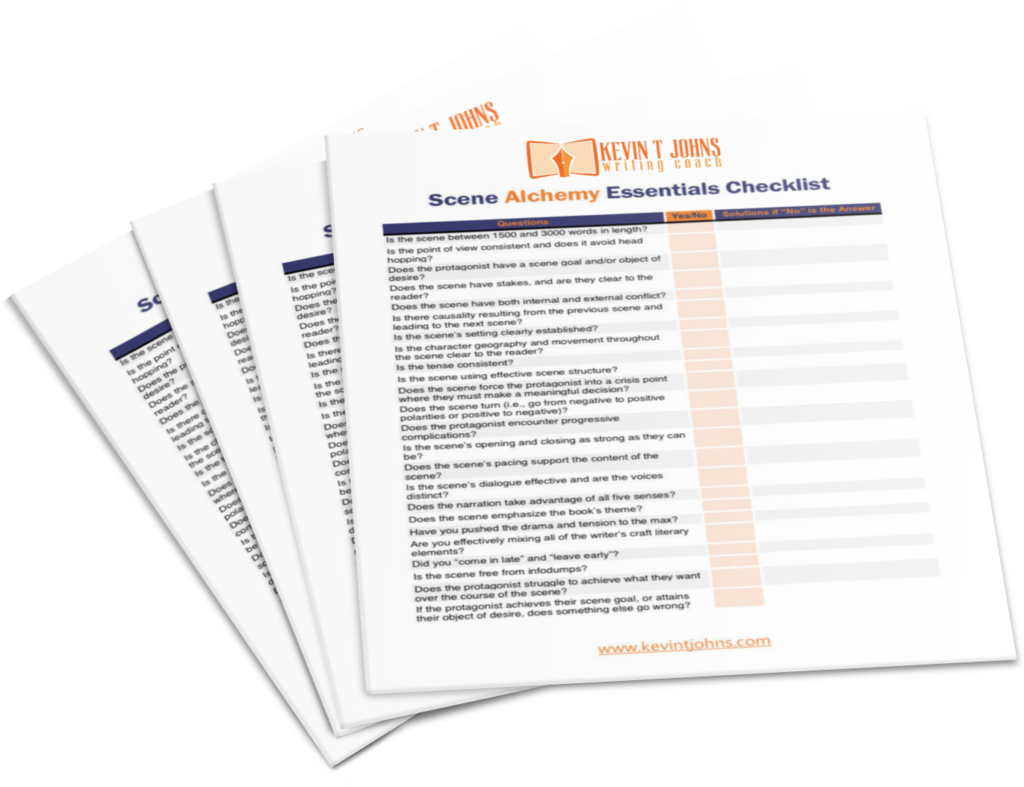
Download the FREE Scene Alchemy Essentials Checklist Now!
The Writing Coach Episode #184 Transcript

Hello, beloved listeners, and welcome back to The Writing Coach podcast. It is your host, as always, writing coach, Kevin T. Johns here.

I hope that you had a fantastic holiday season. I’m recording this on New Year’s Eve-Eve. This holiday season has almost come to an end; we’re almost into 2024, which means it’s time to think about the goals that you want to set for yourself for 2024.

What is it you want to achieve this year with your writing?

Now, before we get into goal setting for writers, that’s going to be our topic today, I first want to do a public service announcement. Please save your manuscript in multiple places. I have a client whose computer recently blew up. Now they’re trying to piece it back together and recover all this data that she only had saved on her computer; you do not want to lose months, weeks or years of work on books or multiple books because of a computer blowing up. So save your work frequently while you’re working on it, save it on an external drive or thumb key of some kind, save it on your computer, email it to yourself, save it in the cloud, print off copies, and I’m talking about doing all of those things.

If the house burns down and you lose the hard copies in your computer, you have it in the cloud. If Google or OneDrive or Dropbox goes out of business and you lose everything in the cloud, well, at least you haven’t saved on your computer. If your computer dies, at least you haven’t saved in your email. If computers die, if there’s a nuclear war, and we’re back to pre-industrial age, at least you have some paper copies saved somewhere of that manuscript; make sure you have multiple, multiple copies saved.

There you have it. No marketing at the beginning of this week’s episode, just a public service announcement from me to you save, save, save your work. It is so heartbreaking to lose those words that you’ve put down on the page.

As you might notice, my voice might not be 100% in this episode. I have been sick for a week straight. I’ve taken three different COVID tests; I keep convincing myself that I’ve COVID because I’m so sick, but it keeps coming back negative, which means it’s just a cold and it’s the cold that just does not want to let go. I am hoping that perhaps, come the new year, I’ll finally be over this thing. I’m feeling maybe a little better today than I was yesterday, so hopefully this cold will finally go away. I’ve had it all through Christmas.

I’m not just mentioning my cold to whine and moan to you. I am mentioning it because anytime I talk about planning with writers, I talk about building slack into your timeline. By slack, I mean space for the unexpected. So many times when I see people setting goals and creating timelines for their creative projects, they do it in this imaginary world where everything works out perfectly.

Here’s the reality: life is not perfect. Nothing ever works out as planned.

On any project that you’re going to be working on for several months, you’re probably going to get sick somewhere in there, like I’m sick right now. Or you might have a busy week at work, or your kid might need you to attend a sports event or a recital, or you know, there are so many things obviously that can happen in life that can stand in the way of us sticking to our schedule and achieving goals that have been set in this artificial space of everything going perfect according to plan.

I’ll give you an example of what I mean by that. This is a weekly podcast, so it’s easy to set goals for it. You would think I would say there are 52 weeks in the year. This is a weekly podcast, so my goal for this podcast in 2024 is to record 52 episodes.

But as I said, that’s assuming life is perfect. That’s assuming, for 52 weeks straight, my schedule is going to be as anticipated. I’m going to be feeling great and I’m going to be able to record an episode. That is not a realistic goal as realistic as it sounds. It’s almost completely unattainable, or attaining it isn’t worth the effort it would take. It’s not that big a deal to me to miss a week in there.

Bringing it back to reading with the writers, they’ll say something like, “I want to write 52 chapters this year.” You’re never going to write a chapter a week; things are going to happen.

And so what’s my goal for this podcast?

40 episodes.

You might think, “Wow, that’s what, like twelve missed episodes?”

Yeah, that’s budgeting for at least once a month, something being off, something being weird. Now, hopefully, that doesn’t happen. Hopefully, I totally crush that goal and I’m way above 40 episodes. But 40 is realistic, and it’s attainable and achievable. Unlike so many goals, I see writers set that are ‘perfect world, everything works out’ goals, where they’re unattainable. And so they don’t get any of the joy of meeting deadlines, because the deadlines weren’t realistic in the first place.

In my FIRST DRAFT group coaching program, I work with a lot or a fair number of first time authors. And at the beginning of that program, we do a lot of this goal setting work, like we’re talking about in this episode of the podcast. But the thing is, if you’ve never written a book before, when you create deadlines and timelines for yourself, you are absolutely guessing at how long things are going to take. It’s a hypothesis, it’s an estimate, You don’t have any actual facts or data that you can base that goal on, You’re looking at what I recommend, what other writers seem to do, what you suspect you can pull off, and then you create a deadline and a timeline and milestones based around that.

But just like my example of 52 podcasts in 52 weeks, so many authors underestimate how long it really takes to write a book. And not just because they assume everything’s going to work out perfect, but also because it’s harder than they think. It just takes a lot more work than someone who hasn’t written a book might think. Even if authors are able to perhaps estimate the amount of time it takes them to get a first draft written, they almost always underestimate how long revisions take.

What I tell people is to schedule in at least at least twice as much time for revisions as you spent on the first draft. If you spent six months writing that first draft, I don’t think it’s unreasonable at all to spend a year revising it and getting it publication ready.

There’s a lot of people out there, especially first time authors, who take years and years, six, seven years sometimes to get that first draft completed. It takes a long time for a lot of people and so you might be listening to this right now and saying, “Oh, Kevin, I’ve been working on my first draft for three years. Now you’re telling me I’m supposed to spend six years revising the manuscript?” No, that’s obviously ridiculous, but what that speaks to is the fact that spending three years, four years, five years on a first draft of a manuscript isn’t an efficient way to go about writing a book and you are totally underestimated the amount of time that needs to go into revising the book by trying to perfect a first draft. You’ve got to loosen up, you’ve got to drop some TKO (some ‘to comes’) in there, you’ve got to be willing to make mistakes and move forward in that first draft, so that you can buy yourself the amount of time that’s really required to take a rough manuscript and polish it up to be a high-quality book.

Another thing I want you to think about, especially if you’re a first-time author, but even if you’re not even if this is your fourth book, you need to remain flexible with your deadlines and timelines. You need to be willing to adjust those timelines and milestones and deadlines as you go.

I’m not saying this so that you have an excuse to miss deadlines. That’s not what this is about. But what it is about is recognizing the need to make realistic deadlines.

Deadlines and milestones don’t help if you’re not meeting them. It just puts extra pressure and stress on you and makes you feel like a failure.

One of the reasons we want to create lots of milestones in the writing process, one of the reasons we want to break things down into really small chunks, is so that we can celebrate small victories along the way. And those celebrations and the endorphins that come along with them build momentum; it feels good to hit deadlines, it feels good to be on track, and it feels good to be making progress.

When we’re feeling good, we’re more likely to meet our writing sessions; we’re more likely to get into that flow state, and we’re more likely to have fun writing our books. I

f you’re continually creating unrealistic deadlines that you don’t meet, it’s the complete opposite. You’re not getting those celebrations, you’re not getting those good feelings, you’re not building up that momentum, and all you’re doing is making yourself feel like a failure when the reality is the goal wasn’t achievable in the first place.

So how do we find that balance between being nimble and being flexible with our writing deadlines but also not using that flexibility as an excuse to continually miss deadlines?

Well, we make those adjustments, we make those changes to our milestones and our deadlines based on key performance indicators.

We are making an estimate at the beginning of the goal-setting process; we’re saying, I think, based on the information that I have, this is what the timeline for this project will look like. But once you are starting to work on that project, once you are at it for a few weeks, and then a few months, you should be tracking performance indicators. And then measuring those indicators against the goals that you’ve set for yourself.

If you have set a goal that requires you to write 8000 words a month, and you are currently writing 5000 words a month, there’s a huge discrepancy there between the timeline you’ve set for yourself the expectation you’ve set for yourself, and what you’ve realistically been able to produce.

If you’ve been writing for four months, and you produce 5000 words a month, look at your deadline and readjust it based on the 5000 words a month output instead of the 8000 words a month that you set for yourself.

Word Count is one of the best performance indicators that you can use during the drafting phase in particular. How many words did you get down this session? How many words did you get down this week? How many words are you shooting for in this book? Probably 80,000 words or something in that range. But using word count for a key performance indicator really only works if you’re in the first draft and if you’re typing those words into a computer.

A lot of writers that I work with prefer to first draft by freehand. It’s really tough to finish a writing session and count up to 1000 handwritten words. In that case, you might be looking at counting perhaps pages instead of word count when you’re writing by hand. I work with some screenplay authors as well, and screenwriters often count by page count, as opposed to word count.

You might also want to look at key performance indicators like number of acts written. Break that book up into three or four acts, give yourself a couple months for each act. Is one act taking longer than another? Or are you consistently moving from one act to another. This is another indicator that you can use to judge whether your timeline is realistic or not.

Once you’re into the revisions phase, this is really when word count can kind of start to go out the window, unless you’re doing a draft of the book where you’re specifically focused on reducing word count, in which case perhaps you’re tracking number of words deleted. That said, once we’re into the revisions phase, you’re probably looking at something more like the number of scenes revised, i.e. “I want to get five scenes revised this week,” that sort of thing.

You might also want to look at Acts revised. “I’m going to spend this month revising Act One I’m going to get it as good as it can be. And then I’ll spend the next month working on Act Two.” Again, this is an indicator that you can use to judge progress against your timeline.

Something that’s even more simple is the Seinfeld method. I’ve heard that this is, in fact, apocryphal, but it is said that at one point in his career, Seinfeld said that what he did was he sat down and wrote one joke a day. Once he wrote that joke, he crossed it off the calendar. By the end of the year, he had at least 365 jokes. Whether that’s apocryphal or not, what I do love about that is this idea of crossing it off the calendar.

I’m a really big proponent of visual representations of success. So even if you don’t want to get into the data, the numbers of counting words or pages or any of that, simply saying you’re going have five scheduled writing sessions each week, and then, when you complete that session, going into the calendar and marking it off with a sticker, with a checkmark, or some other visual representation of success, can be so motivating and helpful in keeping that momentum going, and also keeping those writing streaks going.

In my FIRST DRAFT group coaching program, we have a shared word count sheet that serves a couple of purposes: it gives the writers in the program that visual representation of success,  adit also allows them to track whatever key metrics that they’re using, particularly word count for those writers in that first draft. Having a place where you can go at the end of a writing session and say, “I wrote this many words,” or “I revised this many scenes,” or “This is the 100th scheduled writing session in a row that I met and did not miss,”— all of those things are so helpful and so motivating, and so much more important than saying, “Oh, I’d like to have a book done by the end of 2024.”

Yes, we all want to publish a book next year. But what’s really going to make the difference is not those big goals that you set for yourself this week; it’s not those resolutions that you make on New Year’s Eve about all the success you’re going to have in 2024.

What really matters are those day-to-day steps that you’re going to take, one scene at a time, one draft of the book at a time, one writing session at a time.

And yes, we want those big goals. We want milestones along the way so that we have things to celebrate. But it’s the nitty gritty hard work of showing up and putting the words on the page day after day after day, week after week after week, that is going to lead to those big goals, those successes that you dream about a New Year’s Eve.

The world is never perfect. We always underestimate the amount of time it’s going to take to get projects done. Set goals and be ambitious, but also be nimble. Track progress and adjust milestones and goals based on reasonable key performance indicators that you can track over the process of the drafting of your book. That’s my final piece of advice for you in the year 2023.

Wow, it is over. This was a bit of a crazy year for me. I had some health challenges at the beginning of the year and spent a couple of months recovering. The idea that it’s now I’m coming up on a year since that happened is wild. The older I get, the quicker time flies by, and health challenges make you realize how short and precious life is. We don’t have an infinite amount of time to get our books written. We don’t have an infinite amount of time to achieve the things that we want to achieve in our lives. And so I encourage you to be ambitious this year.

But don’t be ambitious by setting wildly unrealistic goals. Be ambitious in meeting the work that needs to be done on a day-to-day basis. Show up, make that creative effort, whether you feel like it or not, whether you’re inspired today, whether or not you’re having a good day or bad day, show up, do the creative work that matters to you, get those words down on the page.

Time goes by so quickly, and even when it feels like a grind, you’ll blink, and the next thing you know, you’ll have a completed book sitting there on the computer, ready to publish and ready to query.

Life goes by fast as, Ferris Bueller says, if you don’t take a moment and appreciate it once in a while. You just might miss it.

It was a wild year on my end. I hope it was a fun and productive writing year on your end.

I hope you have made a lot of progress in your writing, and if you didn’t, then head on over to my website, check out STORY PLAN INTENSIVE (it starts New Year’s Day), check out the FIRST DRAFT group coaching program, reach out to me about ONE-ON-ONE COACHING; let’s make this next year, 2024, an absolutely incredible year for you when it comes to writing.

That’s it for 2023. Happy New Year, my friends. I will see you in 2024 On the next episode of The Writing Coach.
The 20 Best Books I Read in 2023 — The Writing Coach Episode 183

As the year draws to a close, writing coach Kevin T. Johns looks back on the fiction, nonfiction, business, and writer’s craft books he read in 2023.

Listen now!

The Writing Coach Episode #183 Show Notes

Download the FREE Scene Alchemy Essentials Checklist Now!

The Writing Coach Episode #183 Transcript

Hello, beloved listeners, and welcome back to The Writing Coach podcast. It is your host, as always, writing coach, Kevin T. Johns here.

Christmas is right around the corner, just a few days away as I record this. It’s a fun time of the year. We’re coming up to the end of 2023, which means it’s time to start thinking about what you want to achieve with your writing in 2024.

If you want to kick the year off with an absolute blast, I encourage you to join my Story Plan Intensive program for January 2024. This is a program where I email you new writer’s craft training videos Monday to Friday for four weeks straight. On Fridays, you get creative homework assignments that help you brainstorm and solve problems for your story, and by the end of the month, you have an incredible rock-solid outline for your book. Whether you are in the planning stages, whether you are midway through a book, whether you’re beginning revisions, this outline is going to help, so get signed up for the January 2024 edition now.

As I said, we’re nearing the end of the year, and of course, that’s when we look back on the year, and the events that happened, and the books that we read. I thought it would be fun this week to take a look back over some of the books that I read this year and share them with you.

Now, of course, these are the published books that I read this year. I work with dozens of clients at any given time, and so I’m reading hundreds of manuscript pages every single week, entire novels. There’s been some great material from my clients that I’ve had the pleasure and the honour of reading this year, but what I’m going to cover in this podcast are the books that right now can click on the below Amazon affiliate links and purchase today.

Now, first off, I want to talk about my absolute favorite book of the year; this was gifted to me by my client Peter Sherwood, and it is the annotated Mrs. Dalloway—obviously written by Virginia Woolf, but annotated by Merve Emery. I just am in love with this book. The annotations are fantastic, and the forward is incredible. There are pictures, images, and maps throughout the entire book. The design is gorgeous. The page feel is wonderful. There are many fantastic things about this book. If you’re a Virginia Wolf fan, as you should be, I highly encourage you to pick up the hardcover of this book. It’s just delightful.

One of my favourite parts about it is in the foreword, where Emory includes a page from Virginia Woolf’s diary or journal, and it includes a list of five potential or six potential chapter titles for Mrs. Dalloway. And then, over in the margin, you see this math equation, and it says, “5,000 x 6 = 30,000” or whatever. I know what Woolf is doing there. What she’s doing is she’s beginning the story plan for Mrs. Dalloway. She’s outlining the six chapters that she has been thinking about thus far, and then in the margins, she’s doing the math for the word count. She’s assuming or guessing each of these chapters is going to be about 5,000 words long. She’s saying, oh, I have six chapters that are going to be about 5,000 words long, I guess that works out to 30,000 words.

This is exactly what we do inside of Story Plan! There’s this naive belief that writers just sit down and magic pours out of them, and I try to dispel that myth as much as possible. But at the same time, I think in my mind, some naive part of me still believed that Virginia Woolf sat down and genius just poured out of her, but the forward to this edition and annotations just demonstrate how absolutely thoughtful and meticulous Wolf was in creating and planning her masterpiece. And so the opportunity to actually see her notebooks and see her doing the exact type of prep work and planning work that I recommend in my programs was really exciting and refreshing and kind of a nice reminder that even an utter genius like Virginia Woolf is human just like the rest of us and her, just like all the other writers out there, had to sit one day and say, okay, what’s the shape of this book going to be and how many words is it going to be and what’s that going to look like?

And so, at a time when I’m promoting the next round of Story Plan Intensive, it was really refreshing to see Virginia Woolf, probably favorite writer, doing the same things that I’m recommending with folks. So that’s it.

That’s my number one book of the year, Mrs. Dalloway, the annotated edition by Merve Emery. Wonderful stuff. Pick it up.

Fiction Books

Now, let’s move on to some of the fiction I read this year. I think probably my favorite fiction book that I’ve read this year was the first book I read this year. Actually, I think I read this in February. I had some medical issues earlier in 2023 and so I had some recovery time in bed early in the year, and that was when some of these books were first read. That is when I read Pale Fire by Vladimir Nabokov.

When I think about the type of writer I want to be, I really think about Bradbury and Nabokov. I feel like the two of them just hit that absolutely perfect balance between beautiful literary prose and edge-of-your-seat awesome commercial storytelling, and that’s really what I would love to achieve someday is obviously I’ll never come close to the Nabokov or Bradbury, but that’s certainly what I’m shooting for.

Pale Fire, if you’re not familiar with it, is a fascinating book because the structure of the book, actually it’s perfect. Coming off the annotated edition of Mrs. Dalloway, Pale Fire is actually a novel in the format of an annotated poem. So you get this poem at the beginning of the book and then the rest of the novel is actually the poem’s annotator commenting on it. And it’s fascinating. I have never read a book structured in this manner, amazing stuff, but no surprise from an absolute master like Nabokov.

Next up, I read Blood Meridian by Cormick McCarthy, obviously another master. I’ve read some other work of his The Road a couple other things, but I hadn’t gotten around to Blood Meridian. I’m not a American, so the Wild West, that doesn’t necessarily have a huge pull for me. That said, I’m happy to read anything McCarthy writes and so I took a look at Blood Meridian.

Again, a fascinating book largely in that it rejects most of what I recommend for my clients. Stuff like having a singular protagonist not telling the story about a big group, all sorts of really interesting literary techniques that McCarthy can get away with because he’s so brilliant.

I also read Anansi Boys by Neil Gaiman. I was a huge fan of American Gods and Anansi Boys is kind of a spinoff of Gaiman’s Book American Gods, but much lighter and a more fanciful fun story than the more heavy stuff in American Gods.

Of course, it’s dealing with African, well, we say ‘African-American’ in North America, is it ‘African British’ people? I’m so unworldly, I don’t even know what the proper term is. Anyway, the point is it’s dealing with African Gods and it’s set in England. I think they pop over to America for a little bit. Anyway, probably a book that Gaiman would take a bunch of crap for these days in terms of people saying he’s appropriating African culture or something, but it’s a great read. I enjoyed it. It’s always fun to visit Neil Gaiman in his wonderful mind.

I called this episode the “Best” 20 books I read this year, but I’m going to talk about some books that weren’t necessarily the best books of the year as well. I read Luda by Grant Morrison. Now, Grant Morrison is one of my favorite comic book writers. He has written just some absolutely incredible stuff that I’ve devoured over the years, and I believe this was his first big mainstream novel, and this was actually the one book this year that I didn’t finish.

I just could not get into Luda. Morrison’s prose seemed like he was trying too hard. I never get the sense that Nobakov or Bradbury are trying to wow me with their prose, whereas it feels like Morrison’s kind of jumping through some hoops to try to impress us with how smart he is, but it just kind of takes away from the story. And the story itself is about a drag queen in a pantomime production. Anyway, it was a bunch of kind of subcultures that just didn’t interest me that much and just wasn’t that into the prose style. So poor Grant Morrison. Well, no, not poor Grant Morrison. He’s got his millions! Maybe he should just stick with comics and appearing in my Chemical Romance videos. No, I’m kidding. I’m sure there are fans of Luda out there, but this one just wasn’t for me.

I’ll tell you what was for me, Pet Sematary.

I’ve been reading Stephen King since I was probably 12 years old, and the guy is just so prolific that even though I’ve been reading him for 30 years, there are still books out there that I just haven’t gotten around to reading; Pet Sematary was one of them. Maybe one of the reasons was the premise sounded a little cheesy or something. Oh, it’s a cemetery where you put animals in it and they come back to life. Of course, I read it, and it absolutely blew me away.

What this book is really about is a meditation on death. It’s a heavy, heavy piece of fiction, every element of it, touching on the concept of death in so many ways. It’s obviously appropriate for a horror novel. But as I get older, as I have my own medical issues, as people I know and love pass away around me, I’m glad, actually, that I waited until I was older to read Pet Sematary because I think the meditations on death that take place in this book, whether it’s a parent losing a child or whether it’s a senior citizen losing their partner, I think these are really things that resonate with you as you get older.

And so I was really stoked to read that book this year. Absolutely loved it, and devoured it.

Next up, I read Holes by Louis Sachar. So that’s funny: Pet Sematary is kind of about aging in death, while Holes is obviously a young youthful book about young people. I had seen the movie, I think my dad was a huge fan of the book, and he recommended the movie to us. So then we saw the movie, and then my daughter went and read the book and she was really pushing for me to read the book, and I didn’t necessarily feel like I needed to having seen the movie, but I read it to please her.

And boy, am I glad that I did! This book is just a little tiny mini-masterpiece. I love these kind of punk rock masterpieces where you don’t have to be giant and epic. You can be tight and focused and poppy and still be absolutely incredible.

Holes is now the book I really use to demonstrate the concept of setup and payoff. Thinking of your novel as having a mirror at the midpoint shift and the latter half of the book reflecting or existing in relationship to that first half of the book. And Sacher is just an absolute master in this book of setting things up in that first half and then paying every single one of them off in the second half in the most delightful of ways.

Writer’s Craft Books

Those were some of the fiction novels that I read this year. Let’s move on to the Writer’s Craft books.

I have a stack of probably 30 writer’s craft books on my desk, and I’m always going to them and looking up things in the appendixes and kind of revisiting concepts, but often new writer’s craft books come into my world, or I revisit something in-depth for a course I am teaching.

So the first one up here is The Seven Basic Plots by Christopher Booker. This is a long, long in-depth craft book. I’d read it before, but this year I taught a course called “Story Types” where I was talking with different types of stories. And so I revisited Booker’s work. I have an ebook version, so I don’t know how many pages it is, but it’s got to be probably a 500-page craft book. Fascinating stuff. If you have a chunk of time you want to dive deep into it, I encourage you to check it out.

That said, I will flag for you that I was kind of curious about Booker. I didn’t know anything about him, so I looked him up, and it seems like he might be a bit of a wacko climate change denier, conspiracy theorist type. Just so you know, when I’m recommending Booker, it’s for his excellent, excellent analysis of story and of archetypical plots, not necessarily for his science on global warming and whatnot.

Okay, another absolutely great craft book that I’ve read this year was Seven Figure Fiction: How to Use Universal Fantasy to Sell Your Books by T Taylor. If you are a romance writer, this one is an absolute instant purchase. You should definitely check this out.

Taylor talks all about how a lot of fiction, especially romance, is about tapping into fantasies, universally shared fantasies that readers want to experience and want to escape into. For myself, for someone who tends to write much darker and horror and whatnot, I still found the book hugely useful because obviously, I can use it in reference to my romance clients, but I think a lot of the time what we’re doing in something like horror is we’re tapping into universal nightmare rather than universal fantasy. So even though Taylor is definitely coming at things from this romance angle, I think a lot of her ideas can kind of be flipped on their head and then apply just as well to the say horror or thriller side of things.

So a really fantastic and really readable craft book from Taylor. Kind of the opposite of Booker’s stuff. The Booker stuff is quite academic and hugely long. The Taylor stuff is just really easy to read, quick with a kind of poppy feel to it, fun stuff.

Another craft book I read this year is Save the Cat Writes a Novel by Jessica Brody. Again, there are just these things floating around out there that you’re aware of that you never really get around to and Save the Cat was one of them for me. I’d had clients mention it over the years many, many times, but I always thought of it as a screenplay approach, as a book about how to write a screenplay. But when I saw that Jessica Brody had kind of taken the original ‘Save the Cat’ concepts from cinema and then applied them to the novel, I decided to finally check it out.

I mean, so many people were talking about it, so I said, oh, I better read this book. And wow, I was really pleasantly surprised as someone who had kind of, for whatever reason, avoided Save the Cat for many years. I just dove right into it and really loved a lot of the concepts that they were laying out in that book.

I do think, at times, the Save the Cat outline or Story Beat Sheet can get overly prescriptive, but in terms of their approach to genres, its a really, really interesting examination of story types.

Again, I used both Save the Cat and The Seven Basic Plots as research for that “Story Types” course, and the two of them exist in really interesting relationships to one another in terms of how they conceptualize similar types of stories and what they call them and whatnot.

Another great craft book I read this year was The Secrets of Character by Matt Bird. A client of mine had read it and just absolutely adored it, loved it, and then she gifted me a copy. So Sandy Day, whose book Odd Mom Out is going to be released on January 1, you can head over to Amazon and pick up a copy of it now. It’s fantastic. Thank you, Sandy. She gifted me a copy of Bird’s Secrets of Character Book. I read that and I really enjoyed it and ended up actually hiring Matt Bird to come speak to my FINAL DRAFT group coaching program.

I’ve got a few different programs on the go, but they cover different stages in the writing process. So we’ve got STORY PLAN at the planning stage, which then leads really nicely into FIRST DRAFT, my six-month program where we focus on getting a first draft of your book completed, and then folks who finish that program often graduate up to FINAL DRAFT, where we do all sorts of things including bringing in experts like Matt Bird to come speak to the group.

It is always fun to read someone’s book and then get to meet them and work with them. And so that was a great experience with Matt Bird.

And a very similar thing happened with JP Rindfleisch and their book Story Hypothesis: the Missing Piece of Your Fiction Puzzle. Again, a client of mine had read Rindfleisch’s book and loved it, and so I reached out to JP, got them on the FINAL DRAFT training schedule. Once again, we were able to read their book and then have them come in and speak to us about the concepts.

Rindfleisch’s book is about kind of dispelling the use of Maslow’s hierarchy of needs. I, like many other writing instructors have often pointed to Maslow’s hierarchy of needs when we’re talking about what’s driving our characters, what do they want, and what do they need? But Rindfleisch flips that on its head and presents an entirely different theory of human desire, and what are the things that really drive us. JP comes at it from more of perhaps an outsider perspective or a more modern approach than something like Maslow’s Hierarchy that’s been around for quite some time.

We had a great time with JP going over the Story Hypothesis material, so definitely check out that craft book.

Those were some of the big craft books I read this year.

Star Wars Books

If you’ve been on any of my training, if you’ve probably spent 15 seconds in an elevator with me, you probably know I’m a huge Star Wars fan.

One of the Star Wars books I read this year was Star Wars: The Force Unleashed by Sean Williams. This is an adaptation of a video game, an old video game from over a decade ago. I checked out the video game and I absolutely loved the story, and I was like, okay, they’ve got to have adapted this, and they did. So I hunted that down, and I really enjoyed that book. A

s far as video games adapted into novels, you can’t go wrong with The Force Unleashed.

I had read Heir to the Empire before; it’s the famous Timothy Zhan Star Wars bestseller that came out in the nineties. It was a trilogy of books, Heir to the Empire, Dark Force Rising and The Last Command, and it introduced the villain Thrawn, who made his live-action debut this year in the Asoka miniseries.

In prep for that Asoka series, I decided to revisit the full trilogy, which I’d never read before.

Those three books are probably thought of as some of, if not the best, Star Wars spinoff books ever written. And I enjoyed them. I definitely enjoyed them.

Non-Fiction

Continuing with Star Wars, but moving into the world of nonfiction, I read a great book called A Disturbance in the Force by Steve Kozak.

You may or may not be familiar with the infamous Star Wars Holiday Special. This was a variety special that aired in 1978, a year after the original Star Wars came out. It’s notoriously terrible and strange. For decades, Lucas was trying to bury it and pretend it never existed, but of course, with the internet, you can’t bury anything. You can pop over to YouTube now and watch the holiday Christmas special as I do with my family every year. Yes, I punish them in the most horrible way of making them watch that disastrous two hour long special that feels like six hours long.

 Anyway, Kozak’s book is a fascinating exploration of how that terrible special came about. If you’re interested in seventies culture, if you’re interested in seventies television, if you’re interested in the idea of product licensing and taking intellectual property and spinning it out, star Wars was really the first film to do that in such a successful way. The book is kind of conceptualized around the idea that it was kind of a Wild West time when it came to spinoffs and licensing of things. And while things like the Star Wars toys ended up generating billions of dollars, other things, perhaps like the Star Wars Holiday Special, didn’t go quite so well.

A fascinating book, and that book is actually the result of a documentary. Kozak put out a documentary, and sometimes when you’re putting together a documentary, you get so much fascinating great material that you can’t fit into the movie, and so you put it in the book.

I have not watched the movie yet. I’m looking forward to watching the documentary, but the book was fantastic.

My favorite nonfiction book of the year was The Fund by Rob Copeland.

A few ago, on the Tim Ferris podcast, he interviewed this guy Ray Dalio, this billionaire who runs the world’s largest hedge fund called Bridgewater. He had just released this book called Principles that was kind of his rules to life. And he said that they had used these rules in Bridgewater and that’s why they were so, so successful.

Copeland’s an investigative journalist and his book just completely dispels this myth that Dalio was some sort of brilliant genius leader. The book is basically an examination of an utterly toxic workplace and totally sociopathic, egotistical leader.

I think anyone who’s ever been in a toxic workplace will love this book and will so resonate with it. Anyone who’s ever worked with a boss who’s self-delusional, sociopathic, abusive, all of these things, I think you’ll really resonate with this book.

Obviously, for some reason, we kind of love knocking celebrities down a notch, but I think in this case in particular, Dalio presented himself like he had life figured out, and that through these simple, clear, logical rules that overcame emotions, he had figured out the secret to success. As such, hearing the behind-the-scenes truth of what his success really looked like is absolutely fascinating stuff, and just a great reminder that anyone who presents themselves as some sort of all-knowing guru who can predict the future and make billions all through just his pure wisdom and genius, it’s great to question the validity of those claims. Just because someone appears on the Tim Ferris podcast doesn’t necessarily mean their claims are legit.

The Fund is a fantastic book and a really great investigative piece by Rob Copeland.

Business Books

As a small business owner, I’m always trying to stay on top of things and figure out how to better serve my clients and grow my business, so I did read Alex Hermozi’s book, $100M Leads, which was a book that came out a couple of years ago, and then $100M Offers that came out this year. I definitely preferred a $100M Offers to $100M Leads.

Advice is great, but only so long as it’s actionable. I think a lot of Harmon’s advice in Leads that sounds so easy actually requires a massive team of people and a lot of money, which is not something that a small business owner like myself can afford or have the people to do.

But $100M Offers was really great. At the end of the day, the takeaway, I think it’s the subtitle of the book, but it’s like, “How to make offers so great, people feel stupid not buying it” or something like that. I really took that to heart and this year with FIRST DRAFT, when I’m selling the program and what I’m delivering in the program, I’ve really tried to follow this idea of asking myself, “How can I make something so incredibly helpful, so amazingly priced and just so fantastic that when I presented to writers, they can’t say no, it would be stupid to say no because it’s such amazing offer?” That’s what I have tried to do this year with FIRST DRAFT, and it’s what I kind of took away from that book

It’s not about persuasion skills. It’s not about convincing someone of something. It’s not about specific wording. It’s just about creating a product that’s so damn great that people can’t say no. So that’s what I’m going to continue to do: just continue to try to create incredible programs, but then also be able to present that to people in an offer that clearly defines the value.

Going on a similar idea, I also read Blue Ocean Strategy by W. Chan Kim and Renee Mauborgne, which is largely a book about not bothering to try to compete with others in your marketplace. Instead, try to create your own marketplace. Try to do something innovative, try to do things that other people aren’t doing, try to offer things that other people can’t offer. And when you do that, you don’t need to worry about competition. You don’t need to worry about endlessly lowering your prices to try to compete.

Instead, you can just create new marketplaces by doing innovative, amazing stuff.

Again, like the Hermozi book, the Kim and Mauborgne book was just a nice reminder to try to create really, really amazing programs and products and coaching services. If I’m doing things no one else is doing, if I’m offering support no one else is offering, if I’m getting results no other coaches are getting, then I don’t have to worry so much about the marketing side of things. The marketing just becomes telling people about how great my stuff is. I’m going to continue to try to create Blue Oceans and do great fantastic work with my clients.

Closing

That’s the 20 or so books I read in addition to the hundreds of thousands of words and hundreds and hundreds of pages of manuscript material that I’ve read from my clients this year.

Next week, we will have another episode of The Writing Coach podcast. That said, this will be the last podcast before Christmas. Regardless of what holiday you celebrate during this time of the year, I wish you an incredible holiday season and a Merry Christmas.

What books did you read this year? Hit me an email or respond on social media. Let me know what books you thought were fantastic this year, and if you read any of the same ones I did.

That is it for this episode. I will see you on the next episode of The Writing Coach.
P.S. The above links are affiliate links, which means I’ll get a small amount of money should you choose to purchase any of these books using those links. Thanks!

A Writer’s Guide to Three, Four, and Five-Act Story Structures — The Writing Coach Episode 182

In this episode of The Writing Coach podcast, I discuss a multitude of macro-level story structures, including three-, four-, and five-act structures, as well as circle structures, and more.

Understanding story structure is like pulling the curtain back on storytelling.

When we understand that stories aren’t just birthed from the imagination, but rather engineered using story physics, we can utilize recognized frameworks and structures, allowing for the ultimate freedom of creative expression while building upon a sturdy foundation of story craft.

To learn all about macro-level story structures, listen to the episode now!

The Writing Coach Episode #182 Show Notes

Download the FREE Scene Alchemy Essentials Checklist Now!

The Writing Coach Episode #182 Transcript

Hello, beloved listeners, and welcome back to The Writing Coach podcast. It is your host, as always, writing coach, Kevin T. Johns here.

I hope that the holiday season is treating you well this far, and that you’re making big plans for 2024.

If you’re looking to do some incredible work on your creative journey as an author next year, I encourage you to think about joining the January 2024 edition of STORY PLAN INTENSIVE.

STORY PLAN is my four-week program where I email you a new writer’s craft training video each day of the week, Monday to Friday, culminating in a creative homework assignment on Friday that you can do over the weekend. If you watch the videos, if you do the assignments, by the end of January, you will have a rock-solid outline for your novel.

Obviously, if you’re in the early stages of a book, the planning stage, now is the time to take this program. That said, if you’ve perhaps discovery-wrote a portion of a book but now you find yourself stuck or unable to finish it, or if you even have a first draft completed, STORY PLAN can help you finish that half-completed draft, or it can set up the revisions process really nicely by allowing you to create an evergreen tool via the outline that you can use to analyze and revise your manuscript.

If that sounds good to you, get signed up for that month-long program with over 30 training videos for free.

One of the things that we talk about in STORY PLAN INTENSIVE is story structure. I’m a big fan of story structure. It’s where I start with a lot of my analyses of my clients’ work, and it’s also one of the early stages I recommend writers take a look at when they’re planning a novel.

I know there are people who start with character, perhaps, and I think in the world of comedy, this makes a lot of sense. But I think about something like K.M. Weiland’s great book Creating Character Arcs, and in her character arc book, she basically maps the stages of the character’s emotional transition, their character arc, to story structure. So at least in Weiland’s mind, things don’t start with the character arc, rather they start with standard story structure, then we map that character arc to the structure.

I agree with her and a lot of other folks, that structure is really a great starting point. Once you have determined the genre that you’re going to be writing in. Genre is something we touched on in last week’s episode, so it made sense to move on to macro level story structure this week.

When we’re talking about macro level story structure, what are we talking about? We’re talking about the shape of your entire book. We’re not talking about scenes; we’re not talking about sequences; it’s what needs to happen in your book, and how can we divide your book up in such a way that ensures effective pacing in its storytelling.

And where this all begins, really one of the first writing coaches, one of the first writing instructors was the ancient Greek philosopher Aristotle in his work Poetics. Aristotle said that the structure of a dramatic narrative (of course, this is pre-novel, so he was largely talking about theater, but the theory remains the same) needs a plot with a clear beginning, a middle, and an end. That’s what Aristotle said we need for the structure of a story.

It might sound obvious, but a lot of discovery writers, for example, don’t know when the beginning of their book becomes the middle and they’re not sure when the middle becomes the end. So while it’s obvious that the story needs these things, not all writers are necessarily thinking about them when they’re planning and drafting their book.

It makes me think about when I was in university, I took a lot of cinema courses. I had an undergrad in cinema. I remember one class we were talking about, it might have been DW Griffiths, I forget who it was, but the professor said, “Oh, and here is the scene where he invented the close-up.” You’re like, wait, what? And prof says, “Yeah, he’s the first person who ever thought of moving the camera close to the actor’s face.”

Early American films were largely just filmed vaudeville pieces. The camera was often positioned as though it was sitting dead center in the audience, looking at a stage, even that stage was a set, and we see the vaudeville performance play out. Someone had to invent the idea of a close-up, even though today, it seems so obvious. It is the same thing with the beginning and the middle and an end; at some point, someone needed to say stories need these three things, and it was Aristotle who did that. In doing so, he influenced stories for centuries to come because what is a beginning and a middle and an end other than a three-act structure?

We’ll get to that three-act structure in a moment, but before Hollywood embraced the three-act structure and after Aristotle, there was another author and theorist who did some intense thinking about story structure. Gustaf Freytag, in his book, The Technique of Drama from 1863, he laid out something now known as “Freytag’s pyramid.” It’s a pyramid-shaped story structure, which kind of makes it unique unto itself, because it seems to suggest the high point of the story is midway through, which normally most of us would think of that as much later in the story. But ignoring the pyramid structure of it, it’s essentially a five-act structure that Freytag laid out that involved a beginning portion of exposition where we’re setting up the story, rising action where the story’s plot and tension leads towards the story’s climax, we then get to the climax is often the most intense moment in the story, then We then enter a period of falling action and then we get our resolution or our denouncement, where whe outcome of the story is resolved.

While I think pyramid might look a little outdated or strange, given its pyramid structure, ultimately, this five-act structure approach is pretty solid and still continues to be used today. And we’ll get to the five-act structure in a moment, but first, let’s talk about the Hollywood three-act structure.

This is certainly my introduction to writer’s craft was actually via screenwriting books and books about cinema history. I was a huge movie buff in high school and it was through wanting to learn about cinema wanting to learn about writing movies that I learned about writer’s craft, and that I learned about the three-act structure, probably largely through Syd Field’s book Screenplay, a very famous, well-respected book on the art of screenplay writing.

In that book, Field talked about how a Hollywood script needs to be 120 pages long, we need to be able to split that 120 pages up into three acts, which is essentially a beginning and a middle and an end, with the middle being twice as long as the beginning and the end. And perhaps that’s where we start to evolve from Aristotle’s concept of a beginning in the middle and an end. In the three-act structure, we get three sections of the story a beginning and a middle and an end, but not of equal length. The middle portion is twice as long as both the beginning and the end portions in the three-act structure.  

The three-act structure continues to this day in Hollywood. We’ve had a Hollywood cinema for over 100 years now and for the most part, most big mainstream blockbusters are still using a three-act structure. even when I think of something like Charlie Kaufman’s, Synecdoche, New York, his very kind of self-indulgent arty film with Philip Seymour Hoffman, about creation in art, I bet you if we took a look at it, it’s still very much a three-act structure story even though it is a pretty wild out there film for Hollywood.

If we look at something like Mad Max Fury Road, that movie is just a structural masterpiece. And you can absolutely see the three acts playing out in it, though, I would argue it’s probably using a four-act structure. So maybe now it’s time maybe to move on to that four-act structure concept.

Where I learned about four-act structure and where I think it’s most articulately laid out is in Larry Brooks’s fantastic book, Story Physics: Harnessing the Underlying Forces of Storytelling. He also has a book called Story Engineering: Mastering the Six Core Competencies of Successful Writing. And I think those books work really nicely in tandem, to help perhaps a new writer, or writer new to writer’s craft, understand the importance of the four-act structure.

One of the reasons a novelist, as opposed to a screenplay writer, might want to start thinking in a four-act structure is in cinema we’re looking at a 120-page screenplay. That’s 30 pages for Act One, 160 pages for Act Two, and 30 pages for Act Three. Whereas a novelist, we’re looking at, say, a 400-page book. Iif we’re just thinking of our book in the three acts, that middle act is hundreds and hundreds of pages, and tens of thousands of words long. It can become a bit overwhelming. It can also become a bit of a slog for both the author and the reader, if we’re trying to approach the middle of the story as one big long chunk. What Larry Brooks does, and what I tend to do with my clients, is break that up into a four-act structure so that we’re looking at four acts, all of which are of equal length. So we’re looking at about 25% of the book’s word count, in each of those four acts.

And what happens here, when we break the story up into a four-act structure, is we now have something called the midpoint shift, which is a really important point in the story at the 50% mark, where something changes, and Larry Brooks talks a lot about the importance of the midpoint shift. And James Scott Bell and another great writing instructor has a really nice short book, it’s almost more of a pamphlet called, Write Your Novel from the Middle. That book is all about that midpoint shift. Bell actually argues that not only is the midpoint shift massively important, but it’s actually where you should start the planning process with your book. It’s where you should start thinking about your story, not the beginning, not the end. But in fact, the middle

Probably most writing instructors you hear about are going to be using the four-act structure; certainly myself, K.M. Weiland, James Scott Bell, and Larry Brooks. We all agree the four-act structure is really nice for novelists.

That said, of course, we don’t have to stop at the four-act structure. Shawn Coyne, author of The Story Grid kind of conceptualizes things in a three-act structure in which there’s an initial hook and an ending payoff. But the middle portion, he actually recommends breaking up into three big events. And so essentially, what Coyne is arguably presenting is a five-act structure. And so for a while now, I’ve been thinking about the five-act structure as being Coyne’s structure in terms of we have our normal opening act, but then we have these three big set pieces basically in the middle of the book leading up to the ending payoff.

However, at one point, it occurred to me: “Wait a minute . . . that’s just five-act structure!” And so you know, we see the Hollywood three-act structure, we see people like Larry Brooks and James Scott Bell, KM Weiland, pushing it to a four-act structure, and what Coyne is talking about is essentially a five-act structure, which actually takes us back in time to Shakespeare.

Of course, every Shakespeare play is written using a five-act structure and so clearly a massively useful and successful way of structuring a story. Shakespeare did it for all of his plays. While the four-act structure is probably the most prevalent in literature and in modern commercial storytelling, you might want to think about that Elizabethan/Shawn Coyne five-act structure where you can think about the middle portion of your book in three big chunks.

Now, not all story structures are presented in a linear diagram. While the three, four, and five act structures are all generally presented as an almost bridge-shaped diagram going from left to right across the page. There are other approaches largely a spiral or a circle.

One of the more modern story structures that you might see out there is Dan Harmon’s story structure, you can call it the Harmon circle in which rather than going in a straight line from left to right, the story actually the story structure is presented as a clock shape, where you’re going around the clock. And Hartman’s approach to story structure involves an eight-staged process that is the characters in a zone of comfort, but they want something, they enter an unfamiliar situation. And they adapt that, to that unfamiliar situation. They find what they wanted, but they pay a price for it. And they’d go back to the starting place of the story, now capable of change.

The circular story structure can be really helpful for thinking about stories where our hero returns to where they started, at the end of the story changed. Stories are about change. We want to emphasize for our reader, how the story has changed how things have changed how the character has changed at the end, otherwise, they feel like it was all pointless. And one of the most effective ways to demonstrate change is to return the story return the character back to where it started, only clearly the world or the character is different due to the events of the story.

The Harmon cycle makes a lot of sensed, and it is building off probably one of the most famous story structures of all time: Joseph Campbell’s Monomyth.

Campbell was an academic who studied story and who came up with this concept that is known today as the hero’s journey. He looked at hundreds, if not 1000s, of stories from all sorts of different cultures. And what he found was that there was a core story, a mono myth being told in all cultures, and that’s what was dubbed the hero’s journey. You hear the hero’s journey, probably thrown around a lot in writers craft circles in film analysis, circles and whatnot these days. But the thing to note is that the monomyth was discussed and introduced to the world by Joseph Campbell, in his book, The Hero with a Thousand Faces. When you hear about people like, say, George Lucas, the creator of Star Wars, drawing from that work, while creating the original Star Wars film, it’s really that Campbell book that’s being referenced.

That book is a little bit of a slog to read. It’s a fairly academic piece, so when you hear people talking about the hero’s journey these days, they’re actually usually talking about a modernization of Campbell’s monomyth by Christopher Vogler, as outlined in his book, The Writer’s Journey.

Vogler worked for Disney in the 80s. And he was obviously familiar with Lucas and familiar with Joseph Campbell’s work. What Vogler did was modernize Campbell’s story structure for modern storytellers and largely for modern Hollywood storytellers. Vogler was trying to create a system that Disney screenwriters could use to effectively execute on Joseph Campbell’s theories, but in a more modern context, and Vogler’s theories were hugely successful throughout the 80s. And then he eventually published his book on the topic, originally in the 90s. Vogler adapted the language of the hero’s journey, so some of the things that Campbell called one thing, Vogler has a different name for it. And Vogler’s terminology tends to be what you hear about in modern conversations about the hero’s journey.

Okay, now this is just the beginning of an exploration of the concept of macro level story structure. These ones that we’ve looked at so far are really looking at the big milestones, the big plot points where your story transitions from act one to act two, those sorts of things. But there are also story structures out there that are a little more detailed, and they’re really going down to the beat level where they’re suggesting, not just what are the big milestones where a story goes from beginning to middle and middle to end, but really what needs to be taking place within each of those acts.

If you’re a romance writer, you should definitely be taking a look at the book, Romancing the Beat, in which the author lays out a story structure beat by beat for the romance genre. The author and cover designer and writing instructor Derrick Murphy has his own conception of a four-act story structure that again, he breaks down beat by beat. It’s great so you  should take a look at Derek’s work.You might also have heard of Jessica Brody’s Save the Cat Writes a Novel. In that book, she takes the original Hollywood save the cat story structure and transitions it over into the world of novels and literature. Again, it’s more of a beat-by-beat breakdown of macro level story structure.

I love nerding out on this stuff, as you might have picked up. This stuff, I find so fascinating. I feel like as a kid, when I discovered story structure, it was like the curtain had been pulled back on storytelling. It really completely revolutionized the way I thought about films and literature and stories. And that, as Larry Brooks would say, there’s story engineering involved, there’s frameworks and structures that we can build our creativity upon. If we use the house metaphor, if our story is a house, well, if we build our house upon these proven, sturdy structural foundations, it gives us the confidence to know that our house is going to stand and we can go as crazy as we want with our creativity because we know that the fundamental structure of the story is there and we’re building upon it. That’s why story structure is one of our key focuses in week two of STORY PLAN INTENSIVE.

As I talked about last week, one of the topics we touch on in the first week of the program is genre. One of the topics we dig deep into in week two is macro-level story structure. So if you would like to learn more about these structures that we’ve just touched on here, if you’d like to see diagrams of each one and perhaps some templates that you can work from for your outline, I highly encourage you to join STORY PLAN INTENSIVE now.

We kick things off January 1, the first day of the new year, the first video will go out. You might be recovering from a wild New Year’s Eve night, so you can lay in bed, pull out your phone and watch the first training videos for the course that first day of the year. Kick-off 2024 with some intense focus on learning your story craft but also learning a process that you can replicate time and time again, for producing an outline for your book quickly in a concentrated period of time.

This is the problem that I see: we have discovery writers who aren’t planning their novel at all, or we have planners who never start writing because they’re still planning, they’re still researching. They have to have the perfect story Bible laid out before they ever start writing.

I’m somewhere in between. I’m saying you should spend an intense month planning your story. That’s why it’s called Story Plan “Intensive.” We do a ton of learning, and we do a ton of work, but we keep it to a four-week window so that we can then get to the real work and the real fun, which is writing your novel.

If you’ve perhaps avoided planning in the past, I encourage you to give the program a shot and see if perhaps you can learn anything from the planning side of things. If you’re someone who perhaps overly plans or who isn’t producing your books as quickly as you would like because you’re spending too much time in the planning phase, join STORY PLAN INTENSIVE and get a system that you can replicate time and time again for outlining a novel incredibly quickly. I can’t wait to see you inside of STORY PLAN.

That’s it for this week’s episode. Thank you so much for tuning in. As always, hit that subscribe button so that I can see you on the next episode of The Writing Coach.
Note: The above Amazon links are affiliate links. I will get a small payment if you purchase the books using those links. Thanks!

The Incredible Importance of Knowing Your Genre — The Writing Coach Episode 181

In this episode of The Writing Coach podcast, writing coach Kevin T. Johns delves into the nuanced interplay between storytelling and genre, recognizing genre not merely as a classification but as a dynamic force shaping the very essence of a narrative.

He explores the profound impact of genre on storytelling concepts, controlling ideas, thematic values, story length and physical form.

Then, through the lens of seasoned insights from writers like Robert McKee and Chuck Palahniuk, he explains how a nuanced understanding of genre not only enhances storytelling but also dictates practical elements of the publishing landscape, shaping the reader’s experience from the story’s inception to its physical creation.

Listen now!

The Writing Coach Episode #181 Show Notes

Download the FREE Scene Alchemy Essentials Checklist Now!

The Writing Coach Episode #181 Transcript

Hello beloved listeners, and welcome back to The Writing Coach podcast. I’m your host, Kevin T. Johns here.

I’m thrilled to announce the return of the Story Plan Intensive, my free four-week training program. It is set to launch its January 2024 edition. Registration is now open, so get signed up.

The goal of Story Plan Intensive is to help you craft a rock-solid outline for your book in 30 days or less. The program includes over 40 writer’s craft training videos, weekly homework assignments, and a supportive community of creative artists progressing through the program together. I’m immensely proud of the program and I hope you’ll join me this January. The time to sign up is now.

Like many of you, I’m contemplating my current work in progress, the final book in The Page Turners Trilogy—the series that marked the beginning of my writing career. The series blends sci-fi, horror, and fantasy, starting small and evolving into an epic story by its third installment. Crafting a three-book trilogy with a vast cast of characters and a fusion of multiple genres is just the type of thing a young, naive artist starting his career would set out to do. With a decade of writing and teaching experience, I might approach it differently now, but the path is set, and I’m currently juggling multiple storylines, characters, and genres.

The blend of genres in my current project has me reflecting on the importance of genre in writing. It plays a crucial role in helping readers choose their next book, whether perusing shelves in a bookstore or searching through categories on Amazon. Agents also rely on genre to determine which books to pitch to publishers and which writers to represent. Publishers themselves are organized around genres, with different houses focusing on distinct types of books. As lovers of literature and art, we appreciate and embrace genre. Whether it’s returning to a familiar one or delving into the intricacies of a specific genre, our fascination extends beyond literature to various forms of art.

I’m a devoted punk rock enthusiast, as you may already know. While to some, punk rock is a single genre, to me, it’s a vast umbrella encompassing over a dozen sub-genres. I could effortlessly rattle off names of various punk rock sub-genres from the top of my head. It might all sound like punk rock to you, but to me, and fellow punk rock enthusiasts, 80s hardcore punk rock from Washington DC sounds distinctly different from 90s pop punk originating in South California.

We take pride in being connoisseurs of a genre and deeply understanding its nuances as consumers and passionate fans.

In my experience working with numerous writers and artists, however, I’ve noticed a recurring challenge on the creative side. Many writers, particularly at the planning stage of their books or even midway through drafting or revising, struggle to pinpoint or narrow down the exact genre they’re working within.

This struggle might stem from the fact that we often think in terms of story, plot, or character rather than genre. Additionally, in modern storytelling, the prevalence of genre mashups, like my Page Turners Trilogy, can make it challenging to categorize work into a single genre. Perhaps, as artists, we resist being pigeonholed, avoiding the confinement of identifying with just one label.

Regardless of the reasons, it’s crucial for us to define our genre. We need to communicate to our readers the type of story we’re telling, approach the right agents, and tailor our query letters accordingly. Agents, in turn, need to confidently pitch our manuscripts to publishers, aligning with the genres they are actively seeking. While it may feel restricting, ultimately, narrowing down our genre is essential for effectively reaching our audience and navigating the publishing landscape.

Ultimately, we must define the category our book falls into.

But what exactly does that mean? How do we interpret and define this category?

I would argue that the genre category represents an agreement between the creator and the reader regarding the thematic elements to be explored in a story. It outlines the types of scenes to expect, the archetypal characters that will appear, and even details such as props, costumes, and locations—all of which are influenced by genre.

Consider the Western genre as a straightforward example. In this genre, props like guns and water bottles, costumes such as cowboy hats and elaborate dresses for women, and locations predominantly set in the desert of the American West with iconic elements like saloons and small-town prisons are all dictated by the genre. While this may be most evident in commercial genres like Western, sci-fi, or fantasy, every genre encompasses a set of ideas that the creator pledges to incorporate into the story when choosing a particular genre.

I like to envision genre as a sandbox—it establishes boundaries for the narrative and then populates that space with various elements or “toys” to engage with. For instance, if you’re crafting a science fiction story, you’ve defined the borders of your sandbox around a specific set of ideas. Within this space, you introduce elements like spaceships, aliens, laser guns—all the imaginative tools that a sci-fi writer might want to explore. These ideas become the anticipated “toys” for readers who are fans of science fiction, shaping their expectations for your story.

Navigating the intricacies of storytelling and genre became apparent in my First Draft group coaching program this week. Our focus this week was theme, and we delved deep into Robert McKee’s crucial idea of the controlling idea. McKee emphasizes that the controlling idea should be a single sentence and should center around a value shift in the story. The term “value shift” raised some questions among group members. The explanation is tied to genre; different genres involve different global values at stake. These global values are in constant tension or conflict throughout the story, with one ultimately prevailing—a shift in value.

For example, in a crime story, justice and injustice may be the conflicting values. When unsure about the genre or dealing with a genre mashup, even identifying the values at stake in the story can become murky. Understanding our genre and its inherent concepts allows for a deeper exploration of the category of story. It helps us identify the values at play, the recurring themes, and the dynamic character conflicts that echo throughout the genre. This clarity provides a wealth of material to enrich our storytelling and enables a more focused narrative.

 Robert McKee underscores the significance of the controlling idea, emphasizing that it allows authors to zero in on the key values, themes, or the essence of the story, preventing it from becoming unclear.

Chuck Palahniuk echoes a similar sentiment in his writer’s craft book, Consider This, where he discusses minimalism. He suggests that stories aren’t about a myriad of things; instead, they revolve around three or four key elements explored from numerous angles. This approach ensures a more cohesive and impactful storytelling experience.

Once again, the exploration of what elements we’re incorporating into our story is heavily influenced by genre. Beyond shaping the story’s content, genre plays a pivotal role in determining the very structure of the narrative. Take, for instance, story length—a parameter that holds significant weight in traditional publishing. Certain genres come with expectations regarding the length of the narrative. A young adult story, for instance, is unlikely to span 200,000 words, just as a high fantasy novel typically leans towards a longer word count, often exceeding 60,000 words.

Moreover, the genre you’re writing in doesn’t just influence the length of your story; it can also dictate the physical form your book takes. Romance and erotic fiction, for instance, often find a natural fit in the e-book format, as readers prefer the convenience of electronically accessing these types of books rather than visiting a physical bookstore. On the other hand, literary fiction is more inclined to be published in paperback, emphasizing the tactile experience over the digital one. Thus, genre not only shapes the narrative within the pages but also extends its influence to the practical aspects of how the story is presented to and consumed by the audience.

On a related note, I’d like to take a brief detour. Among the many remarkable writers I’ve had the pleasure of working with is Peter Sherwood, a current client on the verge of completing an incredible book. As a Christmas gift, Peter gave me an annotated hardcover edition of Mrs. Dalloway, and it’s nothing short of breathtaking. Complete with captivating photos, illustrations, and insightful annotations, the book is a treasure. Though this may not directly tie into our discussion on genre, I found myself immersed in its pages last night, reveling in the exquisite feel of the paper. This edition boasts pages that exude a delightful smoothness without being overly glossy. So, if, like me, you appreciate the works of Virginia Woolf, I highly recommend exploring this awesome edition of Mrs. Dalloway. A huge shout-out and thank you to Peter for this thoughtful present.

Returning to our topic of genre…

Genre is so important that it is where we start in Story Plan Intensive, which is set to launch on January 1, 2024. Story Plan is an exciting opportunity for writers eager to embark on a structured and compelling writing journey to kick off the new year. If you find yourself yearning to breathe life into a book but have struggled with outlining or completing your manuscript, Story Plan Intensive is tailored just for you. Whether you’re a seasoned author seeking a more efficient way to plan your stories or a new writer facing challenges in the drafting and revision stages, this four-week immersive experience is designed to empower you in crafting an excellent outline for your next book, and the best part—it’s free.

Having worked with thousands of writers over the last decade, I understand the common challenges writers encounter in planning and organizing their stories. Story Plan Intensive addresses these challenges with a meticulously curated program that combines daily writer’s craft training videos and weekly creativity-stimulating assignments. Delivered straight to your inbox starting January 1, these videos delve into the intricacies of storytelling, offering valuable insights and practical techniques to elevate your planning process and expand your writer’s craft knowledge.

As a participant, you’ll engage in weekly creativity-stimulating assignments—designed not as tests but as thought-provoking exercises aimed at reinforcing learned concepts and applying them to your work. Throughout the program, you’ll have access to guidance and support within a vibrant community of fellow writers, all passionate about storytelling and undergoing the same program.

By the end of Story Plan Intensive, you’ll emerge with a robust and well-crafted outline, laying the foundation for a captivating writing journey. To seize this opportunity and turn your book idea into reality, register now, and then mark your calendars for January 1, 2024.

That’s it for this week’s episode. Thank you so much for tuning in. Don’t forget to hit that subscribe button and I will see you on the next episode of The Writing Coach.
8 Writing Activities for When You Are Feeling Low Energy — The Writing Coach Episode 180

Navigating the ups and downs of creativity can be challenging.

Let’s face it: we don’t always feel 100%, and on those low-energy days, it can feel difficult to get started on our writing.

All the same, maintaining consistency in your writing schedule is crucial for habit formation and momentum, even when motivation is lacking.

In today’s episode of The Writing Coach podcast you’ll discover 8 writing activities designed to kickstart your creativity and help you make significant strides in your book, even when the energy tank feels low.

Listen now!

The Writing Coach Episode #180 Show Notes

Download the FREE Scene Alchemy Essentials Checklist Now!

The Writing Coach Episode #180 Transcript

Hello, beloved listeners and welcome back The Writing Coach podcast. It is your host, as always, writing coach Kevin T. Johns here.

Have you picked up the SCENE ALCHEMY ESSENTIALS CHECKLIST yet? If not, pick it up today. It’s a list of over 20 questions you can use to analyze any scene you’ve written and then transform it into literary gold.

Well, I woke up today not feeling that hot, folks. I’m a little worn down, and got a little bit sick. And that happens to all of us. Sometimes, we are not always feeling 100% high energy and ready to live life or work on our books and on our creative projects.

But something you’ve heard me talk about a lot, just last episode, in fact, I was talking about the power of momentum and of habit formation and how challenging it can be to get back on track if we fall off track for some reason and if we don’t stick to our regular writing schedule.

So, just because you’re feeling low-energy or you’re feeling a little bit sick doesn’t necessarily mean all work needs to stop on your writing.

Now, of course, health is number one. You have to give yourself time to heal and get healthy; no one does great work when they’re not feeling well.

That said, I’m not really talking about being sick today. Today, I’m talking about those low-energy days, those days where you’re just not feeling super geared up to work on your book.

We will look at eight low-energy activities you can do to keep making progress on your book, even when it’s one of those days when you’re not feeling super energized. That way, you’re keeping the momentum going, the habit formation, and the forward progress on your project, even when you’re not feeling that great.

Crafting new material is always going to be the most energy-demanding work. Secondary is probably certain aspects of self-editing. Those two things are really cognitively demanding. Arguably, so are aspects of the planning process, especially at the macro level. Those are the types of activities that I would really focus on for those days when you’re ready to rock, sit down and draft that new scene. On the days when you’re feeling low-energy, here’s what you can do.

Read Back Over Your Work

Firstly, revisit your existing writing; reading requires less energy than drafting. Reviewing our work, understanding our manuscript’s progress, and identifying areas for enhancement during revisions is beneficial. To make this process even more effortless and cognitively undemanding, consider having the text read aloud to you. If a willing partner is available, having them read your work can be even better. However, more often than not, you’ll likely prefer using text-to-voice software. It’s a fantastic way to effortlessly review your work—just sit back, listen, and reflect on your material. Personally, I’m using Speechify at the moment. I’m not affiliated with Speechify, but after experimenting with various text-to-voice software, I find its features truly impressive. It has proven to be an effective tool for my current reviewing process.

Transcribe Your Handwritten Material

Another excellent low-energy activity is transcribing handwritten material. Since I often compose my initial drafts with pen and paper, there comes a point where I need to convert that material into digital form. This task is particularly well-suited for those days when energy levels are low, and active thinking is minimal. The beauty of the transcription process lies in what I like to call a “free revisions draft.” As you type, you inevitably make small tweaks and changes, turning a seemingly straightforward task into an opportunity for subtle revisions. Despite its low-energy nature and the perception of merely transcribing your handwriting, you’re essentially gaining a free round of revision in the process. It’s an ideal activity for those days when energy is limited.

Focused Editorial Work

As mentioned earlier, editing is generally a high-energy demanding task. However, there are specific aspects of editing that you can tackle on low-energy days. For instance, incorporating edits or feedback received from an external source is an excellent task for such days. Whether you’re collaborating with an editor or a writing coach, utilizing a low-energy day to implement the suggested changes can be highly productive.

Furthermore, simple editing tasks can be accomplished during low-energy days. This includes actions like running a scene through a grammar checker such as Grammarly or using a scene analysis tool like AutoCrit. These tools provide an efficient way to make subtle adjustments to a scene, whether it’s adding or removing a comma, addressing word repetitions, or other minor refinements. Such tasks are generally low-energy and, when using editing software, can be quite automated and undemanding.

To recap, we now have strategies like reading back over your work, transcribing handwritten notes, and editing specific elements, such as incorporating feedback or making small changes, for low-energy days.

Organize Your Files

Moving on, let’s talk about the importance of getting organized. Unfortunately, I’ve observed many writing clients struggling to locate the latest draft of a scene or, worse yet, finding themselves with multiple versions of the same scene that need to be merged—a potential nightmare. Some writers even express frustration, saying, “I know I wrote scene 46, but I can’t find it anywhere.” These issues often stem from a lack of organization.

Low-energy days present an excellent opportunity to review your files and ensure everything is clean and well-organized. Ideally, you should have a consistent naming convention, possibly including dates, to keep track of versions. Admittedly, we all fall behind on maintaining our naming conventions. Occasionally, during document edits, dates may not be updated, or documents might be given whimsical names to avoid the full convention. Writing a book typically involves managing several versions of numerous documents, especially if scenes are written separately. With a 50-scene book, for instance, you might end up with 50 documents. As scenes undergo revisions or receive editorial feedback, multiple versions of each scene may emerge.

Regardless of your energy level, it’s crucial to take time, especially during low-energy moments, to ensure that you remain organized and stay on top of your file organization.

Mind Mapping

I previously noted that extensive big-picture planning can be mentally demanding. However, an effective strategy during low-energy moments is not traditional brainstorming but rather mind mapping—a visual representation of your ideas. This approach involves branching out and delving deeper into key words and associated thoughts, creating a visually engaging exploration.

It’s not about typing out entire pages; instead, it often involves a pen-and-paper approach, jotting down words and concepts here and there. For instance, if you’re a fantasy author, consider mind mapping on a specific theme, such as dragons. You can explore various aspects like classic historical dragons, fire-breathing dragons, talking dragons, flying dragons, dragons from different regions (north, south, east), and those inspired by Eastern or Western fantasy. By branching into these subtopics, you can uncover a plethora of potential material that serves as inspiration for your fantasy book. The process is not only productive but also enjoyable and interesting, making it an ideal activity for low-energy moments.

Scene Level Beat Sheets

Moving on to beat sheets, particularly at the scene level, let’s address the challenge of facing a blank page. Personally, I never sit down to draft a scene without a plan. I aim to fill that page with words as efficiently as possible. My approach involves outlining the key structural beats of the scene and identifying a few connecting beats in between. In my scene structure method, I focus on establishing a character with a desire, taking action to achieve it, encountering progressive complications, reaching a decision point, and concluding with a cliffhanger.

Even on low-energy days when crafting beautiful prose seems daunting, I can still have a productive writing session by working on these structural beats. For example, if my character wants a banana, I determine their action (ask someone, go get it themselves), the progressive complication (the person refuses), the decision point (will they go themselves?), and the cliffhanger (no bananas on the counter). Jotting down these structural beats isn’t excessively draining, but it’s a crucial step in laying the foundation for a well-functioning scene that can later be enriched with prose.

So, when energy levels are low, beat out that scene. Identify the major milestones, emotional beats, or structural moments that need to happen, and get them down on paper. It’s a valuable process that isn’t overly demanding, yet sets the stage for a compelling scene.

Research

Another enjoyable writing-related activity is research. Regardless of your project, chances are you’ll need to delve into some form of research, whether it involves reading online articles, going through library books, or conducting interviews. These tasks are typically not as energy-intensive as the act of sitting down and writing.

For instance, during the story planning phase—stay tuned for the upcoming January 2024 edition of STORY PLAN INTENSIVE—we encourage writers to identify the genre of their intended book and pinpoint its major conventions, obligatory scenes, and iconography. A fantastic and low-energy approach to achieve this is through a movie marathon. If you’re planning to write a cyberpunk novel, for example, watch three cyberpunk films with a notepad and pen in hand. Jot down every instance where similar elements appear in all three films. In just one afternoon, you can become an expert on the conventions, obligatory scenes, and iconography of cyberpunk or your chosen genre.

Consider this a low-energy activity that still contributes significantly to your writing progress. Watching movies and taking notes might sound like a fun afternoon, but you’re simultaneously making major strides in advancing your writing project.

Draw a Picture

Lastly, if you find yourself utterly drained, lacking the energy to put fingers to keyboard or jot words into your notebook, consider drawing a picture from your book. This creative exercise has proven beneficial on numerous occasions for me. If you have a vivid moment in the next scene in mind but lack the energy to write it out, draw a visual representation. For instance, in the current book I’m working on, “Page Turners Part Three,” there’s a scene where my character fires arrows out of a bedroom window onto the street into goblins. I drew a captivating picture of her standing there, looking badass as she fired arrows out the window. This not only solidified the image in my mind but also aided in describing it when I eventually wrote the scene.

In another example from my book “M School,” which is set in an underwater facility beneath an oil rig, I needed to figure out the structure of the facility during the drafting process. I grabbed a pen and paper, drew a square with water at the top, added lines for floors, and began mapping out the rooms on each level. Here, we’re not just writing; we’re drawing pictures, creating maps, and engaging different creative muscles to explore our book’s world. Although it may not feel like writing or editing, these activities keep the creative momentum alive. The progress made during these low-energy moments becomes evident when you return to writing on a day when you have renewed energy. You’ll seamlessly pick up where you left off, thanks to these alternative but productive creative endeavours along the way.

To recap, here are all eight strategies for making progress on your writing during low-energy days:

Read back over your work: A less energy-draining activity than drafting.

Transcribe handwritten notes: Convert your handwritten drafts into digital form.

Incorporate edits or use editorial software: Focus on refining and enhancing existing content.

Organize your files: Ensure your writing materials are clean and well-organized.

Mind Map: Create a visual representation of your ideas, exploring keywords and associated thoughts.

Work on a beat sheet: Outline the key structural beats for the next scene or several scenes.

Focus on research: Dive into articles, books, or interviews related to your writing project.

Draw a picture related to your book: Engage your creative side by visually representing scenes or concepts.

So, even when you’re not feeling your best, there are plenty of ways to keep progressing on your writing and nurturing your creativity.

For additional tips and support with the revisions process, grab the SCENE ALCHEMY ESSENTIAL CHECKLIST—a simple yet effective tool to help you craft incredible scenes.

I hope you found value in this episode of The Writing Coach Podcast. Don’t forget to hit that subscribe button so you won’t miss the next episode. Until then, happy writing!

Creative Work and the Conservation of Momentum — The Writing Coach Episode 179

The principle of the conservation of momentum is important in physics because it is a key quantity that helps describe and predict the motion of objects. That said, it is also a hugely important principle in the world of imagination, creative output, and productive writing.

We previously discussed the power of momentum in episode 151; now, thirty episodes later, we return to this ever-important topic.

Listen now!

The Writing Coach Episode #179 Show Notes

Download the FREE Scene Alchemy Essentials Checklist Now!

The Writing Coach Episode #179 Transcript

Hello, beloved listeners, and welcome back to The Writing Coach podcast. I’m your host, as always, Writing Coach Kevin T. John’s here.

Have you picked up the Scene Alchemy Essentials Checklist yet? It’s waiting for you over at my website, www.kevintjohns.com/alchemy. The checklist is a simple compilation of about 25 questions that can be asked about any scene to help transform it into literary gold. It’s a gift for you, so head on over and pick it up—it’s a key component of the revisions process.

Now, it always bothers me when bloggers and podcasters say, “Oh, I know I haven’t blogged in a while” or “I know I haven’t podcasted in a while.” I know from your end, you don’t know, right? Maybe you’re even listening to this years later, and there’s been no break between the last episode and this one. But let me clue you in—there has been several weeks since I last posted an episode. It’s a bit strange because I’ve been consistent, hitting that weekly mark since last March. However, in the last few weeks, I haven’t maintained that consistency, and I want to talk about why, as it pertains to writing.

A few weeks ago, or a few episodes ago, I mentioned JK Rowling, as I often do for various reasons. However, a friend and fellow author emailed me, suggesting that I might want to distance myself from Rowling due to her divisive stance on trans issues and her social media controversies. This prompted me to reflect on the matter, leading me to record an entire podcast episode discussing the challenge of separating authors from their work and the need to navigate cancel culture thoughtfully.

After investing time and emotion into preparing the episode, I had second thoughts. I decided to check what Rowling had been posting on social media, and it became apparent that my friend’s advice was valid. Rowling’s recent posts revealed a stance and behavior that I couldn’t align with, making it challenging to disassociate the author from her art. Consequently, the episode never saw the light of day, and that week had no podcast.

The subsequent week, when it came time to record a new episode, I found myself lacking energy and inspiration. The momentum I had built was disrupted by the abandoned episode, and I struggled to regain my creative rhythm. Two weeks went by, and by the third, I found myself inadvertently in the habit of not producing episodes.

This experience highlighted the importance of creative momentum, a topic we’ve touched on before in episode 151. The gap in podcasting emphasized the profound power of momentum. Starting anew is challenging, whether it’s in the gym, asking someone on a date, or working on your writing. The difficulty lies in moving from zero to being up and running. However, once that momentum is established, maintaining it becomes significantly easier.

Let’s delve into physics for a moment. While I must admit my expertise lies in English literature rather than physics, I believe in exploring the principle of conservation of momentum. This fundamental concept in physics posits that the total momentum of a closed system remains constant if no external forces act on it. Drawing a parallel to my podcast, it was cruising smoothly week after week, functioning as a closed system with positive momentum. However, the JK Rowling controversy acted as an external force, disrupting the forward momentum and veering me off course. Consequently, the podcast lost its momentum, and I found myself lacking the energy or interest to create episodes in the last couple of weeks.

Momentum is often used as a metaphor, especially in discussions about creative work. It represents the strength or force gained by a person or project through continuous effort. In finance, momentum is discussed in terms of stocks, reflecting the tendency to persist in a certain direction. This concept is crucial for predicting the motion of objects, economies, or creative projects. If you consistently work on your book or publish podcasts, the momentum suggests you’ll likely continue. Conversely, when you stop, a new trend line emerges, leading in the direction of not working.

Regular writing schedules and habit formation play a significant role in maintaining creative momentum. Habits help overcome resistance and the energy required to start a task. Establishing a routine, such as writing on specific days and times, ingrains the habit, eliminating the need to psych yourself up. It’s crucial to get back on track after missing a writing session to prevent the formation of a new momentum—one that leans toward not creating. Keeping a streak going feels good, providing the positive reinforcement necessary to sustain creative momentum.

Getting an endorphin rush after a productive writing session is a feeling many of us cherish. Celebrating these small victories becomes crucial, especially in the context of novel writing—a long-term project that may take at least a year before reaching readers’ hands. Waiting for the eventual success at a book launch or the influx of sales revenue is a distant prospect. Therefore, recognizing and celebrating small wins is vital to sustaining momentum.

One strategy I advocate for maintaining momentum is adopting a four-act structure in storytelling, as opposed to a three-act structure. Finishing each act presents an opportunity to celebrate progress and infuse positive vibes into the project. Chunking down a book or any creative endeavor into manageable portions and celebrating achievements at each step contributes to the overall momentum. This approach provides more opportunities for encouragement and aids in avoiding the lulls associated with longer stretches of work.

Consistency and habit formation play a pivotal role in supporting productivity. A regular writing routine or podcasting schedule establishes a flow state, making progress feel natural. This consistency also benefits creativity. Contrary to the common belief that creative inspiration is finite, creativity fills from below. The more creative work undertaken, the more imagination is generated. Waiting for inspiration to rain down becomes unnecessary; instead, the act of creating itself replenishes the well of creativity.

Regular creation also facilitates continuous improvement. Lessons learned in one session can be applied and refined in subsequent sessions. Conversely, breaks in momentum lead to a loss of continuity, making it challenging to remember recent lessons and progress. Steady, regular work allows for better retention of lessons learned, contributing to overall improvement.

This episode serves as a reminder of the importance of perseverance and continuity. Even if a creative endeavour doesn’t see the light of day, the act of creation itself is a valuable lesson. The road to continued creation, production, and sharing of insights is a journey marked by progress. The key takeaway is to stay consistent, maintain momentum, and allow creativity to fill from below.

If you’re looking for assistance with your creativity, check out www.kevintjohns.com/alchemy for the Scene Alchemy Essentials Checklist—a valuable tool for enhancing your creative process. The Scene Alchemy Essentials Checklist proves to be a great tool, especially when you find yourself in the revision stage. Whether you’re just starting the revision process, grappling with how to enhance a scene, or if you’ve revisited it multiple times and feel you’ve exhausted your improvement efforts, this tool comes to your rescue. In both scenarios, the checklist provides you with the ability to analyze your scene with a fresh perspective. It empowers you to make those subtle yet impactful tweaks—momentum-building adjustments that elevate the quality of your scene. As you navigate the intricacies of the revision stage, this tool becomes your guiding companion, offering a structured approach to scene improvement. Its effectiveness lies in its capacity to unveil new insights and opportunities for refinement, even when you feel you’ve scrutinized the scene from every angle.

And with that, we wrap up this week’s episode. Thank you sincerely for tuning in—it’s always a pleasure to connect with you in this way. Don’t forget to hit that subscribe button, ensuring you won’t miss the next episode of The Writing Coach.
The Unique Power of a Writing Coach — The Writing Coach Episode 178

What is a writing coach?

How do they help writers?

What unique powers and insights do they bring to the writing process?

Writing coach Kevin T. Johns answers these questions and more in the latest episode of The Writing Coach podcast.

Listen to the episode or read the transcript now!

The Writing Coach Episode #178 Show Notes

Download the FREE Scene Alchemy Essentials Checklist Now!

The Writing Coach Episode #178 Transcript

Hello, beloved listeners, and welcome back to The Writing Coach podcast. I’m your host, as always, Writing Coach Kevin T. John’s here.

Have you ever written a scene and felt that, while it was good, you knew in your heart it wasn’t as great as it could be, but you didn’t know how to get it to where it needed to be? Well, I’ve got a tool for you. It’s called the Scene Alchemy Essentials Checklist. It is a list of over 20 questions that you can ask of your scene and use it to turn a good or average scene into literary gold.

I was thinking back recently to when I was publishing my first book and how I learned to write a book and how I learned to publish a book. It was really through going to the library and getting books on writer’s craft from the library and from the internet. There was a website called The Book Designer, which Chandler Bolt now owns as part of his self-publishing.com website. But that website back in the day was really where I learned how to self-publish a book in terms of what goes on the cover, what goes on the back, what goes in the front matter, when you have your half-title, all of these details like how to put running heads on the boo … all these things that you never really think about I learned from that website. I was thinking back to those days when it was really me reading blog posts and books from the library, and I was thinking, “Man, I wish I’d had a writing coach back then.”

I had no idea writing coaches even existed, let alone how they could help me.

I’ve been talking to writing coaches for over a decade; my friends are writing coaches. I’ve been coaching authors every day for a decade almost. So, to me, book coaching it’s second nature. Of course, people know what a writing coach is! Of course, people know what we do in our work! But, of course, the reality is this might be the first time you’ve ever listened to this podcast. This might be the first time you’ve ever heard the word “writing coach,” or even if you are familiar with the concept of book coaches or writing coaches, if you haven’t worked with one, there might be a bit of a mystery in terms of what these folks do. What is it Kevin actually does with his clients?

In today’s episode, I thought we’d really go back to first principles, go back to fundamentals, go back to the very simple question of what is a writing coach? What do I do with my coaching clients?

I think of what I do in three big general areas.

Editorial Advice

First up is I provide editorial advice and writers’ craft instruction and training. That might be my strength, my niche, perhaps. I really am a huge fan of the fundamentals of writer’s craft, of the simple—well, not always simple—but of the things you can do to make your writing better, that you just don’t know about because no one’s ever taught it to you before.

I work with people who come out of MFA programs, and they haven’t heard of some of this stuff. I’ll ask them what scene structure they’re using, and they’ll be like, “What’s scene structure?” Even the people who have done a master’s degree in writing aren’t familiar with a lot of the fundamentals of fiction writing. So I absolutely love to try to teach that stuff.

I was thinking about it back when I was in school. The courses I always loved were the first-year courses, they call them “survey courses.” I always just loved first-year English literature, where one week you’re reading Beowulf, and the next week, you’re reading Chaucer, and the next week, you’re reading Shakespeare, and the next week, you’re reading Pope, and the next week, you’re reading Wordsworth and Coleridge. You’re moving through history. I just love that stuff. I just love getting my mind blown week in and week out in my learning. I think that’s probably how I’ve approached my teaching and coaching as well.

I really don’t narrow in on a specific genre. I narrow in on the fundamentals of writer’s craft, of what is it everyone can do to make their writing better. Regardless of whether you’re writing romance, or you’re writing sci-fi, or you’re writing a thriller, or you’re doing modern contemporary drama, you still need a premise and a concept. You need to understand the fundamentals of the genre, the convention, the iconography, what audiences or readers are expecting from that type of book. You need a controlling idea; the book needs to say something, it needs to have themes and thematic patterning that provide the book with a sense of unity. I mean, something as simple as point of view. And again, I mean, even point of view sounds simple; it’s not. Most writers who come to work with me, the very first thing I do is work with them to lock down their point of view because most people write in quasi-third person/omniscient, head-hopping nightmare of a point of view. And so, we’ve got to get that stuff locked down, world-building, and reality building, and magic systems, and understanding how setting can play a role. Like I said, scene structure, so many people, I ask them, “What’s your character’s scene goal?” and they’re like, “Hmm, I don’t really know.” Or they’ll have complications, but they don’t have progressive complications, or they haven’t worked with decision points into the scene. They haven’t thought about where best to place their dialogue tags, or whether to use dialogue tags, or whether to use character action or internal narration instead of a dialogue tag.

And, of course, for a lot of people, getting through that first draft is difficult. Something I do is help people get through that first draft, but what I’ve found is actually that a lot of people find revisions even more mystifying and terrifying and complicated. So taking the revisions process and giving a stepped path for that and helping people to understand what they can do to take the book that they wrote and now make it better, and now make it extraordinary is something that I do.

I mentioned in the Scene Alchemy Essentials Checklist at the beginning. It sounds simple, right? It’s just 20 questions to ask yourself about a scene, but it took me 10 years to develop that list and understand what are really the fundamentals that apply to every scene, what are the things we want to be executing on at the craft level in each and every scene to make the scene as good as it can be.

So that’s what I do; I teach writers’ craft, and I also play a role as an editor on multiple levels.

I’m a developmental editor in terms of giving people big-picture feedback on their book and what’s working at the macro level, maybe being a bit of a creative partner for folks, and maybe sharing some ideas with people or giving people a direction they can go in that they can then run with.

There was a time when developmental editors played a huge role in the publishing industry. Of course, that is gone as publishers have been swallowed up by the big conglomerates and as the conglomerates push for more and more money and more and more cuts, the idea of an editor working with a writer over the long term to help make their book as good as it can be just doesn’t exist anymore inside the traditional publishing industry. But luckily, we now have this freelance world of writing coaches and developmental editors that people can work with and get that support and feedback that they need while developing their book.

I’m also helping folks on almost a copy-editor level in terms of fixing my client’s typos and asking them, “Is this the best way that they can formulate a sentence?”

I’m really a creative partner and editorial resource and a writing instructor all in one, and that is what I consider the first bucket, really that writer’s craft training and editorial advice.

Project Management

The second bucket where I think writing coaches can really help novelists, especially first-time novelists, or even experienced novelists looking to do things more effectively, is the Project Management bucket.

Bucket number one, let’s talk writing. Let’s talk craft. Let’s talk fundamentals. Let’s talk editing.

Bucket number two, let’s talk about the project itself.

A novel is a big project that takes many months to complete for most people, if not years. And when you’re working on a long-term project, it’s really easy to go off the rails for any number of reasons. Especially if there are no deadlines involved. For most first-time novelists, they don’t have a contract, they don’t have a deadline that they need to complete the book by, and so the book ends up taking five or six or seven or eight years to write because there is no deadline. And there’s also no real understanding of what the steps involved are.

When it comes to project managing a book, I’ve helped hundreds, if not thousands, of writers at this point through the writing and drafting and revisions and publishing process. I know the steps involved, and I can be there to help authors understand this is just step two of a 25-step process; don’t get hung up at step two, we’ve got a long way to go.

Like in any good project management process, we need to identify things like critical paths and goals and deadlines, not just, “Oh, I want this book done by the end of the year,” but, “I want this draft done by next month,” which means I need to be revising five scenes a day, four or five days a week, or whatever. Really doing the mathematics of drafting and revisions and figuring out how to keep a project on track and how to try to meet the deadlines that you set for yourselves.

Sometimes that involves productivity techniques. Sometimes it involves me saying to clients, “Okay, what can we do to get you writing more, or to get you writing faster in the scenes that you do have? How do we get more words on the page or more scenes revised faster?” And we look at different techniques for doing that.

A lot of the time, that requires analysis of key performance indicators and things like understanding how fast you as a writer can actually get a scene revised or can get words on the page because so often writers are inventing deadlines and milestones, which is great. That’s step one. A lot of people don’t even do that. But step two is actually determining whether those milestones and deadlines are reasonable or not because usually people are over-ambitious in their deadlines, and then they beat themselves up when they miss them. They don’t get any of the endorphins and good vibes and fun that come from being on track, and meeting deadlines. I’m a big proponent of measuring progress and then adjusting goals accordingly so that writers have good feelings about how their project is moving forward instead of constantly disappointing themselves, not because they fail to do anything in the execution of their work, but because they set unreasonable goals and deadlines for themselves to begin with.

On that project management side of things, I also include my network as part of the project management support. If you’re on my mailing list, you’ve probably seen me do a beta reader outreach, right? When my clients are ready to have beta readers review their books, I’ll send it out to my mailing list of thousands and thousands of writers and folks interested in writing and reading and see if we can get some beta readers for your book. Through this show, I’ve interviewed about a hundred different folks who work with writers in a variety of manners, from editors to marketing folks to book launch experts and all those things. I’ve been in this world of writing and publishing for a decade now, and I know people, so, if I don’t have the tool or if I don’t have the thing that can support you in this certain stage in your book development process, well, I probably know someone who does. That is why I include my network as part of that project management support role that I provide as a writing coach.

Also included in this project management bucket is the accountability. Accountability is so huge.

I work with a business coach, and he has me track specific metrics, and do all this kind of math stuff for my business, which I would never do if he didn’t make me. I know it’s important, I know I need to know that I have 25 clients this month, but I had 22 last month, which means I have two new people. And I have to adjust my systems and my timelines and everything to account for that. But I just don’t like to do that stuff. So, I don’t do it unless I have a coach expecting me to deliver those numbers before our next coaching call.

It’s the same thing with the writers that I work with. If you’re in one of my group programs, and you’re on the hot seat this Thursday, you better get those pages in. If you’re a one-on-one client, and you’re paying the big bucks to meet with you on a weekly basis, you better get me those pages. The reality is that people do. I charge rates now where it’s unreasonable for people to hire me and not do the work. The people I work with these days, they’re doing the work because they have invested in coaching, and they’ve invested in this project, and they take it seriously and so they do the work.

Of course, we set goals, and we try to hold ourselves accountable, but it’s so difficult to hold yourself accountable. It is so much easier to do the hard stuff when you know there’s someone on the other end waiting for you to receive the pages or the revisions or the tracking or whatever it is.

I’ll tell you a little story. There’s this business coach, Matthew Kimberly, and he has this thing called the Single Malt Mailing List or something. Basically, it’s a mailing list, and it’s pretty expensive. I think it was like $600 or something. And I did it for a year. And how it worked as that every Monday, he emails you and says, “What are you going to do this week?” And then every Friday, I think, maybe Sunday, he emails and goes, “What did you do this week?” That’s it. That’s the entire coaching program. One, because it’s expensive, and two, because I knew he was on the other side waiting for a response, I did the work. I set weekly goals on Mondays and tracked my progress, reported back to him on Fridays. He wasn’t even actively coaching in terms of saying, “Do this, do that.” He was just asking a question twice a week: “What are you going to do this week?” at the beginning of the week, and “What did you achieve this week?” at the end of the week. Even that simple accountability was so helpful.

So, accountability is huge, and I include that in the project management bucket.

Mindset Support

The final coaching bucket that I think about is the mindset support side of things.

Writing a book is not easy, and it can be really frustrating at times.

In addition, artists tend to be emotional people. We work in emotions, we delve into emotions, we’re trying to evoke emotions in the reader. There’s that famous saying: “No tears in the writer, no tears in the reader.”

Emotions are not a separate part of writing a book; emotions are deeply involved in the craft and the effect we’re trying to have on the readers. Emotionally available people are drawn to writing because it’s an emotional art form. But it can also wear you down, make you sad, stir up traumas, and depress you. Because it’s so difficult, you need to be coached in the right way.

The best sport coaches know that some players need a hug and encouragement, while others need a stern push and direction. Different people need different support and feedback. As a writing coach, I need to not just teach people the fundamentals of writing, but also provide emotional support, as well as understand what type of feedback individuals need.

Writing can be a lonely endeavor. You stare at that page, and having a coach there to be on that emotional journey with you, and especially to celebrate the small wins along the way, is really important. There’s so many art forms where you get almost immediate gratification, but writing a book involves a lot of work without a lot of positive feedback. As a coach, I try to bring positive feedback to my clients along the way and celebrate every little victory. Every single chapter you write is an accomplishment, and every draft of a scene is an accomplishment. While very few other people in your life may understand the monumental journey you’re on when writing a book, I get it. I’ve been there, and I’m there to support you and cheer you on in the process.

You might be familiar with all of this already, or this might be completely new to you. Coaches are there to help you get your book out of your head onto the page and into readers’ hands.

If you want to take a look at one of my tools, the Scene Alchemy Essentials Checklist, you can head to my website, pick up a copy of that tool and get a sense of the types of tools that I create to help my clients improve their writing and get their books done, perhaps a little bit quicker and with a bit more fun along the way.

I said it before, and I’ll say it again: writing a book is difficult, but that doesn’t mean it can’t be fun.

Thank you so much for tuning in to this episode. Don’t forget to hit that subscribe button so that you can catch the next episode of The Writing Coach.
The Problem with National Novel Writing Month (NaNoWriMo) — The Writing Coach Episode 177

National Novel Writing Month (NaNoWriMo) is an annual event where writers attempt to draft a 50,000-word manuscript in the month of November.

The event has helped tens of thousands of writers with their writing.

That said, NaNoWriMo is not without its problems.

In this episode of The Writing Coach podcast, host Kevin T. Johns outlines what you need to know before committing to participating in NaNoWriMo.

Listen to the episode or read the transcript now!

The Writing Coach Episode #177 Show Notes

Download the FREE Scene Alchemy Essentials Checklist Now!

The Writing Coach Episode #177 Transcript

Hello, beloved listeners, and welcome back to The Writing Coach podcast. It is your host, as always, writing coach Kevin T. John’s here.

Now far too often as writers, when we’re trying to determine whether a scene is good or not, we’re really going on gut feel we’re writing this scene, and we’re going with what we intuitively feel like is the best that it can be.

Now while that might be good enough for a writer, in my role as an editor and as a writing coach, I really needed a more structured way to be able to analyze and improve the scenes of the clients that I work with.

What I ultimately ended up developing is a tool called The Scene Alchemy Essentials Checklist. It is a checklist of over 20 questions I have in my head every single time I’m reviewing a scene and looking for ways to improve it.

I’ve made that tool available to you so that you can pick up your copy and start turning average scenes into literary gold.

Today on the podcast, we are going to be talking about the problems I see with National Novel Writing Month. Now for those of you who aren’t familiar with NaNoWriMo yet—that’s the acronym that it’s affectionately known as —it’s an annual event every November where writers from all around the world commit to attempting to write 50,000 words of a novel in just one month. Obviously, this is a massive undertaking. The event has been really successful in inspiring hundreds, if not thousands of writers out there to get their work done.

That said, in today’s episode, we’re going to be looking at some of the potential problems that I see associated with this super famous and well-known writing challenge.

Before we go any further, let me be clear: I’m not here to bash NaNoWriMo. I think there are a ton of benefits to it. I just want to balance out those benefits with some of the drawbacks that I see. but first off, let’s talk about these benefits.

It Gets People Writing!

You know, why am I not bashing it? Well, I’m not going to bash anything that gets people writing. As a writing coach, a lover of literature, and an instructor of writing, I just want people to write. I want people to enjoy the experience. I want people to put words out into the world. I want people getting better at the craft of storytelling, and NaNoWriMo can be really helpful for people overcoming that fear of getting started or that procrastination, of actually finding the time or committing to really trying to write a book.

It Gives Writers a Timeline and a Deadline

NaNoWriMo also gives people at least the beginnings of a critical path, and, even more importantly, a deadline. You can break it down into something like 1800 words a day, but the goal is 50,000 words by the end of November. A lot of writers, especially beginner writers, just sit down and start writing a book without any sort of timeline and, worse yet, without any sort of deadline. This is why time and time again, we see first novels taking years and years to write. Well, of course, it takes years to write when you don’t have any sort of deadline! So National Novel Writing Month can be a great way of creating a deadline and a timeline for writers who otherwise might not have one.

It Gives Writers Lots of Opportunities for Support

National Novel Writing Month is also a great opportunity for people to get support with their writing. It’s a big national event, so all over the internet, there are tools, there are clubs, there are events, online and in person. It’s a great way for writers to find resources and find support to help them with their writing.

Community

It’s also a wonderful way to meet other writers.

Writing is such a solitary activity and NaNoWriMo is one of those events that can bring people together and allow writers from around the world online or in your local area to meet one another. I think that’s one of the coolest things about NaNo: there are in-person events that take place in cities all over the world where writers get together and do writing sprints together and have some fun together and more importantly, meet each other and socialize and start to develop a community of artists.

Those are just some of the benefits that I see to NaNoWriMo. That said, NaNo is not without its drawbacks, and I really want writers who are thinking about participating in it, I want you to have a balanced perspective before you commit to something like trying to write 50,000 words in a week and a half’s time. I’m sending this out the weekend of the third week of October, so that’s why obviously NaNO is on my mind. People are gearing up, people are getting ready to get started in a little over a week. So please, if you are thinking about participating, listen to this podcast first and get a balanced perspective.

We’ve covered some of the benefits. Now let’s talk about some of the drawbacks.

The Hockey Metaphor

I often use hockey metaphors in my writing coaching. I’m from Canada, and I played hockey all my life. I was a goaltender. I love watching hockey with my kids.

I think sport and art actually much more overlap than you might think.

I want you, instead of thinking of National Novel Writing Month, to think of National Hockey Playing Month. Imagine you’ve never played hockey, but you’ve been a fan all your life, and you’ve watched a million games, and you have a pretty good feeling that you’d be good at it. What would happen if you committed to playing hockey an hour a day for the next month?

Well, the expectation that some people might have is that “Oh, within a month’s time, I’m going to be an incredible hockey player. In fact, I might even be in the NHL if I dedicate a month to playing hockey.”

Of course, the reality is that you would realize skating is extremely hard, you would realize hockey is a complicated sport, and you would also perhaps realize that the people in the NHL are the absolute top elite of the elite athletes in that field. You’d also learn that most of them had been playing hockey nearly daily since they were probably about six years old, They have dedicated years and years and years to the sport, and not just playing the sport and practicing the sport, but also being overall athletes: to hitting the gym and to doing conditioning and stretching and probably watching their nutrition and having a good diet and doing everything they can to be professional athletes now.

Let’s say even a rookie in the NHL who gets in at 19 years old, they’ve spent probably 13 years focused on developing hockey and their body and their mindset and their diet and all of that. If you were to spend a month playing hockey, one hour a day, how far behind that professional hockey player would you be? Probably like a decade and two years and 11 months!

There is a huge difference between dedicating yourself to something for a month and dedicating yourself to something for a decade or more.

And, of course, that a little over a decade idea ties really nicely into Malcolm Gladwell’s “10,000 Hour Rule.” I think it was The Tipping Point where he stated his theory that if you spend 10,000 hours actively practicing something, you can be in the elite top 1% in the world or 5% or something of the people doing that thing.

What is 10,000 hours of practice? That’s an hour a day for a little over a decade, very similar to what professional hockey players put into becoming professional hockey players.

Expectations

There’s this expectation with National Novel Writing Month that people are going to sit down and write a book for a month and have something that’s comparable to Chuck Palahnuik, JK Rowling, Scott Smith, Stephen King… any of these amazing professional writers out there who’ve spent a lifetime practicing their craft.

When you set up the expectation that people are going to have this insane massive progress in a short period of time, what it really does is set people up for failure.

In fact, the reality is that in any given year, it’s somewhere between 10 to 20% of NaNoWriMo participants who actually reach the 50,000-word mark. So this is an event where 80 to 90% of the participants fail every single year. If you’ve set up this expectation for people that they’re going to be a superstar author at the end of the month, or at least have a publishable book, and the reality is that 80 to 90% of people don’t even finish the challenge, let alone have something good at the end of that… I don’t know… there’s something wrong there.

If you’re running an event with a 90% failure rate, maybe it’s time to rethink the way this challenge or this event is set up.

Reality

For most people, for 80 to 90% of people, what happens in National Novel Writing Month is that they discover Writing a book is really, really difficult. They also discover that something that appears as simple as writing 1800 words a day, every day for 30 days, is virtually impossible, especially when Thanksgiving falls in the middle of the month of November. Even the people who are killing it early in the month, suddenly American Thanksgiving hits, and there’s family, there’s turkey, there’s events, there’s things going on, and suddenly they fall off of the daily writing habit and things go down south quickly from there.

NaNoWriMo certainly helps people get writing, and some writers have fun and make massive progress on their creativity via the challenge. I think for a lot more people, however, the experience becomes a cold bucket of water dumped on them that leaves them feeling really disappointed and disheartened by how little they accomplished and how difficult they’ve discovered writing really is.

Speed Over Quality

Something NaNoWriMo also does is focus on speed over quality and that doesn’t normally bother me. I’m a huge fan of writing messy first drafts, the famous Anne Lamott “shitty first draft.”

But NaNoWriMo isn’t just writing fast. It’s writing hyperspeed, especially for beginners.

In my FIRST DRAFT program, where I’m working with a lot of first-time novelists who also have day jobs or families or kids or responsibilities, I encourage them to think about getting that book written in a six-month timeline, which I think is still very fast. I think you can still make crazy progress without being hyper-focused on revisions and everything, just getting things down in a six-month timeline. NaNoWriMo is six times faster than that, or I don’t know math, I’m terrible at math, but it’s they are suggesting doing what I think you should be doing in about six months, and they’re it down into one month. And for those who are able to accomplish that, it’s wonderful. You’ve got 50,000 words written in a month. But those 50,000 words are almost certainly a mess. There is a giant mess.

Many people write a book during National Novel Writing Month, and they never do anything with it because they’re so disheartened by the process. They don’t like the book they wrote, and they realize there’s so much work left still to do to get it into decent shape. They’ve put so much energy into just hitting that 50,000-word mark in such a short period of time, that they’re completely out of energy and enthusiasm required for revisions.

Yes, write a first messy first draft.

I’m all about that.

But don’t do it at such a hyper pace that when you’re done, you have no energy or interest to continue working on the book.

Stress

I mean, this whole idea of writing 50,000 words in a month’s time, especially for a beginner or first-time novelist, is like this idea of just throwing the person into the deep end and seeing if they sink or swim. swim. Maybe some people learn by swimming that way, but I think a lot more people probably almost drowned in the process. I don’t want people to almost drown trying to create art.

National Novel Writing Month is extremely stressful. If you’re going to actually hit that 50,000-word mark, you’ve really got to structure your entire life around that goal for a month’s time. And I mean, that kind of pressure, it can really lead to burnout, and blocks and frustration, and all of these things that a writer encounters under a reasonably paced timeline. Now you’re piling all that stress onto yourself in order to try to meet this challenge.

Personally, I don’t think people create or get into a flow state at their best when they’re stressed. I certainly don’t. I know, there are some people, even going back to university, some people feel like they do their best work when they cram it all in the night before. I’ve never been like that. When I feel stressed, I feel tight and blocked. And I feel unable to think. So I never left work to the last moment because I wanted to approach my writing and my research in a way that didn’t leave me feeling stressed and burned out and exhausted.

Not Everything Has to Be a Competition

Now, something you’ll see in the world of National Novel Writing Month is that they also often use the term “winning” to mean that you completed your 50,000 words in a month’s time, and there’s lots of reference to “winning” NaNoWriMo. I think you sometimes get little badges and things for winning NaNoWriMo.

I understand what they’re doing here. They’re using gamification, They’re taking something that might feel like hard work, and they’re trying to turn it into a game and make it fun. And I get that, and to a certain extent, I appreciate it.

But at the same time, the word “winning” really rubs me the wrong way.

The Oscars or the Auroras, these award ceremonies for works of art, have always rubbed me the wrong way a little bit. “It’s the best film of the year.” The best film according to what? According to whom? One work of art might be trying to accomplish one thing, and another work of art might be trying to accomplish another, and the idea that we then have some sort of homogenized competition where we pit them against each other, it just doesn’t really work.

This idea of art as a contest bothers me.

My daughter is a competitive dancer and she views dancing as a sport. She goes to these competitions where people compete and get ribbons and trophies and awards. For me, when I think about dance, I think of it like writing: art, creativity and a form of self-expression. would so much rather she go to these dance events with this performance mindset of saying, “I’m going to express myself through dance,” as opposed to saying, “Oh, my team is going to compete.” I understand she is approaching it like a sport, but not everything needs to be a sport.

Not everything in life needs to be a competition, and I don’t like turning writing into a sport. I don’t think you win or lose at art. I think the only time you’re winning at art is when you’re doing it. And when you’re losing at art, it is when you’re not doing it. If you are actively working on your writing, if you are working on a work in progress, that’s winning to me. Every single day you get up and get in front of that computer and put your fingers on the keyboard, instead of picking up the video game controller or instead of doing the laundry or instead of doing whatever it is that you do instead of your creative work that’s losing, that’s winning.

The Comparison Game

I really think this idea of competition, in general, can be really negative for writers.

One of the great benefits of National Novel Writing Month is that it’s this community event that people are doing together. But the fact that they’re doing it together in such a specific way, can actually be harmful because there’s constant comparison. You’re looking at what other people’s word counts are at and if everyone is way ahead of you or if you’ve fallen behind, there’s this sense of inadequacy or this sense of failure that can really take the joy away from writing.

Now, I absolutely believe in the power of community and in the power of doing your writing as part of a collective as part of a group. That’s why I have group coaching programs like FIRST DRAFT.

But in FIRST DRAFT, right off the bat, we’re very clear: everyone is on their own path. They’re working in their own timelines. Different people have different amounts of time and energy available to dedicate to their writing. So in FIRST DRAFT, what we do in the first week we set up individual goals, individual timelines, and individual writing schedules because we’re all different.

While the people in that program are there in the trenches together working on books, no one’s comparing themselves to anyone else in terms of progress or timelines.

As an artist—I mean, as a person—the only person you should be comparing yourself to is who you were yesterday, who you were a month ago, and who you were a year ago Are you personally getting better at the things that you want to get better at? Are you progressing towards your goals? Is that book that you want to get written moving towards completion at the rate that you committed to for yourself?

So this idea of NaNo being a competition where you’re up against everyone else participating in it, I’m not a big fan of that. I think we all have such different lives and different approaches that you really need to create individual timelines for your creativity.

All right, so National Novel Writing Month has a ton of benefits, and I know people love it, and people go in having fun, but I hope this podcast episode has helped you also go into it with some perspective and with some understanding of the drawbacks that come along with participating in something like NaNoWriMo.

Now if you’re done with that first draft and you’re into the revisions phase, and if you’re looking for ways to make your writing better, make sure to pick up the Scene Alchemy Essentials Checklists. You can use that to take your average or okay scenes and turn them into extraordinary scenes.

All right, that is it for this episode. Thank you so much for tuning in. Don’t forget to hit that subscribe button so that I can see you on the next episode of The Writing Coach.
Author Anne Kane on Writing Sci-Fi, Romance, Erotica, and more! — The Writing Coach Episode 176

In this episode of The Writing Coach podcast, writing coach Kevin T. Johns speaks with his client, award-winning romance author Anne Kane about the launch of her new novella, Kellen’s Conquest.

Anne lives in the beautiful Okanagan Valley. She’s always been fascinated by science fiction and fantasy, so she lets her imagination take over when she writes. The one thing the reader can always count on is that the main characters will live happily ever after, even if they have to defeat a few nasty aliens first.

During the conversation, Anne discusses:

  • How winning a contest launched her career as a professional author
  • Why she is drawn to romance and science fiction
  • Her experiences with both traditional and self-publishing
  • Why she joined Kevin’s Story Plan and First Draft coaching programs despite having nearly 40 publications under her belt
  • And much more!

Listen to the episode or read the transcript now!

The Writing Coach Episode #176 Show Notes

Get your copy of Kellen’s Conquest now:

Download the FREE Scene Alchemy Essentials Checklist Now!

The Writing Coach Episode #176 Transcript

Today, on the podcast, I have author Anne Kane. Welcome to the show.

Thank you. Great to be here.

Can you tell us a little bit about the role that literature played in your life as a young person? Did you read a lot as a child or as a team?

Actually, as a child, the most exciting part of the week was Friday nights, we got to go to the library. And so we’d go to the public library, and I don’t remember how many books we were allowed to bring home, but you could bring books home, and then we’d sit there and read them. I remember sitting there and you’d come to a word you didn’t know when I was very stubborn. You’d try and sound it out. And some of them were hilarious, I’m sure the pronunciation was way off, but that was when I was maybe five or six. I started reading at a pretty young age. The whole family went to the library. I’d hate to age myself, but in those days, we didn’t have 700 channels to choose from the TV.

It sounds like your parents recognize the importance of books.

I think so. Yeah. Like they got books out too. The whole family was sitting there in the evening reading books.

At what point did becoming a writer yourself kind of enter your world? Was that something you thought about growing up?

As a kid, I actually tried to write a story. I think it was about I don’t know a husky or something in the far north, we lived in Ontario, Ontario at the time, so winter was a thing. I remember and I subbed it to some kid’s book. I want to I don’t remember what it was even and at the time of course, they rejected it but they sent me a lovely letter, which I really wish I had a cat I was just crushed that they didn’t think I was wonderful. And that was the end of that. But yeah, that was in that was it for a very long time. Because then you grew up, you get married, you have kids, you don’t have any spare time.

Your schooling, I suspect, was not in the realm of words as much as perhaps numbers.

Yeah, actually, I did not like literature. I did not like English as a subject in high school. I get in arguments with my I actually got thrown out of English class once for arguing. I think it was Shakespeare, and the teacher was arguing, well, this is what he meant by this. I’m going “How do you know? He was gone? You couldn’t possibly have asked him.” Anyway, apparently, that wasn’t a good thing to say to your English teachers.

Did that influence you at all in terms of this idea of pursuing a writing career or was that not even on your mind at that point?

It was not even on my mind at that point. No, it’s just in hindsight, it’s funny because then I go on to become an author. After high school, I basically I stayed home and raised the kids mostly. And I was always good with numbers. My husband was self-employed as a bricklayer, so he ended up doing his books and then I guess at some point I kind of said, if I’m going to do this I’m going to get well paid, so I ended up going through and becoming an accountant.

I think there are a lot of writers out there who wish they were better with numbers and money. At least, I might just be speaking for myself here. I swear, words are my happy place and numbers send my head spinning.

Yeah, a lot of people say that, like, how can you do both? And I’m like, no, actually, you have to be organized, really, as a writer. If you actually want it to get somewhere you kind of got to be organized. And self-disciplined. And so there are crossovers. If I had to choose and if I could make lots of money writing I certainly would. But that hasn’t happened yet. There’s always tomorrow.

Well, we are here talking about your book launch, so there are always more surprises around the corner every time we launch a book.

True, very true.

Take us back to around 2008 when you were first launching your career, or maybe I assume a couple of years before that when you started writing. When did the writing bug hit you and when did the romance genre in particular start drawing your attention?

I’ve always loved just about every genre except Stephen King scares me and makes it hard to sleep and shy away from me. I’m a bit but I’ve always kind of like romance. Um, I lost my husband in 2003. And after that, I kind of struggled with this and I think I started writing because I needed something to fill my evenings and whatnot. So that was it. And then I started I wasn’t really serious for a few years. Probably 2007 I thought I was going to try this. So I joined an online writing group and discovered it’s not as easy as it looks. You start writing you’re like, how do when you came to the end of this or how to get from one point of view to another, there’s a lot to learn. Some of it was just because you’ve read so much you can automatically do it but there’s a lot to learn and there’s still is there always something more to learn? I guess that was in and then I finished the first, and I think my first it was actually a novella. And it took me probably six months to write because I kept going back and rewriting it and I give it to somebody else to read and they go, well, this doesn’t make sense at all. And you’re looking going no, you’re right. That doesn’t make sense for you to have to rewrite that. But you learned a lot along the way. And at that point, I wasn’t really even going for making any money off it. I was totally shocked when I actually got paid for something. It has been a journey and it still is.

You mentioned that first piece was a novella, and I know you’ve published a ton of shorter pieces. What draws you to shorter fiction?

Actually, the first one was because a writing coach told me that practice on shorter fiction and to do to get characters basically for character things. And then I kind of got drawn into one publisher who basically would not publish anything longer than a novella. I just kept writing novellas until recently when I I think that I have few longer pieces in there too. But yeah, a lot of them are very short. And now I find it hard to like, some of the ones they wanted, like under 10,000 words and I’m like, That’s chapter. It’s very hard to tell any kind of story. Unless you’ve got just Christmas dinner scene or something. But, yeah, I’ve kind of gotten to the point where I want to do longer, but yeah, plotting is different for longer.

You’ve self-published and you’ve also been with traditional publishers. Where did you start? Did you sell start self-publishing, or did you start working with a publisher?

I actually the first one I sold was a novella, and I sold it to a publisher through a contest. That was I think they called it the alpha male contest. It was Red Sage Publishing, who at the time were like top-of-the-line publishers, and they published anthology, so there were four stories in every book. I sold to them based on the fact that I won the contest they were running, but then they never really made the jump to ebooks. Which everybody else did. They just kind of fizzled out before that actually went anywhere. So that was that on that one, but I actually got a fair amount of money for that. I just didn’t get any royalties on going because that would, that would mean they’d have to still be up and running.

As someone who’s worked with publishers, and self-publish, how have you balanced those two worlds and do you see benefits or drawbacks each?

They each have their good points in their bad points. Working with publishers is nice because they give you an editor and it goes through a couple of editing things before it gets published, and they handle some of the marketing at least, and they have they’re regular people that buy things, so that’s good, but on the other hand, you don’t have a lot of control over, they have their preferred types of covers. That resists one thing. And like I said, word count, they have a very stringent this is what we publish. Well, not only word count, but content like I’ve had it thrown back at me a few times. You need more romance in this less sci-fi kind of or whatever. So there’s pros and cons. I guess the con of self-publishing is the marketing and that it takes time. Then again, I’ve done it often enough. I said I wasn’t going to do that anymore and here I am doing it again.

In your bio, you mention all your stories have happy endings. Is that just a result of the genre that you’re writing in? Or is that kind of a personal statement that you want to, , put out into the world with your writing?

In romance, which is my genre, even if it’s sci-fi or fantasy, it’s got romance to it, mostly everybody expects a happy ending. They don’t necessarily expect a happily ever after, but my view of the world is that everybody should get a happily ever after. I realized that’s not realistic, but if you want realism, then watch reality shows. I don’t watch those. It’s kind of a personal statement more than anything.

You were saying that you’ve had publishers kind of push back and say, “more romance,” or “more sci-fi,” and obviously you’re doing erotica as well. I’m curious, how do you balance the different aspects of the different genres? Because having read the book that’s about to be published or it will be published as people are viewing this and listening to it. I found the non-sexual parts to be a very traditional kind of sci-fi romance story, and so it got me thinking, how do you mix the erotica in with the other mainstream genre pieces and conventions that you’re working with?

I think at some point, you just decide how far you’re going to go. Are they going to hold hands and run off into the sunset or they’re going to retire to the bedroom or are you going to get to see memory tired to the bedroom part of it is the publishers if you’re going traditional how far they want it to go and I’ve had them telling me you need more sex in here or whatever, in some of them. And the one that is being published I had actually originally intended to go to a publisher, and that didn’t happen, but that’s why it has more erotica in it. I don’t know if I actually balance it. Like if I think about balancing your order. It just happens that way. And like I said, if it goes to a publisher, often at a foot more erotica in it, or you draw it back, depending on where it’s going. I could easily rewrite the whole thing and have it fit the Christian market, but I’ve never actually aimed at the Christian market. I’m not actually sure I could do that. I’m not sure. I could draw that back.

Having read Kellen’s Conquest, the fact that it’s erotic sci-fi romance, and like, right off the bat, boom, we kick off with the sex scene, it gives you the sense of “Okay, this is a writer who very much understands giving the audience what they’re here for.” We’re not easing into the story. We’re like, boom, here’s what you’re here for. We got sci-fi, we got intrigue, we got romance, we got sex. Do you find that you are just a more naturally commercial-minded author, or do you find this is something you learned along the way or does the genre itself demand it?

I think I’m just okay with it. I guess, maybe commercially, I guess more commercial-minded. Okay because I read, and I realize even some of the romances that are considered mainstream, there’s a lot of sex in them these days, at least, unless they actually say that there is nothing in there. And honestly, like if there wasn’t sex, we wouldn’t be here, so it’s not like it’s a horrible thing.

Do you have a sense that for something like Kellen’s Conquest are people here for romance and sci fi and sex in kind of equal amounts? Or, like, is the sex just an interesting cherry on top of the Sci Fi? Or is the Sci Fi just a way to get us to the next sex scene? Do you have a sense of kind of like how the

Most of the readers are here for the whole thing. They’re mostly here for the romance and they expect there to be some sex along with that. And then like, because I’ve written in different genres and then some people are there because the Sci Fi is there as well. Some people won’t touch it because they want werewolves and fantasy and dwarfs and whatnot. But yeah, I think it’s basically what they expect. Yeah, the whole package right. And I do tend to I have been told that whether it’s jumping right into the sex or the guy that got murdered or whatever. I do tend to jump right into the middle of it to start with.

Tell us more about Kellen’s Conquest. My understanding is this was actually a book you wrote some time ago, right?

Yes, yes. This is actually that first book that I wrote that never hit the market. So this is the one that won the contest and this that I actually did pretty good with it. It was originally written because I was aiming it at that, but I was also aiming it as part of a series that never happened because the first book Never got launched. Obviously, I never got a contract for a second book or anything. And I had set up a universe in which basically humanity heads split into people that were genetically altered, which these days actually isn’t that far-fetched. You had the people that were smarter, faster, better, whatever, and then you had the rest of humanity. That was kind of the premise of the world-building. And that’s why it’s one of the author leaks, which basically was the term I was using for the genetically modified Superman, I guess, Superman and women, that’s where this one started out. And it was it was a novella. Because the word was 25,000. And I think once it was all said and done, I think it was 23 something, I managed to stay they’ll let you go under word limits, but though rarely let you go over them. Actually, I asked a publisher once because they wanted me to cut a scene and I was like, and they said because they’re formatting on the books, they publish if it goes over that there’s not enough pages. That’s something I never looked at before, but that’s how it works.

From the time when you first wrote this piece to now, how many publications have you had in between?

Well, if we’re counting tiny, I haven’t actually got a firm number. It’s something around between 40 and 50. Some are really short stories.

Clearly, you are an experienced published author, so what is it like returning to a story you wrote 40 publications ago?

Well, for starters, you read it and go “How much do I want to change?” because I’ve learned a lot in the meantime, and I decided I didn’t change a lot. I did change some things where I went wow, that’s really clunky. Who let that one go through? But yeah, it was interesting. And it was because it had been so long. I think it is probably what I am looking at maybe 10-12 years at least. It was like reacquainting yourself with it. It’s like reading a book you haven’t touched in over a decade. You’re like, Oh, I forgot about that. It’s kind of interesting. And I had actually had notes which I was desperately digging for in my pile of stuff I save on, where I would go with it as a series. I do have some notes for ongoing ones I just, I haven’t decided yet whether I’m going to make them like longer full length than just have this as a prequel kind of thing. I’ll have to I haven’t decided on that one yet. But I yeah, I have notes and I do like sci fi romance. I will probably go ahead with making that series.

Something I noticed you did very well in this book—and again, I don’t know if this is a revision you made after you originally wrote it or if this was something you just naturally understood or studied at the time—but both the world building and the backstory with the lead character and the love interest are fantastic in terms of you avoid info-dumping exposition. Was that something you were conscious of in terms of avoiding that kind of tendency for beginner writers to just info dump all the world-building and backstory early on?

Actually, no. And that isn’t something I’ve revised going forward. It was just I tend to write lean if anything. I don’t put enough backstory in is what I get from editors. This is my whole life I have this tendency if I know something, I assume everybody else does too, which isn’t always actually the truth. But yeah, so I tend to go really lean on the backstories or they get sprinkled in in between but yeah, I’ve always done it that way. For whatever reason, maybe because I’ve read so much.

Tell me about the AI dragon in the book. I thought that was a cool idea, especially when it plugs into the guy’s neck.

When it plugs into the guy’s neck, I think I saw somebody plugging cable into their neck in a movie. I was watching somewhere way back obviously, I don’t remember which movie it was. And I thought, oh cool, so you’re hooked right into the computer. And the dragon, I felt that she needed a sidekick, and obviously a dog or a cat was a bit much at that point in history of the world-building and I’ve always liked dragon so I throw a dragon in there. And then yeah, I thought well, if the dragon was actually just an AI then you could plug the dragon in and it’s kind of useful. That’s where I drew the dragon and just kind of a side. Sideways thing. I don’t know.

In terms of the cci fi, there’s certainly kind of the traditional warp-speed space travel type stuff, but I was also picking up a bit of a cyberpunk feel to it. In terms of the conspiracy kind of thriller aspect to the storyline and even plugging into the internet via the AI and stuff. Is cyberpunk a sub-genre of sci-fi that interests you?

Ah, yeah, I like cyberpunk.

So I’m picking up on your influences.

Yeah. Yeah, that’s just kind of something I like. So that’s how it went.

Something I’ve always found is that romance is the perfect subplot. It’s the one genre that melds almost perfectly with every other genre. For example, cyberpunk romance, right? Or sci fi romance works great. I’m much less knowledgeable about erotica. Does it work the same way? Can you meld erotica with most genres the way you can romance?

I think you can. Because let’s face it doesn’t matter where you go. It’s always going to be a thing, right? Yeah, hopefully, hopefully we’re not going to get past that method of reproduction or whatever or just enjoying it. So yeah, I’ve always found that I can pretty much go through anything. So as the broader audience is looking for, I guess.

As a fantasy author, I sometimes get embarrassed when people would be like, “What’s your book about?” and I’ll be like, “Um . . . vampires.” Is there ever a situation where you like, “Um . . . erotica,” or are you just totally comfortable with what you create and happy talking about it?

I’m uncomfortable with it. I’m happy talking about it. I don’t discuss it with the grandchildren or members of the family. I don’t think they want to discuss it with me. When you say all your friends and family buy all your books, it’s like, no, actually, I don’t discuss it with them because, yeah, there’s just a line you don’t want to cross sometimes.

I saw a photo on the internet recently. It was the dedication to a book and someone had taken a photo of it. All it said was, “If you’re a family member of mine, please for the love of God close this and do not read anymore.”

I’ve got two sons and a pile of grandkids, and I’m pretty sure they all know intellectually, but no, they don’t want details. We just avoid that.

I got to meet you recently through my Story Plan Intensive program. I remember on our first group coaching call, everyone was introducing themselves, and one person was like, “I teach reading,” and the other person was like, “I also teach reading.” And then you said, “Oh, I’m nothing like that. I’m an accountant.” In my mind, I was like, “Okay, there is our beginner. There’s the nice accountant who’s going to come in and try to write a novel. That’s great.” Then I got your first week’s homework, and I was like, “Wow! Okay, this person knows what they are doing.” And you just continued to prove that throughout the program. You were just knocking everything out of the park and came out of it with like an incredible outline. What brought you to the program, given your level of experience? What were you hoping to get out of Story Plan and did you get it?

Oh, well, Story Plan, I think you marketed it, and somewhere it said it was about learning how to plot a novel. I’ve done a lot of short stories but not nearly as many full-lengths. I’m thinking maybe three or four. My problem has always been pacing in a plot. In the end, you get it, but you’ve gone back and revised things 2 million times. I’ve always been a Panster. I just sit down, and I start chapter one and write straight through. In my head, I know how things happen, but I don’t necessarily get it down on the page. With pacing, you’ve got to have certain things happen at the right time, and I wasn’t doing that. I kind of in my head knew how I was supposed to work, but I didn’t have any framework to do it. And that’s what Story Plan Intensive gave me. Maybe it looked like I was hitting it out of the park because once you explain how to do a certain section of something, I would go, “Oh, okay! If I do this, it’ll work.” It got me to plot it out, and I’m really happy with the outline I’ve got for the one I’m currently working on. It’s aimed at being 70,000 words, a full-length novel. It really helped. I’ve always been a fairly quick learner. I guess it helps because I’ve watched people go through courses, and they’ve got a certain amount of experience, so they figure they know everything already. So why take the course if you’re not going to listen to what’s being said? I’ve really found it really, really helpful, and since then, I’ve actually joined your First Draft course, which I’ve also learned a lot from. There’s always something to learn, and especially like I said, I’m kind of heading in a, maybe not a different direction, but a different direction where I’m trying write full length as opposed to shorter, and plot as opposed to just closing my eyes and going for it. So yeah, it’s really helped.

Even when you reach a certain level of mastery, it becomes stagnant at some point, right? As an artist, you kind of want to continue to grow and learn and try different things, right? Which is what you’re doing, I think, with this book and with the programs.

Yeah, definitely. Actually, up until mid-summer this year, I hadn’t written in two years because it got to be boring. It got to be, “I have to get this done. I’m on a release schedule.” You need a book that says this, and I wasn’t having fun with it anymore. I didn’t enjoy it. I wasn’t getting that “Yeah, this is great!” feeling as I wrote it. I was getting, “Oh good, we’re done, and I can send it in now.” And there’s always something to learn, so I kind of thought, “What do I really want to do?” And I thought, go for the full length, and if we’re going to do that I need to learn a little bit more about how to do that. So, yeah, I figured I’d give it a shot, and I’d either like it or not. So here we are.

It’s been such a pleasure working with you. I hope to continue to support you in your writing. Tell the folks listening or watching about Kellen’s Conquest where they can pick it up.

Kellen’s Conquest is a science fiction set in the future where humanity has kind of transitioned into those that have been genetically enhanced, not cyborgs, but genetically enhanced and then the rest of humanity. What you’ve got is a group of guys who have banded together. I think there’s about six of them. And they pick and choose what they want to do. They’re basically futuristic mercenaries, and they do what they want to do. The female love interest is not one of the chosen ones. She was kind of a brat who was orphaned as a child and kind of learned how to steal things and make a living however she could. Previous to this book, she worked with Kellen and then decided these two would never mix. He’s not going get married and live happily ever after. And she wanted a family. She never grew up with one. So she took off and then they kind of came back together with and they kind of came back together in that she snuck onto a ship and tried to steal some stuff from and I don’t want to give away the whole plot here, but and then he was basically set up to murder her when she came back. Then he’s like, Hey, I’ve been set up. I want to know who and I want to know why, not that I would ever care about this woman because she’s obviously not worthy of me, but I don’t want anybody to kill her. So it kind of goes from there. It’s available on Amazon in whatever country you are in, and for the first three months at least, it will be in Kindle Unlimited, if you subscribe to that. And for the first week, I’ve dropped the price on it to 99 cents. If you want to buy it the first week, it’d be a really good time to get it at a really good price.

Absolutely. We will include the link in the show notes for this episode. So that’s 99 cents American, which works out to like $14.75 Canadian, I think, right?

(Laughs) No, not $14.75 Canadian. I think it’s $1.35.

I can’t wait to see this book launch and for folks to get into their hands and enjoy it. Thank you so much on the eve of its launch for taking some time to come on The Writing Coach podcast with me today.

Thank you for having me. That was fun.

Eight Things Writers Can Learn From a Drummer — The Writing Coach Episode 175

In this episode of The Writing Coach podcast, writing coach Kevin T. Johns responds to a challenge issued by author Daniel Pease.

Pease challenged Kevin to watch a drum video by El Estepario Siberiano and develop training advice for writers based on the performance.

So that’s exactly what he did!

Kevin identifies 8 key things writers can learn from watching Siberiano’s video.

Listen to the episode or read the transcript now!

The Writing Coach Episode #175 Show Notes

Download the FREE Scene Alchemy Essentials Checklist Now!

The Writing Coach Episode #175 Transcript

Hello, beloved listeners, and welcome back to The Writing Coach podcast. It is your host, as always, writing coach Kevin T. Johns here.

This episode was a challenge issued to me by a former client and author—no, he’s a current client. He’s in STORY PLAN right now! But we’ll get to that in a moment.

If I sound excited, it’s because here at the Writing Coach headquarters, it is an exciting week; we are opening up the doors to the latest cohort of FIRST DRAFT writers.

FIRST DRAFT is my group coaching program and community where we help writers write an incredible first draft of their book in six months or less, while making incredible progress on their writer’s craft skill set and knowledge.

It’s a coaching program: we’ve got question and answer calls, we’ve got intense hot seats where I’m going over members of the program’s pages in detail the exact same way I do with my one-on-one clients only for a fraction of the cost because you’re in there learning as a group.

FIRST DRAFT has over 20 writer’s craft training courses. We’ve got a community, a private community separate from Facebook, separate from social media so that you can focus on your writing and your creativity and your skill development separate from the distractions of the rest of the internet. We have so much more: positivity partners and tons of other incredible supports inside that program.

The doors are open this week. They close this Sunday, October 1. We kick things off next Monday, so now is the time to join FIRST DRAFT.

Okay, as I said, on today’s episode, I am responding to a challenge from author Daniel Pease. I will link to his novel Careless in the show notes for this episode. He’s an incredible writer. I highly recommend you check out his work. He’s someone I’ve worked with off and on for a couple of years now, and he’s always a delight to work with.

He sent me an email that said, “Your mission is to develop a lesson around El Estepario Siberiano smashing his drum kit.”

I was not familiar with El Estepario Siberiano, but I sure am now, thanks to this challenge.

I took a look at the video that Daniel sent me. In the video, this drummer, El Estepario Siberiano, does a drum cover of the song “Everybody Dance Now”, that old 90s dance song. I know you know it.

This is the video here:

I watched this video, and I thought, how can this apply to writing? What lessons can a writer take from a three-minute video of a drummer drumming along to “Everybody Dance Now”? And I think there are about eight or nine takeaways that I came up with that I think any writer can learn from this video.

I will say off the top I do have a musical background. My origins as a writer were not as a novelist or screenwriter or anything. I wrote songs. I was a punk rock kid. From the time I was about 13 years old, I was writing my own songs, composing them on guitar and writing the lyrics. For most of my teenage years, I did a bit of fiction, some short story stuff here and there, a bit of screenplay stuff, but for the most part, I was really writing songs.

I do come at writing and coaching from a musical background. Certainly, if you’ve listened to this podcast, or if you’ve worked with me as a coach, you know that the ideology and kind of mindset of punk rock absolutely has carried over to my approach to writing and coaching in that I don’t look for perfection. In fact, I like rough edges. All those things that I learned from punk rock certainly apply to my approach to art and business and coaching today.

As such, someone sending me a video of a drummer isn’t totally out of the blue. I do love music. I’ve played music. In fact, I did play drums in one band. Most of the bands I was in, I played guitar. I was a bass player in one of my latter-day bands. And I’m almost certain I was in a band where I played drums. We didn’t stick around too long, possibly because my drumming is not that good.

All that said, I think I can look at music and take writing lessons from it.

Lesson #1: Fundamentals cross genres.

Siberiano is obviously a rock guy. At least, I think he’s a rock guy; his style, his look, and his approach to drums definitely suggest a rock and roll background. And yet, what is the song he’s playing? “Everybody Dance Now” is an early 90s pure electronic dance number!

Why is the video so good? Why is he so amazing? Why does it sound so good?

It’s because he has the fundamentals of drumming, the craft, the art of drumming, so mastered that to him, it doesn’t matter that it’s a 90s dance song. It could be a 40s jazz song or a 2010 crunk song, It doesn’t matter because at the foundation of the art form are fundamentals that cross genres.

Of course, that applies to writing with things like character arcs, things like story structure, things like scene structure. I mean, all of the fundamental elements, for the most part, of writer’s craft cross genres Whether you’re writing historical fiction, a mystery, a horror story, or a sci-fi, you still need environmental descriptions, you still need dialogue, you still need sense descriptions, all of these fundamentals transfer over from genre to genre.

For marketing purposes, many authors tend to stick with one genre. That said, they totally have the ability to write in other genres. We can look at someone like Stephen King; he’s obviously the horror guy, but he’s also got some fantasy books. He’s also got books in other genres as well. It’s because when you’ve mastered the fundamentals, you can tackle any genre, and so seeing Siberiano just killing it with a live drum cover of a 90s dance song doesn’t surprise me.

Lesson #2: When you master something, you don’t flail.

If I sat down at a drum set and tried to play along to “Everybody Dance Now,” I’d largely be flailing about, but Siberiano has clearly broken down the art form into little chunks, into rhythms, into fills, into when to hit the bass drum and when to hit the hi-hat, when they hit the cymbals and when to hit the floor tom drum. It is a clearly calculated performance that he’s doing to create a certain effect.

Ultimately, music and drums in particular is math. Rhythm is mathematical, and you can almost see that in this man’s masterful performance of the drums. He’s calculating, he’s doing little equations saved him in his mind. I know that if I hit the ride cymbal, this way, at this certain time, it’s going to create a certain impact on the listener.

And this is the same thing with writing.

With so many beginning writers, you’re really flailing about on the page. You’re not thinking in terms of the literary elements, you’re not thinking, “Oh, I’ve got too much dialogue in here. I need to work in some internal narration.” I mean, most people don’t even have a point of view locked down or understood when they’re approaching their first novel. There’s a lot of flailing that goes on. You’re kind of just throwing things at the page and learning as you go.

That said, as you continue to master the art form of writer’s craft, you do become much more calculated in how you’re approaching your story at the macro level and at the micro level.

I think of my scenes in a very structured manner, and I have a certain scene structure that I like to follow. I have certain literary elements I like to mix in at certain times and certain amounts.

When you are a master, you’re not just sitting down and hoping magic flows out of you. That’s definitely not what this drummer in this video is doing. That’s not what experienced writers do, either. When you’ve put in the time, when you put in the effort, when you study the art form, and when you’ve written a few books, you become a lot more confident and a lot less flaily (is that a word?) when you sit down to write your book.

Lesson #3: Knowing when to mute yourself is just as important as knowing when to show off.

There’s a moment in Siberiano’s video, where he’s playing the drums, and then all of a sudden, he hits the crash cymbal, and then he catches it with his hand and mutes it. We have this little second of silence, that creates drama, that creates tension, and then he’s back into the performance. It’s not just about when he hits the drums in the cymbals. It’s about when he chooses not to hit them, and when to silence them.

We see this in writing as well.

What is a scene break? What is a chapter break? These are intentional pauses. These are intentional moments of silence to create dramatic effect in the reading experience of the story. In the same way that music is made up of a series of noises and silences, our writing in our storytelling also involves pauses, silences when we’re turning the page and starting another chapter or pausing one story knowing when to pause one story, or storyline or character point of view and jump to another storyline or character point of view.

When I look at this video, I see someone using not just sound but silence wonderfully.

Lesson #4: It’s surprising what becomes iconic.

Here’s another takeaway for me. The second I hear “Everybody Dance Now,” it feels iconic. At this point, I feel like everyone knows this song and that it’s considered a classic of 90s dance pop.

But I can tell you as someone who grew up in the 90s, that song was pure cheese. It was what, in modern terminology, we would call that cringe.

I can tell you that punk rock Kevin in the early 1990s would probably rather stick a pencil in his ear than listen to “Everybody Dance Now.”

In fact, if you have watched Cunk on Earth, the incredible comedic documentary (it’s so funny, you gotta check it out) there’s a reoccurring joke where every episode they end up randomly cutting to “Everybody Dance Now.” The joke is it’s such la silly cheesy song to cut to in a faux serious documentary about the history of humanity.

Yet, as cheesy as the song is, as cringy as the song is, here it is 30 years later, and someone’s doing a rock drum cover to it, and it’s kind of iconic. When I hear it, it kind of brings up good memories of my youth in my childhood.

And so, what’s the point here? It’s that what feels cheesy, what feels contrived, what feels melodramatic or histrionic in the moment, might actually end up being iconic, somewhere down the line.

If something is making someone cringe in the moment, it might be because it’s pushing boundaries, it might be because it’s pushing people’s levels or boundaries of comfort, and sometimes the best art, the art that stands the test of time, the art that is iconic is the art that presses boundaries.

Look at a film like Pink Flamingos, by John Waters. I mean, it’s pretty cringe and yet it’s also iconic and it will also stand the test of time just because it’s so weird and so out there and causes a guttural reaction in the viewer, and it’s so different from anything else.

The point being: don’t be afraid to create your “Everybody Dance Now.” Just because everyone around you right now might think you’re out there or weird or cheesy or cringe or any of that doesn’t mean that down the line with the 20/20 vision, people aren’t going to be looking back on your art and saying, “Wow, it is iconic of its time, it was ahead of its time. Given distance, I now appreciate it.”

Watching someone completely rock out to “Everybody Dance Now” really emphasized that for me. I now happily listen to a song that, in my youth, I never would have been caught dead listening to.

Lesson #5: Style counts and iconography matters.

Siberiano is not just drumming, he’s putting on a drum performance. He is not just playing this in a dark room by himself. He is very aware that there’s a camera on him. He’s spinning his drumsticks and he’s making cool faces, and he is putting on a performance for the viewer and for the listener. This is not a self-indulgent performance. This is not him creating music for himself. It’s him creating music and performing it in a way that viewers and listeners can appreciate and can enjoy. He is creating his art for someone, not in a vacuum.

Building on that idea of style counts and performance matters, iconography matters, he’s wearing a very minimalist outfit. It says the same thing on his shirt as it says on his hat. They’re the same color. And as casual as his outfit looks, it’s actually very specifically chosen. It’s striking and recognizable and memorable in its minimalism in the fact that it says the same thing on the hat and the shirt that things are the same color. This is not someone flailing about creating art in a dark room. This is a master who’s consciously put together a piece of music that he’s now going to perform in an entertaining manner, wearing clothing that will make him identifiable and distinguishable and iconic.

So, carry this over to our writing!

Don’t just write for yourself. You are creating your stories for an audience, so entertain them, throw some drum spins in there, make sure that you keep things fun and exciting and ultimately keeping the reader on the edge of their seat laughing or crying or engaged.

Writing in your journal, maybe writing even the first draft of your book, that’s for you. But everything after that is for the reader.

You are trying to entertain someone or move someone or teach someone or inspire someone. Don’t forget that. Keep them in mind. Do some cool drum spins along the way.

If you can be iconic, if you can be minimalistic in some way, it’s probably going to help. And what do we mean by minimalistic? Well, don’t make your book about 12 things; make your book about three things that you come at 120 different ways. Have your shirt and your hat be the same color and say the same thing within your writing.

Lesson #6: Have fun with your art.

This guy looks like he is having a blast. He is just coming at the drums from a place of joy. And that’s always the funnest art.

I mean, I’m someone who writes from a place of darkness and who is trying to evoke feelings of darkness. But ultimately, if I’m not having fun doing it, and if the reader isn’t having fun reading it, then it’s all kind of pointless. Life is hard enough.

And why do I like dark art? Why do I create dark art? Because to me it is a better representation of life than something that’s all cheery and fun like “Everybody Dance Now”. That said, I think when we find the dark art that we resonate with, it brings joy to our lives. We feel like we are not alone. We feel like we are heard, we feel like people are going through the same pain that we’ve been through. And ultimately it is an uplifting experience.

So regardless of whether you’re writing the darkest, grim-dark story or the happiest light rom-com, just have fun doing it. I used to really focus on productivity and more and more focused on fun. Have fun creating your art, have fun being a writer, trying to have fun living life.

At the beginning of this episode I talked about my coaching program, FIRST DRAFT. Why join FIRST DRAFT if it’s not going to be fun? That’s one of the things I have in the back of mind when I’m creating tools or resources or developing new ways to run that program. I’m always asking myself, “How can we make this easier on people? How can we make it more fun? How can I make it something they look forward to participating in week after week?”

And so when I look at Siberiano smiling as he plays the most incredible drum performance of all time (or one of them), it’s just wonderful.

Enjoy your art and try to enjoy life!

Lesson #7: Make it look easy.

Now, the video Daniel sent me was actually a reaction video, so it was another person watching Siberiano do his performance and then reacting to it. At one point, the person reacting says, “It’s so easy for him. It’s insane.” And I think that’s really interesting.

As I talked about earlier, Siberiano is a master. So in a way, it is easier for him. But not really. He’s putting in an incredible drum performance that’s very easy to mess up and that’s very physically demanding. It took a ton of mental calculation to develop it and to develop it, and it took a lifetime of studying and practicing drums to get to where this performance looks easy.

It’s kind of like magic, stage performance magic I mean; it only works if it looks seamless, if it looks easy to the audience.

It’s the same with writing.

Some writer, I forget who, has said something like, “Who cares if they don’t know writing this was impossible? Let them think it was easy.” And that’s good art. That’s good mastery of anything. If you are a master of any technique, or art form, or job or whatever, you want to make it look easy. That’s part of the magic; that’s part of the charm.

And that’s part of writing. No one that needs to know just how hard that book is to write other than you in your community of artists, the people around you. Again, that’s what we do inside the FIRST DRAFT: we say “Man, this is hard, huh?” and we go, “Yeah, it is hard,” and we support each other. But then we release these books that just look easy as hell, that look like Siberiano slamming on the drums, except it’s us slamming on the keyboard. Itt looks smooth and easy to the reader, regardless of how much work and effort and heart and soul and years went into it behind the scenes.

Lesson #8: What works at the macro works at the micro.

Next up something that Siberiano does in his performance is “triples.” At least triples, maybe more than that, which is basically when another drummer might hit the snare drum once, he’s hitting it three times, or maybe four times! I mean, he’s going so fast, it’s hard to tell. But in that same amount of time, he’s just hitting more drums, more symbols more times than I ever could—unless, maybe, I spent the next 20 years practicing, maybe I could drum at that speed.

What it demonstrates is what I call the “Estonian Doll Theory” of writing, which is like those dolls where you open the doll, and there’s another one inside of it, and there’s another one inside of it.

Why did triples work when in the original “Everybody Dance Now” song, there was only one snare hit at that same moment. It’s because in art, things are embedded. What works at the micro works at the macro level.

So if we’re looking at story structure at the macro level, at the most basic level, your story has a beginning and a middle and an end. But then we could break that up into act. And so let’s talk about the beginning of your story. That beginning Act also has a beginning and a middle and an end. And then if you break it down all the way to the scene level, every scene has a beginning and a middle and an end. And within every scene, let’s go back the other direction, now every scene has a scene goal, but acts have act goals. And ultimately, there’s a story goal that’s driving your protagonist forward through the narrative.

It’s all embedded.

In the same way that Siberiano can overlay multiple drumbeats when one could have worked, it’s the same way with what we’re doing at the one drumbeat level of a book, a scene, can also be tripled at the act level or at the macro level.

There are multiple layers of the art embedded within itself.

There’s the eight takeaways that I’ve got from watching this drum performance:

  1. Fundamentals cross genre.
  2. When you master something, your performance becomes calculated, and you don’t flail.
  3. Knowing when to pause or mute yourself can be just as important as making noise.
  4. Even the cheesiest thing can become iconic over time,
  5. Style counts. Think about your audience, entertain them, and try to be iconic.
  6. Have fun with your art. What’s the point in doing it if you’re not enjoying it?
  7. Things that look easy to the viewer or reader, probably aren’t that easy even if we make it look that way.
  8. What works at the micro level works at the macro level.

And then my final takeaway from this video was that when you’ve got a fever, there’s only one cure, and you know what it is?

More cowbell.

Thank you so much, Daniel, for sending over this fantastic video and for issuing me this challenge of taking some writing lessons from a drum video.

As I said off the top, this is the week that we are welcoming in a new group of writers into my FIRST DRAFT group coaching program and community.

If you’re a listener of this podcast, if you enjoy the types of discussions we have on this podcast, if you want to make serious progress on your writing, if you want to get a first draft of your book written within the next six months or less, and if you want to do it within a community of creative, passionate artists who care about their writing, and who take it seriously, but who don’t take themselves too seriously and who have fun doing it, and who welcome people from other genres and different approaches to art, then FIRST DRAFT is for you.

We would love to get you inside of our community so that you can get access to our training library of over 20 courses, so that you can get on our question-and-answer coaching calls, so that you can get on the hotseat and I can go through one of your scenes line by line and tell you exactly what’s working and where it can be improved.

I want tyou to join so that you can get a positivity partner every week, someone within the program, a new person every week, who reads one of your scenes and provides you with only positive feedback. This isn’t a critique partner. It’s a positivity partner who cheers you on and says “You’re doing great, keep going!”

These are the tools that you need to succeed with your writing. These are the supports that will get you through those challenges. These are the processes, the goal setting, the milestone tracking, the accountability that’s going to allow you to achieve your writing goals and it’s happening this week.

The doors closed this Sunday, October 1, so now is the time to get registered to be part of the latest cohort of writers joining my FIRST DRAFT group coaching program.

I want you to be part of our community And I want to work with you to help you write the best novel you can possibly write, so join now.  

Thank you so much to Daniel for inspiring this week’s episode. Hey, anyone else out there have challenges for me? Would you like me to watch another drum video or some other weird thing and draw writing lessons out of it? That so sounds like fun.

All right, hit that subscribe button and I will see you on the next episode of The Writing Coach.