Most writers don’t burn out because they hate writing. They burn out because writing quietly becomes everything else.
Marketing. Tech. Algorithms. Platforms. Tools that promise leverage but demand constant attention. Somewhere along the way, the actual work—the slow, human, soul-driven act of storytelling—gets crowded out.
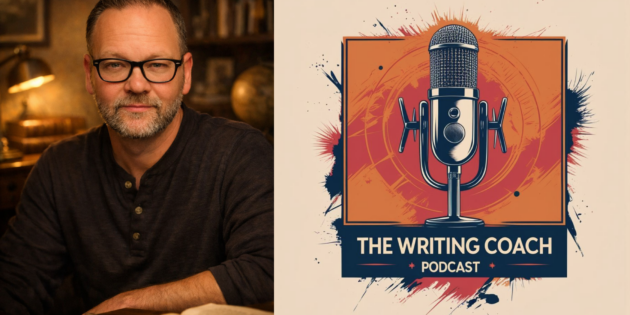
In this episode of The Writing Coach Podcast, I’m joined by author and industry veteran Kevin Tumlinson for a wide-ranging, honest conversation about what it really means to build a sustainable writing life in 2026 and beyond.
We talk about creative burnout, the myth of “doing it all yourself,” and why AI isn’t the monster it’s often made out to be—unless you let it replace the very thing that makes writing matter. Kevin shares how slowing down, writing by hand, and embracing what he calls an “analog rebellion” helped him reconnect with the work after years of rapid release, daily livestreams, and nonstop output.
We also dig into something many writers are curious about—but hesitant to admit: getting help. Not automation. Not shortcuts. Real human assistance. We explore virtual assistants, delegation, leadership, and why letting go of the right tasks can actually give you more control over your author business—not less.
If you’ve ever thought, I just want to write… but I also want this to work, this conversation is for you.
Check out the episode now!
Audio:
Video:
The Writing Coach Episode #221 Show Notes
AuthorAnchor.com – Book a free discovery call!
KevinTumlinson.com – Books, podcasts, and all things Kevin Tumlinson here.
—
Get a FREE copy of Kevin’s book: The Science (and Magic) of Writing Retreats.
Buy a copy of Kevin’s new book: The Frustrated Writer’s Colouring Book.

The Writing Coach Episode #221 Transcript
Today on the podcast, I have Kevin Tumlinson. Kevin, welcome to the show.
Well, thanks for having me, Kevin.
I like the name right off the bat. Synergy.
That’s right. We’re all synced up.
I was looking at your author page, and I think it described you as a writer of fast-paced, upbeat—
Optimistic fiction. Hopeful, fast-paced, hopeful fiction.
There we go. Yeah. See, I write fast-paced, miserable fiction, so I was thinking we might be the yin and yang.
Well, there you go. There has to be balance.
Tell us a bit about your writing. Was literature always a big part of your life? Were you reading books at a young age?
Yeah, absolutely. I was reading very early—I couldn’t say exactly when—but I was also writing very early. I tell this somewhat apocryphal story about how I wrote my first book when I was five years old. It was on one of those Big Chief notepads they use to teach kids how to write. I don’t know if they had those in Canada, but they had big, triple-spaced lines. I had the big, fat practice pencil they give you, and I wrote a story—my book. I taped the whole thing together, stapled the edges, added a masking-tape binding, and drew a cover for it. So I’ve been self-publishing for a really long time.
Amazing. Did you pursue that in school?
Yeah, I did. Early on, I was a contributing writer for the school paper, and I excelled at writing papers—although I often got bad grades because I wouldn’t actually do the assignment.
I remember one time in particular: the assignment was to write about a true event that happened to us—something fun or exciting. I didn’t have anything, so I wrote about my grandfather and me encountering evidence that Bigfoot might have visited our campsite while we were out hunting. I filled it with all the details that might suggest that—large footprints and so on. We never encountered Bigfoot directly, but everyone was blown away. Someone asked if it really happened. I said no, honestly—and I failed the assignment. But I learned a lot.
Did you go on to post-secondary education? Did the marks eventually turn your way, or were you always a poor student?
I was actually pretty good at school. When it came to writing, I excelled, and people noticed. I got involved with the school paper in high school and started writing a column for the local newspaper—a kind of teen-beat thing. I had a little weekly column and made ten dollars a column.
Hold on—how old were you?
I was about twelve or thirteen, through most of junior high and high school.
So you’ve been a paid professional author since junior high.
Rolling in it. That was better than lunch money. Making money as a writer was always something I did—honestly, I probably made more then than I do now.
But I grew up in a very rural area of Texas, and there wasn’t anywhere to spend money. So it accumulated—until a gas station opened nearby with video games. Then all that money became quarters, and all those quarters became hours playing Kung Fu—or whatever it was called—at the local gas station.
At what point did you realize that being a novelist might actually be possible?
I wrote a lot of short stories and what I call my “thirds”—the first third of a novel I’d get excited about and then abandon. I did the same thing in college. I took creative writing classes, won some awards, and wrote two or three novels. One of them actually got a publishing deal, but it turned out to be a bad one. I didn’t have an agent, signed a bad contract, and eventually bought it out. They’d paid me an advance, but I lost the rights to publish it for several years.
I really thought my career was over. But in 2006, I discovered self-publishing as we know it now—back when the industry was barely in its pre-teen years. Amazon came along, CreateSpace, Smashwords—I pulled together what I had, wrote a couple of books, and published them myself. That launched my career, and I’ve been doing it ever since. These days, I’m back to having some traditional deals, so it’s come full circle.
That initial deal sounds like it could have ended things for a lot of people. What kept you going?
I’m incapable of not writing. Even in my worst periods—I suffered severe burnout in 2023 that derailed me and changed the tenor of my career—I couldn’t stop writing. I publish less now, but writing itself has never been the issue.
I write because that’s who I am. I don’t even think of it purely as my identity—it’s more like a spiritual gift. I’m a practicing Christian, and I believe God lays out a path for you. You choose how to walk it, but mine has always involved storytelling—crafting hopeful stories that touch hearts and nourish souls. That’s the point of me.
What did that 2023 burnout look like? Did you see it coming?
It really started with 2020 and the pandemic. By coincidence, my wife and I sold our house and got on the road in a van. I handed the keys back to a temporary apartment on the same day lockdowns were announced. We were essentially homeless except for the camper, and we stayed with her parents for a while.
At the time, I was director of marketing for Draft2Digital. Since authors couldn’t attend conferences, we started a livestream—every single day for three months. I was on the road, trying to find stable Wi-Fi, hosting the show, keeping up with my own writing and publishing, and doing my marketing job. I kept that pace for three years. Responsibilities multiplied, and eventually something broke.
I’d been deep into rapid-release culture—writing as many books as possible, as fast as possible. I’ve done some extreme things. I wrote a book called Evergreen in a single day while stuck in a snowstorm in Manhattan over Thanksgiving. I will never repeat that.
Burnout wasn’t a surprise. I needed to slow the pace of publishing, even if I couldn’t stop writing. There have been positives and negatives, but overall, I feel like I’m healing.
Everyone responded to 2020 differently. You doubled down on work. I was carving spears, assuming electricity would go any day.
Yeah. In hindsight, maybe I should’ve made spears.
You mentioned moving away from rapid release toward something more sustainable. What’s changed?
A lot. I’m back to daily writing, which has always been part of me. I’ve written a few books recently aimed more at traditional publishing. I may loop back to self-publishing just to keep the coffers filled.
But the biggest change is the kind of work I’m doing. I wrote a lot of archaeological thrillers—action-adventure. Nothing wrong with that. But what I’m writing now is more literary, coming from a different place in my soul.
I’ve also started handwriting a book. I tried this dozens of times before and never stuck with it—it felt inefficient. But AI changed that. I can handwrite, photograph the pages, and have them transcribed. I’ve written about the first third of a book entirely by hand, and slowing down has unlocked a different voice on the page.
I can’t compete with people uploading thousands of low-quality books a day. So I’m going the other way. I call it the analog rebellion—slowing down, writing by hand, being more thoughtful. And as a result, I’m doing very different work.
So it’s interesting. You’ve found advantages to AI, like the transcription ability—but I’ve also seen the horrors: a thousand books uploaded in a day of pure trash. Where do you land on the benefits and drawbacks of this emerging tech that’s transforming everything?
Yeah. I’ve created a lot of content around this recently. A lot of people in our business treat AI as the big bugbear—the boogeyman. It’s going to steal the work from us.
But I had this epiphany: one of the biggest reasons AI can generate stories—and it’s getting better at this, by the way—is because our work has become very formulaic and easy to replicate. So if we want to continue to be real writers, I think it’s time to think outside the formulas, think outside the box, and embrace the more human side of ourselves.
Because I’ve read short stories and articles from AI and thought, “That’s pretty good copy.” I have a copywriting background—I can recognize decent copy. It can do a good job with that. But it’s missing a piece. It’s ineffable. It’s hard to pinpoint without sounding like you’re losing your mind.
But when I read something by a human author who really has the skill—who really has the soul—you feel it. And I haven’t had that experience with AI work. Even when people say, “This is profound. It feels alive.” I’ve read that stuff, and I’m like: I could tell you blindfolded that this is either AI, or it’s a writer who doesn’t yet know what they’re doing.
So yeah, I’m probably not answering your question exactly, but for me AI isn’t a threat. It’s a tool. I use it to enhance what I do without doing the work for me.
I use AI to scan my handwriting and transcribe it. I do this thing called looping: I copy and paste into Scrivener, rewrite it in Scrivener, then paste it back into ChatGPT and say, “Find the typos.”
I’ll also use AI to ask, “What do you think happens next?” It’ll tell me what it thinks logically is going to happen—and then I go do the exact opposite. So I love using my enemy’s strengths against them.
We’ve talked about burnout and recovering from that. We’ve talked about digital tools—being on the cutting edge of self-publishing in 2006 with Smashwords, working for Draft2Digital, and now using AI to transcribe. Am I anywhere close in guessing that your interest in working with human assistance came out of both burnout and the recognition that we all need tools and help along the way?
Yeah, yeah. And thank you for looping us back around to the topic of today’s episode.
Author Anchor was founded by the guys from BookBrush, who are wonderful people. I befriended them at a NINC conference several years ago—maybe around 2017. I actually advised them on rebranding their company. At the time, they were called Covers Sell Books dot com, and I said, “So you guys make book covers?”
They said, “No, not really. We help authors create marketing materials.”
I said, “Okay, that’s great—but you’ve got to change the name of your company.”
They came up with some ideas, asked me some questions, and I helped shape that. When Author Anchor came along, it grew out of this realization that a lot of authors say all they want to do is write. They don’t want to do the marketing. They don’t want to deal with the drudgery of publishing.
What these guys already had was a business built around using virtual assistants from the Philippines. They built BookBrush using these resources—these people—and they perfected a system for finding high-quality workers.
They realized there’s no real model for done-for-you marketing that’s profitable for anyone. I’ve seen boutique marketing agencies come and go for years, and they all run into the same problem: authors often don’t have the extra money to pay someone and pay for ad spend. So you’re adding a layer of expense without guaranteed return.
And it’s not one-size-fits-all. The only model that really works is training someone who becomes your marketing team. That’s where Author Anchor started.
You can bring on a VA based in the Philippines. There’s an admin fee, and there’s a minimum hourly rate for the worker. It ends up being about $7.50 an hour. They’re trained to do the things authors actually need—marketing, admin, communication. We have standards for oral and written communication, and quality of work.
It became a way to offload work so the author can focus on writing. That’s the point. When I can hand things off instead of doing everything myself, writing becomes the only thing I have to worry about.
In the entrepreneurial world, hiring a Filipino VA is old news. But in the author world, there are probably people listening right now thinking, “What is a VA? Why the Philippines? What is going on here?” So let’s step back. What’s the simple explanation?
First of all, I’ve been using Scrivener since about 2006, and I probably only use one percent of it—so don’t feel bad.
VA stands for Virtual Assistant. It’s not AI—it’s a human being. Why the Philippines? Because the cost of living there is relatively low.
For example, my VA earns about five dollars an hour. That’s the minimum you’re allowed to pay, and for her, that meant being able to rent an apartment, attend graduate school, and have financial stability her family never had before. And by the way, that’s just the minimum—you should absolutely pay more when you find someone great.
The real question isn’t, “How do I afford a VA?” The real question is, “Will hiring a VA increase my revenue potential?” If offloading tasks lets you write more books, that’s when it makes sense.
Filipino VAs work well because they’re skilled, motivated, and often willing to work flexible hours. That said, I’ve told my VA explicitly: I want you to sleep. I want you to work normal hours. We can communicate asynchronously. Nothing I do is so urgent that it has to be done at 2 a.m.
There’s about a 15-hour time difference, but that’s manageable. They’re good people, good workers, and this is real opportunity for them.
We train them in the tools authors already know—Facebook ads, Shopify, Kickstarter, formatting, Vellum. You may need to provide software licenses in some cases, but many already come with their own tools. Video editing, formatting, admin—whatever you need.
The process starts with a discovery call where you say, “Here’s what I hate doing and never want to do again.” We match you with someone who has those skills.
And where do people go to book that call?
If you go to authoranchor.com, scroll down a bit and you’ll see an incredibly handsome man on the website.
Is his name Kevin?
It is.
I like him already.
Total coincidence. He’s very good-looking. He won’t be the one you talk to on the discovery call, but there’s a big button that says “Book a Free Discovery Call.” No obligations. No contracts.
The only thing you’re obligated to do is pay the VA for the work they do. We don’t take a cut of their pay. We charge a $99 monthly admin fee per VA, and you can have as many VAs as you want.
Because there are no contracts, you can even bring someone on for a one-off project. Need help setting up a Kickstarter? Bring someone in, pay them, and you’re done.
Once you’re making money as an author, this becomes about increasing revenue potential. If paying $7.50 an hour frees you up to write more books, it pays for itself.
Is there a clear list of what’s appropriate to ask a VA to do—and what isn’t?
That’s usually something you figure out together. Physical tasks are off the table—you can’t ask them to pick up your dry cleaning—but anything digital is fair game.
Calendar management. Booking interviews. Outreach. Website updates. Video editing. Social media. Formatting. If it can be done from a computer and it’s legal, it’s probably fine.
I recommend going into the call with two lists. First: everything you must do but hate doing. Second: things you know you should be doing but never have time for.
You’ll usually talk to Moesha—she’s the operations lead. She was a VA who became full-time with Author Anchor and oversees everything. She’ll take those lists and find two or three candidates for you to interview.
If you don’t like them, you can ask for more. If it doesn’t work out, you can stop. No obligation.
We also have resources—YouTube videos, tips on how to work effectively with VAs. I’m always happy to talk about that, but I don’t want to take up too much of your time.
Well, I was about to ask you—as a podcaster myself, I know this may be the most terrible question possible for someone trying to provide infotainment—but are there tax implications involved?
That’s actually a good question.
So, no—you’re not hiring an employee. You’re hiring a contractor. It’s similar to hiring someone to paint your house. You’re not on the hook for their taxes or reporting. They’re subject to whatever taxes apply where they live, but you’re not paying or reporting taxes on their behalf.
That said—and I want to be clear—I’m not an expert, so you should absolutely consult an accountant or attorney where you live. Canada is going to be different from the U.S.
For me, for example, I can report that I paid a contractor X amount, and when it asks whether I issued a 1099, I say no. There’s some nuance there, but I can claim a percentage of what I pay contractors, which gives me a small tax break.
Rules change year to year, so none of this is legal or financial advice—insert all the standard disclaimers—but no, you’re not on the hook for their taxes. And yes, I went off on a tangent.
I’m sure there are people listening to this thinking, “All I want to do is write. This sounds great—but I want to control my author business. I want to own everything.” What advice do you have for people who struggle with letting go?
Start with the smallest task you can think of that you’re willing to let go of. You should do this anyway.
Some authors genuinely enjoy marketing as much as writing. I think there are a lot of closet marketers in the writing space—people who really just wanted something to market and ended up writing books. Some of them are brilliant at it.
But let’s say you decide to hand off something simple, like scheduling and posting social media. Some people balk at paying $7.50 an hour for something that feels small. But that task becomes your training ground—learning how to communicate, how you like to communicate.
For example, I hate email. I tried Notion and got overwhelmed. I felt like I was working twice as hard. Once I figured that out, I switched to Slack and said, “I’ll leave messages. You respond when you’re awake. Nothing here is urgent.”
It took some trial and error. My first VA wasn’t a great fit, so I moved on and found someone else. That’s normal.
The big mistake authors make is either hiring before they’re making money—or trying to hand off everything at once. They expect the VA to do things exactly the way they would, only better and faster. That’s not realistic. This is a human being.
Think about onboarding at any job you’ve ever had. You weren’t handed everything on day one. You were trained. You need to onboard your VA the same way.
You want this person to succeed and be happy working with you. That doesn’t just help you make more money—it helps you breathe easier and have a better experience as a writer. That’s the real end game.
I’ve always felt that books are an older person’s art form. At their core, they’re about sharing wisdom—about what it means to be human. And leadership is part of that. Having employees or assistance stretches those leadership muscles and asks: what do I pass on beyond my words? What skills, wisdom, and opportunities do I create for others?
And books also make money while you’re doing other things. Once they’re out there earning, you’re not actively doing that work anymore. You can sleep. You can take a walk. You can shop. Or you can write another book.
For you, probably serving the community. For me, it’s coke and hookers. But to each their own.
Exactly. I like to jump rope and hang out on street corners.
But this is all an extension of building presence beyond your immediate work. The books are the product. The team helps promote the product so you can create more product. It’s a self-perpetuating machine.
Once you figure out that doing X, Y, and Z makes your life easier and more profitable, you can replicate that formula. You can hire a second VA. You can build a team—admin, marketing, Shopify, podcast outreach.
And you don’t have to manage it all yourself if you build strong systems. Documentation matters. SOPs matter. Once you’re in rhythm, there’s really no limit to how much you can expand. And for authors, that kind of support is a relief.
Kevin, thank you so much for taking the time to come on the podcast and share your experience—not just as an author, but as a businessperson helping other authors. Remind everyone where they can learn more.
Go to authoranchor.com. There’s a big aqua-colored button that says “Book a Free Discovery Call.” Do the call. Bring those lists we talked about. There’s no obligation—but once you try it, I think you’ll realize this is something you’ve been waiting for.
Thanks so much for joining me on The Writing Coach podcast today.
Absolutely. Thanks for having me.
—
Kevin T. Johns is a writing coach who helps authors stop struggling in isolation and start finishing books with clarity, confidence, and momentum.
Book a consultation call with him here.
Podcast: Play in new window | Download
Subscribe: RSS