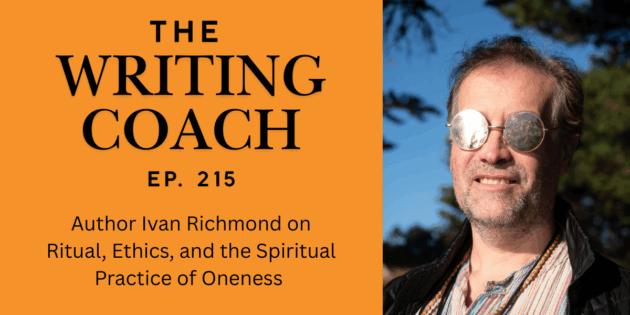
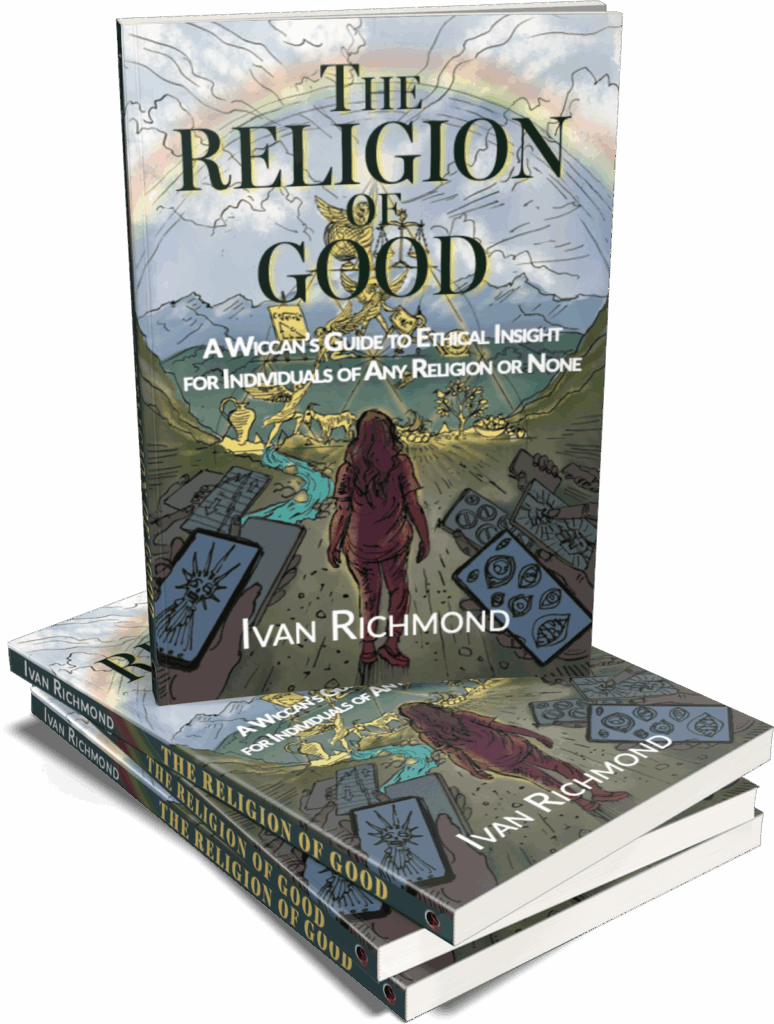
On this episode of The Writing Coach Podcast, I sit down with my client, Ivan Richmond—a Wiccan priest, spiritual leader, and author of The Religion of Good. Ivan’s journey is a fascinating one: raised in a Zen Buddhist monastery community, he eventually found his way to Wicca, blending ancient philosophy with modern spiritual practice.
In our conversation, we explore how ritual shapes meaning, why writing itself can be a kind of ecstatic practice, and how spirituality offers a path forward in what Ivan calls today’s “ethics crisis.” Whether you come from a faith background or consider yourself a skeptic, Ivan’s insights are practical, inspiring, and surprisingly universal.
During the interview, we discuss:
- Ivan’s journey from a Buddhist upbringing to becoming a Wiccan priest.
- How rituals like equinox and harvest celebrations use symbolic acts to connect people.
- Why writers’ rituals (coffee, cafés, robes) are gateways to flow state and ecstatic experience.
- Why reason and intuition fall short and how spiritual practice offers a new path forward.
- How The Religion of Good is written to resonate with Christians, pagans, and atheists alike.
- Lunch-break rituals and everyday habits that transform isolation into connection.
- And much more…
Listen now!
The Writing Coach Episode #215 Show Notes
Visit Ivan online:
Click here to read the first chapter of The Religion of Good.
Buy the book:
Get Kevin’s new book, The Frustrated Writer’s Colouring Book.

The Writing Coach Episode #215 Transcript
Podcast: Play in new window | Download
Subscribe: RSS
Today on the podcast, I have my client, Ivan Richmond. Ivan, welcome to the show.
Oh, thanks, Kevin. Glad to be here.
This is really exciting, because I haven’t actually recorded a podcast in a while. It feels great to hit that record button again and have some good conversations with good people.
Yeah, sure.
So, you grew up with a Zen Buddhist background. I’m somewhat familiar with Zen Buddhism from reading Jack Kerouac as a teen—that was something I was really interested in. But now you serve as a Wiccan priest, which I know very little about.
How did this spiritual path—this interesting and diverse background in both Buddhism and Wicca—influence your ethics and spirituality as an adult?
Yeah, that’s a great question. I was raised Zen Buddhist. I grew up at a place called Green Gulch Farm, one of the branches of the San Francisco Zen Center.
My parents were both disciples of Shunryu Suzuki Roshi, the author of Zen Mind, Beginner’s Mind. My dad, Lou Richmond, is a Zen Buddhist priest. So I grew up in a sort of monastery-slash-commune environment.
My parents were very adamant that I could choose whatever religion made sense to me. When I went off to college, I leaned very secular. I didn’t think much about religion or spirituality. But two events brought me back: In 1999, my dad nearly died of viral encephalitis. He’s fine now, but he was in the ICU, and it was a wake-up call. Then, just a couple of years later, the 9/11 attacks happened.
Those two moments forced me to ask big questions—about mortality, maturity, and the roles our parents play in our lives.
Now, Zen is very flexible; you don’t “leave” Zen because it harmonizes well with other traditions. But I realized I needed more of a mythological framework to make sense of those big questions.
In college, I met people who were Wiccans and pagans, and I checked it out. I met an amazing spiritual mentor, Valerie Voigt, who really impressed me with her deep understanding of Wicca. I started pursuing it seriously, and by 2005 I had become a priest.
Both Zen and Wicca are very non-dogmatic, which is part of their appeal. They don’t hand down commandments. Zen offers meditation to cultivate compassion for all sentient beings. Wicca offers techniques for creating rituals and spiritual practices of your own.
For me, reality itself is my “true love.” It’s the first beautiful thing I saw when I was born, the most beautiful thing I’ll see before I die. Like any marriage, the relationship takes work—it’s not always easy—but it’s transformative. Reality isn’t an enemy; it’s a lover you build a relationship with.
Okay, so when you say you’re a Wiccan priest… I’m familiar with priests in Catholic or Christian traditions. What does being a priest look like in the context of Wicca? Is there a church you go to? Or is it more nature-based?
Yeah, another good question.
Wicca is a nature religion. We have two deities—a goddess and a god. The god has horns or antlers, but he’s not the Christian devil. He’s a positive figure.
We celebrate the changing of the seasons, the phases of the moon. We’re a magical religious tradition, though not everyone interprets magic literally. Some people approach it psychologically or symbolically. Either way, the rituals create meaning in people’s lives.
We have a very simple moral system: minimize harm to others.
Wiccans usually gather in small circles or covens of around a dozen people, often in someone’s home. We don’t have the wealth to build big temples. For larger seasonal celebrations—the sabbats—we meet in bigger groups, maybe in a park or rented Unitarian church.
That makes sense. I’m actually working with another Buddhist client who recently shared some statistics with me. Something like 40% of Americans still believe in organized religion, but about 60% have turned away from traditional Christianity.
He said younger generations, while turning their backs on formal religion, are much more open to paganism, Wicca, and alternative spiritualities.
So, why do you think Wicca appeals to younger people today?
That aligns with what sociologist Steven M. Tipton—who helped me with my book—has written. His specialty is American religion, and particularly American Christianity.
My take is that people are turned off by dogma—the “thou shalts and thou shalt nots”—and by conceptions of God as a king or father figure who punishes. That doesn’t resonate as much today.
Christianity and Islam are belief-defined religions: you must profess certain beliefs to belong. But many other religions are practice-defined. For example, I once spoke with a Hindu woman who identified as an atheist. She explained that worshiping a loving god makes her more loving; worshiping a compassionate god makes her more compassionate.
That’s what appeals to people about Wicca. You don’t have to sign onto a creed. You can work mythologically, psychologically, or spiritually. You decide what you believe. We joke: if you ask 12 Wiccans what they believe, you’ll get 13 answers.
That flexibility and openness is very attractive right now.
You mentioned magic and spells, and how some people see them literally and others metaphorically. I’ve always felt that way about writing. I’m not sure if it’s genuine magic or metaphorical magic, but there’s definitely something there.
Writers take something that doesn’t exist and bring it into reality with words. That feels magical to me.
So, since we’re talking about writing, tell us about your book The Religion of Good. When did the idea for this book first take root?
It really came out of the pandemic.
The Religion of Good is about the spirituality of ethics. Specifically, I believe we’re facing an ethics crisis. We don’t share a common ethical framework anymore—politically, socially, or culturally.
Let me explain how I came to that conclusion.
During the pandemic, I was dutifully sheltering in place. President Trump was downplaying the crisis, which felt absurd since health experts worldwide agreed otherwise. At the same time, I saw anti-mask protests, police killings of Black people, Black Lives Matter protests, and anger boiling over into smashed windows and ideological battles.
It felt like tribes at war—very moralistic, but not grounded in true ethics. Moralism is “my side is always right, yours is always wrong.” Ethics requires a theory rooted deeply enough to distinguish right from wrong, beyond tribal lines.
As a religious leader co-running three groups, people looked to me for guidance. But I realized I couldn’t even answer ethical questions for myself anymore. Everything felt nebulous and intuitive.
So I turned to philosophy. I hoped rational philosophy would provide answers, but it quickly became clear it couldn’t. Philosophy has hit a brick wall in ethics—there are too many directions, too many conflicting frameworks.
Take the Cold War: both communism and capitalism were based on the ethical idea of doing what’s best for everyone, but their definitions of “best” were radically different. That clash nearly brought us to nuclear war.
So reason didn’t solve it. Intuition didn’t solve it either—since everyone’s intuitions differ. Cultural relativism didn’t help either, because ethics are about relationships, not isolated behaviors.
That left me in a dark night of the soul. But eventually I found my answer: a spiritual solution.
It’s about recognizing that we’re all connected, that we are one. Ethics must come from spiritual transformation—seeing ourselves not just as isolated individuals but as part of an interconnected whole. That shift in consciousness allows us to model goodness in our relationships and actions.
So that obviously sounds good—this connection of all people and things—but what does that actually look like in practice, in everyday real life?
Yeah. The other thing I realized is that as a Wiccan priest, I’m in a unique position to share our techniques for developing ritual and spiritual practices. I was taught what makes for a good ritual—how to design it—and we do this all the time.
For example, say the spring equinox is coming up. We ask: what’s meaningful about the equinox? Why do we celebrate it? Then we shape a ritual as a series of symbolic acts that have meaning for people.
Right now, we’re coming up on the autumn equinox. With Waxing Moon—one of the circles where I’m a high priest—we’ll do a harvest celebration. And for us, it’s not just the literal harvest, which can feel abstract if you’re not a farmer; it’s also the personal harvest: the fruits of our labor and creativity.
In the book, I lay out specific techniques for developing rituals and other practices. The results might be chants—my favorite is: “I am we; we are one; we are one and I am we.” You can use that like a mantra. You can also create your own rituals and even your own mythic language. For instance, I have another chant: “Mother Earth, blue and green, global girth and crossroad queen.” You don’t have to believe in Mother Earth as a literal goddess; the Earth is real, we’re real, the world is real—so the figure becomes a symbol for all of us together.
You can likewise invoke mythic personages like Lady Liberty or Lady Justice to get a handle on those ideas. There’s a scholar I like at the University of Toronto, John Vervaeke, who studies the cognitive science of spirituality. He talks about how rituals that engage with mythic concepts help you model those concepts in your mind—so you have a guide to fall back on. You’re not just reasoning abstractly; you’re forming an inner model that can guide you. That’s what I’m trying to lead people through in the book.
Most listeners are writers or writing coaches, so I think they already get the value of ritual—coffee routines, favorite cafés, the lucky robe, whatever. But I also think it’s about getting into flow state once you’re writing.
In the book, you talk about rituals as a pathway to ecstatic experiences. That sounds a lot like flow to me. Can you expand on what you say about ecstatic experiences?
For me, flow is a type of ecstatic experience—and John Vervaeke talks a lot about flow states. My view is that goodness is an ineffable mystery—that’s part of why reason struggles to grasp it. Think of the parable of the blind people and the elephant: different individuals and cultures are touching different parts of the same thing. We’ve made all these attempts to contact the good, but from many angles.
I believe goodness is real—but how do we touch an ineffable mystery? Through spiritual techniques that lead to altered states of consciousness. Ecstatic literally means “out of stasis”—out of yourself. You step outside your ordinary, isolated self to make contact with others’ consciousness, with the wider whole.
I don’t mean “soul” in a literal heaven/hell sense. I mean other people—other centers of consciousness. From another perspective, there’s no hard boundary where I end and the cosmos begins. We flow together. Who we are is contextualized within community and humanity; alone, we would lose our bearings.
That’s the spiritual attempt: to touch the mystery of all of us together. But you need myth, ritual, and ecstatic experience working together. You can go to a rock concert and lose yourself, but to what end? Myth is like the vocabulary and grammar for talking about the ineffable; ritual is like forming sentences from that vocabulary. It pre-programs the autopilot so that when you enter an ecstatic/flow/Zen/contemplative state, you’re oriented—you “land in Waikiki,” not just anywhere in the Hawaiian Islands.
Absolutely. I’m confident this book will appeal to Neopagans and the Wiccan community. But what about people who are already part of organized religion—the remaining 40% of Americans—or, say, us godless Canadian atheists? What might we get out of this book?
This book is absolutely for everyone. The subtitle even says “for people of any religion or none,” and I mean that. Marketing-wise it might show up in occult or New Age shops, but I’ve already met readers from other traditions—Catholic, Jewish, etc.—who connect with it.
For atheists or agnostics, if you want to approach ethics spiritually without signing onto a creed—if you sense we’re in an ethics crisis and the usual tools aren’t working—this book offers another path. You don’t have to believe that Lady Justice or Mother Earth are literal goddesses. Justice is real. The world is real. Humanity is real. You can use ritual and ecstatic practices simply as ways to connect with something larger than yourself—humanity, the world—without invoking God.
This isn’t just theory. I practice what I recommend daily—sometimes twice or three times a day, even a quick practice on a lunch break. The techniques are transformative: they shift us from isolated individuals to interconnected people. That’s valuable no matter where you stand on the religious spectrum.
As we come to the end of the interview—obviously it’s a complicated topic and the book covers a lot—if there were one big takeaway you want readers to leave with, what would it be?
That you can model goodness for yourself. You can develop your moral compass and connect with other people. We are larger—greater—than we tend to think. Yes, there’s an ethics crisis, but there is a solution. We can come together by being more humble, more universalist, less tribal and ideological, and more generous in our sense of ethics and goodness with each other.
For listeners who want to check out the book and learn more about you, where can we send them?
My website ivanrichmond.com. There’s a sign-up for my email list. You’ll get announcements about events and tips like short rituals or spiritual practices you can do even on a lunch break. If you get the book and enjoy it, I’d appreciate reviews on Amazon. When you sign up, you’ll also receive a free PDF of the first chapter of The Religion of Good to see if it’s for you.
Fantastic. I think you also have a YouTube channel where folks can check you out—correct?
Yes. It’s called Religion of Good, same as the book. The link is on ivanrichmond.com: go to Books → The Religion of Good, and you’ll see the YouTube there. There’s also a YouTube icon in the footer. I have videos on the ethics crisis, and I’ll soon be demonstrating techniques from the book—chants, rituals, etc.—so you can see how they’re done or follow along.
Ivan, it’s been a pleasure working with you these last few months to get the word out about the book, and I was excited to have you on the podcast. Thanks so much for joining me on The Writing Coach Podcast today.
Thank you for having me, Kevin.