Imagine trying to build a house without a blueprint. Sure, you might end up with four walls and a roof, but there’s a good chance you’ll forget something important along the way. Like stairs. Or plumbing. Or… doors.
That’s what it’s like to write a fantasy novel without a magic-system rulebook.
Without a rulebook—a clear, consistent structure behind the curtain—your magic will break the moment you push it too hard.
Whether you’re writing high fantasy, urban fantasy, or paranormal romance, in this article, we’ll explore what you can do to create a simple, usable, written magic system rulebook.
Why You Need a Magic Rulebook
The rulebook is what makes your magic feel like a functioning part of your world rather than a narrative convenience that appears only when your plot needs a boost or your protagonist needs an escape hatch.
A magic system rulebook isn’t something your characters carry around in your story; rather, it’s something you, as a fantasy author, develop and write behind the scenes as part of your creative process. It’s your internal guide to how magic functions in the story world you are building. It covers your magic’s source, limitations, rituals, and dangers. It’s your consistency tool and creative compass.
Six Questions to Anchor Your Magic System
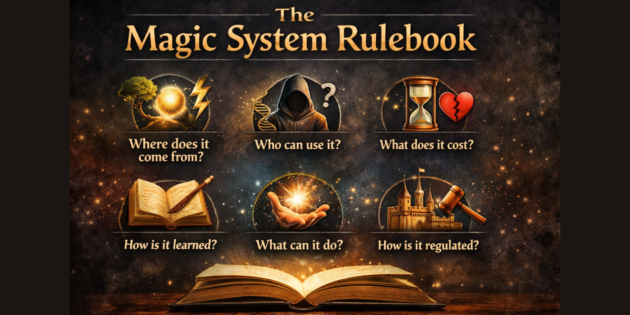
When developing your magic system, ask yourself the following six questions:
1. Where does the magic come from?
- Is the source divine, demonic, natural, technological, emotional, ancestral, or cosmic?
- Is the source stable and eternal, or volatile and diminishing?
2. Who can use it?
- Is access restricted by bloodline, training, belief, social class, geography, or accident?
- What separates those who can wield it from those who cannot?
3. What does it cost?
- Does using magic require physical energy, lifespan, memory, morality, relationships, or something intangible?
- Is the cost immediate and visible, or subtle and cumulative?
4. How does someone access or learn it?
- Is magic awakened, inherited, taught, bargained for, stolen, or discovered?
- What barriers or trials must someone overcome to gain proficiency?
5. What can it do, and what can’t it do?
- What problems does magic solve easily?
- What problems does it absolutely fail to solve, and why?
6. How do people in the world view or regulate it?
- Is magic feared, celebrated, outlawed, monopolized, institutionalized, or misunderstood?
- Who benefits from controlling it, and who suffers because of that control?
Your answers to these questions define your story’s entire ecosystem of magical cause and effect.
Slayers, Wizards, and Jedi – Magic System Rulebooks
Let’s take a look at how the six questions would work in three very different magical narratives: a television show, a novel trilogy, and a movie series.
Notice how each story answers the same six questions but arrives at radically different worlds.
1. Where does the magic come from?
Buffy the Vampire Slayer: Thousands of years before the events of the show, a group of men performed a mystical ritual that forced a demon’s essence into a human girl. She became the first Slayer, imbued with demonic powers and bound to a mystical calling to battle vampires and monsters.
The Lord of the Rings: Long before the events of books, the Maiar, immortal spiritual beings, were created. The wizards, such as Gandalf and Saruman, are Maiar sent to Middle-earth in mortal form to oppose Sauron. Their magic does not come from spells or study but from their nature as angelic beings clothed in flesh.
Star Wars: The Force is an energy field created by all living things that binds the galaxy together. Certain individuals are born with a heightened sensitivity to it. Its power is accessed depending on the user’s alignment to the light or dark side of The Force.
2. Who can use it?
Buffy the Vampire Slayer: A teenage girl inherits the power for her generation when the previous Slayer dies.
The Lord of the Rings: Only beings of a similar spiritual order can wield true wizardly power. You cannot train to become a Wizard, nor are their abilities inherited.
Star Wars: All living beings exist within the Force, but only those who are Force-sensitive can consciously wield it. This sensitivity is innate and cannot be manufactured through study alone. Training refines ability, but it does not create it.
3. What does it cost?
Buffy the Vampire Slayer: Vampire Slayers live short lives. Most never reach adulthood. In addition, they are unable to live like normal teenagers because their Slayer responsibilities always take precedence. They often sustain injuries, and their proximity to death can leave them emotionally numb.
The Lord of the Rings: When the Wizards take physical form, they are bound to aging bodies, vulnerable to fatigue and pain, and forbidden from dominating the peoples they are meant to guide. Their power is intentionally restrained so that free peoples must choose their own courage.
Star Wars: The Force demands discipline. Jedi must surrender attachment and ego to avoid falling to the dark side. The dark side offers faster, more aggressive power, but it consumes the user’s morality and identity.
4. How does someone access or learn it?
Buffy the Vampire Slayer: The slayer inherits her powers when the previous slayer dies. She then works with a mentor, known as a Watcher, appointed to her by the Watcher’s Council, to develop her skills and continue improving in physical, mental, and magical combat.
The Lord of the Rings: Wizardly magic is inherent to the beings who possess it. Growth comes not from mastering techniques but from deepening wisdom, humility, and alignment with their mission.
Star Wars: A Force-sensitive individual trains under a master, learning meditation, combat, and emotional control. Access comes through focus and alignment rather than incantation. Patience and surrender deepen connection to the light side, while fear and anger open the path to the dark.
5. What can it do, and what can’t it do?
Buffy the Vampire Slayer: Buffy’s powers include superhuman strength, speed, and reflexes, accelerated healing, and prophetic dreams; but her powers cannot shield her from the fragility of the human condition. Death, heartache, and trauma affect her the same way they would any other teenage girl.
The Lord of the Rings: Wizardly power can create fire, break lesser enchantments, confront dark forces, and reveal truth. It can’t, however, override free will, instantly eradicate evil, destroy the One Ring, or prevent death. The greatest battles must still be fought by ordinary individuals making costly choices.
Star Wars: The Force can enhance physical ability, enable telekinesis, influence minds, grant visions, and heighten perception. Yet it cannot eliminate suffering, erase consequences, or dominate others without corruption. Attempts to conquer death or control fate inevitably lead toward imbalance.
6. How do people in the world view or regulate it?
Buffy the Vampire Slayer: The Watcher’s Council attempts to regulate slayer behaviour through a variety of means, including control of information, observation, training, indoctrination, punishment, and even the threat of replacement.
The Lord of the Rings: The wizards’ mission is defined by the higher powers who sent them. Many ordinary people view wizardry with awe, suspicion, or misunderstanding. Ultimately, regulation is internal and cosmic rather than political. The true boundary of wizardly magic is the requirement that it be exercised in humility and service rather than in pride and domination.
Star Wars: The Force is viewed with awe, suspicion, or fear across the galaxy. The Jedi Order once regulated its use through strict codes and structured training, while the Sith governed themselves through secrecy and hierarchy. Political powers have alternately suppressed or weaponized Force users. Ultimately, regulation is institutional when Orders exist, but moral when individuals stand alone.
Your Rulebook is a Lifeline
A strong rulebook helps you avoid writing yourself into corners—or writing yourself out of them too easily. It’s a reference you can return to as you draft and revise. It ensures that your coolest scene ideas are actually possible in your world, and that their consequences are believable. And, of course, it can include much more than just the answers to the six questions I’ve identified here. Your rulebook can include:
- Tiers or categories of magic
- Ritual components or tools
- Dangers or backlashes
- Training systems
- Lists of magical objects or weapons
- Cultural rituals or taboos
- Variations across different regions or magical schools
You can even write entries from in-world documents if that helps you think more clearly. Have fun with it, but keep it functional.
When in doubt, return to this question:
If this magic were real, what rules would it have to follow to avoid destroying the world?
While Tolkien treated world-building as its own art, your rulebook doesn’t need to be long. A one-page bullet list, similar to the examples in this article, might be enough. That said, it should be written. Don’t keep it all in your head, because once you’re 40,000 words into your draft, you’ll forget whether casting lightning magic drains stamina or causes nosebleeds.
Let It Grow, But Keep It Consistent
Remember that your rulebook can evolve while you draft and revise. As you write and discover your story, new questions will inevitably arise, and new situations will require an update to your rulebook. Let it grow with you. Just make sure that when something changes, you go back and make that change consistent across your manuscript.
A strong rulebook is one of the fantasy writer’s best pieces of insurance against broken stories. It grounds your world, makes your characters’ decisions feel more meaningful, and creates a foundation for your entire story to grow.
Write your magic system rulebook before you get too deep into your draft.
Your future self (and your story) will thank you.

Kevin T. Johns is a Canadian writing coach who helps fantasy authors build stronger stories by designing magic systems that actually work on the page and under pressure. Book a consultation call with him here.