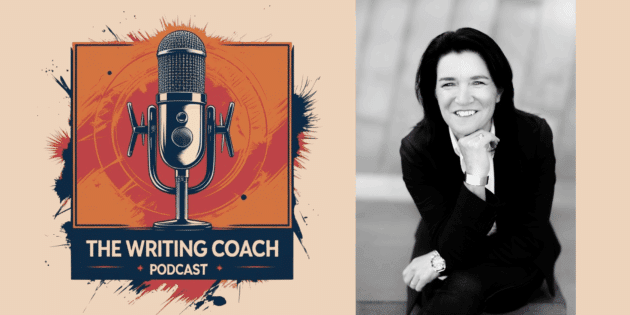
In this episode of The Writing Coach podcast, I’m joined by Gabrielle Dolan, a leadership communication expert, keynote speaker, and the author of eight books on storytelling, including her latest, Story Intelligence: The Craft of Authentic Storytelling Made Smarter with AI.
Gabrielle shares how nearly two decades in senior leadership and change management at one of Australia’s largest banks led her to a powerful realization: stories communicate strategy, change, and ideas far better than data and slide decks alone. That insight inspired her to leave corporate life and teach storytelling as a core leadership and communication skill.
Together, we explore:
- Why logic alone doesn’t persuade and how emotion really drives decisions
- The four key types of stories you can use—parables, public, professional, and personal
- Why personal stories are the most underused yet most powerful in building trust and credibility
- How specificity (like “red back spider” and “Copperhead snake”) makes stories more vivid and memorable
- The biggest communication failures in large organizations and how story can fix them
- What Gabrielle means by “story intelligence” and why authenticity is at its core
- How to use AI as a creative partner to find and refine your stories—without losing your voice
- The growing distrust of AI-polished content and how writers can stay credible in a skeptical world
If you’re a writer, coach, or leader wondering how to stand out in an AI-driven, trust-poor environment, this conversation will help you communicate with more clarity, impact, and authenticity—on the page and in person
Check out the episode now!
Audio:
Video:
The Writing Coach Episode #224 Show Notes
Where to find Gabrielle online:
LinkedIn
Keeping it Real With Jac and Ral Podcast Link
Website
Grab your copy of Gabrielle’s book: Story Intelligence: The Craft of Authentic Storytelling Made Smarter with AI
—
Join the May 2026 edition of Story Plan Intensive!
Get a FREE copy of Kevin’s book: The Science (and Magic) of Writing Retreats.
Buy a copy of Kevin’s new book: The Frustrated Writer’s Colouring Book.

The Writing Coach Episode #224 Transcript
Today on the podcast, I have Gabrielle Dolan. Gabrielle, welcome to the show.
Thanks, Kevin. I’m excited to be here.
So I’m in Ottawa, Canada. You are all the way on the other side of the world, but we’re managing to connect thanks to technology.
Yes, I’m in Melbourne, Australia.
As a Canadian and as a parent, I can tell you the big Australian cultural artifact in our lives was The Wiggles. For many years, The Wiggles were on our TV. We were buying the DVDs. I have myself attended, I believe, three Wiggles concerts. So thank you for your cultural export of song.
Yeah, and now it’s probably Bluey, if you’ve got kids. The cartoon character Bluey.
How did I not think of Bluey? My youngest is all about Bluey. So absolutely.
A little backstory on The Wiggles: I did attend a Wiggles concert with my kids, but before The Wiggles were The Wiggles, they were actually a pop band called The Cockroaches, and I saw them at a pub when I was about 20.
Amazing. I love that. Incredible. So Australia really is a small world.
It is. Well, it’s a large world, but, you know, small.
I was looking up your history and your background, and a lot of the work that you do in communications, corporations, leadership, business, and education makes a lot of sense. But then I saw that your expertise and interest in storytelling actually began while you were working with a bank. So I’d love to hear: how did a place focused on money and numbers become the place where you started thinking about the value of storytelling?
Yeah. So I worked at one of Australia’s largest banks for nearly two decades, and in the last couple of years, I was in a senior leadership role. So I was managing people, but I was predominantly in a change management role. We were rolling out major digital transformation and organizational transformation—organizational change.
And it was in that capacity that I noticed that when I shared a story, and it was a personal story, so it wasn’t related to work, but I connected it back to work, it seemed to get the message across better. People sort of seemed to go, “Oh, yeah. I guess that sort of makes sense.”
Now, it wasn’t a magical silver bullet, but what I did start to notice was that the really good leaders I saw—the really inspiring, influential leaders—were sharing stories. You’d go to a conference, and you’d see speaker after speaker, and you’d go, “They were a brilliant speaker.” And then I noticed they were brilliant because they were sharing stories.
So I started to think, I think storytelling is a skill. I think it’s a leadership skill. I think it’s absolutely a communication skill and an influencing skill.
And so that’s when I started to notice it. Then, over the next probably year or so, I noticed it more and more. In previous roles, I had done a lot of design and delivery of leadership programs, so I knew I could design and deliver training. And I was so convinced that storytelling was a skill, I just decided, “I think I’m going to leave corporate and teach leaders how to communicate more effectively through stories.”
This was 21 years ago. At the time, our kids were two and five, and I just thought, “If it doesn’t work out, I’ll spend time with the kids, and I’ll just go back and get another job.”
That’s what I thought. If it didn’t work out.
It would be fair to say that 21 years later, and eight books later, it has worked out.
So you said you decided to give teaching a shot. What do you see as the relationship between teaching and writing books?
Yeah. So I was actually teaching people how to tell stories. I would go into organizations, run in-house workshops, sometimes do public workshops, and actually teach them the skill of how to get a message across.
I’d ask, “I want to get this message across. How do I find the most appropriate story to do that? And then how do I tell that story in a really succinct and effective way?”
Once you learn that skill, you can use it when you’re presenting on stage. You can use it with your team, but you can also use it in the written format. So regardless of how you’re delivering the story—whether that’s in a book, whether that’s in a newsletter to your team, or whether you’re just saying it—it’s about teaching them the skill of storytelling, and then helping them explore all the different ways they can share those stories across different mediums, even in video now, for example.
Did you see the new career as teaching as parallel to being an author, or was becoming this prolific author a nice side benefit?
So, Kevin, I’m going to let you and your listeners in on a little secret: I failed English in my final year of school.
I put it down to the fact that I think I was predominantly a bit lazy. I was a lazy student. I had this thing of, “Well, 50% is a pass.” And I missed it. I got 49%, so I just missed out.
So the fact that I’ve written eight books is a massive surprise, probably to me and my English teachers.
I went for about 10 years and never thought of writing a book at all. It didn’t even enter my mind. Why would I write a book?
It was only when I was working with a business coach, and he was talking about how, if you want to be seen as the expert in your field—and at that time, 10 years in, no one was really talking about storytelling. I was probably only one of a handful of people around the world teaching people storytelling and seeing it as a skill.
So I wrote the book. I co-wrote the book with my business partner. That was a very long process, the first book.
They always are, those first books.
They always are. You’ve got no idea what you’re doing. No idea what you’re doing.
And then that led to another book, and that led to another book, and that led to another book.
So, yeah, it was purely a business reason I wrote it. I wrote the book to say, “Okay, this is credibility.” Then I actually discovered that I liked the process of writing. I liked the process of thinking and developing my thinking, and I actually started to really enjoy the process of writing.
So then I wrote quite a few more books. I wrote my previous book about five years ago, and I truly thought that would be my last book on storytelling. I mean, there are only so many books you can write on the one subject.
But my latest book, I just felt compelled to write.
It’s called Story Intelligence, so ultimately, it’s a storytelling book, but the subtitle is The Craft of Authentic Storytelling Made Smarter with AI.
The reason I felt truly compelled to write this book is that about 18 months ago, two years ago, I had more and more people sitting in my workshops. I’d be teaching them the whole power of storytelling, and I would get questions like, “Well, will AI replace storytelling?”
And I was like, “No.”
It actually horrified me that people were even asking that question.
Then people increasingly asked me, “Can you use AI with your stories?”
And Kevin, my initial reaction was, “No. No, that’s cheating. You can’t do that.”
But I thought, “Well, I’d better start experimenting with using AI in the storytelling process.” And I was disturbingly surprised by how good it was. I say disturbingly because I thought, “Oh, this could be dangerous.”
So I spoke to my publisher about the concept of this book: that in a world of AI-generated content and in a world of distrust, I truly believe our stories are needed now more than ever. But you can use AI to help find your stories and refine your stories. The most important thing is to not lose your voice in the process.
So that’s the concept of the book. And like I said, I actually felt compelled to write this one.
I want to come back to that book in a moment. But first, I know you’ve spoken with lots of major, big corporations and companies people would know. Having done this so many times, what do you see as the major communication problems within big organizations?
I reckon if you and I knew the answer to that, we could probably make a lot of money.
But I think I know the problem. I just don’t think there’s an easy solution.
I often quote George Bernard Shaw, who says, “The single biggest problem with communication is the illusion it has taken place.”
I think when it comes to communication, especially in large organizations, we’re losing the effect of communication as it goes down this cascading effect.
The CEO and the senior execs might understand something really well. They might understand the strategy. Let’s say it’s communicating a strategy, for example. They understand it because they’ve spent hours, days, weeks, even months discussing it. So they know it inside and out. By default, they have this curse of knowledge. They understand it really well.
Then it gets cascaded down in probably a very polished PowerPoint presentation, in a one-hour presentation, for example. And they get really frustrated that people don’t get it.
Because they’re explaining it in a way that makes sense to them. They understand it so well, but they’re explaining it in a way that is often all numbers. It’s all about the numbers. And that doesn’t have an impact.
There’s too much emphasis on the logic when they’re explaining things. So they think, “If we logically prove why we need to do this change, people will see it logically and get on board.”
But, of course, we’re emotional beings, and we make decisions based on emotion. That’s where I think story can come in.
So there are a lot of factors.
I think another factor, too, is a lot of people in organizations get promoted because of their technical capability. They’re really, really good at their job, and they get promoted. Then they’re really good at that job, and they get promoted. Then, all of a sudden, they find themselves leading people, where now their technical ability is not that important.
The most important thing they need is communication skills. That’s what they need as a leader.
And a lot of people struggle with that, because all of a sudden, they’ve got to do this. Some organizations are very good at providing their leaders training around this, and some organizations are not so good. But either way, this is a new skill someone has to learn.
So, yeah, I reckon those are the three reasons why I see communication go so badly in organizations.
Before the printing press, before the written word, humans have always been telling stories. Has the way we tell stories and the types of stories we tell changed over thousands of years, or have we been telling ourselves the same stories throughout history?
Yeah, that’s a really great question.
I don’t think the stories have changed.
You said in the intro, I’m from Australia. Australia has the longest-running culture in the world, with our First Nations people. Their Dreamtime stories have stayed in place for tens of thousands of years, and the message has stayed intact. They have delivered their messages around their culture and their beliefs through these stories over tens of thousands of years.
So you’ve got to look no further. Some people say to me, “Oh, is storytelling a fad?”
It’s like, no. Storytelling is—we’ve always, as human beings, been hardwired to tell stories. We’ve always told stories. We’ve just gone into business and thought, “Oh, that’s not professional. We need facts and figures and bullet points and flow charts and stuff like that to get the message across.” And it just doesn’t work.
In the book, I talk about the four types of stories you should consider sharing. One of them is the parable. We’ve told parables forever. I tell parables to my kids. Teachers share parables all the time, like “The Boy Who Cried Wolf,” that type of thing.
Those stories are still really, really powerful and effective. The actual parable you’re sharing might change, but it’s still a parable, and it’s a really good teaching story.
The other types of stories are public stories. These are well-known public stories that we often share. And then the other two are professional and personal stories.
So your professional stories and your personal stories—the actual stories might change, but ultimately, we’re covering off on those same types of stories.
If I’m an author looking to market my books, and I’m thinking to myself, “Okay, I’m going on Kevin’s podcast. I’m going to be interviewed. I need some stories to tell,” and we’ve got personal stories, professional stories, parables, and public stories, I’m guessing certain types of stories have certain impacts, or certain types of stories probably achieve different effects.
Can you talk a bit about that? How can people approach using perhaps all four types?
Yeah, and they do serve a different purpose.
Even with case studies, I have some people say, “Talk about a case study.” And I say, “A case study is not a story. It’s a case study.” It’s still really valuable. It just serves a different purpose than a story.
So I would say that parables, as I spoke about, provide great teaching. It’s a great teaching moment, and you would use that to provide advice to someone, whether that’s your kid, one of your team members, or a student. They can be really powerful.
Again, the parables might change. They might not all be about “The Boy Who Cried Wolf.”
I still remember, and I put this as an example in my book, when I was doing my MBA in management and leadership—I don’t know, a long time ago now. Probably 30 years ago. One of the subjects we were doing was competitive advantage, and that term was relatively new back then.
I still remember the lecturer trying to explain what competitive advantage meant. He used a parable. He said, “It’s like two CEOs go walking in the woods, and they come across an attacking grizzly bear. The first CEO calmly grabs a pair of runners from their backpack and starts to put them on. The second CEO says, ‘Are you mad? We can’t outrun an attacking grizzly bear.’ And the first CEO says, ‘I know, but I sure as hell can outrun you.’”
And, Kevin, I’m going to say it’s probably the one thing I remember from my entire MBA: that story.
So it’s a teaching moment.
Public stories tend to be some of the case studies. If you want a great example of innovation, you’ll find a great story about Steve Jobs or something. So public stories are powerful.
But with both those stories, I don’t learn much about you when you’re sharing the story, so I don’t get to know you any better.
The power with professional and personal stories is that I get to know you a little bit better. They’re still used to communicate the message.
Professional stories are the ones you’d typically share in a job interview, for example, when someone says, “Tell me about a time when…” and you’re going to share a relevant work-related story. So they can be really powerful.
The most powerful ones, though, and the most underutilized in business, are your personal stories. So how you share a non-work-related story and connect it to a work message can be really, really powerful when you’re talking about things like values, whether they’re the company values or your values.
If you want to be known as transparent, for example, and you share a personal story around that—perhaps when you weren’t transparent, when you didn’t tell the whole truth, and the regret you have around that—then I get to know you better.
What that does, and all the research shows this, is that because I’ve made a connection with you, and I get to know you better through the story, it can actually fast-track trust and credibility or strengthen trust and credibility. So if you’ve met someone for the first time, it can fast-track that relationship. But if this is someone you already know, it can strengthen the relationship.
And when it comes to writing, especially writing books, I put a lot of personal stories in my books because I think it creates a relationship between me and the reader. They have never met me, but through hearing some of my personal stories about me growing up, or about my kids, or about stuff I’ve done, they feel like they know me.
And that’s the advantage of the personal story. The other stories can get your message across, but the personal story gets your message across and builds a connection.
So you mentioned that we think we make decisions based on logic. In fact, we make decisions based on emotion.
If I am then trying to convince someone via a story or influence a decision someone makes, I’m guessing I don’t throw logic completely out the window. How do I find that balance between bringing logic to the argument but also acknowledging that, ultimately, it’s going to be emotion that gets my point across?
Yeah, and it is. Every human does this.
Some people go, “Oh, but I’ve got to present to the finance team. They don’t make decisions on emotion.”
I go, “If they’re human, they do.”
Again, you are not throwing out the logic. You’re not just going, “Let’s get rid of all the logic and just go story, story, story.” It’s not about that.
But in business, we have too much emphasis on logic. So what I say is, okay, you’ve got all the logic, and it makes logical sense. Sometimes in business, you make this assumption that surely you’re not trying to convince me of something that doesn’t make logical sense. So to me, it’s almost a given that it’s logical.
But we keep banging our heads up against a brick wall, just going, “Logic, logic, logic.”
So I say, how could you potentially share a story that’s going to get people to think, feel, or do something different? And to do that, you have to tap into emotion.
Now, I’m not saying your story has to be emotional, but it’s got to tap into emotion.
Can I provide you an example that I think will highlight this?
Absolutely.
I did some work with a risk team. It was the entire risk team, and the head of risk, her name was Rosemary. Rosemary was saying that one of the biggest challenges she had in her job was that when she talked to the business units she supported around risk, they would just look at her and go, “Well, you’re the risk manager. That’s your job.”
And she said, “It doesn’t matter how many times I have explained to them: I cannot manage your risk. All I can do is help you manage your risk.”
She said the message didn’t get through. The behavior didn’t change. She had provided case study after case study. She had done example after example. She had tried everything.
She tried everything except a personal story.
So she was using logic to try to get them to change, to accept the fact that they needed to manage their risk, not her. She had tried logic, and it logically made sense. But it wasn’t working.
This is the story she started to share:
“When I was a kid, I grew up on a farm. Growing up on a farm, there were all these dangers we needed to be aware of, but Mum would teach us what to do.
So we knew what to do when we came across a redback spider in the timber heap. We knew about all the potential traps in the dam after heavy rain, and we knew what to do if we ever came across a snake in summer.
I remember this day Mum was telling me to get my bike from the front gate. So I ran down to get my bike, and then I just froze, because in front of my bike was this massive copperhead snake.
But I remembered everything Mum taught us to do, so I played statues and slowly walked backwards until there was enough space between me and the snake. Then I ran back to the house to tell Mum.
I’m sharing this with you because it reminds me of the role we play in risk. All I can do is give you the skills, knowledge, and advice. So when you come across your own copperhead snake, regardless of what that looks like, you will know what to do.”
So, Kevin, can I ask you three questions? Does that story help you understand the message of a risk manager better and the role you play in risk?
Absolutely.
Yeah. So now it’s like, “Oh, okay, I get it.”
Now, will you remember that story? Do you think you’ll remember it?
Yes.
Yeah, you will. And I can talk a little bit about why you will remember it.
And the third question is, if you had to, could you retell that story to someone else? You wouldn’t do it word for word, but you’d be able to retell it.
Yeah. I think so, yeah.
So when we share a story, it’s about communicating with clarity. Okay, so now I get the message, but you’re going to remember it, and if you have to, you could retell it to other people. Ultimately, that’s what you’re trying to do when you communicate.
And the reason you’ll remember it is because that story has tapped into emotion.
Now, again, I said before, it’s not about being emotional. It’s not about being scared of snakes. But without you even knowing it or having any idea about it, it’s tapped into emotion.
As human beings, as we spoke about, we make decisions based on emotion, and we use logic to rationalize. So you still need the logic. It still needs to make sense. But we make decisions based on emotion.
And we know this, whether you’re buying a new pair of shoes, or the latest iPhone, or buying a house, or buying into a strategy, or working for you or working with you. They’re emotional decisions.
You then go through the logic to go, “Okay, does this make sense?” And then you might ultimately change your mind if it logically does not make any sense at all. But once you have made the emotional decision, you can find amazing reasons to justify the logic.
A few years ago, my husband and I weren’t even really looking for a house, but we walked into this house we are in now, and I would say, within a minute, we both emotionally decided to buy the house.
Now, we’re not stupid. We went home and worked through the numbers, but we were coming up with extremely logical reasons why we were spending 20% more than what we had planned to.
Now, if it had been a really dumb decision, and it logically made no sense, we would have changed our minds. But can you see how that’s a really reluctant change of mind? Because we had already bought in emotionally.
In your risk story, was it a red spider?
A redback spider. That’s a very Australian spider.
Okay, so I’m not familiar with that spider, but as a writer, I often tell my clients specificity leads to universality.
Yes.
And I feel like maybe if the story had said “a spider,” I might have even forgotten the spider part. But because you said “a redback spider,” the specificity locks it in. You’re like, “Oh, that must be something,” right?
And copperhead snake as well. It’s really interesting. You are obviously evoking images of threatening animals that humans have this natural inclination to avoid. But then you’re dropping details in, like a redback spider or a copperhead snake, and it really brings the story to life in a visceral way that I suspect adds to the impact and memorability of that story.
You are absolutely spot on. Very great observation.
What I’ve provided is enough detail for you to visualize it. You would have visualized it, right? And you’ve got no idea what a redback spider looks like, but you would have visualized something. You’d be disappointed to know it’s a tiny, tiny, tiny little spider. But, you know, as with spiders, the smaller they are, the more dangerous they are, mostly.
But it’s providing enough information for you to visualize it. And I love your take on that: that the more specific you are, the more universal it is.
People sometimes don’t appreciate that. They might go, “Well, I’m speaking to a global audience, and redback spiders are an Australian thing, so I’ll just say a dangerous spider or a spider.” But it doesn’t have the same effect.
So you’re right. You don’t need to know what a redback spider is. You don’t even need to know what a copperhead snake is. But from what I’m saying, you’ve thought, “Well, they’re clearly dangerous.”
Exactly.
And then you will visualize your own dangerous scenario.
The new book is called Story Intelligence. Can you break it down? What does that mean? What is story intelligence?
Yeah. As a writing coach, you would probably know one of the hardest things to do when writing a book is coming up with the title and then the subtitle, because that’s got to try to capture the whole book.
Every working title I’ve had for my books—I always have a working title to keep me anchored on what I’m talking about—has never, ever been the title. I’ve always thought, “It’s going to be the title,” but the publishers never like it, and it never gets the title.
But they actually really liked Story Intelligence.
So I did have to come up with a description, because there’s emotional intelligence and business descriptions for that. So my description of story intelligence is: it’s the ability to purposefully and skillfully use authentic storytelling to communicate with clarity and to connect, engage, and inspire.
Now, it’s a bit of a mouthful, but I think the main phrases in this are “purposefully and skillfully.” It is a skill, and you’ve got to know why you’re sharing the story. You don’t want to be sharing random stories.
And authentic storytelling is so important. Your stories need to be authentic on so many levels. Not only true, as in factually happened, but you actually believe in the message.
The whole reason we’re doing this is to communicate with clarity, so people get my message, but also to connect, engage, and inspire your audience. The story builds the connection with your audience.
I was speaking with a client this week about writing under pen names, and he was wondering whether he should create an AI image for his pen-named author, who was going to be a female, so a different gender than him.
I felt like maybe in the past I would have been like, “Oh, invent a new identity.” But what I ended up saying to him was, “I feel like everyone is already so distrustful at this point of AI and this idea that we no longer know what’s real in the world.”
Yeah.
And I know this is a topic you touch on in the book. So can you speak to this idea of how we be authentic in our storytelling in the face of online media, at least, where it’s no longer really clear what’s real and what’s fabricated via AI or any other tool?
Yeah. I follow the Edelman report. They produce a global report every year, and they’ve been doing it for 20 years. Trust has been on the decline. The last report they did showed that trust was at an all-time low. They measure it across things like government and media, and for the first time, employers. So trust was really low for employers.
Everyone is distrusting, and rightly so, because we are fed so much fake news. With AI-generated content, it’s not only the deep fake videos and images we’re seeing, but it’s also the content. You’re just going, “Is that true?”
So now, with everything we consume, we are going, “Is that true?” We’re becoming quite cynical, rightly so, about how we consume information.
I mean, Kevin, I don’t know about you, but when I grew up, our news—especially our parents’ news—would come from one TV station and one newspaper. If it was in the newspaper and if it was on TV, in their mind, it was true. And, you know, they were probably right.
We don’t have that now. We have to question everything.
So I think I agree with you. If you’re writing under a different name and you’re creating an image, I think it’s going to do damage. People can’t trust that. It’s not credible.
Why would you not use your own name? I get ghostwriting and all that type of stuff. But I’m even seeing pushback now when we’re using AI to refine our stuff. It could just be a newsletter to your team, and you’re using AI to refine it. There’s a lot of pushback now that the moment it feels like AI was involved, people switch off.
It’s a disconnect. It’s having the opposite effect of what we’re trying to do. We’re trying to write, and we’re trying to connect with our audience. But the moment people think it’s AI, they disconnect.
And I think this is a real danger. If people are having an overreliance on AI—and I’ve fallen into this trap myself, where I go, “I’ll just get AI. I’ll put it through ChatGPT just to check it”—it may sound good, but it’s not you.
That’s the real danger. I think there’s going to be real credibility issues the more and more we rely on AI to polish our content.
Let’s bring that back, then, to the subtitle of the book.
Yes.
Because it seems like there was an opportunity here to take a stance against AI, right? Like Story Intelligence: authentic story against AI. But here you’re saying, “Here’s how to work with AI to stay authentic.”
So was that a difficult decision, to actually spin it that way? To say, “Hey, we are going to work with it”?
Yeah. So, again, for your listeners, the subtitle is The Craft of Authentic Storytelling Made Smarter with AI.
When people asked me, “Can you use AI to help with your stories?” Kevin, my reaction was, “No, no, you can’t.” But as I started to explore it, it was like, “Well, it can be useful.” It can be useful as your creative partner.
So there was a lot of discussion about putting it in the title. Even when I was coming up with the definition of story intelligence, my editor was saying, “But you need to have AI in the definition of story intelligence, because it’s a book about AI.”
We had lots of discussions, but in the end, I said, “No, 90% of it is a storytelling book.” You can be brilliant at story intelligence and never use AI. It’s what I was doing, what we were all doing, before two years ago.
But when I started to experiment, I found you can use AI to help find your stories, predominantly.
For example, Kevin, if you and I were sitting down for coffee and you said, “Hey, I’m writing something about innovation, and I’m trying to think of a personal story, and I just can’t think. I don’t have any stories.”
The first thing I would do is ask you all these questions. “Can you think of a time when you just made one small little change to something and it made a difference or saved you time? Can you think of a time when someone was saying, ‘Do this,’ and you didn’t?”
I would keep asking you question after question, and I guarantee you, you would think of a story.
You can use AI in that way. You can say, “Act as my storytelling coach. I’m trying to find a story about X. Can you ask me questions to help uncover my stories?”
And so it’ll just do that.
I think that is a brilliant way to use AI. You could use your friend for that as well. You don’t have to use AI. But AI is available right there when you need it, and you don’t have to buy it a coffee. So that’s good.
The danger—and I do talk about this in the book—is that you can use AI to refine your story. What I will do is say, “Choose one of these and give me some bullet points,” and it’ll turn it into a story, which can be useful.
But then, and I take people through this process, the AI will shoot back a story, and it fills in the gaps. It makes stuff up, as it does.
So it could have something in there like, “I felt really excited about the prospect of whatever,” and you might go, “I didn’t feel excited at all. I felt terrified.”
So change that to be accurate: “I felt terrified.” Make sure it’s factually true to how you felt.
And then the other thing is, say it out loud. Make sure there’s nothing in there that sounds AI. “You’ve gone from this to this.”
“It’s not so much this as it is that.”
Right. And I use AI to check my writing, but I’m trying not to over-rely on it, because I think that’s the danger.
I once had to write a couple of paragraphs on what I do. So I started off with, “I teach business people to communicate more effectively through stories.” Then I did some other stuff and put it through AI.
It came back with, “I teach business people how to communicate effectively through stories that bridge the gap between impact, trust, and impact.”
And I’m thinking, “What the hell? I don’t even know what that means.”
But there’s a real danger to go, “It actually sounds pretty good, doesn’t it? I might use that because it sounds good.”
But first of all, it sounds like AI, and it doesn’t sound like you.
That’s what I mean when I say the real danger is, you’ve got to keep saying, “Does this sound like me?” And if it doesn’t sound like you, don’t use it, because it sounds like AI.
I used to say the real risk was that everything was starting to sound boring and bland. I think the real risk now is that it’s affecting your credibility, because people are going, “You used AI for that.” It sort of does feel a little bit like cheating.
Imagine if you got a love letter from someone, from your love, and it was beautiful. And then they went, “Yeah, I just got AI to generate that.”
You would instantly go—it would have the opposite effect.
Yeah. That’s a good analogy.
I’m going to write about that.
Well, I think it goes back to that Japanese art of filling in cracks in pottery with gold, right? This idea that perfection isn’t that great.
I come from a punk rock background, and when I hear super-polished, perfect, Auto-Tuned pop music, I cringe. It’s the wrong note. It’s the microphone turned a little too loud. It’s those imperfections that feel raw and real and authentic to me musically.
So I agree. I think that’s one of the losses when we do have AI polish everything to perfection. Where are the spelling mistakes? Where’s the crossed-out word in the love letter?
Where’s the humanity? I don’t want to say humanity, but where are the cracks in the pottery that make it different from all the other pots?
Yeah. That’s another great analogy, Kevin. God, we’re coming up with some good analogies.
I always say real leaders aren’t perfect, and perfect leaders aren’t real. And I think when we’re trying to be too polished—and you know what I’m really excited about now? Because people are sort of saying, almost, if there’s a spelling mistake in your writing, it’s almost a good thing, because it’s clearly not AI.
And as I said right at the start, I’m a terrible speller and terrible with grammar. Finally, my time has come. My weakness has become my strength.
I’m just loving it. I go, “You know, so, my English teacher—bloody hell. I knew it would pay off. I knew it would pay off eventually.”
Well, the book sounds absolutely fascinating. It obviously sounds very of the moment. I don’t think I’ve done an interview, and I don’t think I’ve hosted a coaching session in the last year, that hasn’t touched on AI in some way.
So obviously, it’s affecting every part of our lives, and there’s huge interest out there in it.
If folks are listening to this and they want to pick up the book, or they want to learn about you and the work that you do, where can we send them?
Yeah. So the book is available globally, on Amazon and the usual suspects.
I’m really active on LinkedIn. So, Gabrielle Dolan on LinkedIn. You’ll find me, and you’ll see me, hear me, and read me sharing stories.
I also have my own podcast. I co-host it with a colleague of mine. It’s called Keeping It Real with Jac and Ral. That’s a podcast on all things work, career, leadership, and people. People say it’s like having a little professional coach in your pocket.
So if you like podcasts, which clearly you do, because you’re listening to Kevin’s, then you can catch me there as well.
You know, I checked out your podcast. I did listen to your latest episode, and you were talking about how often in the workplace, we assume that we have the best intentions and assume others don’t. Fascinating conversation. So I highly recommend everyone check out the podcast. I really enjoyed the episode I listened to this afternoon.
Excellent. Thanks, Kevin.
Thanks so much for being on the show, Gabrielle. It’s been a fantastic conversation.
Yeah, I loved it, and we came up with some brilliant analogies, I just might say.
—

Kevin T. Johns is a writing coach, editor, and author who helps writers strengthen their craft, find their voice, and build stories that truly connect with readers. Through coaching, courses, and The Writing Coach Podcast, he shares practical, encouraging guidance for writers at every stage of the journey. Need help finding more time to write? Grab his free guide: THE BUSY AUTHOR METHOD.
Podcast: Play in new window | Download
Subscribe: Apple Podcasts | RSS