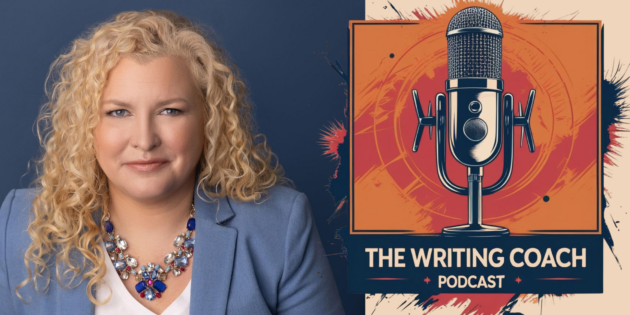
In this episode of The Writing Coach Podcast, I’m joined by Patty McGee, a nationally recognized literacy consultant, speaker, and educator who is passionate about transforming classrooms into spaces where language and learning come alive. With decades of experience as a teacher, coach, and advocate for joyful, practical literacy instruction, Patty has worked alongside educators across the country to help unlock the potential of their students. She is also the author of three books, including her newest release, Not Your Granny’s Grammar.
In our conversation, Patty and I explore what it really means to help writers grow. We talk about the kind of feedback that builds confidence instead of crushing it, the connection between grammar and voice, the importance of revision, and why so many writers carry lasting scars from being corrected rather than truly taught. We also dig into the challenge of teaching writing in online spaces, the role of play and inquiry in learning grammar, and how writers can protect their authentic voice in the age of AI.
Whether you’re a teacher, a writing coach, a parent, or a writer trying to strengthen your craft without losing your humanity on the page, this episode is packed with insight, encouragement, and practical wisdom.
In this conversation, we cover:
- how to give feedback that helps writers improve without discouraging them
- why revision is essential to strong writing
- the relationship between grammar, voice, and artistic choice
- what teachers and coaches can learn from effective classroom practice
- how to make online writing instruction more engaging and human
- why a playful, inquiry-based approach to grammar can be so powerful
- how to think about AI without surrendering your voice as a writer
Check out the episode now!
Audio:
Video:
The Writing Coach Episode #223 Show Notes
Visit Patty’s website here.
Pick up your copy of Patty’s new book: Not Your Granny’s Grammar: An Innovative Approach to Meaningful and Engaging Grammar Instruction.
—
Join the May 2026 edition of Story Plan Intensive!
Get a FREE copy of Kevin’s book: The Science (and Magic) of Writing Retreats.
Buy a copy of Kevin’s new book: The Frustrated Writer’s Colouring Book.

The Writing Coach Episode #223 Transcript
Today on The Writing Coach Podcast, I have Patty McGee. Patty, welcome to the show.
I’m really happy to be here.
You told me one of the best bios you’ve ever gotten came from a student, so maybe tell us what that student described you as and how that explains what you do.
Yes, I love this story. I wish I had recorded it in some capacity, but it was just a gift to overhear. I was leaving school when a second grader walked out with her grandpa. She pointed to me and said to her grandpa, “That lady’s not a stranger, Grandpa. She’s a traveling teacher,” which means she goes into schools to help make teachers’ jobs just a little bit easier. And sometimes she teaches us.
I love it. Beautiful. So you are a teacher of teachers in the school system, and sometimes you teach the students as well.
Yes.
Like me, most of your career has been focused on understanding language, writing, and working with people to help improve their writing. How did your interest in language and writing start? Was it when you were young?
Sort of. I loved to read, and I was quite good in school when I wanted to be, and that didn’t really set me up for success as a teacher, because I was good at it, and I didn’t know how to work through the hard parts. And so that’s when I became very interested, especially in writing, because, you know, I’m a teacher, and the only way I knew how to respond to writing was to correct it. And I was doing a number on my kids’ hearts, chipping away at their confidence and their willingness to show up on the page. So that’s really where my passion started: with a problem of practice in the classroom.
And so, really trying to figure out the best pedagogy for students and ensure that we can help improve their writing, but in a way that makes them feel confident.
Yes. And what I’ve done since then with that concept, and with that book that was about nine years ago, is I’ve realized it’s just a universal way of responding to people who are looking for feedback rather than fixing it for them.
And what’s that book called?
That book is called Feedback That Moves Writers Forward.
It’s so interesting because you say your interest was in helping students improve, but I think of my clients as students. I suspect you mean younger people, but working with, you know, sometimes retirees writing their first novels, I must teach them the skill set and the craft in a way that is encouraging, and that does not discourage them, because putting down someone’s writing, whether they’re seven years old or seventy years old, can do as much damage.
It’s so true. And sometimes I think it does more damage to those of us who are older, because we’ve been corrected to oblivion. Pretty much the only response to writing that I’ve received is correction throughout my life. And I think that, number one, it doesn’t work. Number two, it hurts our hearts. So I’d love to describe to you where I found this model of feedback and why it’s rich and effective.
As a teacher of writing, you’ve got the perfect audience here, so I’m on the edge of my seat. Of course, I’d love to hear that. Envy with it, okay?
I must have been ten or eleven, and my dad decided he wanted to learn to crochet. I don’t know anybody else who has had that same experience. So my Aunt Helen, his sister-in-law, was a master crocheter. She would come and give him crochet lessons. And when I was trying to work through this problem of correction-as-instruction, I watched her. Now, she wasn’t a teacher, but this is what it looked like. She would come and sit next to him, with her own materials, by the way, and then she would say to him, “Tell me what’s going on with your blanket,” because that was his only genre: blanket. No scarf, no glove. And he would usually say something self-deprecating before anybody else could. He’d say, “Oh, there are all these holes in here.” And she’d say, “Yeah, but do you see where you counted your stitches? When you count your stitches, that helps them stay in order, and that helps you avoid holes.” So she starts with, “Here’s a strength, and here’s the impact of that strength.” I mean, goodness gracious, I was like, okay, that alone needs to happen when giving feedback to anyone about anything. Even when my husband cooks dinner for me, it’s like, “Here’s what was really delicious, and here’s what needs a little more time.” It’s just a great way to respond to other humans.
So then, instead of saying, “But your holes are all over the place,” she would say, “You counted your stitches, so that means you’re ready to use that counting to fill in the holes.” So the feedback was an invitation built on a strong foundation. And then she would be crystal clear. She wouldn’t just say, “Okay, fill the hole now.” Or, “Take that hook over there and try and hook.” Or she wouldn’t take the blanket out of his hand and do it for him. She had her own materials, and she showed step one, step two, step three, maybe four, to fill the hole. And then she would sit with my dad as he was filling the holes. Now, this would take five minutes at most, but because there were many holes, he would have plenty of practice and become a stronger crocheter. And that’s what she was looking at: how can I help you be a stronger crocheter each time?
And I know in the editorial world that we’re not necessarily teachers of writing, though we can be in ways. When we do see strong writing, it’s funny because the editor of my first two books would point out parts in my manuscripts that were strong, and I was like, “Yeah, you wrote that, Wendy.”
I think every coach and instructor has had that beautiful moment where you’re looking at someone’s stuff, and you go, “I love this moment,” and they say, “You told me to put that in there.”
Exactly. So just that type of feedback, repeated over time, and it doesn’t have to be the only type of feedback. In the writing world, we know we have deadlines and all of that. But there is a way to show any writer a strength and why that’s so important, because oftentimes we don’t know. We know what’s wrong, because that’s the major feedback.
So I don’t know if this will be on video, but anyway, I want to show you this perfect little photo. There it is. Okay, my dad. And then eventually, those blankets he was making himself, where Aunt Helen didn’t have to help.
Beautiful. And a blanket is a great metaphor for writing, because how do we write a book or an essay? One sentence at a time, one paragraph at a time, just like crocheting a line in a blanket.
Yeah, exactly.
I had a similar experience on the other end when my first book came out, and I wanted to put together an author website. And I had a friend who was very good at design, like an amazing artist, a whiz with computers, and I asked him to show me how to build a website. And he was so frustrated with me, and he was terrible at explaining it. And I had this moment where I went, oh, I think I’m pretty good at teaching. I think this teaching thing is actually a unique skill set.
And of course, there’s that saying, “Those who can’t do, teach.” They’ve never been teachers. It is an extremely unique and challenging job that is not easily done. And so, you know, I think there are two examples there: someone kind of just not having that teaching skill set, and me learning through that; and then you seeing a master teacher and learning from it. And either way, it speaks to the power of effective teaching and coaching.
Yeah, exactly.
Speaking of editing, and editing in a way that inspires people, I think beginner authors that I often work with are very concerned about their voice as an author. And quite often, they seem to think their voice is their own unique take on grammar, perhaps. And so when an editor comes in and starts fixing their punctuation, suddenly they say, “Oh, you’re stealing my voice.” So how do you respond to that, as someone who kind of lives at that intersection between voice and grammar?
I do think grammar can be used artfully so that our voice is fully apparent on the page. However, there needs to be a lot of practice and understanding of, let’s say, just how sentences work at the basic level to break the rules to create your voice then effectively.
And the vast majority of us were taught grammar in a way that wasn’t really thorough and effective. So we grow up, love to write, but may not have command of certain expectations that, when not followed, make the writing awkward or clunky. So it’s like Picasso. He was a fine artist before he went all Picasso on us. And so that’s how I feel about using grammar to really establish our voice on the page.
I feel like I came out of high school knowing that a sentence had a subject and a predicate, but I think if you had handed me a sentence and said, “Why is this sentence clunky?” I never would have been like, “Oh, there’s an object missing.” I feel like I got the bare baseline of understanding, and only kind of the fringes of understanding, and not a real technical ability to apply the theory in a way that improved my writing.
Yeah, absolutely. Same here.
You have a book called Feedback That Moves Writers Forward. Is that the first one, or is that the second one?
That’s the first one.
That’s the first one. Okay, so what was the second one?
The second one is called The Seven Essentials of Writing Workshop: For Every Classroom and Every Writer. So it was basically—my books are so based in classroom practice. Teachers are trying things out for me, so I have things being tested and tried, and I revise. This one was basically from my Google Drive, because it was COVID and we were all thrown together, you know? Just a very simple guide to the things we need for writers to thrive. And it’s seven things. And as a traveling teacher, most of those things aren’t found in the schools I’ve been part of.
The majority of my teaching is through online courses, and the majority of my coaching and editing is via Zoom with writers around the world. I have taught workshops, though—or more specifically, retreats—in person. Vastly different experience teaching in a classroom with people breathing the real air than teaching online, and I would argue probably much more effective in person.
So, as someone who’s tested their theory and gained all this experience in classrooms, do you have any advice for translating what works in classrooms and classroom workshops into something like online seminars or coaching sessions?
I believe that we have gotten tech-crazy, that we have so many technological tools at our disposal that we’re missing the essential human connection. This social brain is basically the gatekeeping of learning. And so when we create things for people to be part of, like a webinar or an online course, we want to keep the slides to a minimum and keep them basic. We want people to do something more often than just hear us talk. We want breakout rooms so there’s that human connection, like in a classroom or workshop, where we might form small groups for feedback. And we want to use technological tools only when they can’t be replaced with something else. So I think simplifying is really the most important thing.
I think you really identified one of the challenges of teaching online: it tends to lean more toward the university lecture style than toward breakout groups and similar activities. And yet, increasingly, in my own work, I’ve been doing more exercises and less of me trying to be a university professor. And I find not only that people are more engaged, but that we’re all having more fun too.
You know, I have some part of my mind that’s like, “They’re here for you, Kevin. They’re here to hear your genius.” But I’m like, no, they’re here to improve their writing, and maybe the best way to do that isn’t listening to me jibber-jabber about literary theory. Maybe it’s them filling out a worksheet that forces them to think about their story in a way they haven’t before.
Yeah, it’s still your genius. It’s just how you’re translating your genius to those who are there to learn from it.
You have a brand-new book, Not Your Granny’s Grammar, that came out recently. So tell me: what is granny grammar? What does that title mean?
Oh gosh, it’s been something I’ve been working on in my mind and in my instructional practice for a very long time, because I think every listener here has had the experience of a worksheet where we identify parts of speech, or we fill in a blank, or we diagram a sentence, and then poof, we’re supposed to know how to use grammar proficiently, immediately, and without mistakes. And that’s just not realistic. That’s not how we learn. There are so many missing ingredients in that approach that, again, it was a problem of practice for me to figure out.
And it has taken a very long time. But you know how you were saying the fun part of holding, say, a webinar or a course online is that when you give more experiences to help people understand and learn from your genius, then there is that greater investment? I want to say this approach is definitely more fun, but I also want to say it’s playful. It’s playful for us—not in a game sort of way, because there are grammar games. But the thing about games is there’s a winner and a loser, and if we’re already feeling like the feedback we get is constantly corrective. Then we’re playing a grammar game, and we don’t know grammar very well, so we’re going to lose, there’s a very good chance we’ve added more shame on top of already feeling uncomfortable. This is an inquiry-based approach to grammar, with play as a way to understand it.
Okay, so many authors I work with are terrified of grammar. I have to admit, I know extraordinary novelists who kind of freeze when I ask whether there should be a semicolon here. So how do you communicate that maybe not even just playfulness, but looseness? I feel like the second we start talking about grammar, my clients get tight, you know? Like, “I don’t know if there should be an em dash or a colon.” Can you tell me a little more about the idea of being a little loose or playful in your approach to teaching this?
I think some of the basics of it are also about choice. So I’m thinking about novelists and their discomfort around grammar, and let’s just talk about how we can put two simple sentences together and the effect that it has. So a semicolon shows that these two sentences are very important to think about together, but I didn’t want them separated because they really need to be considered together. I could also use a coordinating conjunction—which we usually remember with the acronym FANBOYS, because those are the coordinating conjunctions—and it would have this effect. We could also use subordinating conjunctions, and it would have this effect. If we want to also think about the em dash, it will have this effect.
I think it’s a matter of us knowing the effect of the things that we know we want to do, and the nuances in them, and then how they contribute to the meaning that we’re trying to make on the page.
I think almost every writer and editor out there has some sort of rebel in them, some part that wants to be wild and break the rules. As someone interested in teaching, writing, and grammar, are there any grammar rules that you’re happy to ignore? Do any of the rules drive you crazy?
Oh yeah, definitely. Number one, I really don’t care if I end a sentence with a preposition, if it makes sense, and it strikes the tone that I want it to. Prepositions can be at the end. I am not out of my mind here.
I can’t stand it. They put it, it just looks so awkward at the end of a sentence. It feels wrong.
Well, if it creates that tension in your writing, then it’s a great point. Maybe that’s right. That’s what matters. Yeah, yeah. That’s one that I don’t pay as much attention to. Also, the comma that creates a compound sentence seems to be a rule that’s kind of going the way of the buffalo. It’s used sometimes, sometimes more for effect, but it’s still a rule that if you’re going to connect two simple sentences with a coordinating conjunction, you need a comma there. But I don’t think that’s important any longer.
Interesting. Are you familiar with Cormac McCarthy’s novels?
Yes.
Do you know that he hates punctuation? A high school student once interviewed him, and the high school student said, “Why do you have so little punctuation?” And he said, “Oh, I don’t like all those little dots messing up my page.” It gets back to what you were saying about how he has a very specific effect he’s looking for with his writing, and that comes right down to how the page looks.
I tend to err way more on the side of punctuation, and I don’t know, maybe it’s because I’m a Star Trek nerd or something, but I just think people read so fast, and any opportunity to slow them down a little bit, I’m like, I want that Captain Kirk drama. Put those commas in there. Yes. But again, clearly Cormac and I are going for a different feel in our writing.
Yes, two different voices.
It comes right back to our voice conversation.
Speaking of voice, it’s almost frustrating that I can’t have a conversation with anyone anymore without addressing the elephant in the room, which is AI, obviously. And I think one of the major fears people have about AI is that writing is going to become generic and bland, and everything’s going to sound the same. So, as someone who teaches writing and obviously cares about voice, what are your thoughts on AI and also on maintaining someone’s view of the world and how they express it through their own words?
I think that only strengthens the need for everyone. All writers need to know standard grammar and to know their voice and how they choose to use standard grammar, or not use it, so that when they’re looking for feedback from AI, if it doesn’t sound like them, if it’s not the way they want it to be written, then we have the discerning eye. We still own our writing then. And AI can be helpful, but AI is not and will never be a human who has the creative power of choosing how to express themselves on the page.
I think that a critical eye is really important as more and more authors use AI, not just for writing but for coaching, brainstorming, and those sorts of things. Many times I’ve met with a client who’s like, “I’m super confident in the scene this week because my AI said it’s great,” right? It’s like, we cannot turn over our gut instinct and our educated knowledge of what works and what doesn’t in storytelling and writing and say, “Oh, well, the AI said I did it right.” The AI is not the ultimate arbiter of what a good story is, or, definitely, not of what a great sentence is. And so, while it’s a useful tool, I think we also need to be conscious of who we are as writers, what we want to say, and the most effective way to say it.
One hundred percent. And I think there’s a place for it in terms of yet another resource to help us write in a way that is really what we want to say. And we know that takes a long time. I know for some people it just comes out a lot more naturally. But one of my favorite essays is “Shitty First Drafts,” you know, from Anne Lamott. And it’s like, if we don’t go through that angst of trying to get what we’re trying to say on the page in a really crappy way, and then move from there, it really isn’t the art that it needs to be.
You know, we look at AI as a tool, totally, but there’s still that process. And it’s so funny and ironic that, of all authors, Anne Lamott is one of my favorites, and to know she goes through that and is afraid that when she’s on the way to the dentist, something is going to happen to her, and somebody will then read her writing and think she’s a fraud. That is part of the creative process. And it’s a yucky part for me. That’s not my most fun part. I love to revise. But I do like to have other tools: human people reading my writing, AI reading it, me looking at it. I’ll ask for a couple of different versions of it, even, and I’ll take from it if I really think it sounds better in different parts. But that’s my choice, because I know what I want to say.
When you say that revision is the favorite part of your writing process, I look back at my education—and maybe my education was unique—but I feel like I was never taught the importance of revision. I feel like so many people go through their entire education thinking you have one shot at it, probably the night before it’s due, and then you hand it in, and it’s graded. I really feel like I never revised a paper until my master’s thesis. It’s not until you’re in grad school that you have someone say, “You could do better. You could do this part better. What about this?” Right?
So, as someone who teaches educators, what are your recommendations for ensuring that children, everyone, get a better understanding that writing is not a one-shot thing, that it’s an iterative process that develops through revision?
I would start with the research. There is decades of research on writing instruction by Stephen Graham, Karen Harris, and their crew, showing that a writing process is essential to writing achievement. So if our process is always to write the best we can on the first try, we’re not going to become stronger.
Yes, sometimes in schools and in life, we need to fill something out quickly, or we need to do a timed writing sample, and we need to, yeah, that’s almost its own genre. Like, what are you going to do when you have to write fast? Here’s what you do. But how do we improve your skills? And just think back to the metaphor of my Aunt Helen and my dad. Imagine if he just had twenty minutes to make a blanket, and then another twenty minutes to make another blanket. He needed a process to make that happen, and he needed feedback throughout. And so those two points are really essential in writing instruction.
But you’re right. I feel like I didn’t learn how to revise. I think I taught myself how to revise by teaching kids how to revise. So that might be why I enjoy that part of the process so much. But I also think that because we were writing quickly, handing it in, and getting it graded, we’re hard on ourselves when our first draft isn’t the best.
Absolutely. I see it every day with first-time novelists, right? They’re taking on this monumentally challenging project that they’ve never done before. Then they just berate themselves with self-criticism when it’s not perfect on the first shot, when the most professional author you know does not get it perfect on the first shot.
Exactly. And maybe if we could realize that when we’re writing, we’re almost like a conductor in an orchestra. We have to know every instrument and how to play them. Number one, we need to know what we want the music to sound like, who’s coming in where, and we’re supposed to do that all at once? We don’t have to be conductors all at once. We can start with the flute section if we want, and that might be our first draft. And then we bring in the next layer. It’s expecting too much of our minds and not giving them the opportunity to really create something uniquely ours.
While we’re talking about systems and processes versus perhaps this idea that either I have talent or I don’t, one of the first things I say when I start a new group program is, “I really don’t care how talented you are. I’ll take hard work and discipline and information over talent any day.” So, for the most successful and effective writers that you’ve taught and worked with, were there skill sets that you saw them demonstrating, other than some natural-born talent, that allowed them to succeed?
Yes. And I think the most brilliant writer in my life is the editor—and now dear friend—of my first two books, and her name is Wendy Murray. Aside from her natural inclination to create beauty on the page, she has an incredibly deep knowledge of words. And because of that knowledge, and the vast number of words that she understands and what they often mean in comparison to each other, also mixed in with almost like a cleverness to it, I really think that depth of vocabulary can make a very big difference in how we create on the page.
The second anyone says “clever,” I instantly think of Oscar Wilde. And I think there’s a perfect example of what you’re talking about, right? Playing with words on the page. The Importance of Being Earnest—he’s playing with words right in the title of the play.
Yes. Oh my gosh. And his final words: “Either this wallpaper goes, or I do.”
For people who want to learn more about the new book, what can they do? Where can we send them?
Sure. So my website holds a lot of resources, including a link to where the book can be purchased or more information about it. And my website is pattymcgee.org. But Patty is spelled with a Y. If we look for Patty McGee with an I, that is a very famous skateboarder from the sixties, and I’m not sure how much work she’s done about writing. It’s pattymcgee.org. Or just Google Not Your Granny’s Grammar. It’s kind of a catchy title, I’ve been told.
And is that book targeted at teachers, or at teachers and students, or who’s the target market for that book? Who should pick it up?
The target market is teachers of, I would say, second grade—so seven-year-olds and up. That said, I co-authored this book with Tim Donahue, who understands grammar in a way that I’ve never understood, but that’s because of the ecosystem he grew up in. His parents were English teachers, so they passed along their knowledge of grammar to him. And then, to graduate from college with an English degree, he had to pass this one grammar class, and to pass, he had to get an A. Then he became an English teacher. He talks about how, at dinnertime, his fourth-grader came home and said, “So-and-so used a semicolon today.”
So what he did for this book is that the last, very significant section is a grammar refresher, which I would like to see become a book in and of itself as well. So for those of us who are unsure about grammar, just that part of the book alone—the way Tim explains things—and then there’s a QR code there where you can watch Tim teach the lessons and build understanding through the videos too. So it’s just kind of priceless. And it’s also cute, because he set up a dry-erase board in his basement, and his three boys helped him by recording the sessions that he’s teaching. So I think that section of the book is incredibly valuable for everyone.
Wonderful. I have children, so obviously education, literature, and writing are so, so important to me. And so, you know, when I came across you, I was really excited to have you on the show and to talk about this stuff, because I’m an author. I’m a writing coach, but I’m also a parent of kids trying to navigate literacy in a world where technology is changing by the moment, and they’re trying to get their heads wrapped around things. So thank you, not just for joining me on the podcast today, but for the work that you do. I think it is so, so important.
Thank you. Well, I just appreciate the conversation. I really love the intersection of writers, novelists, writing coaches out in the world, and the connection to teachers and students and how it overlaps. It really is a beautiful and, I think, unique conversation we just had.
—
Kevin T. Johns is a writing coach, editor, and author who helps writers strengthen their craft, find their voice, and build stories that truly connect with readers. Through coaching, courses, and The Writing Coach Podcast, he shares practical, encouraging guidance for writers at every stage of the journey. Need help finding more time to write? Grab his free guide: THE BUSY AUTHOR METHOD.
Podcast: Play in new window | Download
Subscribe: Apple Podcasts | RSS