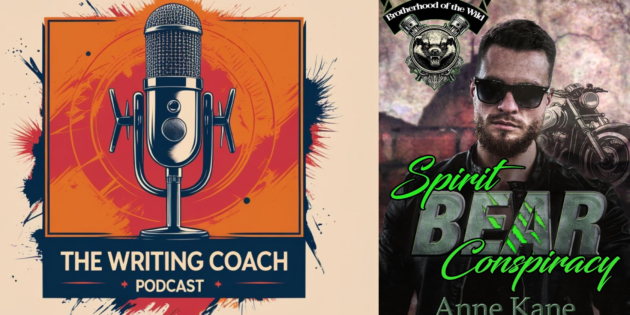
In this episode of The Writing Coach Podcast, I’m joined by author Anne Kane, who published six books in two years, including her hit motorcycle romance series ACE: Riptide MC. Her latest book, Spirit Bear Conspiracy, launches on January 2, 2026.
We talk about what changed in Anne’s writing life over the last two years: how plotting sped up her drafting, why a genre shift helped her rediscover her love of writing, and what it’s like working with a small publisher that offers real support (covers, editing, marketing, and community).
If you’re trying to finish a draft faster, write more consistently, or find the right genre “fit,” this conversation will give you practical insights—and a big dose of momentum.
In this episode, we cover:
- Publishing 6 books in 2 years (and what sparked the streak)
- Plotting vs pantsing (and why plotting made drafting faster)
- Why “motorcycle romance” is a powerful two-word pitch
- Action + romance: making the genre fun to read and write
- Small press publishing: support, process, and collaboration
Check out the episode now!
Audio:
Video:
The Writing Coach Episode #218 Show Notes
Visit Anne’s Website: https://annekane.com/
But Anne’s new book, Spirit Bear Conspiracy
Get a FREE copy of Kevin’s book: The Science (and Magic) of Writing Retreats.
Buy a copy of Kevin’s new book: The Frustrated Writer’s Colouring Book.

Enroll now in the February 2026 edition of Story Plan Intensive:
The Writing Coach Episode #218 Transcript
Podcast: Play in new window | Download
Subscribe: RSS
Hello, beloved listeners, and welcome back to The Writing Coach Podcast. I’m your host, as always—writing coach Kevin T. Johns—and I’m recording this on New Year’s Eve.
Yes, this is the final episode of 2025. Tomorrow morning, 2026 begins. A whole new, fresh year.
What have you got planned for 2026? What are you going to achieve? Are you publishing a book this year? Are you starting a book?
Let me know. Shoot me an email or reach out on social. Tell me about your plans for 2026, and maybe I can help get you there.
It was a big year for me. I think I’ll remember 2025 as my retreat year. It was the year I hosted two in-person retreats, did a lot of research around retreats—how to put together a successful one, and why they work—and that will probably be the biggest memory from 2025.
I also finished the manuscript for my next novel, which is the third book in The Page Turners trilogy. That manuscript has been sitting on the side of my desk for years, so it was very exciting to finally finish that project and get it out into the world.
Another big thing that happened this year was that I brought my first team member on board. Laura Moreno—a longtime friend, a former client, a fantastic writer, and an amazing person—joined my team as Client Success Manager. She’s there to ensure all of my clients are having as much success as possible in my programs, and she’s helping me behind the scenes with so many things.
We’re putting together a lot of great things for 2026 already. We’re developing new tools, new ideas, new programs. Having Laura on board has essentially doubled what I’m able to do in my business and for my clients, and I can’t wait to see the impact that’s going to have in the year ahead.
My goal has always been to serve my writing clients to the best of my ability. And what I’ve learned after a decade of doing this is that the best way to do that is actually to get some help—to start growing a team so we can continue to grow the business and deliver the highest-quality service possible. So I’m incredibly excited about that.
Looking ahead to early 2026, one of the big things happening in my coaching world is the next round of Story Plan. People are always asking me when I’m running Story Plan next, because I don’t run it on a strict schedule. I do offer it every few months, and the next round will take place in February.
January will be all about letting people know and getting folks signed up, and February will be the month we run the program. If you’re plotting a novel, if you’re in the middle of a novel that you haven’t plotted yet, or if you’ve finished a draft and don’t know how to analyze what you have, Story Plan is perfect for all of those situations.
You can head over to my website at
www.kevintjohns.com/story-plan-intensive
and get signed up for our February edition right now.
On the podcast today, this is a super exciting episode for me because I’m welcoming back author Anne Kane. Anne was on the show a couple of years ago, right as I was getting to know her and right as her career was transitioning—when she was moving from being a pantser into the world of planning her novels. That’s how she and I first connected.
So talking about Story Plan is very on-topic here, because Anne joined Story Plan to figure out how to plot her books so she could write them faster—and wow, does it work.
As you’re going to hear in this interview, in the two years since Anne was last on the show, she’s been absolutely killing it: publishing half a dozen books, signing multiple book contracts, and selling hundreds and hundreds of copies. She’s doing incredibly well.
I’m so excited to have her back on The Writing Coach Podcast to share everything that’s been happening in her world over the past couple of years.
So with all that said, let’s cut to the interview.
—
Today on the podcast, I’m welcoming back author Anne Kane. Anne, welcome to the show.
Hi! Glad to be here.
I was just looking up the date you last appeared on the show. Do you know when it was?
Probably about a year ago? Two years?
Over two years ago—October 16, 2023. And in those two years, you’ve probably published… I don’t even know how many books. How many do you think you’ve published?
In the last two years? Probably six. Six books.
Six books in two years. Incredible. So tell us about that. What is this massive spree of writing and publishing you’ve been on?
Honestly, I think the first year was less about sprinting and more about learning how to actually plot a novel. I was basically relearning how to write because I’d moved into a totally different genre. The books were longer, and I had to make sure all the plot points were in the right place.
So I think that first year was really about learning the process. And then I just kind of got on a roll.
And went from there. So tell us—what genre were you in before, and what’s the new genre you moved into?
Before, I was mostly writing sci-fi—really sci-fi fantasy—and it was very heavily steamy. They don’t really call it erotica anymore, but it kind of sat in an awkward space. Sci-fi doesn’t have a huge readership, and it wasn’t quite kinky enough to be considered erotica either, so it didn’t really fit anywhere.
Spicy sci-fi is probably what people would call it these days.
Yeah, probably spicy. But it was totally different. I don’t know if you’d call it burnout exactly, but I got tired of writing it. Someone suggested I try contemporary fiction, and I hadn’t written in about two years at that point.
I actually missed writing. So I thought I’d try contemporary—almost like a hobby that wouldn’t cost me too much—and I just went from there.
But it’s turned into more than a hobby. A career, a side hustle—whatever you want to call it. You’ve got contracts, you’ve got a publisher, you’ve got books out in the world. Was there a moment where it started to feel more professional?
I think it really hit when I put the first contemporary book out. I was shocked—I think I had about 85 pre-orders before it even hit the shelves. Before that, I was lucky if I had two pre-orders. And it just kept going from there.
That book is still selling. I get an update from the publisher every week, and so far this month I’ve sold 283 copies of a book that’s been out for a year.
So what book is that? What’s the title?
It’s Ace. It’s a motorcycle romance called Ace: Riptide MC. There are five books out in that series now, and I’m currently working on the sixth. That was the one that really started everything.
Now it feels like this is becoming a career—something I could actually fall back on and maybe do less of my other career, you know, the daytime job.
Do you have a sense of why that book has done so well?
I think I hit the right readers at the right time. The publisher puts out a few other series in the same genre, so they already have a mailing list and a readership. When a book publishes, it goes out to that audience.
I also had a lot of help from other authors—people saying, “If you do this, it’ll sell better,” or “If you do that, it’ll sell better.” They were really generous about sharing what was working and what was selling.
By “other authors,” do you mean authors signed with the same publisher?
Yes.
That’s interesting, because I’m always thinking about the benefits and drawbacks of self-publishing versus going with a publisher. It sounds like access to that kind of author community is another point in favor of working with a publisher.
I think so—especially because it’s a small publisher. I actually talk to the owner. She calls me every once in a while. I have a lot of say in how the covers look, the marketing, when I’m going to launch, how often—really, I have input on all of it, without having to do all the work myself.
I don’t have to pay for covers. They supply the editor. I really like the small-pub model. With a larger publisher, you’re basically handing over your work and you don’t get much say in anything.
When you say the other writers gave you tips and advice, was there anything specific that stands out—anything you changed or implemented that really helped?
The biggest thing was that the books had to be written in first person. That’s what sells in this genre.
Then there were little things—like, if there’s an animal in the book, you never kill the animal. I think that probably applies across most genres: don’t kill the animals.
They’d also read chapters and say things like, “The main character threatened to shoot the guy—why didn’t he just shoot him?” Stuff like that.
They were also really helpful on the marketing side. They’d say, “This social media platform works for this genre,” or “Don’t worry about TikTok—you’re not marketing to 18-year-olds.” That kind of guidance was huge.
I’m actually going to Tennessee next July for a signing. I can’t sell books there because I’m not American, but the publisher said, “That’s okay—we’ll have someone else sell the books, and you just show up.” Which is great.
So if you cross the border, you can’t sell books at a show?
Nope. I’d have to partner with someone in the States, set up a corporation—it’s just not worth the effort.
So you get to be a celebrity, basically.
Exactly. The publisher supplies bookmarks and promo items, and you just stand there, smile, and hand them out.
I remember you mentioning that motorcycle romance books often need a specific logo on the cover—that it’s part of the genre. Am I remembering that right?
Yes. Ace has its own logo. Riptide MC has its own logo. And they just created a logo for Spirit Bear Conspiracy, which is a different series tied into it.
They decided it had to be an animal, so they went with a badger. And then I was in Kamloops—there’s a wildlife park there—and they had a big sign that said, “Adopt a badger.” So I adopted one. Now the series has its very own badger.
There has to be a marketing campaign in that somewhere.
So here’s a theory I have—tell me if this feels right. Obviously, the book has to be good first. But I’ve worked with clients who’ve written great books that didn’t sell well, and others—yourself included—who’ve done very well in sales because the pitch is incredibly clear.
Like, “Catholic aliens.” Two words. You instantly get it. And “motorcycle romance” works the same way. People know exactly what they’re getting.
Do you think being able to boil a well-written story down into a simple two-word concept really helps on the marketing side?
Definitely. I actually use Publisher Rocket, which shows you the keywords people are searching for. You try to work those into your blurb and your tagline.
You’ve got to have those short phrases—that’s what people are looking for. And you want to make it easy for readers to find the book.
Was romance a genre you were already familiar with, or was it something you had to study?
I had to study it. I assumed it would be like mafia romance—lots of blood and guts—which is not my thing at all.
But I found out it’s really more of a fantasy. The guys are technically outside the law, but they’re the good guys. There’s always the woman, the kitten, the happy ending.
Before I agreed to write it, I read half a dozen books in the genre and thought, “Oh… this actually sounds like fun.”
You’ve now written five books in the genre, you’re plotting the sixth, and you’re about to release a spin-off. What do you enjoy most about writing motorcycle romance?
I think I enjoy the fantasy of it. The guys are great, they’re devoted, they’ll do anything for the people they love, and there’s always a happily-ever-after.
I like the idea that life could work that way—even though we all know it usually doesn’t.
Something that really stands out to me in your work—and this carried over from the mafia stories too—is this idea of honor and nobility. Even though these characters live outside the law, they often have a higher moral code than the rest of society. Does that feel accurate?
Totally. They’re all ex-Marines, so it’s really about brotherhood—sticking together, integrity, morality.
Someone once said, “There’s justice, and then there’s the law.” These characters are about justice. The bad guys don’t get off on technicalities with them.
One thing I find interesting is that when people think of romance, they don’t always think of action. But your motorcycle romances are full of action—chases, shootouts, explosions.
Then again, your sci-fi had a lot of action too. Is that something you’ve always enjoyed writing?
I’ve always enjoyed it. Something has to happen. I don’t enjoy books where nothing really happens—where it’s all emotional interiority and no external action.
So yeah, we need a few chase scenes and someone getting shot at.
It really is action-adventure storytelling for a romance audience. You get the best of both worlds: high-stakes external plot, and at the core, heart, romance, and emotion. It’s a fun genre to read.
It’s fun to write. And like I said, originally I didn’t think I was going to make a living at this—it was just fun. It was kind of a hobby that didn’t cost me anything.
And now it’s generating some income.
Now it’s generating income, yeah.
So if you look back—say, two and a half years ago, when we did the last interview—how has your writing, and how has your writing process, changed over the last two years?
I think it’s become more focused. I actually make a point of having time set aside to write now, and that’s the big change.
And the process—obviously, I plot now, which I never did before. That makes writing a lot faster, because before I’d get halfway through and think, “I wonder what happens next.” Now I know what happens next—I just have to get there.
And Story Plan was really where that process began for you, right?
Yes, definitely. That’s why I joined Story Plan—I needed to learn how to plot. That’s kind of where all of this started, actually.
I always make the argument—especially at the beginning of Story Plan, and on the VIP coaching side—that it’s ridiculous to say plotting is wrong or pantsing is wrong. Obviously, both work. We see it all the time.
That said, I do believe plotting ahead is ultimately quicker. Knowing where you’re going tends to get you to a more solid first draft faster than pantsing and then reverse-engineering everything afterward. So it’s rewarding to hear you took the same thing away from the process.
It really does help. And the thing about plotting is that you know where you’re going, so you can scatter little hints along the way, instead of going back later and trying to force them in.
I wouldn’t say I follow the outline perfectly—sometimes I go off on a tangent—but at least you have the outline, and you know where you’re going to end up. That’s a big help.
And novels are great that way—we have room to go off on tangents.
Yeah. And I like reading for the same reason—you get the emotion, what people are thinking and feeling. You don’t always get that from watching a 20-minute episode of something. You don’t really see all of that.
So I think that’s something I put into my books too—the emotion behind what’s going on. It helps.
The book you worked on in Story Plan is actually the one being released now, correct? Spirit Bear Conspiracy?
Yes, yes. It was released January 2.
Oh my goodness—okay. So we’re just days away from the release.
Days away from release, yes.
That was so exciting.
So obviously, that was a book we worked on a couple of years ago. Why is it just coming out now?
I originally subbed it to a big publisher, and they turned it down. They said it didn’t really fit what they were looking for at the time. Their lines are very narrow—it has to be this, this, this, and this—and it didn’t fit.
And I wasn’t willing to make enough changes to force it into their line, so it just sat on my hard drive. Then I mentioned it to my current publisher kind of in passing—we were talking about release schedules—and I said, “Yeah, I’ve got one book that’s been sitting on my hard drive forever, and I haven’t done anything with it.”
And she said, “Oh, we can do something with that.”
It did take a lot of revising, mainly because it was in third person, and I had to convert it back into first person to match the rest of the series. That was interesting.
Okay—so for our non–British Columbia listeners, and especially our non-Canadian listeners, tell us what a spirit bear is and the role it plays in the book.
I didn’t realize people thought a spirit bear was fictional—like some kind of fantasy creature or a shifter turning into a bear.
A spirit bear is actually a subset of the black bear. It has one genetic difference that makes it white—or kind of a creamy off-white—instead of black.
They’re very rare. They’re only found in the Great Bear Rainforest on the B.C. coast, up near Haida Gwaii in northern B.C. And you don’t see a lot of them because the rainforest is a protected area—so that’s where they are.
The last I heard, the entire population was around 400. That’s all that’s left. They used to be more widespread, but with forestry and other development, they’re now confined to that one area.
The Indigenous peoples of the region have a word for them, and there’s a lot of mythology around them. They’re considered protected and very important.
In the book, someone sees one farther south than where they’re usually found, and they don’t tell anyone because they don’t want people taking advantage of it. Because you know what happens—you see something rare, and suddenly two million tourists show up, and something bad happens.
Then there are poachers who hear the rumor and think, “If we killed that one and sold parts of it, we could make a fortune.”
So the story becomes about protecting the bear and protecting the person who saw it, and everything escalates from there.
And the hero, of course, is part of a group that’s trying to protect endangered animals and go after people who exploit them. They were already tracking a group that was killing black bears too—apparently that happens more often than people realize.
Not all of your books are set in Canada, right? This one is unique in that it’s set in your neck of the woods.
Very unique. It was funny, because when I started writing the motorcycle romance, I said, “Well, I could put it in the Okanagan.” And the publisher—who lives in West Virginia—said, “It snows there. You can’t ride bikes year-round. There couldn’t possibly be a motorcycle club.”
But since then, I’ve learned the northernmost Harley-Davidson outlet is in Anchorage, Alaska. And apparently there are at least four motorcycle groups up there.
So I could have set it in Canada… but I didn’t.
If people want to pick up the book, where should we send them?
It’ll be available on Amazon, Barnes & Noble, Kobo, and a bunch of others—Google Play, Apple… pretty much anywhere.
You can also go to my website, which has a link to all the places you can buy it: www.annekane.com.
I’m super excited about this release. A lot of people come to work with me when they’re halfway through a manuscript and can’t figure out how to finish, or they have a manuscript but know it’s not good enough and need help revising.
So it’s not that often I get to be there for the whole process—from the idea, to the outline, to the draft, and now to a published novel.
To see Spirit Bear Conspiracy go from “I think I’m going to write this” all the way to a real book in the world… that’s so, so exciting for me.
Congratulations, Anne.
Thank you. Thank you.
And I love the success you’ve had over the last two years. It feels like your writing career has taken off like a rocket ship. I love the sales, I love the productivity, and I love how much fun you seem to be having with it. It’s genuinely awesome to watch.
It is definitely fun. Like I said, I always thought of it as a hobby. Now I’m like… “Oh. This could be a very lucrative hobby.”
But it’s still fun, and I want to keep it that way. So I write what I want—what I would be happy reading.
Kevin Johns
Fantastic. Thank you so much for taking the time to rejoin me on the show.
I’m sure two years from now you’ll arrive in a limo for our next interview, living in a penthouse in downtown Vancouver, looking out over the city, throwing hundred-dollar bills like you’re The Wolf of Wall Street.
But for now, I’m just really happy to be your friend—and to get to witness this journey you’ve been on, with this book and everything else you’ve written over the last couple years.
Well, it’s been good to be part of your group—and part of everything you’ve done, and the people there. It’s been great.
Thank you.
—
There you have it, my friends—my interview with author Anne Kane.
As you could hear, I was so excited to have her back on the podcast and talk about all the success she’s had. I love seeing clients not only grow and develop as authors—not only be productive artists—but also make sales, grow an audience, and find readers who truly devour their books the way readers are devouring Anne’s.
It’s so rewarding to see someone’s career grow like that, and to see them bring so much delight to so many readers out there.
So a huge congratulations to Anne Kane.
To get all of Anne’s info—along with my stuff—and to get signed up for the February edition of Story Plan Intensive, head over to www.kevintjohns.com. In the show notes for this episode, I’ll have links to everything we discussed.
And you can grab Anne’s new book, Spirit Bear Conspiracy. It’s coming out today—this episode is launching on release day—so head over to Amazon or your preferred bookseller and pick up your copy.
That’s it for this episode. Thanks so much for tuning in, and I’ll see you on the next episode.
Kevin T. Johns is a writing coach who helps authors stop struggling in isolation and start finishing books with clarity, confidence, and momentum. Book a consultation call with him here.