In this episode of The Writing Coach Podcast, I sit down with my client, author Linda Garnett, to celebrate the release of her debut Gothic vampire novel, Red Falls.
Linda’s journey is a fantastic reminder that writing a book is rarely a straight line from “idea” to “finished manuscript.” Her novel evolved through outlining, drafting, revising, group feedback, one-on-one coaching, and a whole lot of faith in the process.
We talk about what it feels like to finally publish a book, the emotional roller coaster of launch week, the power of writing community, and how Linda went from wanting to simply prove she could finish a novel to seeing her debut climb the Amazon bestseller charts.
We also dig into the deliciously dark stuff: Gothic towns, dangerous vampires, found family, action scenes, messy first drafts, and why sometimes the best way into a story isn’t through plot or character, but through atmosphere.
If you love vampires, Gothic fiction, indie author success stories, or practical craft talk with a bit of Gothic charm, this conversation is for you.
Audio:
In this episode
- Enter a stuck first draft through atmosphere: after two months of staring at a blank page, Linda started with the Gothic town’s architecture and mood.
- Give yourself permission to write messy: Linda’s first and last drafts were unrecognizable from each other, in a good way, and the outline changed too.
- Keep vampires dangerous and unsettling: Linda avoided human-vampire romance so the fear and dread stay intact, using romantic elements only as a distraction for Grace.
- Stretch into unfamiliar scenes: Linda had never written fights, so she pictured herself as Grace and says her craft grew by leaps and bounds.
- Start marketing long before launch: Linda began a year ahead building an audience, and her indie debut reached the top ten in occult suspense.
The Writing Coach Episode #225 Show Notes
Where to find Linda online:
Website: www.lindagarnettauthor.com
TikTok: www.tiktok.com/@redfallsseries
Facebook: www.facebook.com/lindagarnettauthor
Instagram: www.instagram.com/lindagarnettauthor
Pinterest: www.pinterest.com/lindagarnettauthor
Get a free prelude to Red Falls that doesn’t appear in the book: www.lindagarnettauthor.com/prelude
Buy Red Falls today!
—
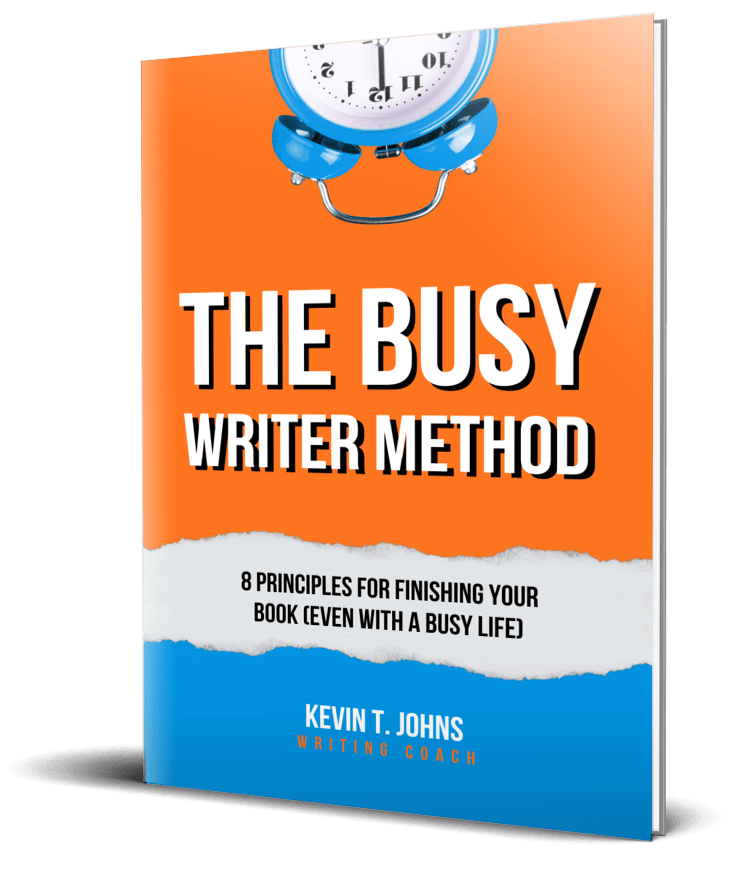
Grab your free copy of The Busy Writer Method here.
Buy a copy of Kevin’s new book: The Frustrated Writer’s Colouring Book.

The Writing Coach Episode #225 Transcript
Read the full transcript
Welcome to the podcast.
Thank you, Kevin. It’s great to be here.
The book came out a couple of days ago. How are you feeling emotionally and energy-wise?
Both excited and drained. Emotionally, yeah, it’s draining because it’s exciting, and it’s also overwhelming.
That’s something I often warn clients about. You kind of anticipate nothing but good feelings upon finishing a book and having a successful launch like you’ve had. But there’s also this sense of, “Oh my goodness. A major part of my life has reached an end.” And obviously you’re into a whole new phase with marketing, but it can be hard to suddenly go, “Oh my God. It’s done.”
Yeah, and then there’s book two. So that helps. I’m also writing the sequel, so I have a distraction. Sort of. It is that whole accumulation of, “It’s coming. I’m marketing. I’m getting there. I’m getting all my ducks in a row. My launch plan is going exceedingly well. Let’s see how this works.” And then when it kicks in and does crazy things, like put you on the bestseller list, you’re like, “What?” I mean, this is beyond what I ever dreamed.
I just thought, “If it does well, that’s cool.” The main thing for me was that I could say I’m a published author. But all the excitement, especially from this morning, has just left me drained.
We’ll fill the listeners in on what was going on as of this morning.
Well, the rankings. In occult suspense, I hit number seven, which put me in the top ten bestsellers for occult suspense. That sandwiched me in with Preston & Child, who are there at number one and at number eight, so I’m actually ahead of one of their new books. And on the other side of me is another New York Times bestselling author. Above all that are USA Today bestselling authors. I’m the only indie author in there, and I’m with people I look up to.
So that was totally mind-blowing. I’m pinching myself, going, “Is this real? No, it’s not real.”
Does it feel like a validation of some kind?
Yes, it does. I mean, it was worth it. It was a good accomplishment. I’m really proud of getting that book done because my entire goal was to write a book and say I wrote a book. I wasn’t even going to publish it. I just wanted to say I could write a book. And then I went ahead and published it with your encouragement.
This is way beyond what I ever thought would happen. I guess it is a validation that, yes, you can write a book.
Which was the original mission.
Which was the original goal, yes. To be in that territory with big sellers from big publishing houses, and I’m this self-published indie person with my debut novel. It’s just crazy.
What was that moment when you decided to write a novel? I know you were a flash fiction author and a short story writer for a long time. What was that “I need to write a novel” moment?
I enjoyed my short stories. I wrote them for a number of years. I wrote flash fiction for a number of years, and in the back of my mind, I always thought about writing a novel. I did NaNo every year for 12 years. I have 12 messy manuscripts that I don’t even call books.
And one day, I just said, “You know, people are always talking about how they want to write a book before they die. It’s on the bucket list, and they never do it, or they regret not doing it.” And it got me thinking. Maybe I could do this. Maybe I can do this.
I enjoyed doing NaNo. I had a lot of ideas for books, and I just didn’t want to be a person who said, at the end of my life, “I wish I had done this.” I wanted to be the person who said, “I did it. I wrote a book.”
Interviewers often ask people what the original idea for the book was, or what the original inspiration was. But having worked so closely with you on this book, I know that it really was an evolution. I would say that was more true than there being a single moment where you were like, “I’m going to write this sort of thing.” It really evolved over the planning, drafting, and revising. Would you say that’s correct?
That’s correct. If I went back and looked at the outline versus what the book is now, I mean, the only things that are consistent are the character names and Grace. The seed of Grace stayed the same, but she evolved tremendously, and the other characters really evolved.
To watch that happen was something else. I was really proud of the way that all worked out. But yeah, from the outline to the finished product, they’re two totally different things. It just took off and had a life of its own.
Was there a character or two who surprised you or came alive in a way you didn’t anticipate?
Zack really did, the conspiracy blogger. He took off. He was more of a background character originally, and Jesse the cultist was going to be the main sidekick. Zack was going to be somebody Grace sort of touched base with in the beginning, and then he wouldn’t really count as much. He’d still be around, but he was sort of lurking in the background.
Then he just took off. He really evolved fast, and that surprised me. But I’m happy with the way he turned out.
We know that the book is about a journalist, a disgraced journalist, investigating stories in a small town. But beyond the plot, what is the heart of this book? What would you say this book is really about?
I think it’s about being able to go ahead and do something people say you cannot do. It’s about going from a place where someone says, “You can’t do that. You’ll never be able to do that,” and maybe you believe them. Then, along the way, you start to believe in yourself. Those self-doubts fall away, and the more your confidence grows, you can say, “Hey, I really can do this.” And in the end, you do.
That’s what Grace does. She goes from being disgraced, thinking, “My career is sunk. What am I going to do about this?” to, “Here’s my opportunity. I don’t know if I can really do this.” She hits a lot of lows and a lot of obstacles, but she overcomes them and redeems herself and her career.
I think that’s a lesson we can all learn: just because someone says, “No, you can’t do it,” doesn’t necessarily mean that’s true.
Tell us a little bit about Grace. I know that you had a career as an indie music journalist, and of course, Grace is a journalist. Did you draw a bit from your own experience as a journalist when crafting this character?
Of course. Yeah, definitely. I mean, they’re two different things. I’m not chasing stories across the globe, and I’m not chasing stories that could kill me like Grace is. But it’s the same personality. It’s a drive. It’s an ambition. It’s getting the story when it’s interesting, and you want to bring it to your readers. You dig deep. You’re not just doing fluff.
And I’ve done fluff, so I know where she’s coming from. I also did newspaper journalism when I was in college, so I have a little bit of background that’s similar to Grace in that respect. Again, it wasn’t edge-of-your-seat journalism, but yes, I did bring that experience into the story and into what she does.
I enjoyed working with you on this book so much, especially because this is the type of stuff I write and read. How would you say this book fits into the genre in terms of Gothic, vampires, and the other sorts of books that you and I both like?
I am running a few minutes late; my previous meeting is running over.
I think it fits pretty well. It’s a gothic town. The architecture is Gothic. It’s brooding. It’s moody. The town is a character all on its own, which in Gothic literature is usually the case, right? You’ve got the haunted mansion or some haunted place with Gothic architecture, and it’s almost the main character. Mine is actually another character in the book. That’s how I see it.
With the vampires, I kept them out of the sparkly category. I wanted to go back and keep them traditional or classic. There’s no romance between the human and the vampire. They’re dangerous. They’re things to be wary of and not trust, and yet they play an integral part in the story.
Mine don’t stick to all the traditional rules. Garlic and water and crosses and all the traditional stuff that scares vampires off or keeps them away does not work. I wanted to make it unique but still fit into the Gothic genre. It’s also slow-moving, which is important. Then it does pick up, but you have the investigation, and then you have the action that follows. I think it fits pretty well.
My paperback copy of the book arrived yesterday, so I was holding the book before the interview and thinking about it. Something that struck me was that it’s a very unironic take on vampires. It doesn’t feel postmodern or like it’s winking at the audience. It’s really a straight-up, dark, gothic take on, as you said, a traditional dangerous vampire.
Yeah, I wanted to keep it that way. I didn’t want to go where things have veered since Twilight. You have, like I say, the human and vampire relationships, and it gets muddied. It takes away that scariness and that fear and the dread of a good vampire story. Instead, it becomes, “Oh, will they? Won’t they?” And it’s like a romance story instead.
So I kept to the traditional route instead of The Vampire Diaries or The Originals or Twilight path. I don’t know if people were expecting Elijah, the vampire, to eventually end up with Grace, but I didn’t want to go that route. I said, “Nope. Let’s make him a little dangerous and a little unstable.”
Given that the book does have some romantic threads to it, or at least some strong emotions between characters who are otherwise not attached to other individuals, I think some people might be surprised that you were fairly resistant to any sort of romance in this story. I’m curious: how do you see the story in terms of romance? I think a lot of people would clearly see some strong romance in there as a subplot. But I know you don’t necessarily focus on that very strongly. What’s your take on all of that?
Originally, no, I didn’t want any romance in my book. Again, I wanted to stay away from the Twilight, Vampire Diaries kind of stuff. I wanted to write something more traditional.
As I got writing, it was like, well, you’ve got an attractive woman, two handsome guys, and a handsome vampire to boot. You’re probably going to have to put some kind of romantic element into the book. Disney does it. Star Wars does it. Even in big adventure stories, or Harry Potter, there’s always a romantic element, but it’s not the main focus.
I don’t think mine is really a subplot. I think it’s just romantic elements, just to give Grace something to knock her off her feet. She’s very determined to get to the bottom of whatever she thinks is going on. Then she gets a distraction or two.
If romance is one theme, more so than a subplot in the book, what are some of the other themes the book touches upon?
I think, with each of the characters, there are different themes. Jesse never felt he belonged because he lost his mom. Then the elder in the book, Oric, took him under his wing as a son, and Jesse started to belong as part of the occult community. They welcomed him in. He wasn’t alone anymore. He has people to support him.
Zack, on the other hand, was very paranoid as this conspiracy vlogger, but he found connection with sources. He found connection with Grace, to some extent.
I think the other theme is that you really aren’t alone in whatever you pursue. There are always people around who will support you. You’re never truly alone. You can be living on the outer fringes of society and still have support from your people, your found family. I think found family is another theme that runs through the book as well.
Something interesting about the book is that it’s called Red Falls. The book is named after the town. And I really would suggest that the town itself is almost a character in the book. Was that always the intention? Did you realize going in that the focus was going to be so much on bringing this community or this town to life?
Oh, absolutely not. No. It didn’t even occur to me. And I’ve read the classic Gothic stuff, but it just didn’t occur to me. I was more focused on the characters and the villain and the story going forward than I was on the town.
Then, as I got into the writing and the drafting and the details, it was like, wow, this town really is alive underneath, in a sense.
Was there a part of the drafting process that you found particularly difficult?
The first draft. That was the hardest. The hardest part was getting started and staring at a blank page for two months, not knowing where to start, looking at my outline and going, “I don’t know.”
Even when I finished the outline, I went back and used it, as you suggested, as a touchstone. But immediately there were things I didn’t like about it. Even after I’d finished it, there were things I wanted to change. I know I had an extra character in there. I forget what her name was, but we got rid of her. There were other things that didn’t make sense right off the bat.
I was just not used to writing from an outline. I’m used to writing off the top of my head, and my outline was low-key paralyzing. To look at my blank page and not be able to get any words down — it wasn’t because I wanted a perfect opening line or anything like that. It was because I was overwhelmed with where it should start.
Then I realized I could start with the town. I could start with the architecture. I could start with the atmosphere. Is it moody? Is it broody? Is it welcoming to visitors? No, it isn’t. It’s hidden. You don’t get to know where the town is unless you’re a reporter and you need to cover a story. Then they give you the GPS coordinates.
That wasn’t original either. That just came out of writing and revising. This town is Gothic. It’s not located anywhere. A lot of people ask me where it’s located. It’s not located anywhere. It’s in your imagination. It’s a hidden town. It’s a gothic town. It’s been around for 100 and some odd years, and you only get invited to it.
That’s a great piece of craft advice for any writers listening to the episode. If you’re having trouble finding an entry point into your manuscript or into your story, maybe you don’t start with plot or character. Maybe you start with environment.
When I get stuck, usually I’ll start with atmosphere. I’ll start with setting. I can write paragraphs on setting.
Lately, there were a couple of scenes — I think I jumped ahead to the last couple of scenes of the book — and they were bugging me and telling me to write them. So I sat down and started with dialogue. That’s not something I normally open a scene with. I just wrote two heads talking, but it got down all the ideas I wanted and where I wanted the scene to go. Then everything started falling into place from there.
It doesn’t matter where you start. Just start. If you have a piece of dialogue stuck in your head, write it. If you have the setting in your head, write it. Then you’ve got a starting point, and it doesn’t have to be perfect.
That’s something I had to learn over the years. I wanted the perfect opening line and the perfect dialogue, but you’re on draft one, so it’s going to be messy. I had to give myself permission to write messy. That’s what you have to do: give yourself permission to write messy. It’s a first draft, one of many, and it will change and evolve. My first draft versus my last was not recognizable in a good way.
As a writing coach, it’s funny. I’m not a religious person, but as a writing coach, I find there’s always a phase at the beginning where I’m like, “Have faith, child. Have faith. You will persevere.”
Then with all my clients, there’s always this period of time where they’re like, “Who’s this guy? I don’t trust him.” And I’m like, “Just believe it. Stick with me. Have faith.”
Eventually, there’s always a moment where things start to click. I’m curious for you, do you recall when that click happened? When did you say, “Okay, this book is working. I can do this”? When did you really start rolling? Because it does feel like somewhere along the way, you went, “Yep. Okay. I can do this.”
I think it was Grace’s mirror moment when she was talking with Edgar and convincing him, “I have to stay in town. There’s a bigger story here.” And it clicked. It was like, there is a bigger story here. This is not just covering a book launch. This is not just this, this, and this.
I got a full sense of who she was becoming, and then it just clicked. I was able to roll with that. But before then, yeah, it was like, “Ah, this is painful. I don’t know where this is going.”
But the more I wrote about Grace and her internal thoughts, and where she is in that moment, that’s where it all kind of became an “aha.” Like, “Oh, now I know who this woman is and where she’s going and how she operates.” That was my moment.
Was there a specific scene that was your favorite to write, or a specific aspect of the process that was your favorite to do?
Maybe this doesn’t answer your question, but I had never written fight scenes that were really involved. I had a lot of scenes where Grace was up against vampires, physical fights with the Afflicted, and I’d never done any of that kind of writing. So that was a challenge and a frustrating challenge.
But in the end, it ended up being satisfying too, because I could work on it, look back, and go, “Wow, this really works. This is really exciting. Let’s write another one.” Some of the action scenes went from drudgery to something I could really get my teeth into — no pun intended.
I read some books on how girls fight and that kind of thing. I think that’s the title of a book. But in the end, I just went, “Let me put myself in her place. Let me, in my head, be Grace, and this is what I’m doing to fight off these vampires.”
As far as craft goes, I think I grew by leaps and bounds just by writing those scenes.
No spoilers here, but the climax of the book is probably my favorite climax I’ve read from a client of mine, and it is obviously very action-focused. Are you proud of that great culmination of the story, what it all comes to in that big climax?
Yeah, I was really happy with it. I did write it a couple of different ways, but when I did what I did, it felt right. It felt like, no, this is what needs to happen. This is a good, satisfying ending or climax.
It was difficult and really emotionally hard to write. In fact, I avoided writing it because emotionally, it was hard. I was writing a scene in the second book where I actually teared up over something Grace had to face and deal with. So, yeah, with the climax, even though I rewrote it 450 times — I lost count — it was very satisfying.
You and I worked together one-on-one on the book, but you were also a participant in several of my different group programs. I’m curious, as an author, what were some of the benefits you found in being part of a community of other people doing the same sort of thing you were doing?
There are a lot of benefits. There’s support. There’s accountability. I liked the hot seat aspect of your groups, where you get your scene in front of everybody, and we go through it to see what works and what doesn’t work. Those were eye-openers for me, especially if I was stuck and didn’t feel like it was the best version of my scene. Those sessions were gold for me.
You can also give feedback to each other. You can say, “Hey, this is what’s working. This is what’s not.” And you can read what other people are doing, which is really exciting. It’s like, “Oh, this is cool,” because everyone in your group is writing different genres. You’ve got one person who’s a gamer, one who’s writing ghosts, one writing historical fiction, romance — the whole gamut.
Even though I don’t read some of those genres, it’s still great to read what people are writing and be able to cheer them on and encourage them and say, “Hey, this might be a hard scene, but you’ve got this.” We’ve got each other’s backs, and I think that’s more important than working by yourself all alone in a cabin in the woods trying to write your novel.
I just think writer groups are gold. And if you can find one like yours — I will shout out your groups — I think they’re just gold. I’m an introvert. I prefer working on my own. But once I got into the groups and got to know everyone, everyone was welcoming, everyone was warm, and everyone brought a vast amount of experience with them. Some are published. Some are not. I can’t say enough about it. I think it’s a good experience.
And with all that together, I think it helps you grow as a writer because you’re also learning about craft. You teach on craft once a week, and that levels you up as well. You’re not just getting feedback or reading other people’s work. You’re also learning the craft as you go. That twofold experience is just a perfect storm.
It’s a vampire book. It’s a Gothic book, both of which have been around for, you know, 150 years. Gothic predates horror, so this stuff’s been around for a while. What attracts you to dark art and Gothic art?
I have always been attracted to it. Edgar Allan Poe was one of the first authors I was drawn to when I was a kid. I liked dark science fiction, like Ray Bradbury’s Something Wicked This Way Comes. I think I’ve read that book 500 times, at least once a year. It just holds my attention.
It’s digging into the dark side of humanity, the dark psyche, without risking anything. It’s more exciting. It’s more interesting than — sorry, romance writers — a romance or something like that. I mean, take a book like Rebecca. The Gothic, the psychological tension — that’s something else. With the environment and everything else, there are no jump scares, but it’s creepy. It keeps you on the edge of your seat.
It gets into that dark psyche of how cruel people can be or how scheming they can be. You really don’t know who you’re dealing with. Halloween has always been a favourite of mine. I just like it. I don’t know what that says about me.
What are some of the books, films, or TV shows that you consider influences?
I know I bashed them in the beginning, but The Vampire Diaries and The Originals, which was the spin-off of The Vampire Diaries, dug way deep into the dark side of vampirism. It was about how the vampire community interacted with itself and imploded upon itself if there was no cooperation. I kind of took that influence into the second book with Elijah and the vampire community.
The Vampire Diaries was good because, again, it was not just the romance but the complexity of being a vampire, living as a high school kid year after year after year in a human town. How do you deal with that? How do you watch people change and die? There are a lot of psychological things you can take away from the story. The character stories individually are very interesting: love, loss, brother dynamics, family dynamics. There are a lot more layers than people give it credit for.
And then I do want to see Dracula: A Love Tale, I think it’s called, that came out. I’ve seen many, many clips.
I enjoyed last year’s Nosferatu update.
Yeah.
What is it about vampires, do you think, that is so appealing?
I think it’s the immortality aspect, right? Live forever. Do what you want. Live forever. No consequences. Being the bad boy or the bad girl without the consequences. It’s just a whole vibe.
Yeah, I think it’s being a badass without the consequences. That’s what attracts me anyway. Of course, you have to watch out for being staked.
In my mind, it’s kind of like smoking or something, right? Where James Dean or whoever is smoking as a way to say, “This is death in my hand. I’m flirting with death, and I don’t care.” There is something cool about flirting with death, which I think is why Twilight and things like that are so popular. It’s this idea of getting up close and personal with death, of literally flirting with death.
And having control over it. You can get up close and personal with death and then just blow a raspberry at it.
Right. So many authors, especially indie authors, publish the book and then go, “Oh, I guess I needed to start marketing this thing.” I mean, I certainly did. I put my first vampire book out and thought it would just take off on its own. Then I learned, “Oh. Turns out you have to market these things.”
But you were very strategic in that you started marketing Red Falls months ago. Tell us a little bit about that process of looking ahead and really starting to build a marketing foundation to support the release of the book long before the book was actually out.
I started a year ago thinking about marketing, knowing I had to do marketing because, without it, as with anything, it’s not going to happen. I came from the indie music platform I created, and it was all about marketing. I had to teach myself how to get the word out, reach artists, and peddle my stuff.
It’s a little bit different, obviously, because it’s music versus books, but it’s the same concept. You can’t just go on social media and say, “Here I am. My book’s out today.” You have to build trust and an audience and followers. That’s a big process.
As a coach, I know there are some clients who kind of fight you every step of the way, which can be really good because it makes you justify your recommendations. But there are other clients who just go and do what you told them to do, and then they’re super successful.
I’d say you’re one of those clients, right? I would give you a piece of advice, and then you’d go and execute on it. So it doesn’t surprise me to hear that Kimberly told you what to do next, you went and did it, and now you’re having all this success.
I’m curious: did you think of yourself as a good student? What allowed you to come into the writing process and the marketing process with this collaborative and open approach to taking advice and making it your own, but also having faith and trust, like we talked about, in the advice you were being given?
If I take it back to my music platform, I started out with nothing and no team and didn’t know what I was doing, except that I wanted to promote women in the indie music space. Same thing: you want to get exposure. You want to get out there. That was my whole mission.
In order to do that, I knew I had to surround myself with people who knew what they were doing, people who could give me good advice and guide me in the endeavor. It was the same with writing, and it was the same with marketing.
With Kimberly and with you, it was instantaneous. I had that feeling that this was going to work. These people are grounded. They’re great. This is advice I can put into action and go with. When it works, it really works. You have to be open and not fight it.
If you’re going to fight it, it has to be because it’s just not there for you. It’s not clicking. It’s not something you feel you can move forward with. But if it clicks, go for it.
Every great leader is surrounded by a team of experts they trust and feel can lead them where they need to go. I strongly believe in that.
So the book is out. It’s doing fantastic. But as you said, you have the luxury of moving your attention and energy around because you’re also working on the next book.
This started as just a process of proving to yourself that you could write a book. At what point did you realize this was going to be a series?
When you told me it was going to be a series.
The original plan was a standalone book. I think as we got toward the end of it, and I started seeing where it was going and where it could wrap up, I realized it could still be a standalone. If the reader says, “Okay, I don’t need to know what happens beyond that,” it’s a satisfying ending without it being a trilogy.
But there was always going to be that little nagging voice for me: “But if she says what she’s going to do, and she’s going to do what she says she’s going to do at the end, then it could really blow up. We could explore her a lot more.”
How much has she changed? What did this experience do to her? It was traumatic. How has she grown? How did it affect her life when she went home? How did it affect her relationships, like with her editor? How did her new career go?
It was all those questions. So I thought, “I think I need to write a sequel.” Then I started outlining book two, and I went, “Yeah, there are some more unanswered questions.” There are whole backstories, I think, because we tackle a couple of different things going on in book two.
In book three, unless something shifts while I’m writing, it will definitely be the end of Grace’s story. Never say never.
Obviously, it’s a Gothic book. It’s a book for people who like dark stuff, who like vampires. But if someone’s listening to this and they’re like, “Oh, this little lady sounds pretty cool. I think I might be interested in checking out her stuff,” what do you have to say to the listener? Who’s this book for? Who’s the perfect reader for Red Falls?
Obviously, if it’s your genre, if you like the dark and the Gothic, it’s for you. There’s no horror. It doesn’t really lean into horror, so it’s not Gothic horror.
But I think if you like a little bit of romance in your books, and a little bit of darkness, and a little bit of vampires, and you’re curious — even if you like the sparkly kind — I think it would still appeal to you. I don’t think you have to be a diehard Gothic genre reader. I know I had ARC readers who had never read the genre before and enjoyed it.
The cultural touchstones I’ve been using to describe it are The X-Files meets Buffy meets Twin Peaks. Does that sound about right to you?
Yeah, I think that’s a perfect explanation of what the book is. I know when I’ve run that on my social media and pointed to those aspects, the engagement goes through the roof.
Did you grow up with The X-Files and couldn’t get enough? Did you cheer Buffy on? With Twin Peaks, have you lived in a creepy little town that doesn’t appear to be what it is? I think if you’re a fan of any of those, you’d really enjoy the book.
The book is available now on Amazon. I know you also give away a free prequel for it.
Yes. If you go to my website and sign up for the Raven Quill Society, you’ll get a 3,000-word scene that did not make the book. It’s Grace taking on the vampires at the hotel. No spoilers. It’s just a fight scene.
And some mean editor made you cut it out. Who is this person?
To get the prequel — actually, I think it’s called a prelude — there is a tab on the website that says “Prelude,” and you can sign up there and get it automatically downloaded. LindaGarnettAuthor.com will get you to my website.
As I said, Linda, it’s been such a pleasure working with you on this book, and it’s so exciting to see it released into the world and having so much success.
It’s the end of the interview, so I’m supposed to give some sort of feeling of wrap-up, but for you and me, it’s just back to work, right? We’re 80% of the way through book two’s first draft. It’s really exciting to have book one out and to see people enjoying it, but I knew they would. So for me, at least, it’s like, “All right. Fun interview. Now let’s get back to work. Linda, you’ve got chapters you owe me.”
Exactly. We’re almost at the completion of the first draft of book two, so I’m really excited.
Any final thoughts for the listeners, or any ideas you want to leave people with?
Go check out my book.
There we go. I threw you a softball, just setting up that call to action. Well, thanks for being on the podcast today.
Thank you. It’s been a pleasure.