Podcast: Play in new window | Download
Subscribe: Apple Podcasts | RSS
In this episode of The Writing Coach podcast, I sit down with Emil Wilson to talk about how a former advertising and design professional who didn’t grow up reading comics ended up creating The Nightingales, a genre-blurring work that feels part graphic novel, part literary memoir, and part sketchbook of memory itself. We dig into the book’s bold formal choices (no panels, mixed media, pages that feel torn from a working artist’s notebook) and how those decisions grew directly out of the question, “What does memory actually look like on the page?”
We also explore how Emil’s background in marketing and visual communication shaped this approach to storytelling: the discipline of doing “a lot of work in a little space,” the difference between illustration and true comics storytelling, and the way composition, color, and even blank space can deliver an emotional punch to readers.
Along the way, Emil shares candidly about caring for a sick parent, working as a buddy during the AIDS crisis, and transforming deeply personal, semi-autobiographical material into a story that still protects their own interior life.
If you’re interested in graphic storytelling, blending memoir with fiction, or simply writing about family, grief, identity, and kindness in a way that feels honest rather than exploitative, this conversation is for you.
Check it out now:
Audio:
Video:
The Writing Coach Episode #229 Show Notes
Books Mentioned
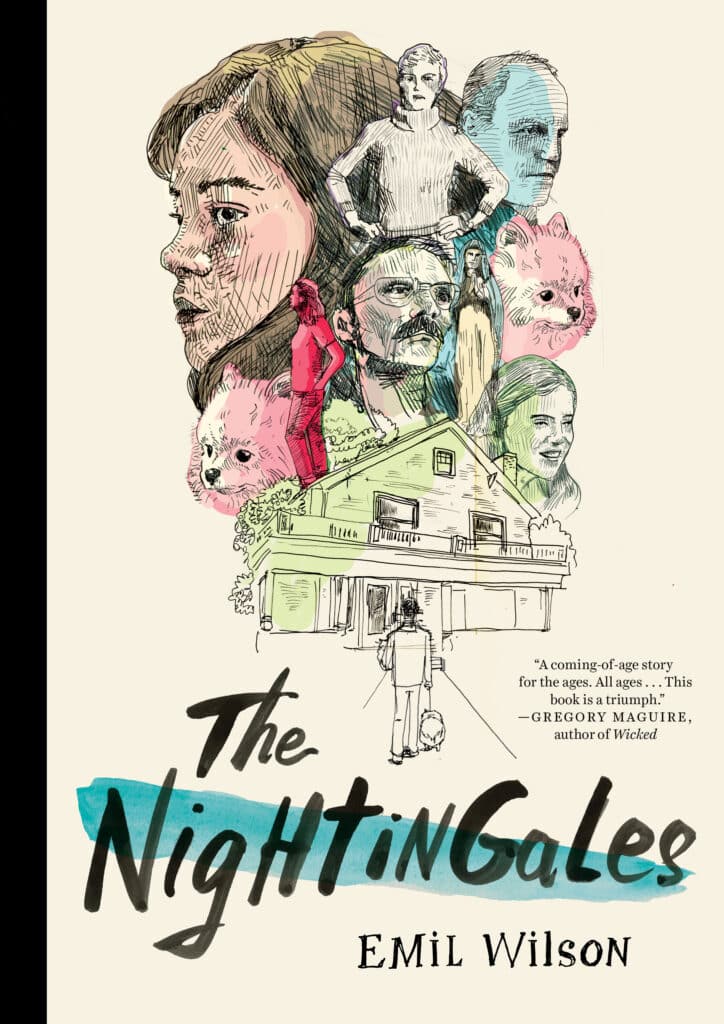
The Nightingales by Emil Wilson
How to Write a Novel in 20 Pies by Amy Wallen (illustrated by Emil Wilson)
Fun Home by Alison Bechdel.
The Page Turners: Fantastic Realms by host Kevin T. Johns.
Institutions & Organizations Mentioned
Simon & Schuster – Publisher providing more information about The Nightingales.
The Center for Cartoon Studies (Vermont) – Where The Nightingales began as Emil’s thesis project.
GMHC (Gay Men’s Health Crisis), New York – Organization where Emil volunteered as a buddy for people with AIDS.
Kevin’s Book Marketing Course
Signal Boost – An 11-module book marketing system that shows you how to get your book in front of the right readers without becoming a full-time marketer.
—
Grab your FREE copy of The Busy Author Method here.
Buy a copy of Kevin’s colouring book: The Frustrated Writer’s Colouring Book.

The Writing Coach Episode #229 Transcript
Today, Emil Wilson joins me on the Writing Coach Podcast. Welcome to the show.
Thank you so much. This is great.
Now, I absolutely want to dig into your new book, The Nightingales, with you. But first, on the show, I interview folks who work with authors and help them excel. A couple of years back, you worked on a book called How to Write a Novel in 20 Pies. Can you tell the listeners a little bit about that project?
That was a project that I worked on with a writer named Amy Wallen. She had this program in San Diego where she would do writing seminars, and she would serve pies. She wanted to create a book that broke down the writing process and, you know, also had recipes. It was this really interesting way to combine two of her favorite passions, which were—I mean, not hobbies. She’s a professional writer, not a professional baker. But she combined writing with something that she loved, which was baking pies. I did all the illustrations, and, you know, it was a great project.
The Nightingales is your first official book. Was it already in the works at that point, or were there any lessons you learned working on that project about how to write a book that then led to you working on The Nightingales?
Well, I did make a lot of pies while I was working on that book, so that skill set definitely developed pretty well.
I had started the book as a thesis project. I went to the Center for Cartoon Studies in Vermont, and I had just graduated when I was working on that book. I took a couple of years off because of family stuff. I had a parent who was sick, so I didn’t work on The Nightingales. I worked on the pie book instead.
When I came back to it, I definitely had a better sense of how to think about story and how to think about character. So I guess it did benefit in the long run. I hadn’t really thought about that, but it really had.
So I read the book today, which means I spent most of the afternoon crying. Incredible, incredible book—especially if we’re going to say this is your first book. Incredible work here.
One of your testimonials says it deserves to stand alongside Fun Home, and I don’t think you could ask for much better praise.
Yeah. I mean, that’s bonkers. That’s one of those things where you… yeah. That was a surprise when I read that. I was incredibly grateful.
The book, I believe, officially gets released the first week of August.
Correct.
It’s not out there in the world yet, but obviously you’re already getting this feedback. I hope you’re pleased with the project. How incredible does it feel to be getting the kind of feedback you’ve been getting on it?
Yeah, I mean, I think I’m being punked every time somebody sends me those comments because I’m just like, “This can’t be true.” Then I sit at my laptop for about 20 minutes and cry, and then get back to work.
You know, you’ve been through a lot of workshops. Sometimes you workshop stuff and you think, “Oh, I think this works,” and people are like, “It doesn’t work.” Then there are other times you put work out there and people are crying, and you think, “Oh… this is better than I thought it was.”
I mean, I thought the book was good. I’m really proud of it, and I worked really hard on it. But I think there’s always this moment of surprise when somebody really likes it. I think I’m still sort of at that place where I’m just happy that they were reading it, and the fact that they liked it just seems like extra gravy.
So, yeah, I don’t know. Hopefully I’ll get used to people liking it, but I’m not there yet. I hope I’m not, because I think it makes everything feel really special.
Well, it is a special book. It is powerful, emotional, and beautiful.
Thank you.
Interesting thing, though—you could call it a graphic novel, but there are no panels. It’s literary memoir… only it isn’t memoir.
Have you found it challenging to present it to audiences as a thing? Do you get a lot of, “What is this?”
You know, not as much as I expected. Interestingly, the people who have those kinds of questions are people who make graphic novels.
And I couldn’t have asked for… I mean, this is kind of what I had hoped for. I didn’t grow up reading comics. I didn’t make comics. I only started a few years ago, so my orientation isn’t really toward comics.
My background is in advertising, design, graphic design, commercials, posters—that kind of stuff. So I think my approach to this book wasn’t as a comic artist, but as somebody who’s like, “This is just what I like, and hopefully someone else will like it.”
I think that’s why I’m always a little surprised, because it doesn’t look like a comic, and yet that’s the thing people seem to warm to about it. I couldn’t be happier about that.
If there’s any takeaway I have from this book, it’s that people… you know, like I said, I didn’t grow up reading comics. I was always under the impression that graphic novels were comics, and comics were for teenagers—either superheroes or stories about feeling stressed over braces and acne. And I love those books. I just don’t really have a connection to them, even though I had braces and acne 50 years ago.
I wanted to make a book that just felt more adult. I wanted to write about my family and the dysfunction in the family. Those aren’t necessarily subject matters for books aimed at teenagers. I’m really proud of the fact that it feels like an adult novel.
Your design experience obviously comes through in this graphic storytelling. But I’m curious—what about your marketing background comes through, if anything, in the way you tell this story?
I think when you compare advertising to comics, they both do something very similar, which is that they have a little bit of time and a little bit of space to do a lot of work visually.
If you’ve ever designed a billboard, where you have a second to make an impression—to tell someone what the product is, what it does, and what you want them to do, whether that’s buy it or donate to something—you understand very quickly that you have to be economical with the visual language you’re choosing. The headline shouldn’t be more than five or six words.
I think all of that trickles down into comics—making the story visual and having the visuals do work.
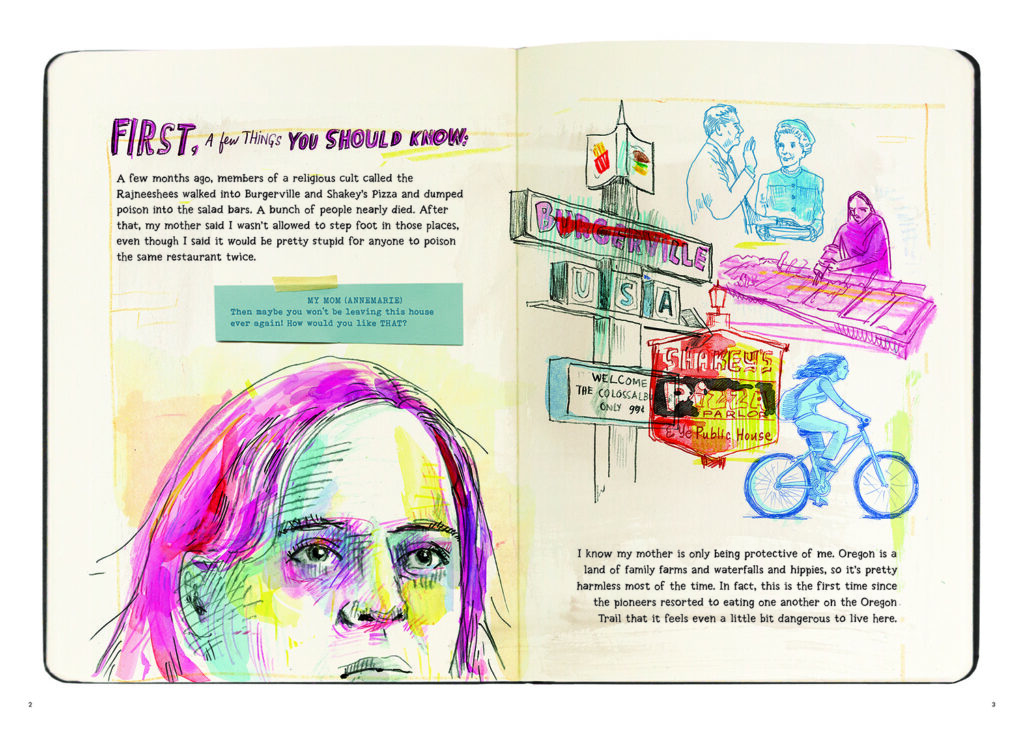
Sometimes people have the impression that comics are just illustrations. I think illustrations are slightly different, in that they’re a picture of what you’ve been reading. In comics, the picture should do work that the words aren’t doing, so the two are in conversation. That conversation creates a whole that’s greater than either part.
That’s absolutely true in advertising too. The headline should do one thing, the visual should do something else, and together they create the final message. That conversation is really what the product is.
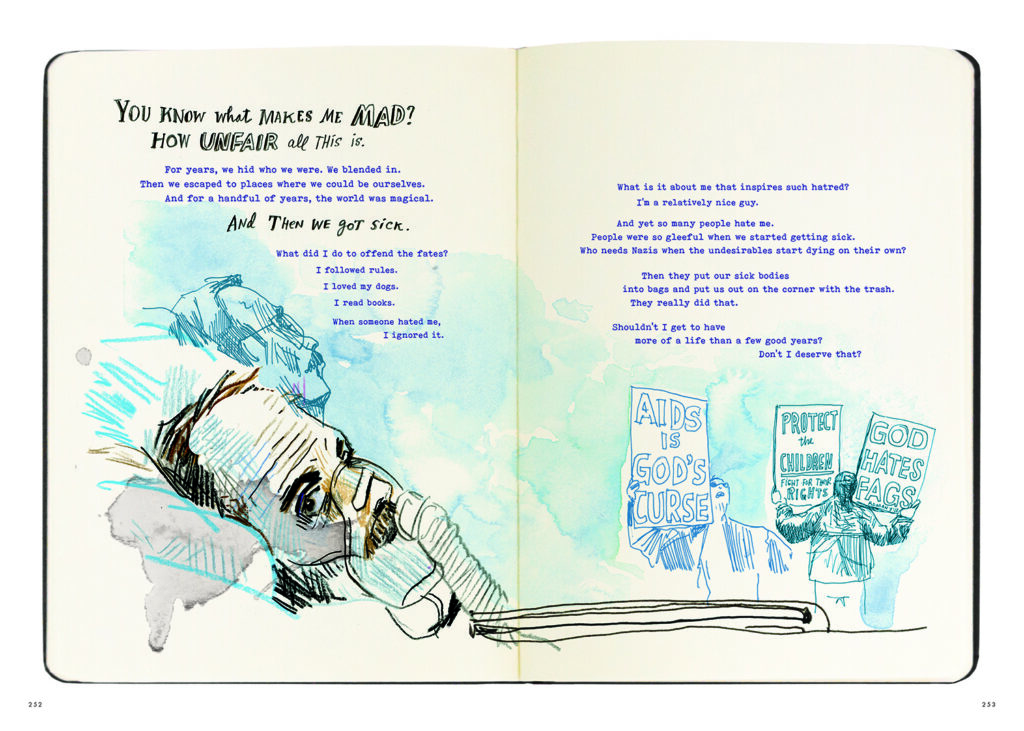
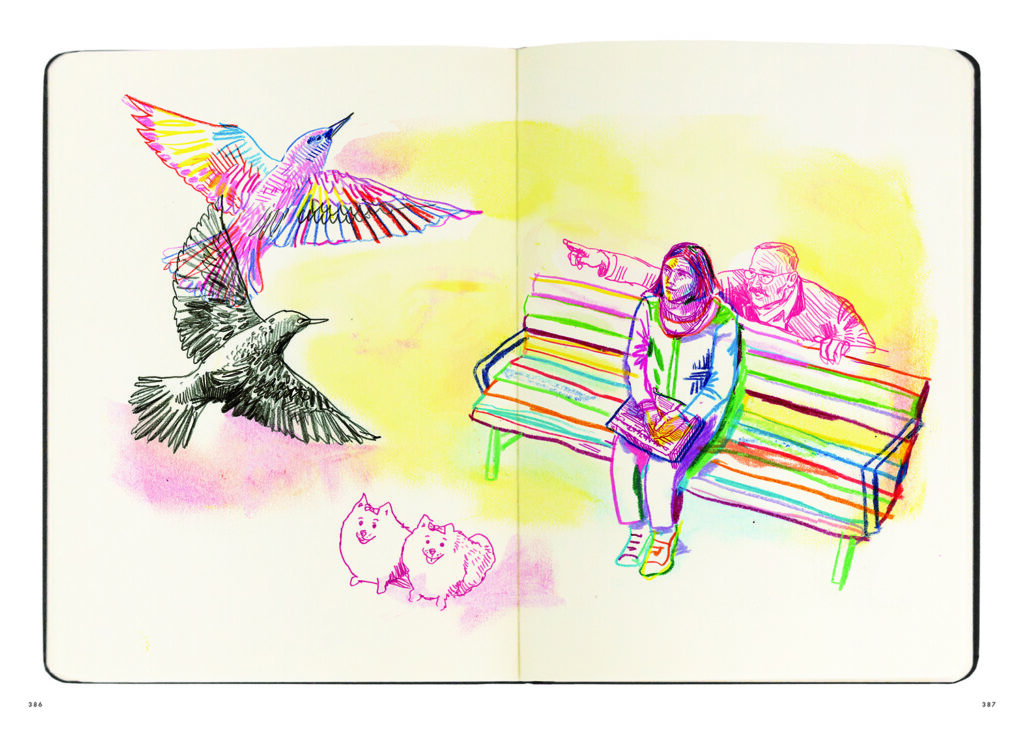
Early in the book, there’s a bit of a thesis statement—or at least for the form of the thing—where the narration says, “I’ve always felt like memory felt like a sketchbook.”
Was that the starting point for this project? Was it always going to be this sort of sketchbook, multimedia approach to the storytelling?
Yeah, I’m actually really glad you asked that. You’re the first person, in conversation or in any kind of promotion, who’s asked that, and I’m so proud of that. Not proud that you asked it—I’m just proud that it’s in the book.
It did start there.
One of the things you do in graphic design is try to find a visual language that enhances the message. I kept thinking, “Here’s this book about memory. What does memory look like? How would memory sit on a page?”
I’ve always been fascinated by artists’ sketchbooks. I love art, but what a sketchbook does that’s different is that it’s expressive. There are mistakes. There are things that are half-started and never finished.
That’s the way memory comes through. You remember something in incredible detail, but you don’t remember the room it happened in. Or I remember the expression on my parents’ faces during a conversation, but I have no idea what we were talking about. I just remember the expression.
That chaotic, spontaneous way memory is generated feels like a sketchbook to me. So those ideas fit together from the beginning. It was one of the first things I decided.
Whenever I’m looking at illustrated art—especially something with the sketchbook nature of this—I’m fascinated by the choices.
As a writer, I don’t really have that option. A sentence kind of looks like a sentence. So whenever I talk to artists, I’m always curious: How do you decide you’re going to draw a perfectly detailed hand on this page, and then four little squares for fingers on another page?
In this project, it feels like you’re making those kinds of decisions on almost every page. How do you go about making those choices?
You know, like I said, some of it’s just spontaneous.
One thing that was really interesting, and something I hadn’t counted on, is that you become a better artist in the process of making the book. I’ve talked to other graphic novelists who said the same thing happened on their first books.
So when I went back to edit it with my editors, I was a better artist because I’d finished the book. Then you go back to the beginning and think, “Oh… these drawings are rough.”
It felt important to keep the integrity of those early drawings because I think if somebody were actually making this sketchbook—which is sort of the idea behind the book—they too would become a better artist.
But it made editing the beginning challenging because you wanted to match what was already there. After a while, your eye starts saying, “Oh, I’m good at drawing now. I can draw a better face than I did on page 20.” So that was a bit of a discovery.
I’ll let you know—novelists go through exactly the same thing.
That’s fantastic.
Every time. By the time you get to the end of a draft, you’re so much better. You know the characters so much better. You’re writing more strongly.
Then you go back to the beginning for the next draft and think, “What was I doing?”
It’s this perpetual cycle where you’re always improving, which means the beginning is never quite as polished as the end. But I think there’s a rawness to that which can be powerful too.
I think because they’re pictures, it feels a little more obvious—at least to me.
With writing, maybe you just feel like the story gets stronger and you build momentum as your skills improve. But with art, you can literally look at a drawing and say, “Oh, this drawing is better.”
So it’s a process. It’s definitely a process.
Can you tell me a little bit about how you approached colour in the book?
Yeah. I mean, I think about colour a lot.
Maybe because of my age, and maybe because this is still a relatively new direction for me—I mean, I’ve illustrated throughout my life, but this kind of work is newer—I still feel a little bit like a five-year-old at the art table.
It’s like, “Oh, I like this colour today,” or, “I don’t like pencils right now. I’m going to use watercolours.”
I think that spontaneity—the spontaneity of the materials and not feeling like I have to do something especially artful—lets me experiment and play around.
The sketchbook forgives that, too. It does a lot of forgiving.
Another thing is that I’m not especially good at character design, where someone looks exactly the same from page to page. But in a sketchbook, nobody looks exactly the same. No portrait looks the same every time.
So I thought, “Great. I’ve created a system that covers up all the things I’m bad at.”
Again, I know writers do the same thing. That’s just part of learning your skills and understanding your strengths.
So in terms of colour, it’s really spontaneous. I want to be a brooding artist, but I just like bright colours. People say my palette is kind of candy-coloured, and I think that’s partly an accident… and maybe not an accident. I think it’s just my natural way of painting.
What really jumped out at me was that it’s certainly lush in colour, but there’s also a restraint to it. There are certain pages that are almost monochromatic.
Then—and I won’t spoil anything—but near the end of the book, there’s a spread with a nightingale in it that feels visually like the most colourful image in the entire book. I think there’s a rainbow element in there as well, which obviously plays into the storytelling.
I don’t know. I just felt there was a really nice sense of restraint until the perfect moment to unleash the rainbow, and it felt like you chose exactly the right moment.
Oh, thanks. I think some of that was conscious. Some of it was just this exuberant feeling at the ending—the realization of who this character is, and the realization that she has gone on this journey and we’ve gone on the journey with her through reading the book.
I felt like that was part of it. There are a lot of gay, lesbian, and LGBTQ themes in the book. The colours all feel really basic and bright, which leads into the rainbow as well. So I think that’s something I did partly consciously and partly unconsciously.
If someone just picked up this book and started reading it, they might think it was a memoir by Lou, perhaps. Your name is on the front cover, and there’s a reference to a brother early in the book, but your name doesn’t appear until around page 100.
Then suddenly, the author’s name drops into the story, and eventually you—or a version of you—puts in an appearance. Tell me about the process of writing a story that’s clearly influenced by your family while not having yourself be the point-of-view character.
Right. This is a really fascinating question to have and a fascinating conversation to have with somebody who is a writer and teaches writing.
I wrote a memoir many years ago that I ended up not publishing. One of the things I discovered while workshopping it was that, with memoir, there’s always this feeling—or these comments—of, “You need to go deeper. You need to go deeper.”
There was a point where I thought, “I don’t know that there’s anywhere deeper to go. I feel like I’m going as deep as I can go.” But people just kept saying, “No, you need to go further,” and that felt really frustrating to me.
So when it was time to write this book, I thought, “I don’t want to deal with any of that. I don’t want to deal with people saying I’m not going deep enough.”
I wanted to deal with my family, whom I know intimately and know well enough as characters that I can imagine what they would do in any given situation. But I didn’t want to self-analyze. I just wanted to analyze them, which is both freeing and maybe a little mean. I think my family is probably like, “Why are we the ones you’re going to make this story about?”
The scene where the brother comes in—and the brother is based on me—is true in the sense that I came home and met this gentleman who was living with my family.
I wanted to insert the brother into the story because he exists as this sort of shadow character, and I thought it wouldn’t be fair to the reader not to bring him in. I needed to show how the other characters reacted to him and then get him out again. Fortunately, that’s more or less what actually happened, so it was easy to do.
It was interesting choosing to make the characters people I knew really well because I felt like I knew them well enough to move them around the chessboard, so to speak.
I didn’t have to worry that somebody in a workshop was going to say, “You need to go deeper with these people,” because I was going as deep as I knew how to go.
I don’t know. Does that seem fair to say to somebody who works with memoir and writers?
I’d be curious—was there ever a moment when the character wasn’t going to have your name? Because the second you name the character after yourself, there’s a certain level of intertextuality that becomes unavoidable.
For sure. I think one of the great things about having a really unusual name is that this was the one time when I felt like, “I’m going to take this odd name I’ve been fighting with since I was a child and have it work for me in ways I didn’t even know were possible.”
I changed the names of every member of my family in the book. But I thought, “Here’s one name somebody is going to connect to the name on the cover.”
I thought it worked to great effect.
We’ve talked about colour and illustration a bit. I wonder if we can touch on composition.
I’m thinking particularly of a certain double-page spread in the book where the majority of the verso—the left-hand page—is blank, and the right-hand page shows a hospital bed.
Yep.
I found it profoundly powerful. Could you tell me a little bit about the process or the choices that went into creating that image?
Yeah. In general, I think composition is where my advertising background really came in.
It’s interesting talking to comic artists about composition because it’s so ingrained in the panel and grid system. The focal point often seems oriented toward the centre of the page.
In advertising, that’s never necessarily the case. It’s more like, “This is the page, and I’m going to tell you where to look.”
In terms of the composition of that page specifically, I knew what that moment felt like because it was something I had experienced personally, even though it happens to the teenage daughter in the book.
Most of the final third of the book is drawn from my experience. This is semi-autobiographical in the sense that pretty much everything in the book happened. Who it happened to and the order in which it happened are things I played with.
I worked as a buddy for GMHC—the Gay Men’s Health Crisis—in New York, supporting people with AIDS. I worked with one particular client when I was 22, and we had this really wonderful friendship. It was similar to the friendship my father and sister had with the man who moved into our home.
I took those two narratives, stitched them together, and streamlined them.
I remember coming into St. Vincent’s Hospital in New York after he had passed away during the night. The nurse said, “I’m sorry. He passed.”
My first thought was, “Oh, he passed his blood test. He’s probably waiting for me downstairs in the lobby.”
Then there was this realization that this person had died.
When you’re 22, mortality is still a relatively abstract concept that you don’t really know how to grasp. Most 22-year-olds think, “What do you mean he died? That’s crazy. Nobody dies.”
As you get older, you realize everybody dies. But when you’re 22, you don’t know better.
I wanted that moment of realization to figure into the composition of the page, where everything slides to one side. When you have those moments, reality feels tilted on its edge, and you’re thinking, “How do I make sense of this?”
She’s going through that. I went through that. I think the visual on the page helps that thought along.
I think it’s a beautiful example of how graphic storytelling can incorporate silence or nothingness into the story.
In music, we use pauses all the time, right?
Sure.
Unfortunately, as novelists, we often struggle with that. I work with so many writers who will say something like, “It felt as though we were moving in slow motion,” or, “The room was completely silent.”
But neither of those sentences necessarily communicates the feeling of absence or the experience of actually being silenced. I thought it was a very beautiful technique.
It’s interesting. When you make a graphic novel, one of the many things I discovered is that there are times when it feels much more akin to filmmaking than to writing.
When you make a film, you’re constantly thinking about how the viewer is seeing it. What are they seeing? What’s the angle? How are you presenting this?
In film, you don’t necessarily have the ability to use words to narrate what’s happening inside a person. That can be challenging.
That’s especially true in graphic novels because, if you don’t want to use narration, there isn’t much outside of action. And you don’t have performance the way you do in film.
So you have to figure out ways to communicate, “Oh, this is how she’s feeling in this moment.”
That can be challenging when you don’t have the ability to use three pages of description.
You mentioned that you didn’t grow up with comics.
Right.
I did. I come from the superhero world, and I love bad guys and all that.
So I’m curious about Annie Marie and her scenes with the religious figure, the Virgin Mary.
Right. Yes.
If those scenes didn’t exist, we could view that character as pure comic-book-villain evil. Why care about her? Why humanize her? Why not let her be a comic-book bad guy?
There are a lot of reasons.
In one of the first drafts of the book, the Virgin Mary was always there as a way for Annie Marie to reveal her character. It was a useful device for understanding what she was thinking.
We know it’s fantasy because she’s talking to the Virgin Mary, and the Virgin Mary isn’t actually there. So it was clear that Annie Marie was generating this.
Somebody in a workshop—which shows the value of workshops—said, “I think the father is the problem here. The father has made this decision unilaterally for his family. Here’s this woman who doesn’t seem to have a vote. Of course she’s angry. She’s frustrated because she isn’t being listened to.”
It was one of those workshop comments that made me think, “Oh my gosh. Not only am I reassessing this character, I’m reassessing my mother.”
That was really helpful, especially when I began creating a backstory for this character.
She’s a product of growing up in the postwar period in a very patriarchal family. She was an attractive young woman who was constantly told, “You don’t have to worry about anything. You’ll have a man to take care of that for you.”
Then she was in her 30s when the feminist movement arrived, and suddenly she was thinking, “Those people don’t represent me, but this old way of life doesn’t represent me either. What are my choices? I have no choices.”
That workshop comment opened a window and helped me think, “I don’t necessarily have this character wrong. She isn’t simply bad. But I need to make the source of her badness clear. I need to explain what this really is.”
From a writing point of view, that was incredibly helpful.
While reading those scenes, what really struck me was her loneliness.
I had this moment when I thought, “She’s talking to an imaginary person.”
Right.
That was very sad.
But by the end of the book, I was no longer on her side.
Let’s talk about that without giving away any spoilers. Part of the book is about a man suffering from AIDS, and obviously, during the period in which the book is set, there weren’t many happy endings to those stories.
There are some very, very sad moments in the book. As I said, you made me cry several times.
We experience this loss and sadness, and then we enter the final portion of the book, where you hit the reader with a gut punch I did not see coming from a million miles away.
Oh, that’s great.
You know what I’m talking about?
I do, of course. Yeah.
As someone who studies story structure and talks about structure all the time, I’m familiar with the “all is lost” moment at the 75 percent mark, or with a final surprise during the climax.
But this technique of breaking your reader down, allowing them to think things are getting better, and then breaking them again really caught me off guard.
Where did that idea come from? I can’t think of many other stories where I’ve seen that technique used.
Well, thank you so much.
I don’t know what the technique is, but I can tell you where it came from.
When I was first conceiving the book, I was talking to my sister. I said, “There are some things at the end of the story where I don’t really know what happened. What happened to all of these things he introduced into the household?”
She said, “I don’t know. Those things just sort of disappeared.”
I said, “Well, this is where my head goes with it.”
She said, “That’s nothing. That’s a scenario we’ve all considered. It’s not outside the realm of possibility.”
That was just enough.
Because it was a novelization of something that had really happened, it felt like permission to say, “Great. I don’t need to talk about this anymore. I’m going to take this idea, run for the hills, and do what I think is right for the story.”
There were also things that happened to me as a young man, just after college, that fed into it.
I think my parents were wonderful people. I also think they made some bad parenting decisions based on how they had been brought up.
There was a moment when I thought, “I’ve got to get out of here. I’ve got to get on a plane to New York and start my life.”
That’s essentially what happens with the character, and I needed things to happen that would push her into the same mindset I had been pushed into.
We also had a similar situation in our family. My parents made certain decisions and then lied about them, and eventually we found out the truth.
I think that happens in a lot of families and with a lot of parents.
Part of writing, I discovered, is taking all these experiences, rolling them together, making them coherent and narrative, and turning them into what happens in the book.
Is it true? It’s a combination of truths.
I know a lot of writers do that every day, but for me it was a discovery. I thought, “Oh, I can take four or five different stories, turn them into this one story, and make it work.”
That felt really empowering.
There are several points in the book where you focus on different characters and tell us part of their backstory or give us insight into who they are, but you do it through different formats.
We get Don through a manual—almost like an office or user’s manual. We get Annie Marie through paper dolls. We get Lou through a girls’ magazine questionnaire.
Tell me about the decision to use those different communication formats to tell those parts of the story.
I think that comes from my graphic design background.
Again, they were grounded in truthful things. I never saw my father read a book, and yet I can remember countless times when he sat in his chair reading the user’s manual for an appliance we had just bought.
He was someone who wanted to know how things worked. He wanted to understand what he should do if something broke. He wanted to know how to troubleshoot it.
In terms of talking about who he was and telling his backstory, I thought, “What better way than to turn him into an appliance?”
If he were the product, how would you explain to a consumer how to use him? Where did the product come from? What do you do when it starts to break or have problems?
It was one of those ideas where you initially think, “This is genius,” and then, as you start writing it, you continue thinking, “This is genius.”
It felt really smart when I was making it, and now, when I look back at it, I still think it’s a great way to talk about a character.
It’s also so representative of my dad—who he was, what his priorities were, and how he thought.
There’s something very sobering about a user’s manual, but there’s also something heartfelt in its intention: “We want this to work. We want you to be happy.”
It seemed to work on every level, and I’m really proud of it.
This story feels as though it would have landed differently 15 or 20 years ago. I think we might have read it and said, “Boy, people were so backward back then.”
In 2026, it feels miserably relevant.
Is this simply the story you’ve always wanted or needed to tell, or did it emerge partly from the political times we’re living in?
Maybe a little bit of both.
For the most part, it was probably the story I wanted to tell because it was the story I knew.
When I first pitched the idea to an agent, I had a first chapter and a synopsis. The agent said, “We like this story, but we think the AIDS storyline isn’t something a modern reader would want to read about. We’d prefer it if the girl were non-binary or trans and the man had COVID.”
I thought, “That’s not the story. I can’t write that story, and I don’t want to write that story.”
Then I stumbled across the agent who became my agent, and they basically said, “What’s different is what you’re passionate about. What’s different is what makes it special. Your passion comes through in the story you want to tell.”
The lesson I learned was to believe in the story you want to tell.
If something is happening in the world that allows you to say, “Here are some connections to what’s happening right now,” that can be meaningful.
But publishing takes so long. In 2020, who knew what the world would look like five years later? It’s hard to say, “I’m going to make this story relevant,” because the minute you do, it can become dated.
But it is a wonderful, happy accident when you’re writing about the lack of kindness in the world and then you pick up a newspaper and think, “There’s still a lack of kindness in the world.”
That wasn’t my intention, but I certainly welcome the connection to what’s happening today.
It really is a book about empathy.
As much as I’ve talked about reading it with tears in my eyes because of the sad aspects of the story, I was also crying because of the beautiful demonstrations of caring, kindness, and empathy.
Thank you for saying that. That’s so lovely to hear. I can’t even tell you how lovely that is to hear.
Needless to say, I absolutely loved the book. I thought it was fantastic.
What do you have on the horizon as you move toward the launch date? Is it mainly promotional activities? Are you thinking about the next book? Where are you at as an artist?
It’s interesting because I sold this book about a year and a half ago, so there was a little bit of downtime, and I’ve started working on something new.
It still uses my sister and me as touchstones. It’s a little more memoir-like.
It’s actually the memoir I wrote 15 years ago, put in a drawer, and thought, “Nobody wants this.”
Suddenly, it’s becoming a really interesting graphic novel about the relationship between siblings and how that relationship changes.
It has a much broader scope. This book takes place over three or four months, whereas the new one takes place over four or five decades.
It’s been a challenge to write something new with similar characters but within a completely different framework.
I’m super excited to work on it.
Fantastic.
You’ve mentioned that you don’t come from a comic-book background, and I would encourage you not to reach out only to the literary community.
There are so many people who love superheroes and also love Alison Bechdel.
Yeah, yeah. No, I’m learning that.
There’s a whole world of people who are going to absolutely love this. Congratulations on the book.
Thank you so much.
If people want to learn more about it or about you, where should we send them?
I have a website, which is emilwilson.com. Simon & Schuster is also a great place to learn more about the book.
Hopefully, it inspires people to learn about the 1980s, AIDS history, and graphic novels in general.
There’s plenty of information out there. If you like this book, there are plenty of places to go from here.
I hope people really enjoy it, and I’m so excited and thrilled that you did.
I think they will.
Thank you so much for taking time out of your day to join me on the podcast today.
This has been great. Thank you so much for this.