Conflict is the beating heart of storytelling.
When most writers think about conflict, their minds go straight to villains—the big bads we all love to create.
But those sneering, black-capped baddies represent just one tiny slice of the larger antagonist pie.
Because here’s the truth: conflict isn’t just about a mustache-twirling foe. It can take many forms—some obvious, some internal, and some hiding in plain sight.
So, let’s rewind to a lesson most of us first encountered in high school: the classic types of conflict fueling every great story.
The 4 Types of Conflict at a Glance
| Type of conflict | The antagonist is… | Examples |
|---|---|---|
| Person vs. person | Another character who actively opposes the protagonist | Luke vs. Darth Vader; Batman vs. the Joker |
| Person vs. nature | The natural world | Twister; The Old Man and the Sea |
| Person vs. society | The world’s rules, systems and structures | The Great Gatsby; Nineteen Eighty-Four |
| Person vs. self | The protagonist’s own doubts, fears and flaws | Buffy the Vampire Slayer, Season Six |
1. Person vs. Person Conflict
This one’s a classic. It’s when your protagonist faces off against another individual—someone who actively opposes them.
Think:
Luke Skywalker vs. Darth Vader
Batman vs. The Joker
Dorothy vs. The Wicked Witch of the West
In genre fiction and commercial storytelling, we often find a flesh-and-blood antagonist representing evil, danger, or resistance.
This type of conflict gives readers someone tangible to root against, and it’s usually juicy, dynamic, and fun to write.
Free download
Get the Conflict Toolkit
Printable worksheets to plan your story’s conflict, map how the stakes escalate, and check every scene for tension.
No spam. Unsubscribe anytime.
2. Person vs. Nature
In the case of person vs nature, the antagonistic force isn’t a person at all—it’s the natural world.
In a disaster flick like Twister, the villain is the tornado. In survival stories like Swiss Family Robinson, the characters are up against the wilds of an uninhabited island. In Hemingway’s The Old Man and the Sea, the conflict is between an aging fisherman and a massive, elusive marlin. Nature becomes a powerful and indifferent opponent. (Nature can also mirror your characters’ emotions; that’s called pathetic fallacy.)
These stories pit human resilience against the raw, unstoppable force of the natural world—and they can be some of the most primal and compelling narratives we have.
3. Person vs. Society
This is when the world itself is the antagonist—its rules, its systems, its structures.
Take The Great Gatsby, for example. Gatsby isn’t fighting a supervillain—he’s fighting against a class system that tells him he can’t ever really belong.
Or think about Orwell’s Nineteen Eighty-Four, where the antagonist isn’t just Big Brother—it’s the entire machinery of the totalitarian state.
Kafka’s The Trial leans into this, too, with bureaucracy becoming a surreal and oppressive foe.
These stories challenge cultural norms and interrogate the systems that govern our lives.
4. Person vs. Self (Internal Conflict)
With person vs. themselves, we’re getting into my favourite territory.
This type of conflict is internal. It’s not a monster. It’s not a government. It’s not a flood or a fire or a tornado. It’s you. Or rather, your protagonist. It is their doubts. Their fears. Their flaws. Their deep, dark impulses.
This is the type of conflict I suggest all my coaching clients embrace.
The books I write, and the ones that interest me most, are the ones in which a character is their own worst enemy. When that happens, we’re dealing with truly powerful storytelling.
I once wrote an academic paper that got accepted at a university conference. It was about Season Six of the television series Buffy the Vampire Slayer. I argued that in each of the first five seasons of Buffy, the villains escalate in power. Season One? Vampire. Season Five? God. Literal deity. And Buffy sacrifices herself at the end of Season Five to stop that god.
In Season Six, Buffy’s friends use magic to bring her back from the dead. They assumed she was stuck in some demon dimension and that they were just doing the right thing by rescuing her.
Plot twist: she wasn’t in hell. She was in heaven.
And now, she’s back on Earth—and she hates it.
Yes, there are still monsters to fight because it’s Buffy, after all, but Season Six is really about depression. It’s about a person who doesn’t want to be here anymore—and the monumental inner work it takes to want to live again. That’s a story. That’s conflict.
Closing Thoughts on Conflict
When I write fiction, I often create characters who are so deeply flawed and broken that the primary antagonist they must defeat isn’t an outside force—it’s their worst parts. That, to me, is the most compelling kind of battle.
But that doesn’t mean your story has to be about internal conflict. Maybe your antagonist is a literal bad guy. Perhaps it’s a society. Maybe it’s a snowstorm. Or a vampire. Or a space empire.
The point is that conflict is essential. Crafting great villains is important—but remember, a “villain” doesn’t have to be a person. It can be a system, a situation, or a swirling storm of self-doubt inside your protagonist.
There are many different ways to approach the antagonistic forces in your story. What matters most is that something stands between your character and what they want—and that the journey to overcome conflict makes for a story worth telling.
Frequently Asked Questions
What are the 4 types of conflict in a story?
Person vs. person, person vs. nature, person vs. society and person vs. self. Some teachers add more, such as person vs. technology or person vs. the supernatural, but most of those fit inside the four classics.
What is an example of person vs. person conflict?
Luke Skywalker vs. Darth Vader, Batman vs. the Joker, or Dorothy vs. the Wicked Witch of the West: the protagonist faces another character who actively opposes them.
What is the difference between internal and external conflict?
Internal conflict happens inside the character (person vs. self). External conflict comes from outside: another person, nature or society. The strongest stories often use both, with the outside battle forcing the character to face the inside one.
How does conflict connect to theme?
How your character wins or loses their central conflict is what delivers your story’s message. See What Is a Controlling Idea? for how to plan that before you draft, and Scene vs. Sequence vs. Chapter for how conflict plays out scene by scene.
More on Conflict and Stakes
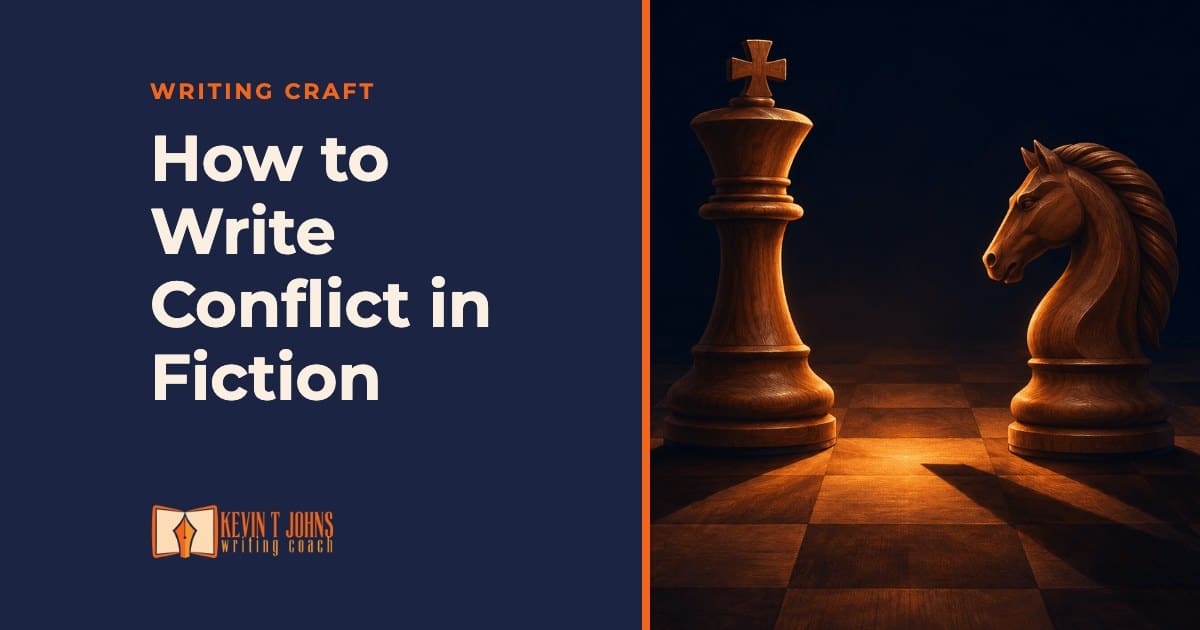
Start here: How to Write Conflict in Fiction: A Writing Coach’s Guide
- Beyond Bad Guys: Exploring Core Conflicts in Fiction (you’re here)
- Hero vs. Villain: How to Build High Stakes Through Character Conflict (Advice from a Writing Coach)
- Conflict is (Too) Easy to Find – The Writing Coach Ep. 134
- Kevin’s CTE Formula: A Writing Coach’s 3-Step Method for Raising Stakes (that Actually Works)
- How to Escalate Conflict Without Losing Control: A Writing Coach’s Proven Method
- Setting the Stage for Suspense: How to Use Atmosphere to Raise the Stakes
- Are You Killing the Tension? 3 Common Mistakes Writers Make With High-Stakes Scenes
- Tease and Please: How to Write Cliffhangers That Keep Readers Turning Pages
Want to finally finish your novel? My free guide, The Busy Writer Method, shows you how to find 5–10 hours a week to write it.