There’s a persistent myth in the writing world: that great books are created by lone geniuses, toiling away in isolation, waiting for inspiration to strike.
It’s a compelling image.
It’s also wildly unhelpful and mostly untrue.
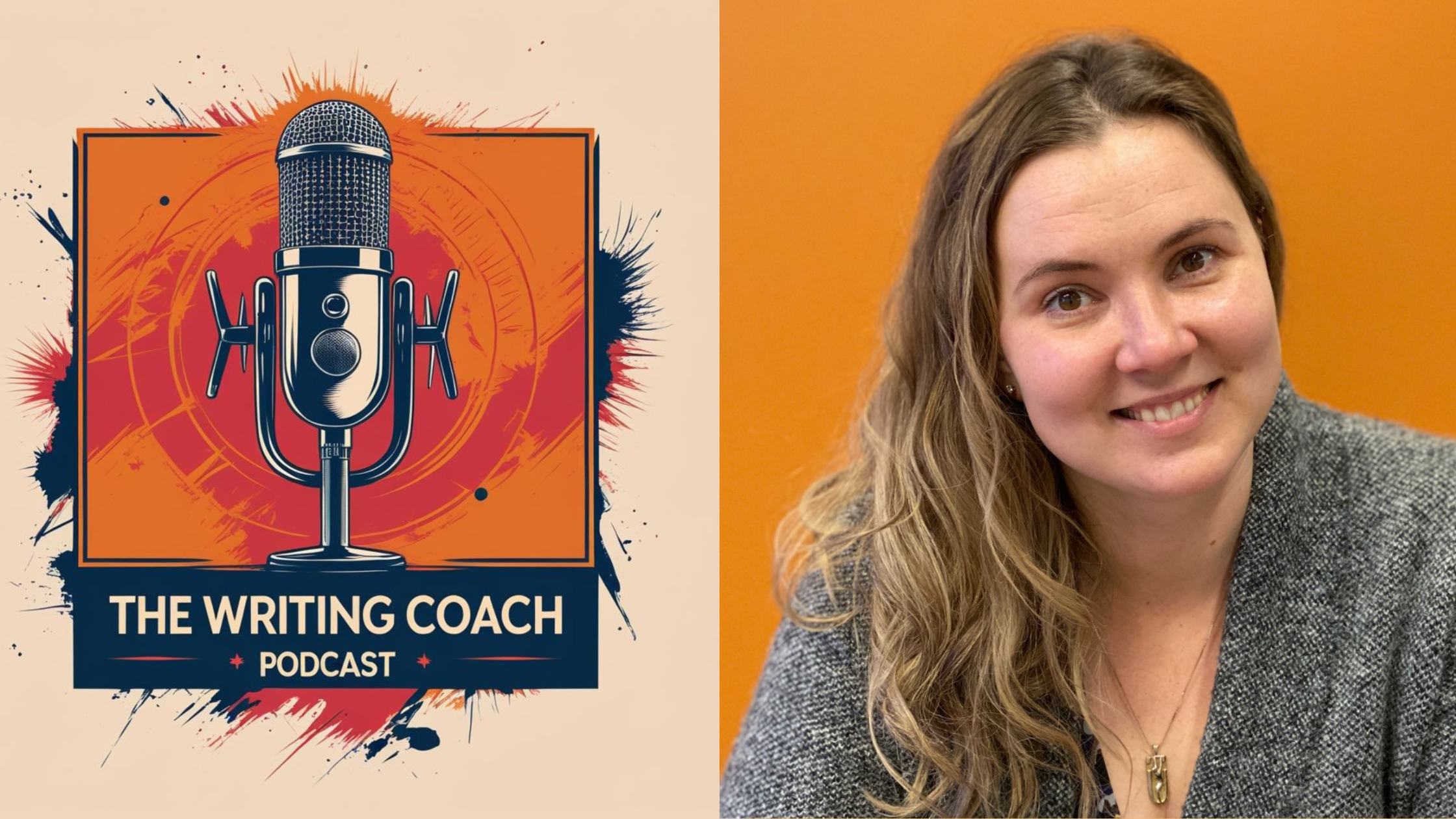
In this episode of The Writing Coach Podcast, I sat down with Gala Russ (author, editor, and writing coach) to talk about what actually helps writers grow: community, feedback, structure, emotional intelligence, and learning when to stop doing everything the hard way.
Gala’s journey into writing didn’t follow a neat, linear path. She started publishing fiction on Wattpad, learned to write in a serialized format with live reader feedback, was eventually hired by the platform, and later moved into book coaching and developmental editing. Along the way, she studied linguistics, taught ESL, worked as a strategic consultant, collaborated with co-authors, and trained as a coach—bringing all of that experience into how she now helps writers.
In our conversation, we dig into:
- Why so many writers struggle alone for years before asking for help
- How community and collaboration accelerate growth (without taking away your voice)
- The real difference between pantsers and plotters—and why it mostly disappears after draft one
- Why perfectionism is often a misunderstanding of how writing skill actually develops
- What co-authoring really requires (hint: it’s a lot like improv—and a lot like dating)
- How learning to write is more like learning a language than finishing a single project
- Why “DIY” doesn’t mean “do it alone,” whether you’re talking about punk rock or publishing
We also talk about Gala’s approach to coaching, how she blends structure with intuition, strategy with somatics, and teaching with long-term support, plus what she’s working on next, including courses for beginner novelists and writers looking to integrate romance subplots into non-romance stories.
Listen to the full episode below, and consider this your reminder that becoming a better writer doesn’t require more suffering—it requires better systems, better support, and a willingness to learn alongside other humans who care about the work as much as you do.
Audio:
Video:
The Writing Coach Episode #217 Show Notes
Visit Gala’s Website: https://galarussauthor.com/
Follow Gala on Instagram: https://www.instagram.com/galarussauthor/
Get a FREE copy of Kevin’s book: The Science (and Magic) of Writing Retreats.
Buy a copy of Kevin’s new book: The Frustrated Writer’s Colouring Book.

The Writing Coach Episode #217 Transcript
Podcast: Play in new window | Download
Subscribe: Apple Podcasts | RSS
Gala, welcome to the show. Hi, thank you for having me. So right before we hit record, we were talking about accents and language. Let the listeners in on your unique background in terms of travel, language, and accents.
Yeah, whenever I speak, people say, “Oh, you have some kind of an accent.” They’re not wrong—I do have an accent. I was actually born in Russia, and Gala Russ is my pen name. “Gala” is my mom’s name, and “Russ” comes from Russian. I had to come up with that pen name really quickly.
I used to write on Wattpad, and I didn’t want to write under my real name because I worked at a bank at the time, so it seemed prudent to have a different name for writing romance on Wattpad. I literally came up with it in five minutes.
So I’m originally from Russia, but I also went to school in France, and I speak different languages. My bachelor’s degree was in education, linguistics, and ESL, and I taught a lot of languages—especially ESL—as a younger person. I love languages, probably more than is strictly necessary.
I love that—it’s so fascinating. It makes me wonder: did your interest in language come from travel and learning other languages, or where does that fascination—enough to study linguistics—come from?
It’s kind of both. I grew up in the USSR, and travel abroad really wasn’t a thing you could do. My first trip abroad was when I was 14. And the reason ties directly into why I love languages—I traveled with my children’s choir.
I was in a children’s choir from about age seven or eight, and when you sing in a choir, you sing in many different languages. I had to study and sing music in German, French, Italian, Spanish, Hebrew, Japanese—and more. I even sang a song in Estonian.
I think that’s where my fascination with languages really started. I’m also a huge reader, and reading works in translation always made me curious—what is it like in the original language? I’ve done some work in translation, and I’m still fascinated by it. So really, it all comes from music. It started with singing.
That’s fascinating. I was in punk rock bands throughout my teen years, and I think that had a huge influence on my writing and my coaching.
So many beginner authors struggle with perfectionism, and I’m like—I came from the punk rock world. We didn’t want it polished. We didn’t want it perfect. We wanted it raw, emotional, gritty. Do it ourselves. It doesn’t have to be perfect to be worthwhile.
I feel really lucky to come out of that DIY world when it came time to publish my own work. I don’t think I’ve ever had that perfectionist lock-up that so many authors deal with—and I’m sure many of the clients you work with face that.
Yeah, I’m a recovering perfectionist. I feel pretty recovered at this point, but I understand it deeply.
I’ve worked with a lot of newer writers who haven’t completed a first draft yet. You know how people say your first three books—or even your first five books—are really about learning who you are as a writer? How you write, what works for you, what doesn’t.
And as you write more books, your business changes too. Even in traditional publishing, you’re not just a writer—you’re a writer and a marketer. Your time availability changes, your writing schedule changes. The more books you write, the more business you have to attend to.
I don’t remember exactly what your question was—but I think a lot of early perfectionism comes from this belief that everyone else needs editing, but I will be the unicorn. Because I studied all the things, or because of whatever, I’ll be the one person whose first draft is perfect.
Yes. I always use Stephen King as an example. I love him as an author, but I’m not the biggest fan of On Writing. It’s a great read—we all love it—but I think sometimes extremely gifted people aren’t always the best teachers for the rest of us.
When he says, “Just sit down and write 2,000 words a day, 365 days a year,” it sounds simple. But some people need help getting there.
When people say, “I’m different—I’m the outlier,” I always think: Stephen King built a printing press in his basement at eight years old so he could publish a local newspaper. I didn’t do that. I’m guessing you didn’t either.
If you were the unicorn, you’d probably already know. Most of us are regular artists working hard at an art form we love. There are these aliens—Stephen King, James Patterson—but the rest of us? We need revisions.
I like Brandon Sanderson’s advice. He’s said that his first five—or maybe seven—books weren’t edited, and the biggest lesson he learned was that you have to learn how to edit to sell a book to an agent.
His path was different—it was 20 or 25 years ago—but his advice still holds. Now he has a huge team of beta readers and editors because he’s incredibly prolific. Like Stephen King, he writes very character-forward and less focused on structure.
And based on your conversation with Monica—I know structure matters to you. I’m kind of both. I call myself a “plans-er.” I’m a pantser and a planner. I love structure. I love learning it and applying it, especially when I’m doing developmental edits or coaching writers who need that support.
But I’m still very much a pantser when it comes to drafting. I know what needs to happen in the chapter, but how it happens—I let that come out organically. I enjoy letting my imagination loose.
I’ve worked with people on both ends, and I think both are valid. Plotters spend more time upfront, but they still have to let go of the expectation that everything they planned will manifest exactly. Pantsers spend more time revising later. Either way, editing happens.
I think you just articulated something perfectly: pantsers and planners aren’t actually that different—we just do things in a different order.
Either you plan and then write, or you pants and then reverse-engineer what the planners did. Either way, we need character arcs, a beginning, middle, and end, setups and payoffs.
After the first draft, it doesn’t really matter. At that point, we’re all revising and trying to make a great story.
At least, I hope we’re all revising. That’s one reason I usually only do developmental edits with people I know. A lot of earlier writers expect tweaks—but then I say, “You probably need to cut the first two chapters,” or “This needs another chapter,” or “These three characters should be one.”
And they say, “No, you’re changing my story.”
It’s always up to the author what they do with my advice. I don’t claim to know best. I’ve published nine books, written over fifteen, and probably have twenty unfinished ones floating around. I’m not a New York Times bestseller.
I give advice based on experience, industry standards, and what tends to make for a compelling narrative—for readers. And again, I don’t remember what the question was.
You mentioned Wattpad earlier, and I’m curious—was that where you first started publishing fiction?
Yes, I started on Wattpad—and it’s a testament to the power of marketing.
Way back when Colleen Hoover was just starting, she published a novella on Wattpad as she was writing it. Readers could leave inline comments, almost like Google Docs. I read it live as she wrote it, probably around 2012.
My mom died in 2017. She was a writer and poet, and I inherited boxes of her handwritten work. I couldn’t look at it for two years. In 2019, I finally opened the box and started reading her poetry. It was all in Russian, so I decided to translate some of it.
Around that time, I had a story forming in my head. I joined a book club, a communication club, and things just collided. I sat down and wrote ten chapters—and then I didn’t know what to do next.
I went online looking for community. I’m very much a community person. That’s why I love masterminds. I searched for places beginner writers could post work, and Wattpad felt familiar and safe.
The writing was… not great. But I found my people. I found other writers, a co-author, and eventually I was hired by Wattpad. They paid me to write for two years. Later I moved to Kindle Vella because I was used to serialized fiction, and eventually I published books.
That was very long—but that’s how it happened.
I love that. I have a client—shout-out to John—who’s publishing on Royal Road and having a fantastic time. Publishing serially teaches you “shipping,” as Seth Godin calls it.
Instead of writing a book for ten years, you write a chapter a week, publish it, and build momentum. You create and release work consistently.
It also teaches you how to receive feedback—and how to protect yourself from it. Not all feedback is equal.
Posting weekly taught me rhythm: write a chapter, lightly edit it, publish. I eventually had to unlearn polishing too early—I now prefer a rougher first draft—but it was invaluable training.
I don’t know how else I would have started.
You even got paid to do it—that’s huge. Why do you think your work stood out?
Gala Russ
I honestly don’t know. They never told me.
If I had to guess, I’d say emotions. I teach classes on how to put emotions on the page, and in romance, that’s essential. I love writing feelings—raw, complicated feelings.
I grew up reading Russian and French literature—Crime and Punishment, Les Misérables—very young. That deep interiority stuck with me.
If I had to guess, that’s probably it.
I talk a lot about the myth of the lone writer. You’ve said you’re community-driven, and collaboration played a big role in your career. What’s it like working with a co-author?
It’s both difficult and inspiring. It’s like dating. Not every first date leads to a second. Some relationships last months, some years, and some turn into marriage—I’ve been married for twenty years.
I started looking for critique partners and realized people want very different things. I want honesty—but with kindness. Tell me if I have spinach in my teeth, but don’t yell it at me.
I look for that balance, and I’ve been lucky to find mentors like Beth Barany, who embodies those qualities.
She’s been on the show—we know her well.
I love her. Beth is such a knowledgeable person, but she also leads with warmth and support. So when you don’t know something, it doesn’t feel like it’s because you’re dumb or incapable—it’s because you just haven’t been taught that yet, or you haven’t encountered that yet. And she’s there to show you the way and, kind of, lead you into your own genius that you just haven’t uncovered yet.
It’s such a pleasure to work with people like that. That’s what I look for, and what I encourage other people to look for: finding people who are better than you at something, who you can trust—and who are going to make you better at those things.
And with co-writing, it’s also a lot about give and take, because—similar to improv—if you’ve ever done improv, the story is not solely your own. In improv, you start saying, “I’m an author, and this is going to be the character, and I’m going to do this, and I’m going to do this…” and then the other person says something different, and you’re like, “Oh—I wasn’t going there.”
And instead of trying to convert that person into the story you already created in your mind, you have to say, “Okay—if I take what they’re giving me and join it with my story… where does the story go now?” Now you operate in that universe. You move in that direction. You add your contribution. Then they receive your contribution—which probably isn’t where they were going—and they throw the ball back to you, and you have to catch it and, in the moment, reshape it.
So co-writing is a lot of that. You have to be flexible. You have to be willing—and interested—in receiving what the other person’s mind is giving you, and letting that be a gift and a boost, not something you’re actively pushing against.
As long as you have that relationship of “yes, and”—and that excitement of “let’s make something out of this”—you’ll probably have fun co-writing. If you’re constantly like, “Oh, what? That’s not what I thought. No, no—let’s change that. Let’s go back to my thing,” you probably won’t enjoy having a co-writer. That’s my personal experience.
It goes back to what you talked about when you said most of us don’t really know our strengths until we’re three or four books in. And I think that knowledge of yourself would be so helpful when you’re collaborating in that manner—because, as you said, you want to find someone who has a strength different from your own. I mean, personally, I can plot a novel in ten minutes—have it all perfectly laid out in my mind. But yesterday, I was talking to my wife and I was like, “Honey, how do you describe this?” You know, when someone goes like this—palms up, shoulders… that doesn’t sound right. Those tiny, minute description things are what I really struggle with as an author. But you don’t know that until you’ve done it a million times. You’re like, “Oh, okay—here’s what I’m good at. Here’s what’s going to take some work.” Yeah.
And then you change too—like in a relationship. I don’t know how long you’ve been married, but in almost 20 years… when we got married in our 20s, we were very different than we are now in our 40s, right? We grew, and we had to adjust to each other’s growth. And you’re not both growing in the same direction equally at the same time. One person grows more, the other less, and then you adjust and go with it—and you have to be a willing participant in the other person’s growth, and know they’re going to be a willing participant in yours.
Co-authoring is the same. As long as that’s happening, you’re good. And whenever it stops happening, you might be going in different directions.
And sometimes you really like the person. I had some critique partners I really liked as authors—really liked as people—but we just didn’t mesh. You know, it doesn’t work. Like a relationship: you can really like someone, but there’s no chemistry. And you’ll know.
I tried to force it, and at some point you realize it’s just not going to work. Letting go when it’s not working is just as important.
I love that you said you need to be a willing participant in the other person’s growth—because to me, that’s the heart of coaching. So I’m curious: how did you get into the writing coach side of things?
I’m a fairly new official coach. I’ve been coaching officially for a little bit over a year, and I’m still growing my business. I feel like I’m in that “writing my first three books” stage of coaching—I’m still figuring out what I enjoy, and what people enjoy receiving from me.
Because one of the big things is figuring out, as a writer: what do you enjoy writing, and what does the market want? And when I teach writing to market, I don’t mean you abandon what you want to write and only write what they want. It’s finding where those things intersect, so you can write what you want and what the market wants to read at the same time.
I think with coaching, it’s the same. I love a lot of things, and I’m trying to figure out—out of all those things—what people like that I can give them, that I also enjoy teaching.
And so far this year, it’s been “Romancing the Subplot,” which is teaching people who are not romance authors what the expectations of romance are, and how to put it into a non-romance story—and how to weave it in so it’s not just, “Oh, this is my story… and this is romance.”
Romance has to tie right into the wound, the goal, the motivation, and the conflict of your main story. If it’s a completely separate thing, it won’t be as good. It won’t be as compelling. You want it to have deep roots in the same engine your main plot is running on. It has its own little plot, and it intersects with your main plot.
I started teaching that because of Beth. I needed to do a presentation for my local writers’ club, and I gave her a list of like 15 topics I was excited about. And she said, “Oh—you can explain to someone how to put romance into the main story.”
And I was like, “Oh, yeah.” I have a very analytical mind. When I worked at the bank, my last job was strategic consultant. I can look at little parts and find patterns.
And because I’m a teacher—once a teacher, always a teacher—and because I taught ESL and other languages for years, and taught teachers how to teach languages, I understand curriculum design.
So I have this weird, uncanny ability to look at disparate parts, figure out the connections, figure out the structure behind them, and then lay it out in step-by-step instructions: “You as a student can’t see the big picture yet, so I’m going to guide you from step one, and the yellow brick road is going to open up. You’re going to walk it, and you’re going to get to the Emerald City—and you’re going to be happy doing it. It’s going to be fun.”
Everything I’ve done this year draws on what I’ve been doing for the last 25 years—as an educator, project manager, and strategic consultant—just applied to writing.
And again, I don’t remember what your question was to begin with… but—how did I land in the book coaching world? Yeah.
Book coaching was very, very weird. I wasn’t planning on it at all. But I was working with a coach—and like I told you, I’m both: I’m a very structured, by-the-book project manager, and I’m also what people call “woo-woo.” I’m into vision boards, somatics, nervous system regulation—what your body is telling you, what stress looks like, and how to manage it on a body level and emotion level.
And like Monica, I like psychology and social psychology, and how to apply that to yourself and to writing. So I really like both.
I was working with a coach on somatics, and at some point she decided to teach a class—basically training coaches. She approached me, and I’d known her for years, and she said, “I think you need to join this class.”
She’s not pushy. She’s very kind. But she said, “I think you need to join this program I’m opening. I’m going to train people to be coaches.”
And I said, “I’m not planning to be a coach. Thank you. I love you so much. I’m not doing this.”
And she said, “I really think, after working with you for years, you need to be a coach.”
And I was like, “What am I going to coach? I don’t know anything.”
And she said, “Okay, so—you were a teacher. You taught ESL. You taught foreign languages. You taught art. You were a swim coach. Teaching people is in your DNA. We’ll figure out what you’re going to coach. But you need to be not just a teacher—you need to be a coach, because there’s a difference.”
And I kept saying no. It was starting in January, and I was like, “January is a busy month.” And I was also like, “I can’t afford it. It’s too much money.” You know—the same things my clients tell me now.
Then we had another conversation months later—March or April—at a party. Something had grown in me. I asked how the program was going, and she said it hadn’t started yet; it was starting next month.
And I said, “I still don’t have the money.”
And she said, “I’m offering payment plans.”
And I was like… “I think I want to sign up.” And I did.
I did a ten-month coaching program. At the beginning, I had no idea what I would coach. But as I went, I figured it out. I knew writing was what I wanted to coach. I started dabbling, and then I met Beth at my local California Writers Club. She was a presenter and did an amazing job.
She didn’t make a huge pitch, but I approached her—and she speaks French—so we spoke French, and I was like, “Oh, you’re my person.” And I asked if she’d ever grab coffee so I could pick her brain, because I was considering being a book coach.
I’d had a few clients already—just word-of-mouth referrals—but I hadn’t really “hung up my shingle.” I wasn’t fully committed internally.
And she said, “Oh yeah—I’d love to mentor you if you want a mentor.” And I was like, “Yes.”
So I started working with Beth as a mentor. And I realized: I’m good at this. People respond well. I’m giving them things they actually need, and Beth was supporting me.
I had the coaching program first, then Beth. I paid a lot for that support—Beth went above and beyond what I paid her—but I needed it. And it taught me: if I’d had that support when I was starting as a writer, Beth taught me things in a month that I’d been trying to figure out for years.
And I realized that writers who are floundering could use someone like me—someone who can support them emotionally, and who also has the map and can give them the map. So they don’t have to go in blindly. Some people like that, but a lot of people—as you were saying with Monica—want to be told what to do. They don’t want to be terrified every step of the way. They want confidence, support, and a sense of where they’re going.
I find, unfortunately, so many people are like seven years into their writing journey before they realize they could use some help, right? I think almost everyone assumes you sit down, you write a book, and it just magically comes out. And it’s only after so much pain and suffering that they finally go, “Maybe there’s a path I could follow. Maybe there’s an expert who can make this quicker, easier, more efficient for me.” But at least for me, so often when people come to me, it’s after a long period of struggle—which is so unfortunate. Because, as you said, especially over the last 150 years, we’ve kind of got a handle on story. We kind of know what people like, and we also know systems for getting it done efficiently. You don’t have to reinvent the wheel every time you decide you want to be a writer.
Yeah, yeah. I love metaphors, and the metaphor I have is: you don’t have to grow your own hemp, process it, knit the fabric, cut it out, and sew your own clothes. We’re at a point where you can go to a store, and there are all these different styles ready for you. You can try different things on and figure out what you like. And you can have a stylist there—not someone who tells you, “This is your style,” but someone who understands who you are and helps you express that. I think a good writing coach or book coach does that for you, too.
But there are still people—actually, I follow a lady on Instagram—she’s documenting this whole project where she grew her own hemp, processed it, and now she’s going to make cloth and create a dress out of it. That is a totally valid process if that’s what you’re after—if the joy is, “I want to figure everything out on my own.”
But if your goal is, “I want my clothes to represent how I feel inside. I want them to represent my style,” then you can use what already exists and get there faster—with other people’s help. And everybody likes different things.
Again, I’m very much into: I’m going to give you what I have and guide you, but you are the author. That’s what I like about the editors I’ve worked with—you’re the author, you know yourself, and in the end it’s on your plate to make the final decisions. I can show you the way, but you need to decide which path feels right.
And maybe this is the somatics in me, but if you know yourself, you’re going to know. I have a sticker I share sometimes—it says, “I know the answer.” Even if I ask a million people for opinions, in the end it’s up to me to sit down, think, and feel, because I know the answer. And I think that’s true for other people too. If you dig deep enough, you know the answer.
You’re located in San Francisco. I grew up in the 90s, and the Bay Area—San Francisco in particular—was the center of punk rock culture in the 90s. And on that topic of punk rock—DIY is a big part of that, right? Don’t sign to a major label. Do your own label. And I was watching an interview with Laura Jane Grace—singer-songwriter of a punk band called Against Me!—and she said this great thing. She said, “I never thought DIY meant do it alone.” Just because you’re doing it yourself—coming at this with an indie publishing or punk rock attitude—doesn’t mean you have to do it alone. It’s exactly like you said: at the end of the day, you’re the author. But that doesn’t mean you need to be the only person involved in the process.
It’s so nice to be in community. I think you learn a lot in community. And you can also see how different people do things. I can usually tell right away if something isn’t for me. That doesn’t mean it’s bad or wrong—it’s just not how my brain works or how my personality works, and that’s totally fine.
But it’s nice to be exposed to different approaches. Like, when kids go on field trips—educator mode here—I have kids, so lots of kid examples. One reason schools do field trips is that not every family has the same background. Not every family goes to museums. Not every family goes to the Jelly Belly factory. Not every family hikes through a canyon. So schools include those experiences so kids can see things and realize, “Oh, maybe I like hiking,” even if their family never does it.
Community is like that. You get exposed to things you might never have considered. You get the opportunity—going back to my stylist metaphor—to try different things on, or at least see them and go, “Oh, people do it this way.”
I had no clue people released six or eight books a year—pre-writing, fast releases, all of that. I’m like, absolutely not for me, but it’s fascinating. And I learned a lot about fast drafting. I can apply parts of it. I understand how series attraction works. Even if I’m never going to be that person releasing six to eight books, being around people who do it gives you exposure to methods you might never have tried on your own.
Right—absolutely. And if folks are looking to work with you and get that support and roadmap, where should we send them? Where can they find out more about your courses, your coaching, and everything you’re offering?
GalaRossAuthor is my website currently, and I’m primarily on Instagram as GalaRossAuthor. I’m also on TikTok occasionally.
I’m working through my 2026 agenda, and I’ll probably post about that on my website. I also have a newsletter—definitely sign up. It’s on the website. I’m going to post what I’ll be doing in 2026, and hopefully some of it will be something you’re interested in.
I know for sure I’ll be teaching a course I taught in person this year called Write Your Novel for beginner authors—for people who are on their first novel and haven’t finished it, or who are like, “I want to write a book, but I don’t know where to start.” Like I was when I joined Wattpad with my ten chapters—I was like, “I don’t know where to go next.” I create a roadmap and explain the core things you need to know, and then you can develop that later.
I’ll definitely be teaching Romancing the Subplot. I figured out this year that it’s not for absolute beginners. If you haven’t written your first book, you’re better off joining when you have a first draft—or you’re very close to the end—because otherwise it can feel overwhelming. But I’ll definitely be teaching it.
And I’ll definitely be teaching with Beth in other iterations. We co-taught Creative Entrepreneur Apprenticeship, where we teach people how to become book coaches, book editors, voice actors—anything around creativity and the creative writing process. If you want to teach other people how to do what you do, we’ll run another session and iteration of that.
So lots of plans. This year we ran the full cohort in the fall—the big cohort, but still a very small group, like four to six people. We go deep. It’s awesome. So much fun, great results. We’re going to run that again next fall.
And then in the spring, I think our first thing will be a boot camp in March. It’s for people who are like, “I want to be in this area, but I’m not sure what I’m good at. What can I teach? What can my offers be? What’s my niche? What kind of coach can I be?” That’ll be in March.
If you’re on my newsletter or Instagram, you’ll be able to follow along. I’m excited about all of it. And it’s a cool combination between me and Beth—Beth has 25+ years of experience, and I come in as someone who recently went through it, so I still have those fresh questions and that fresh memory. I’m only two years removed from where a lot of those people are.
Absolutely. I remember when I first started coaching—that was one of my arguments. I was like, “I was where you are now just a couple years ago,” right? That’s a really fun angle to pitch. Now I’m an old, grizzled coach with a gray beard, so it doesn’t work as well anymore—but it’s always a good thing to have that perfect match: the experience from Beth and the freshness from you. You’re not that far removed from remembering what it felt like.
…going back to that, it’s nice to have the combination. When you have a “co-” something, you bring different things to the table. That’s the symbiosis of it.
And I just love figuring out what a person needs and how to help them in a way that makes sense to them—as a coach, as a teacher, as a parent. Seeing that light bulb moment when they get it, and then seeing them implement it on the page.
That comes from my experience as an ESL teacher. Learning a language is a multi-month, multi-year process. You can’t just say, “Here is English grammar,” and then they leave and come back next lesson magically knowing it. It doesn’t work that way.
Coaching writers has been similar. I like the gradual integration—being with the person, seeing the aha moments, building on them, building on them, building on them. It’s such a rewarding process.
I love that analogy. I’ve never heard anyone make that analogy before. I work with so many writers who are like, “I’ve been working on this book for two months—how come I’m not done yet?” But no one expects to learn a language in two months. It’s the same thing. We’re dealing with words and language and grammar and syntax and all of these things.
So many rules. Because it’s one thing to know the rule. Like, I understood what “show, don’t tell” was around month three of my writing. I could implement it around month twelve. And I could implement it without thinking probably after my third book.
Before that, you have to think. You have to look. You have to intentionally put it there. Then you kind of do it sometimes, sometimes you don’t. It takes iteration and time to get to the point where you’re like, “Oh—I just did it. I didn’t even think about it. It came out naturally.”
And maybe some people are naturally good at certain things—but I don’t think writers are naturally good at everything. Maybe you’re naturally good at “show, don’t tell,” but your setting might lag behind your dialogue. Or your prose might be great, but structurally everything floats.
I have never met a writer yet who is good at all of those things.
It’s like Hemingway said: we are all apprentices in a craft where no one ever becomes a master. Well, thank you so much for joining me on the podcast today. It’s been an incredible discussion. And we didn’t even touch on your interview series on Instagram. We barely touched on your marketing expertise. So maybe in the spring, when you’re getting ready to run your program, we’ll get you back on the show and have another conversation.
Would love that. Would absolutely love to be back. Thank you.
Kevin T. Johns is a writing coach who helps authors stop struggling in isolation and start finishing books with clarity, confidence, and momentum. Book a consultation call with him here.
