Let’s talk about something most writers won’t admit:
You’re trying to write a book that’s too long.
Almost every writer I work with shows up aiming for a 100,000-word epic… or more.
Whether it’s a sprawling fantasy world, a genre-busting thriller, or a literary masterpiece-in-the-making, the assumption seems to be:
Bigger = Better
But here’s the thing: it’s not true.
And worse—going long might be holding you back.
The 160,000-Word Mistake That Taught Me Better
When I wrote my first novel, The Page Turners, I went all in.
It was a genre mash-up of sci-fi, horror, and fantasy with a massive cast of characters and a word count that tipped the scales at 160,000 words.
It was epic.
It was also unpublishable.
The plot dragged.
It was bloated and overstuffed with multiple books’ worth of ideas.
Everything happened too fast and took forever—the worst of both worlds.
Only when I stepped back, embraced my punk rock DIY roots, and broke that monster manuscript into three leaner books did I finally get published.
The first book came in around 55,000 words (and no reader has ever said it felt too short).
Writers, Stop Thinking Bigger Is Better
I get it.
You want your book to be worth something. You want readers to be immersed, to feel like they’re getting their money’s worth.
But the truth is:
• Shorter books are faster to write
• Shorter books are easier to revise
• Shorter books are cheaper to edit
• Shorter books get quicker beta reader feedback
• Shorter books are more likely to get finished
And yes, shorter books can still be masterpieces.
Want proof?
15 Masterpieces That Prove Short Books Can Be Legendary
Here’s a list of incredible, enduring, often life-changing books that clock in around the 50,000–60,000 word mark.
Written by a teenager, loved by generations. Short, sharp, emotional, unforgettable.
Fahrenheit 451 by Ray Bradbury
Tense, poetic, and powerful. Bradbury mixes genre and literary brilliance better than almost anyone.
The Turn of the Screw by Henry James
An eerie psychological ghost story that gets under your skin in under 60K words.
The Old Man and the Sea by Ernest Hemingway
A minimalist masterpiece. Simple story. Profound impact.
Lord of the Flies by William Golding
Required reading for a reason. Short, brutal, unforgettable.
The Catcher in the Rye by J.D. Salinger
A slim volume packed with voice, emotion, and literary genius.
To the Lighthouse by Virginia Woolf
Dreamy, layered, lyrical. All under 60K. (Woolf is a hero of mine, in case you’re new here.)
The Metamorphosis by Franz Kafka
A man wakes up as a giant bug. Things get weird. And amazing. And existential. All in a very short book.
Heart of Darkness by Joseph Conrad
Dark and dense and deeply influential. Also under 60,000 words.
The Picture of Dorian Gray by Oscar Wilde
Gothic horror, philosophical musings, and Wilde’s signature wit—in a short and tidy package.
Notes from Underground by Fyodor Dostoyevsky
Yes, even the Russians knew how to keep it lean when they wanted to. A powerful meditation on isolation and alienation.
Alice’s Adventures in Wonderland by Lewis Carroll
Whimsical, strange, and wildly imaginative. A classic that’s short enough to read aloud to your kids in a few nights.
Slaughterhouse-Five by Kurt Vonnegut
Time travel, World War II, and aliens… Vonnegut juggles it all in a book that’s as brief as it is brilliant.
The Hitchhiker’s Guide to the Galaxy by Douglas Adams
Witty, absurd, and fast-moving. You’ll laugh your way through the galaxy in record time.
Why Shorter Isn’t Just Easier—It’s Often Better
Shorter books force you to:
• Focus on what matters
• Trim the fat
• Create tighter pacing
• Respect your reader’s time
And in many cases, that makes for a better book.
Need an example of what happens when no one reins you in?
Let’s talk Harry Potter and the Order of the Phoenix.
Ugh.
It’s long. Like, really long.
Like 300 pages just to get to Hogwarts.
There are monologues from Dumbledore that go on for 15 pages. It’s bloated and, frankly, a real slog.
Why? Because (evil-nut-job-in-the-making) J.K. Rowling was too successful to be edited at that point. No one said, “Hey, maybe cut this down.”
Just because a book is long doesn’t mean it’s deep.
Sometimes, it’s just… long.
What Mark Twain Knew About Writing Short
“I didn’t have time to write a short letter, so I wrote a long one instead.” — Mark Twain
Writing something concise—something tight, polished, and effective—takes more effort. It takes more craft.
So don’t confuse short with lazy
Short books demand discipline.
But they deliver.
Ask Yourself This
As you look at your current manuscript, ask:
• Am I stuffing too much into one book?
• Am I writing toward a word count—or toward impact?
• Is there bloat that could be trimmed to strengthen the story?
Writing a shorter book doesn’t mean compromising your vision.
It means executing it with precision.
TL;DR: Short Books Are Awesome. Write One.
Forget the 160K word epic—at least for now.
Write a lean, focused, powerful book.
You’ll write it faster, finish it sooner, and have more fun doing it.
Some of the greatest writers in history have done it. So can you.
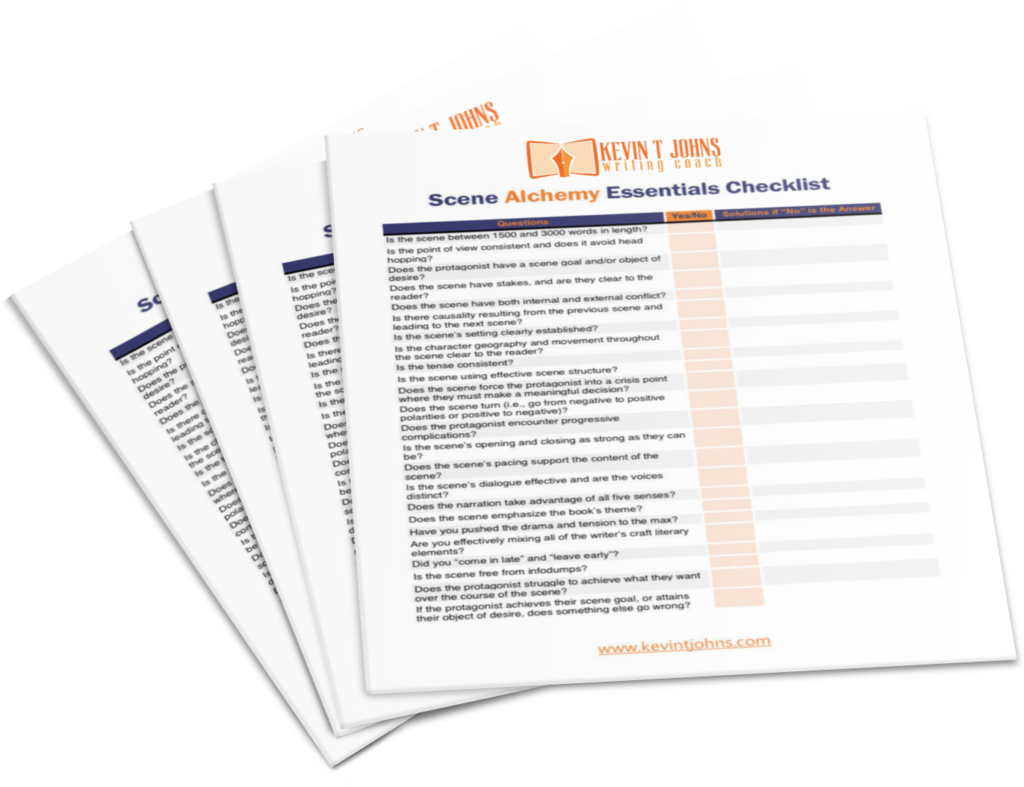
Kevin T. Johns is a writing coach who helps authors ditch the bloat, tighten their prose, and finally finish the damn book. Want help trimming the fat from your manuscript? Grab his free checklist for writing leaner, meaner, more publishable stories:
Download the FREE Scene Alchemy Essentials Checklist Now!