Every writer has a moment when a story that was meant to stay private begins to ask for a wider audience.
Sometimes it starts with a notebook. Sometimes it starts with a question from your children. And sometimes it begins with a simple realization: If I don’t write this down, these stories might disappear.
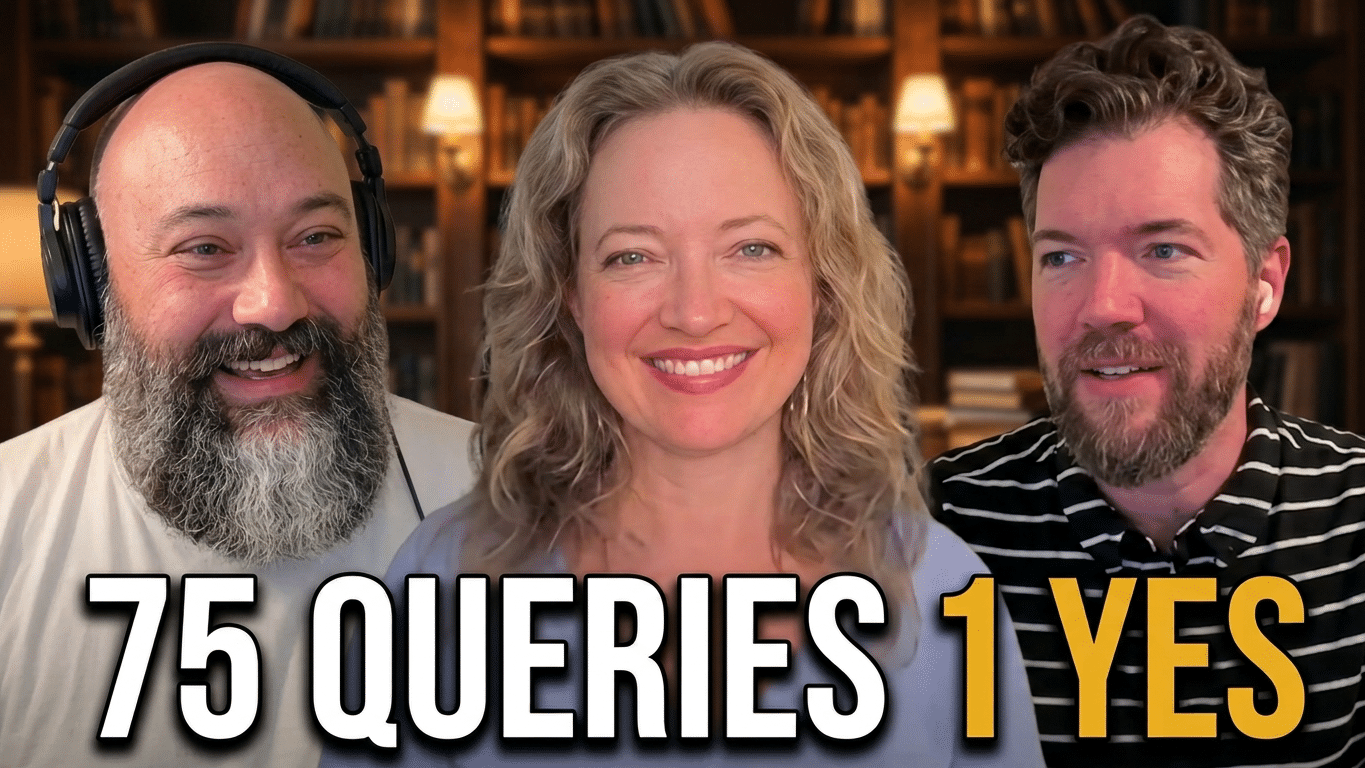
In this episode of The Writing Coach Podcast, I sit down with my client Margot Stornelli, a retired librarian who turned a personal journaling project into a full memoir. What began as a way to record her life for her children eventually grew into The Big Red Suitcase, a travel memoir filled with memories, reflections, and stories gathered over decades of living and exploring the world.
Margot’s path to authorship is both inspiring and reassuring for writers at any stage. She didn’t start with a grand publishing plan. She started with curiosity, a lifetime of experiences, and a desire to leave something meaningful for the next generation.
In our conversation, we talk about the surprising way her memoir began, how she slowly transformed scattered diary entries into a cohesive book, and what it’s like to move from being a lifelong reader and librarian to becoming an author herself.
If you’ve ever wondered whether your own life stories might be worth writing down, this conversation will give you a powerful reason to start.
Check out the episode now!
Audio:
Video:
In this episode
- Start a memoir by simply writing your life down for your family, as Margot did with several Word files she later connected into a book.
- Dig into old photographs and ask relatives for their stories to rebuild childhood memories, comparing recollections with siblings to fill the gaps.
- Ask the people who shared the experience for keepsakes, as Margot’s friends sent a scanned 1974 guest-book note for the chapter she wrote first.
- Use regular coaching and a small critique group to finish, since Margot says she would have abandoned the book without that support.
- Get away from home distractions for a retreat, as Margot did, and expect that even a surprise blackout can become a favourite night.
The Writing Coach Episode #222 Show Notes
Get your copy of The Big Red Suitcase by Margot Stornelli.
—
Get a FREE copy of Kevin’s book: The Science (and Magic) of Writing Retreats.
Buy a copy of Kevin’s new book: The Frustrated Writer’s Colouring Book.

The Writing Coach Episode #222 Transcript
Read the full transcript
Today on the podcast, I have my client, Margot Stornelli. Margot, welcome to the show.
Thank you.
You worked for years as a librarian, so obviously, books have always been a huge part of your life. When did you realize they were going to be such a big part of your career — not just then, but now as an author?
After I retired, I realized my kids didn’t really know my life story. And I knew very little about my parents’ life stories. So I decided I was going to write it down. I started by writing a diary, and once I saw how much material I had, I thought maybe I should actually learn how to write a book.
Tell me about that diary process. Was there a moment when you bought a notebook and thought, This is happening? Or did it just naturally start getting written down?
Well, these days I did it all online — on the computer.
Word? Or was there special software?
Just Microsoft Word. Several different files. Then I started putting those files together and trying to connect them.
The memoir, The Big Red Suitcase, is ultimately a travel memoir. At what point did you start thinking of it that way — instead of just “Here’s my life story for my kids” — and begin shaping it into a book about travel and your experiences abroad?
I think it was 2023. I had already been retired for two years, and my daughter had just had her first baby. I was doing a lot of babysitting, and I decided I wanted to pass my legacy down to her.
I started Googling memoirs and writing, and I connected with a woman in Alaska. She hosted weekly webinars — Thursday nights at 7:30 — and I tuned in every week with about 150 other people. She would often feature someone’s writing, but at that point I wasn’t actively writing yet.
After a year of listening, I thought, Maybe I should get started. I’m not getting any younger.
You worked in school libraries for much of your career. Was there ever a memoir you read that made you think, Maybe one day I could do this?
Believe it or not — Anne Frank.
Wow. That’s a huge book for so many people.
Yes. My mother is Jewish, although I wasn’t raised in the Jewish faith. I learned a lot about the Holocaust and the war in Europe later in life, especially when I was living in Europe fifty years ago. I had missed my senior year of high school, when they taught that material.
So I started reading memoirs by survivors of the war. Eventually I thought, maybe I could do this too.
That’s something you touch on in the book — learning about history and culture by actually going there. You write about speaking with Holocaust survivors and how different that felt compared to learning about it from a distance.
Yes. In 2025, it was the 80th anniversary of the end of the war. The Dutch and Canadians have a special connection because the Dutch royal family lived in Ottawa during the war — they were exiled there. Since then, there’s been an ongoing relationship, like sending tulips back and forth.
I went to an exhibition in Mississauga with a friend who’s also Dutch Canadian. Her father married a war bride. There were 80 participants featured in the exhibit. Their photographs were displayed along the walls with captions underneath — stories about where they were 80 years ago.
Most of them had been young children displaced from their homes. It was very moving. I think I ended my book with that exhibit. Seeing those stories — written by people who had lived through displacement — was powerful.
You were born and raised in America, then spent significant time in Europe, and eventually settled in Canada. How does the book explore that journey — and your evolving sense of cultural identity?
I moved to Canada about five years after returning from Europe. I had quit college at the time, met a man, and eventually married him here in Toronto.
After living in Europe, I never quite settled back into American life. I had this feeling that maybe I could live abroad again. Even when I visited Toronto on long weekends with a friend, it felt completely different — even though it was less than 200 miles from home.
Eventually, as a resident, it became home. I adapted to it and really enjoyed it. And 45 years later, I’m still here.
Given that this is a book about travel and movement — where do you consider home now?
Rochester will always feel like home — where I grew up — even though I left at 23. My parents stayed in my childhood home until the early ’90s. My kids were introduced to that house when they were young.
I still stay in touch with high school friends. We have reunions every five years and a webpage where we update our profiles.
I lived in Canada for 37 years before becoming a citizen. People always asked why I hadn’t changed my citizenship. I made excuses — maybe I’d move back to the U.S. someday, or become a snowbird in Florida.
But I’ll admit — the night Donald Trump was first elected in 2016, I downloaded the application. I was sworn in six months later.
The early part of the book revisits your childhood in America. I can’t remember what I had for breakfast yesterday — so how did you dig back into those memories and bring them to life?
Two years ago, my mother moved into assisted living. When my sister and I cleared out her apartment, I ended up with all the photographs because I had driven there and she had flown.
One day I started going through them — pictures I’d never seen before. My own photo albums don’t really begin until the 1980s, when I was living in Canada and had my own children. So I began piecing together the earlier years.
Both my parents are now in their late 90s. Whenever I visit — about every six weeks — my father talks about his childhood. He didn’t fight in the war, but he worked as a clerk on a fort in Georgia. He started sharing stories.
I asked my mother questions too, but she didn’t want to talk about her childhood. My older sister knew more than I did, so we started sharing stories and comparing memories.
I also mention in the book that when my father first began practicing as a family physician, we lived in a house attached to his office at a busy intersection. I don’t remember much of it from my earliest years, but later, when extended family visited Rochester and the main house was full, my kids and I would stay at the office house.
The upstairs had these old walk-in closets that connected together. My kids loved running through them. And I started imagining that maybe my childhood had unfolded in similar ways in that same space.
You write about the importance of family vacations — how those early trips shaped your later experiences in Europe. What were those trips like?
They were wonderful. Lots of road trips. We’d get up at five in the morning and drive seven or eight hours. One of our annual trips was to the White Mountains in New Hampshire.
We stayed at a lodge at the base of the mountain. We packed three days of clothes in backpacks and climbed up to cabins at the top — really more like huts with large bunk rooms, one for men and one for women, and a big communal dining area. They served hot meals and packed lunches for the next day.
I doubt there were any accommodations for food allergies back then. It was just the way it was.
It became a summer tradition from the time I was very young until I left for college.
Do you think those trips instilled something in you — curiosity, bravery?
Definitely bravery.
On our very first trip up the mountain — I was maybe five or six — we got caught in a snow or hail storm near the top. There were four children between five and ten, plus my parents. We’d been hiking all day and saw other hikers sitting on rocks and logs. We joined them.
People were starting to get worried about being lost. Some of the older men built a fire. Eventually someone noticed a searchlight in the distance. The staff at the hut must have realized that 15 people were missing from the reservation.
This was before radios or cell phones. They eventually found us. We were only about half a mile from the hut, but in those weather conditions it felt much farther.
Well, you bring up the idea of what was available back then — and that was something that really jumped out at me in the book: how disconnected people were before cell phones and before the internet was everywhere.
There’s a period in the book where you’re out of contact with your parents for over a month, I think. And I just think… if I go a day without hearing from my kids, I start wondering what’s going on.
It’s such an interesting glimpse into a time when kids — especially teens — had to be much more independent than they are today. So here you are… how old are you in the core section of the book? Eighteen?
My trip to Europe was age 17 to 18.
Seventeen to eighteen — and you’re alone in Europe, navigating other countries and cultures, without a cell phone, without a computer, without the internet or email… and yet it was profoundly transformative for you. So much so that you’re still writing about it all this time later.
Why do you think it was such a transformative experience — that huge adventure, on your own, in Europe?
Before I left, we had an exchange student a year or two earlier. I think she was with us for one semester — four or five months — and I really got to like her. And of course, as soon as we really got to know each other, it was time for her to leave.
My sister had been to France one summer before that. My brother had been to Israel working on a kibbutz. I have an older brother and an older sister, and then two younger brothers — so I’m right in the middle.
And I was thinking, in the back of my mind, that a summer was too short. It would feel like a vacation. If I was going to do this, I wanted to really get to know people and have the full experience.
And also… I don’t know. It was just a time in my life — like most teenagers — I wanted to get out on my own as quickly as possible.
I hear you.
So I looked into a year-long program. I was very concerned about whether I could do it during my senior year of high school instead of waiting until after I graduated — because I didn’t want to fall behind. I wanted to stay with my age group when I got to college.
I found out I could double up on credits — take an extra course, no study halls — and I could graduate as a junior instead of a senior. So that’s what I did.
And little did I know at the time that my departure day was going to be my graduation day. I kind of regret missing out on that.
But fortunately, our school district has reunions every five years, and they’re organized by class volunteers. A couple of times I even helped from Canada — looking people up online and trying to find them, because of course women change their names and all of that.
So it’s been nice that every five years, at least 100 of us get together. Our graduating class was, I think, 450 or 500 people. Of course, several have passed away. But there’s a core group that always comes — people who still live in Rochester, and people who come back for the events.
The book is called The Big Red Suitcase. What role does that suitcase play in the story?
Well, it wasn’t actually a red suitcase when I first started out.
Funny enough, I’ve had a red suitcase set for the last 20 years — four pieces that fit inside each other. It’s canvas, and I still use it.
The title went through a couple of name changes, but when I landed on the suitcase title, everybody — people in your class, and friends and family who knew I was writing — were really excited about it. So I stuck with it.
Do you see it as a symbol of freedom, or does it represent something else?
It’s like my little companion. I don’t have a dog, but I do have a suitcase on wheels that I can stroll through an airport.
One of my favorite parts of your book — and travel memoirs in general — is hearing about the food people eat in other places. Your book covers some really interesting meals, both good and bad.
Are there any favorite — or not-so-favorite — meals that come to mind?
I do not like pea soup, and that’s a staple in the Netherlands. More so with the last family I stayed with for a couple of months — not the other ones — but I sipped it and endured it as often and as much as I could. Maybe I mixed it with other things on the plate. I don’t remember.
There are other foods in the Netherlands that I was introduced to that I still have today. One is a stroopwafel. It’s a small, flat, circular waffle — maybe the size of a jar opening — with syrup or honey in the middle. It’s delicious.
It’s pretty much a breakfast staple, or you eat it with coffee or tea. They have a tradition of a coffee break in the morning, a tea break in the afternoon — like the British — and then another coffee or tea after dinner, usually served with little treats.
Ah, nice. Do you have a favorite moment from the book — or maybe a favorite chapter?
I’d say the chapter about the year in Europe, because it’s been a significant memory that I’ve cherished all my life. I adopted a lot of the customs I learned over there.
I still correspond with three girlfriends — one of them being the Dutch “sister” who was in California during the year I stayed with her family. We met in person three or four years later and we’ve been in touch ever since.
She and her parents also developed a relationship with my mother. My mother, brother, and sister came to visit the Netherlands that Christmas when I was there. We had two weeks together, and we took a side trip to Paris while they were there.
That chapter was actually the first one I wrote. I went through bags of pictures I still had — and I never did find the diary — but I got in touch with the three girlfriends and they sent me things.
For example, one of the girls had a summer home on an island north of the Netherlands. I’d been there twice, and I’d written a thank-you note in their guest book back in 1974. My friend found it, scanned it, and sent it to me.
That’s amazing. So you were able to incorporate it into the book.
Yeah. And the three of us have kept in touch for 50 years.
They’ve all been to Toronto and to the U.S. a couple of times where we reconnected. I went back to the Netherlands at Christmas in ’77 — about three years after my year there — and then it was another 37 years before I went back again. Once I got married, we didn’t travel that much. There were other priorities.
So it was really nice to go back 12 years ago, in 2013, and bring my daughter with me. I wanted to bring my son too, but he had other things going on.
My daughter didn’t end up meeting my Dutch sister because of the timing — I left on a Friday night and she arrived Tuesday morning. So I spent the first three days with my Dutch sister, then we visited the other two friends, and then we took a week to go down to Paris.
But my daughter was very impressed. She liked that everyone spoke English.
It does make travel easier.
It really does. Even the younger people spoke very good English. That was impressive.
Speaking of your daughter and son — and your parents, who are both still alive — you mentioned being inspired to write this because you wanted to share your story. The book is now out. Has anyone read it yet? Have you gotten any feedback?
It only went on the market about a week or two ago.
My oldest brother said he ordered it, but at the same time I gave the publisher a list of 25 family members and friends to send it to. So he’s going to get two copies. Hopefully one of them comes back to me.
I’m sure that feedback will start flowing in.
I advertised it on my high school website, and one of the girls jumped in and said, “Oh yeah, I’m ordering it now.” But I haven’t heard anything since.
Honestly, I’m still waiting for my copies to come from the publisher.
That’s how fresh this is.
I blame the Canadian mail service on that one.
Where is the book available? If people want to pick up a copy, where should we send them?
They can search The Big Red Suitcase and it’ll take them to Barnes & Noble and Amazon, as well as the publisher’s website and bookstore.
It’s available on Amazon.com and Amazon.ca. There’s been a pricing problem on the Canadian side, but they’re working on it.
I was able to buy my ebook copy no problem, so I’m sure the paperback will get sorted.
I hear paperbacks might be eliminated soon.
Oh wow. Okay.
Yeah, I just read that a few days ago somewhere.
Last thing before we wrap up: you attended my retreat last summer while you were putting final touches on the book. It was so wonderful to spend time with you in person and see you working so hard.
Can you talk about the retreat experience and the role it played in helping you finish the writing and revision process?
I was very impressed with the location and setting. It felt like an old-fashioned manor home in the middle of the woods — just north of Ottawa, on the Quebec border.
I originally thought about driving, but I told myself, once I get to Ottawa I’m going to get lost. So I flew instead — and it was really nice.
It was four days with a small group. You did a lot of teaching, and we also had free time to walk through the woods or do our own writing.
The hostess, Sandy, was very accommodating. She made delicious meals and always had healthy snacks out.
I was impressed by the whole experience. I’m glad I did it. I didn’t finish the book until around Christmas, but I got a lot done during that week — in a way you just don’t when you’re at home and distracted by everything.
Absolutely.
That was my “vacation” for 2025, and I’m glad I did it. It was a very interesting experience for me, and I highly recommend something like that to anyone — whether it’s writing, cooking, art… anything.
It was wonderful having you there, and it’s been so fun supporting you on this book.
Can I say one more thing?
Absolutely. That six-hour blackout was quite an experience.
So many people — whether they’re planning a retreat or writing a book — are focused on what could go wrong. They’re terrified, and they think everything has to go perfectly for it to be good.
But, as you point out, in the middle of the retreat we had a giant storm and lost power. Was it just after dinner — or almost during dinner?
I think it started around four or five o’clock. The power came back around ten.
I actually don’t think it came back until three in the morning.
But for me, that was one of the best parts of the retreat. We got out the candles, stayed around the table, and spent the evening talking. Maybe it wasn’t the most productive night in terms of writing, since we had no electricity — but it was my favorite night.
What I’ve always wanted is to create a life where I can spend time with artists — people who care about books and literature and cinema — and talk about the things that matter to me. That night felt like that: wine, beer, candles, and talking about books late into the night.
It’s a great example of how sometimes the best things are the things you don’t plan for — not perfect, but real, and special in their own way.
Margot, congratulations on the publication of The Big Red Suitcase. We’ll have links in the show notes so people can grab a copy.
What’s coming up in the next few weeks or months in terms of getting the word out about the book?
My book will be featured at the London Book Fair in England in mid-March. There’s also a book fair scheduled in Los Angeles in mid-April, and I’ll be attending that one to sign books with four other authors from this publisher.
I’m really looking forward to it, because I’ve always been on the other side of the table — getting my book signed — instead of doing the signing. So that’ll be a new experience.
And of course, getting back into social media and learning the updated technology again. I’ve been away from all that since I retired.
There’s nothing better than getting to follow the whole journey — from an idea or early draft to interviewing you now and hearing you’re headed to LA in a couple of weeks to sign books.
It’s exciting for me, and it’s been such a pleasure to be a small part of that journey with you. Thank you for allowing me to work with you on this project.
I just want to say I really, really enjoyed working with you this past year. I don’t think I would have finished this project without your guidance — two or three times a week — and sharing our scenes and getting them critiqued, not only by you, but by the other classmates.
I honestly think I would have abandoned it otherwise. Having that one-on-one support, and the small group experience of about 20 people to share stories with — that made the difference.
And I was the only one doing a memoir. Everyone else was writing fiction. So it was a very interesting experience being part of that group.
It was an honor to work with you. Thanks so much for joining me on The Writing Coach podcast today.
Thank you, Kevin.