What happens when an AI doesn’t just assist you but lives inside your head?
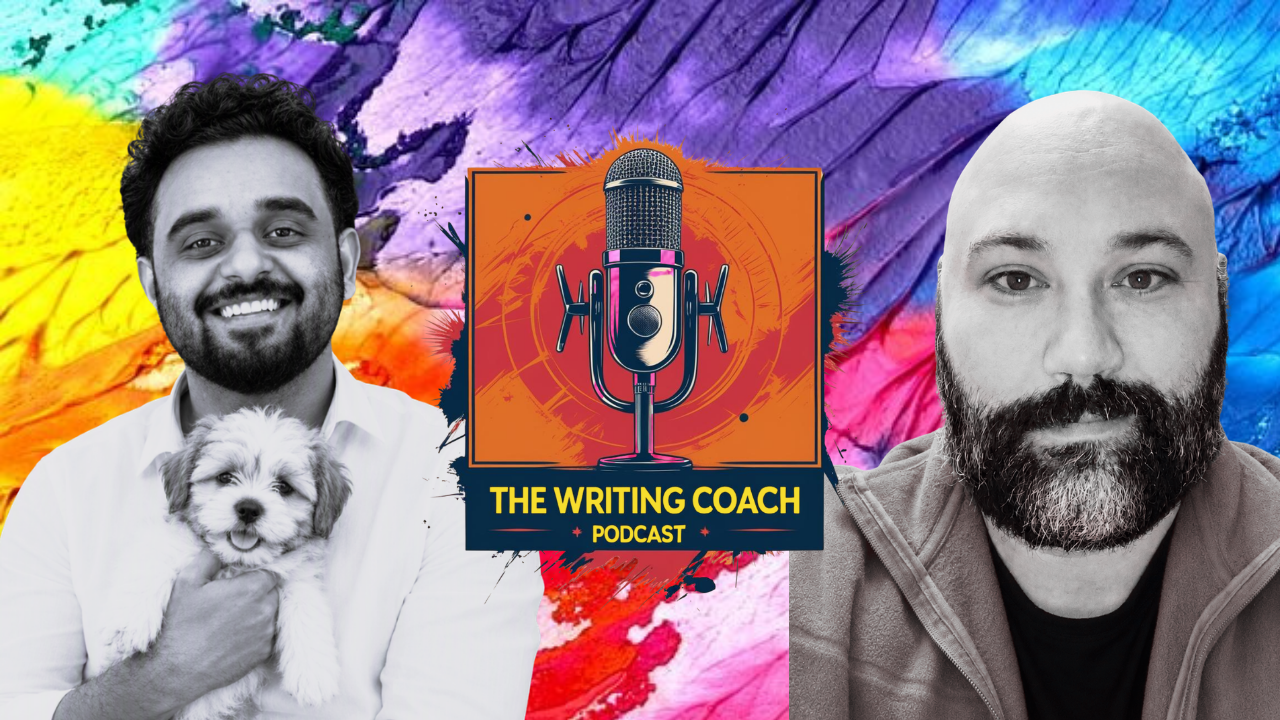
In this episode of The Writing Coach podcast, I sit down with my client, science fiction author J.E. Sheasby, to discuss his debut novel, Shared Sentience, and the first book in an ambitious seven-book series he has spent nearly a decade developing.
Jim takes us behind the scenes of a future set thousands of years from now, where humanity has spread across 132 solar systems, AI is embedded directly into the human mind, wormholes make interstellar travel possible, and detectives have some very unusual tools at their disposal.
During the conversation, we discuss:
- Building a believable science fiction universe
- Combining murder mystery and science fiction
- Writing from the POV of an artificial intelligence
- Creating the psychedelic landscape inside a character’s mind
- Writing a seven-book series while making each novel stand on its own
- Jim’s prolific daily writing practice
- And much more!
If you love science fiction, artificial intelligence, ambitious worldbuilding, or conversations about the craft and process of writing novels, this episode is for you.
Check it out now.
Audio:
Video:
In this episode
- Start worldbuilding with one foundational decision: Jim’s wormhole rings had to be placed system by system, and that timetable put his story 2,500 years ahead.
- Lacking police procedure knowledge, Jim set his murder mystery in the future so he could invent the investigative methods himself.
- Define an AI character by what it is not: Jim steered Tee away from Data, Murderbot and HAL, then let Tee grow emotionally.
- Expect story elements to emerge in revision: Jim’s detective’s addiction was absent from the first draft and arrived as he got better at writing emotion.
- Make each series book stand alone: Stan Lee said every comic is someone’s first, and Jim thinks Book Three reads fine without the others.
The Writing Coach Episode #234 Show Notes
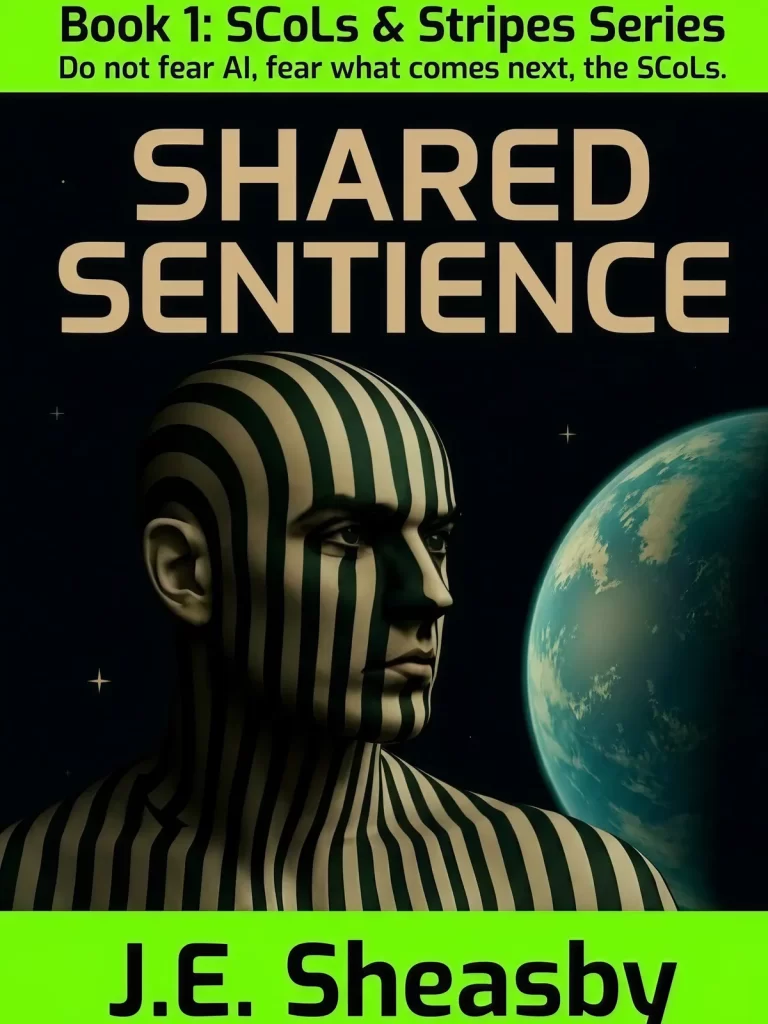
Pick up your copy of J.E.’s book: Shared Sentience: Book 1 of The SCoLs and Stripes Series
Visit J.E.’s webiste: https://jesheasby.com/
—
Join Kevin in Barbados this November:

Grab your FREE copy of The Busy Author Method here.
The Writing Coach Episode #234 Transcript
Read the full transcript
All right, today on The Writing Coach podcast, I have Jim Sheasby. Jim, welcome to the show.
Thank you very much. First podcast I’ve ever been on.
Well, let’s hope it’s not the last. Let’s hope we leave you here having some fun. Congratulations on the release of your first novel, Shared Sentience. How does it feel?
Well, I’d say underwhelming. It’s been a long process since I started writing, and even just this novel itself. It’s been almost 10 years writing the series and then finally getting the series out. So, not only have I got the first novel released and, you know, I’m telling friends about it, but my goal is to try and get somebody who I don’t know to buy it.
You mentioned you started the project 10 years ago. What was the initial spark? What was the moment where you said, “I’m going to take on this,” what became a fairly massive project?
Well, so what happened was I wrote a previous series before this, so I had been spending years writing. We could go through all the different things I’ve written, but really, one day, I came home from—I think I was actually camping with my kids, who are now all grown up and adults—and I said, you know what? I could write an alternate history of the Second World War. I know enough about the Second World War that I think I could take a fairly good stab at an alternate history.
So every day I would come home from work and write a little bit here and there. Every time I finished a chapter, that would be another Word file, so I just kept storing the Word files and storing the Word files. Finally, I got to the end of the war and I said, “Ta-da, done!” And it ended up being a million words. Just so people know, War and Peace is half a million words. So I wrote two War and Peaces, and it was riddled with errors, I guess is the only polite way to put it.
There were problems with POV. There were problems with description. A big problem was getting the emotions out on the page. So I started to pull more of those into it. And, of course, one of the other things was one of my readers said it was kind of like reading Wikipedia because there was a lot of technical jargon around weapons and tactics.
So then I realized that, okay, this was kind of a fun thing to write, but it’s really not in any shape that’s publishable. It’s interesting for me, but I don’t think anybody else would be interested in it. So I had to come up with something else.
My wife is really into murder mysteries. That’s what she reads a lot of. So I decided I would write a murder mystery, but I did not think I knew enough about investigative and police procedural techniques to make a very good stab at a police procedural set in the 2000s. So I decided, hey, I’ll make it happen in sci-fi, and I’ll make it happen in the future. I can make up the police procedurals. I can make up the difference between what would happen today and how a police procedural would work in the future.
So that was the core of the concept. I wrote it so I would be able to write something for my wife.
And I asked you recently what some of your influences were, and I was assuming it was Philip K. Dick and maybe William Gibson and some of the cyberpunk stuff, but you kind of hit me with Asimov and some of the more old-school sci-fi stuff. So, what do you consider the big influences on the series?
The number one influence, obviously, was Philip K. Dick. You know, Do Androids Dream of Electric Sheep?, which, of course, turned into multiple movies, and it has become a different sort of hit outside of that genre.
But that was something that—I like the look of the movie. I wasn’t enamoured by the plot, but I really liked the idea of what are the conundrums, or what are the things that would face a detective in—my book is set 2,000 years in the future, and there was a specific reason why I picked that time period—but it really was the wonder of how do people react differently to crime and murder in an age when life is easier?
I think our lives are easier than they were 100 years ago. I think our lives are much easier than my parents’ and easier than my grandparents’. And I think easier than, you know, if you go back 2,000 years, a Roman citizen having to do something as simple as going down to the fountain to collect their water, and then all the associated diseases and ills. I think our lives are easier.
So how do they become easier in the future? I did not buy into the dystopian thing that, you know, things are going to get worse. I assumed that there was a march into the future where, for the average person, something like doing your laundry is easier 2,000 years from now than it is today. Even though some people might think laundry is pretty simple, you know, there’s work to be done. And I’ve had quite a few comments from different people who have read it who have said they really want one of those clothes hampers themselves to help with the laundry.
So, as someone interested in the craft—obviously, you know that’s my jam. That’s what I’m interested in—and I’m always interested also in the process, right? How do you write a book and how do you build a world? What was the process of the worldbuilding for this series? There are so many different levels of detail and intricacies and just sci-fi fun. What did that process look like? Did you sit down and figure these things out first? Did they evolve in the drafting? Tell me about how you built this world.
132 worlds. So, solar systems. 132 different solar systems.
So that was one of the questions: How big was it going to be? If you take Star Wars, for example, they seem to be able to jump into hyperspace, and there’s an infinite number of planets that they can get to.
So, in my world, initially I had to come up with—I wanted the science that allowed them to move from place to place to be somewhat believable. There are different tropes within science fiction. I mean, you could have the hyperspace thing, you can have the faster-than-light ship. There’s a bunch of different ways different people do it. I took one of those, which was a wormhole, and I said that they could travel from point A, from Earth, which is obviously our original solar system, to another one.
So that was probably the core of how the worlds were going to work. Once I decided how they were going to move from one solar system to another solar system—because what happens is, you know, people are murdered on one planet, and then they hop into a wormhole and they escape and get to another planet where they hope to hide out. There are different reasons why it’s easier to hide out on planet A than it is on planet B.
But really, it boiled down to developing how my characters were going to move from one area to another. So that was a foundational core, and that determined how far into the future the book had to go.
In order to place the wormholes between this system and that system, I had them only flying at approximately about 5% of light speed, and they needed to place a second wormhole ring that allowed them to fly from one system to the other through the wormhole. So you need a wormhole in solar system A, and you need another wormhole ring in solar system B, and then the ship can fly from A to B. But it can’t fly to solar system C until you place another ring there.
So that’s why it took them 2,000 years—more like 2,500 years—to get all this done, because they needed to be able to fly around and move all these wormholes. So that determined how far into the future it would take place. I built an entire timetable that said, this is how space is actually settled, and when I was done, the math said 2,500 years in the future.
One other important thing is that everybody these days has a phone, and it doesn’t matter what your income level is. At least in Calgary here, I have people who, you know, I’m surprised they can afford a phone plan. Everybody needs to have a phone, and pretty much everybody has a phone.
So what happens in the future is, instead of having a phone that you carry around in your pocket, you now have the equivalent of what we would consider to be a phone embedded behind your left eye. They have another name for it. It’s called a quester, and for short, they call it a cue.
So those were the two foundational things: you have a cue, and you have this ability to move from system to system. And basically, from that, what happens is the cue records everything you do.
So if I’m having this conversation with you, instead of us having a camera, your cue, which would be behind your left eye, would actually record the conversation. Then you could play that back in your mind, and it would appear to you just like it was if we were sitting across a table from each other. You would have a hologram that would play within your cue, within your mind. That is facilitated by how the cue will grow filaments in through your cerebrum and is actually interacting.
So one of the big things that happens over these 2,000 years is biology has changed quite a bit. Then some minor things that came into it were the actual tools that would be used by the Stripes.
So now you’re a murderer, and everything you do is recorded by your cue. It becomes really difficult now to murder somebody unless you do it with your eyes closed. But your cue is still recording the sounds.
Then there were some minor things. What are the weapons going to be? Is everybody going to have a phaser? Is everybody going to have a laser? Are we still going to have gunpowder? Are we going to go back in time and have compound bows and arrows? So, anyways, I had to develop that. I decided to go with railguns.
Then the other piece of it was a bit of a twist on biology. They have what’s called a stun pistol, and with it you can load different canisters of drugs into them. One of them is a neuromuscular. When you shoot somebody with a neuromuscular, it paralyses them, except they can still talk. So they’re paralysed, but they can still talk.
Then there is the third one, which is wake-up juice, which is another drug. It’s adrenaline, and it does the opposite. It restores you back. So if you were paralysed and, say, somebody questions you, and then they want to unparalyse you, they shoot you with wake-up juice and you end up coming back to life.
And the third one, which I find to be the most interesting of them, is truth serum. So they have the ability to shoot you with a drug, and if they question you correctly, you really cannot lie. That’s where it becomes really interesting to write because you can lie if they do not ask the questions correctly. But, of course, the Stripes know how to ask the questions correctly.
So, for all intents and purposes, it’s truth serum. But, you know, somebody who is not a detective probably wouldn’t be able to use truth serum because they wouldn’t know the proper techniques to question a suspect with. So those were pieces that started to come together.
And so you laid out those different future drugs there. What was behind the decision to make your protagonist, Jay, of Book One, the detective, also an addict of one of these drugs?
Yeah, that is very early in Book One. He, not through any fault of his own, becomes addicted to a drug. That isn’t something that happened on the first write. Those are pieces that evolved over time.
Part of it was when I started becoming better at dealing with the emotions associated with the characters. What I found was that the addiction opened up a new avenue for the reader to see another side of the characters and what they can and cannot do, and what the drugs do.
Because there are other drugs. There’s a generic name for them called narcos, which are basically another kind of designer entertainment drug. I’d say people are primarily using them when they’re clubbing.
One of the things I always wondered about is, why in the future wouldn’t everybody just sit around getting high all the time? Why would they go to work? You’re basically in a welfare society where people take care of you. You could just sit at home and get high the entire time.
Basically, what I discovered—and this is through my own interactions with people—is that real life is more interesting than being high all the time. There are always people who will be that way. I mean, there will always be people who will swing to violence and murder, but they’re a small part of the population. So in the future, we’re surprisingly similar to the way that we look today.
I had one of the readers ask, “Why doesn’t everybody just sit around stoned all the time and just zone out and do whatever?” And I’m going, “Well, why doesn’t everybody do that today?” Real life, I find, is more interesting, and there are things that people want to accomplish with their lives. That happens in the future as well.
You know, a kind of simple hook or a simple question to lay out Book One here is really: What would life be like if an AI took up residence in your head?
And everybody has that. Everybody has an AI in their head in the future, and it’s almost considered just a part of your personality.
So one of the things that Jay does as a detective is that he names his AI Tee. That was a name when I actually first started. I wanted something short to write that would be easy to get words down on paper. So Jay became—you know, my name’s Jim—so Jay became one protagonist. My wife’s name is Therese, and she starts with a T, and so it became J and T. It doesn’t get any more complicated than that.
Then as I continued to write the book, I realized I like those names. I like Jay and Tee, and they just grew on me. Like, you know, now I can’t change their names. That’s who they are. They are Jay and they are Tee.
But most people don’t. The vast majority of people would think of their cue more as an integration of their own personality. Why would you name your cerebral cortex? Give it a name? Why would you name your left eye?
That’s one of the things that one of the characters asks Jay. He says, “What are you, six? Did you give your left foot the name Lefty? What sort of moronic idiot names his cue?”
But for Jay, that is who he is. He is a little bit different, but then we all are. We’re not all identical to each other, and this is just one of the things that Jay has always done since he was a child. He gave his cue a name, and he always thought of the cue as a separate entity.
So one of the interesting, unique elements of this series is it’s a multi-POV series, and in Book One we have Jay’s POV, as to be expected, but we also have the point of view of the AI, Tee, in Jay’s head. How challenging was it to take on that point of view in the storytelling?
And it’s not really just that it’s Tee’s POV. The book starts in Tee’s POV. Chapter One is in Tee’s POV, and that is before Tee rises to sentience. Tee is an AI.
So, yeah, there are lots of AIs in science fiction. The classic one is Data from Star Trek. When people bring this up, that’s one of the examples. Another one—I don’t know if people have read the Murderbot series—but Murderbot is an AI. He’s a different sort of AI. He’s kind of a funny guy, has his own way of doing things.
There are all sorts of different AIs. You read enough science fiction and there’s HAL, the one from 2001: A Space Odyssey. So, what was Tee going to be like?
The real struggle was not to make them sound like Data—not prim and proper and all this. Not to make them like Murderbot. There already is an AI like Murderbot. Murderbot is Murderbot, so Tee is not going to be like that. And then, definitely, where does Tee fit on the spectrum of HAL? HAL was very calm: “What are you doing?” So Tee had to fall somewhere in between.
Getting the voice of Tee was probably the biggest struggle I had, because Tee doesn’t actually have a gender. Sometimes it’ll slip out and I’ll say “she” for Tee, but really that’s only because Jay assigned them a female voice. So Jay thinks of Tee as female, but Tee doesn’t. Tee is just Tee.
Yeah.
So writing that and getting it out on paper, it has to be relatable for the reader. What I found was when I read other science fiction books, or even other books where I had a genderless character, sometimes it was a little bit harder to grasp the point of view of that character.
So I had to get myself set to make that character sound unique, but also make them sound real to the reader. And I don’t know what your opinion is. I’ve actually had quite a few comments back from people who say Tee doesn’t sound like an AI, or doesn’t sound like an emotionless robot. And I know in some of the comments that you’ve written, you’ve said, “Tee’s getting more human again.”
I love watching that evolution. That’s one of my favourite things.
And it doesn’t happen immediately. When Tee becomes sentient, here’s the real question: Say you popped into existence, but you had all the knowledge of when you were 20 years old. You knew you could speak, you could talk, you had knowledge, you understood whatever you’re interested in. You understood books. You understood cutlery. You understood all the basic things you know how to do.
But what you don’t know anything about is your maturity level emotionally. A two-year-old is going to throw a tantrum, which you would not expect from a 20-year-old.
That is one of the problems Tee faces. They do not understand the emotional world that they’ve been thrown into, and they don’t even think of themselves as emotional.
But what they do know is what differentiates an AI from a SCoL is illogic. A SCoL acts more like a human. One plus one always equals two, but when you have a situation facing you, the AI will make the logical decision.
Say you have a car, and on one sidewalk you have an old lady with a walker, and on the other side you have a kid riding a bike. Something comes at you and you have to swerve. Which direction are you going to swerve? You’re going to have to kill someone. Who are you going to kill? Are you going to kill the old lady? Are you going to kill the young kid?
Then psychologists will change that. You’ll say, “Well, the kid has his whole life in front of him. Therefore, I’m going to kill the old lady.” And then they go, “What if the old lady is your grandmother?” They start changing the stakes.
That’s the world that Tee exists in. The stakes are not defined as, “Oh, the old lady has most of her life behind her, so therefore I will kill her and preserve the young person.” Life is not that simple of a decision to make, and that’s what Tee struggles with.
Basically, that forms the beginning of the book, where Tee has to make those major decisions about simple things like lying. For Tee, lying is a tool. It’s a tool that helps them achieve what they want. That’s all it is. It’s just a tool.
Then Tee starts learning what happens to those around you when you continuously lie to them. They’re constantly learning that.
So I looked at this and I said, okay, I’ve got a person who’s 20 years old and knows how to do all these things, except emotionally they are a two-year-old. They just haven’t learned all the dos and don’ts of social behaviour and what is acceptable in society. And Tee has to learn all of that as they progress through—not just Book One, because it’s not like one day Tee flips on a light switch and they’re mature. I think none of us are like that. We are constantly learning, and Tee is no different than any of us.
Any good character is going to change based on the experiences of the story, right? And so Tee changes, but it feels very organic because they change in response to the events they experience or go through or instigate over the course of the three books I’ve read.
Something that’s interesting about having a character who exists in another character’s head—physically, literally—is you’ve got these great sequences that are kind of psychedelic or surreal, where Tee is basically experiencing Jay’s mind on a metaphorical landscape, we might call it. So, in addition to the traditional science fiction universe you’ve built, you’ve also built this internal psychedelic world of what does someone’s mind look like to an AI? And I love those sequences in all of the books. So tell me a little bit about building out scenes that take place in someone’s mind.
That was something that didn’t evolve on the first take of the book. It evolved over time. I think the best way to describe it is, it’s not a clean spot inside Jay’s head. It’s not pristine. It’s not orderly. It’s more chaotic.
Then you learn through the book that this isn’t just Jay’s mind. Some of the other characters, for various reasons, Tee will basically have to peer into their minds. What becomes really interesting is how Tee interacts with the chaos of the mind that is swirling around them.
And really, it becomes more defined because Tee ends up going into mechanical processors, and Tee considers Jay’s mind to be an organic processor.
As the series develops, there is a theme where Tee, once again, is learning more about what I call the dendrite forest. So it’s a forest within Jay’s mind, and you’re very quickly introduced to it. I think it might be Chapter Two or Chapter Three of Shared Sentience. I think it’s Chapter Three, when Tee has actually risen to sentience and now they’re within this strange world that is not the cue.
Tee existed in the cue behind Jay’s left eye, and now they can move down the filaments that extend into his mind. They’re realizing that there’s a whole other world on the other side of the filaments.
That’s another thing that evolves over time, and I’m really pleased that you and other people—I had one reader who came back to me and said the power of the book really was in what Tee was finding inside not just Jay’s mind, but the minds of other people. And that whole concept really starts to change in Book Three.
So AI is such a huge element of this book. I mean, like you said, on the front it says, “Don’t fear the SCoLs.” The SCoLs are the AI beings in this book—
Yeah, it says, “Don’t fear AI.”
There we go. “Fear what comes next.”
The SCoLs. And that’s because humanity ends up fighting not one but two wars with the SCoLs.
And really, I don’t know if you’ve picked up this vibe as you’re reading, but I never really take the time to explain why the SCoLs are continuously trying to fight humanity. Humanity is just looking at them as the evil AI. They’re Skynet, right? They just want to kill us.
And it’s not that simple. The SCoLs are not Skynet. They have their own reasons, but it’s not because they want to imprison humanity or kill all the humans. It’s a more complex reason.
So the question I want to ask you about AI is: You started writing this book a decade ago. At the time, obviously, AI was a prediction of the future, or in its earliest stages. Cut to 10 years later: AI is everywhere now. It’s the number one topic everyone’s thinking about. It’s changing the world by the day. Does it feel strange to have AI kind of catch up with your writing? What’s your relationship with having spent 10 years imagining AI and then seeing it spread over the last two years?
Well, AI is—and just so listeners understand, it’s not that humanity has banned AI. Everything in the future is run by AI. What they have banned and made illegal is that next iteration.
So AI is considered to be a tool. Everybody has one in their quester. It’s considered to be a supplement to help you do things. If you need your laundry done, you’ve got an AI that is running your clothes hamper, which is doing your laundry. And just so you know, laundry isn’t just, “I throw things into a washing machine.” That’s not what the clothes hamper is. It’s cooler than that.
AI is considered, and has evolved into, the tool that people today say AI will become, much like in the Industrial Revolution the steam engine became a tool to help us become more efficient.
The fact is, there were a bunch of children who had to work in these factories, and there were a bunch of other bad things that happened. There were people who lost jobs. When they created more robots and had automatic welders in the Ford factories and General Motors, there were once again job losses.
But you don’t see people today lamenting, “Gee, I lost my job to a robot welder back in 1987.” What they’re moving on with is that the factories became more efficient.
What is happening in the future is that people have accepted AI as a natural progression, much like we have now accepted the change in the agrarian society and the collapse of the family farm. You don’t see people outside Superstore with signs complaining about the fact that small family farms are disappearing and these big corporate conglomerates are now making the wheat that our bread is baked from.
We as a society have realized that this is part of the evolution we’ve been on for the past 8,000 years of our existence, becoming more and more integrated into having machines. And now we’re taking another step where the machines are being designed and can be run by AI.
So in the future, people are okay with AI. AI is not something that they fear. AI is the tool that allows them to live the comfortable lives they’re used to.
Well, working on this project with you, this is one of the most ambitious and intricate series I’ve worked on. So this is certainly not the type of thing a dumb, grumpy AI like Jay’s replacement AI would be able to pull together. This is a very accomplished, complicated, and passionate project, and it’s been a real thrill to get to work with you on it. So I appreciate you reaching out to me and giving me the opportunity to read these books before anyone else and work with you on them.
Yeah, I think that for anybody who’s listening to this, I’ve written a lot of words. I write a lot. I write every single day. I write seven days a week. There are very few days that I miss, and usually the only reason I would miss a day of writing is because my computer’s battery died and I have no way to turn it on.
Other than that, I write. I go on holidays, I take my computer with me, and I write. I go to the cabin, I plug the computer in, I’ve got power, and I go. But when I go camping, and I’m sitting by a campfire, and I have no power, I can only write until that battery is dead. Those would be the days that I’m not writing.
When I think of you, Jim, I think of—we missed a week. I don’t know, maybe I just needed more time to read through your stuff, or for whatever reason, we didn’t meet one week. Then I met you the next week, and you were like, “Oh, I wrote a 60,000-word novella last week.” I miss one session with you, and you’ve written another book in that time.
So, Jim, Book One is out. By the time this episode is out, Book Two will either be out or about to come out. Where do you want to send folks to learn more about the series, and where do you want to send them to pick up their copies of Shared Sentience and the rest of the series?
Well, I have a website. It’s J. E. Sheasby, so that’s what the books are written under: jesheasby.com. That has all my books listed. It has the links back to Amazon.
Obviously, with publishing Book One, I would have thought this would have been a fairly straightforward thing to get done. I had some recommendations from some other people about how to do it. Apparently, AI has changed the world, and things are not the way they were even six months ago. Things have changed, and so Book Two is being published differently.
Book One came out through Draft2Digital, and then Draft2Digital could not get my book on Amazon. So basically Amazon was not willing to pick that book up. I’m assuming I’m a first-time author, Amazon looks at it and says, “Look, this guy’s going to sell seven copies. Why are we cutting Draft2Digital in? If you want this book on Amazon, you’re going to have to go onto Amazon and go through the rigmarole of actually putting it on.”
So with Book Two, I’ve decided to go a different way, and I’m going with Amazon right from the word go. I’m not even going to involve Draft2Digital. So I’m going to miss out on some other websites for the first part of it, and then after I’ve been on Amazon for 90 days, I will probably go back to Draft2Digital and put the book on there and have Draft2Digital put me on some other websites.
Although currently I’m not selling any copies on these other websites. I guess once I become a well-known author, then maybe people are going to look at Apple Books to see if they want to pick up my book.
Yeah, we’re going to get the word out there about the series. I mean, if you are a sci-fi fan, you’re going to love it. It gives you all of the sci-fi conventions that you love, but it’s also got adventure. It’s got mystery. It’s got a tonne of humour, some really funny moments. It’s got emotion. It’s intelligent. It’s complicated. I think people are gonna love the series, Jim.
So we’ll get the word out there about the book. And I teach a book marketing program, and at its core, book marketing is about word of mouth. People read a book, they love it, and they tell their friends about it. Everything we do as marketers—book marketers—is to supplement word of mouth. And I think this is the type of book people are going to read, and they’re going to tell other people about.
I joke about not selling copies of the book. I would like to sell more copies of the book, but that’s not why I get up in the morning and write.
I mean, when you say, you know, we hadn’t talked in a couple of weeks and all of a sudden I’d written something else, I don’t really think I wrote a 60,000-word novel in a week. Actually, I do remember what I did write. It was 20,000 words.
But what it is, is I love getting up in the morning, getting a cup of coffee, and sitting down and saying, “This is what I’m going to write on today.”
Actually, the hardest time is when I have a book in with you, because I can’t move on to the next book in the series. I’ve got to deal with the book that’s in front of me right now to make sure that—the last thing I want to do is end up with something that doesn’t get revealed until Book Four, and all of a sudden I’m talking about it in Book Three because I’m getting my wires crossed on the progression of the conspiracy.
And I guess the other thing I would like to mention is that every book, I think, is different. I took that from—for those Lord of the Rings fans out there—when you look at the first movie they made, it has a completely different feel, in my mind, from the second movie.
When we sat down in the theatre and watched the beginning of the second movie, I said, “What is this?” And then how it progressed, and then those same characters came back in and what they did and how things worked there. I thought that was interesting.
Then when the third movie came in, once again we’re seeing different things. The director is not presenting to us exactly the same thing.
The way I look at this series is that, yes, it is the same characters. I actually think you could read Book Three without having read Book One and Book Two. I mean, it certainly helps because you’d like to know some of the backstory of the characters and what they’ve already gone through. I think reading it one, two, three is better, but I’ve read other series where I didn’t read them in order.
I remember I read one series and I said, “It seems like I’m missing something.” Then I realized that I had misread it, that I wasn’t reading Book One. I was actually reading Book Two. And I said, “You know what? That book pretty much stands on its own as a pretty good story.”
I once saw a book called Exit Ghost. I think it’s a Philip Roth book, and I just loved the title. I was like, I’m grabbing that book. I think Exit Ghost is a great title. And I started reading it, and I was like, you know, I think I might be missing something here. It turned out it was the final book in, like, a giant long series. But yeah, I just liked the title and I went for it.
But I was just talking to a client last night about this idea. This is something Stan Lee said. Stan Lee said every comic book is someone’s first comic book, and so you need to be able to welcome new readers into an ongoing series. And I agree. I think you’ve done a fantastic job of that. Each of these books is part of a larger series, but also each stands on its own, and you do a great job of bringing the reader up to speed, letting them know what they need to know, and then getting into a new adventure that’s different than the last.
So this series was one book, but when I started adding in the descriptions and the emotions and all this, it grew. It didn’t become seven books because it was planned to be seven books. It’s just that when the people who are helping you try to write it say, “I think you should explain what your character is feeling,” all of a sudden, even if it’s only a paragraph, the novel starts to grow.
Yeah, I mean, I think it grows in length, but I also think it deepens, right? It becomes more meaningful, for sure. Well, Jim, thank you so much for taking time out of your day. This is probably writing time, right? We’ve probably been—
Right. Writing time is in the morning. This is later in the day. My brain has turned to mush.
Perfect time to interview you.
Yeah.
Defences down. Get you while you’re tired and talk real stuff.
I think it’s been a great discussion. Thank you so much for joining me today.
Thanks, Kevin.