If you’ve ever felt like promoting your book on social media is a second full-time job you never signed up for, this episode is for you.
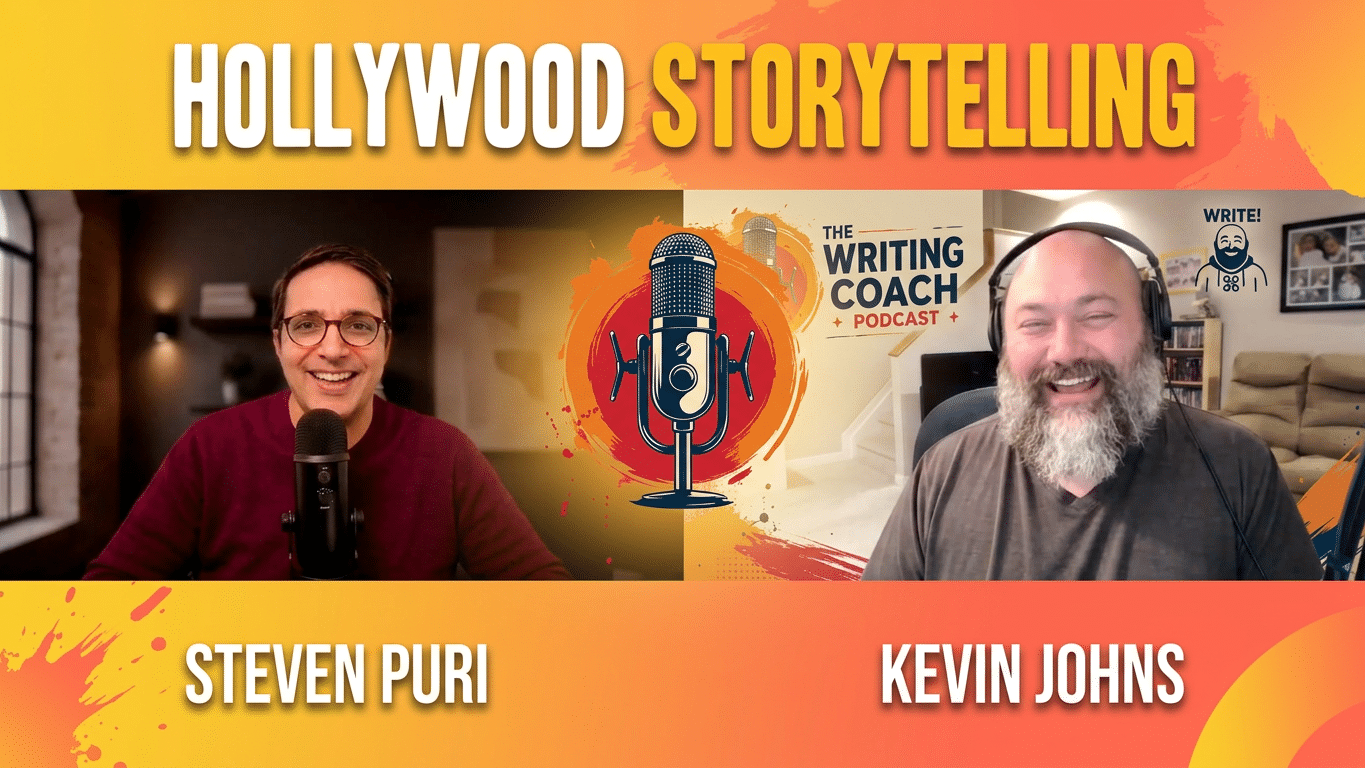
My guest is Marvin Wey, co-founder of AuthorScale — a tool that helps indie authors turn their own books into the social media posts that actually sell them. Before AuthorScale, Marvin spent years working with six- and seven-figure authors at Inkit and Galatea, watching what happened when BookTok turned overnight virality into a real marketing channel.
We get into the two post formats that are actually working right now, why he thinks “creativity in the author world belongs to the books,” and how to figure out which scenes in your own manuscript are worth promoting — without burning yourself out trying to be clever on TikTok every single day. We also talk honestly about the AI question: what it’s for, what it isn’t, and why AuthorScale built a zero-AI version for authors who want nothing to do with it.
If marketing your book has been eating time you’d rather spend writing it, here’s Marvin.
Check out the episode now!
Audio:
Video:
In this episode
- Find post ideas worth copying by looking up top authors in your Amazon subcategory, then searching their names on TikTok or Instagram to spot patterns.
- Lean on proven formats like the hook-led slideshow and the Kindle screenshot excerpt, where the book itself is the marketing, so you skip daily creative pressure.
- Treat consistency as the main factor: expect to post a couple of times daily for months before traction, within one to three hours a week.
- Choose scenes to promote by asking beta readers what stood out or checking Kindle reader highlights, favouring emotional and funny moments.
- Batch your posting by filling scheduled queues on a Sunday, and choose a zero-AI workflow if you want hooks and slides to stay your own.
The Writing Coach Episode #236 Show Notes
Visit AuthorScale at authorscale.com
Learn more about the Barbados Writing Retreat:
Grab your FREE copy of The Busy Writer Method:
The Writing Coach Episode #236 Transcript
Read the full transcript
Today on the Writing Coach podcast, I have Marvin Wey from AuthorScale. Marvin, welcome to the show.
Hi, Kevin. Thanks for having me.
You got your start working in the technology space as it relates to authors and book publishing almost a decade ago. Tell us about that.
Yeah, so that was back in 2016. I was one of the first employees at a company called Inkit. Back then, it was a very early stage startup — there were a couple of people, and I worked very closely with the founder. The main idea behind Inkit was that we had a platform where authors were uploading their manuscripts and readers were able to read those entirely for free. And while the readers read the manuscript, we analysed the reading behaviour. This was pre-AI, so all the algorithms were developed in house, and we looked at the reading engagement, and based on that, the idea was to pick the books that proved promising based on the reading data rather than subjective gut feeling, and then publish those titles commercially.
That was kind of the founding idea. Self-publishing was getting stronger and stronger, but a lot of authors still had this big dream of being a published author. That’s still the case nowadays, but I think less so, because it’s very easy now to make a living as a self-published indie author. There were all those popular rejection stories — editors receiving manuscripts and rejecting them — and we believed that was very unfair. J.K. Rowling being rejected 13, 14 times or something. A lot of authors have had dozens of rejections, and after they kept insisting, their books sold millions of copies — Harry Potter being one of the most popular examples. But many authors probably gave up earlier, after five or six rejections, thinking maybe my book isn’t that good after all.
So we tried to democratise that by outsourcing the decision to actual readership. If you have a book that a thousand readers start reading today and they all finish it within a weekend — I’m exaggerating a bit — then you’re like, wow, must be something good about this book. Let’s have a closer look, let’s talk to the author, let’s close a deal and publish the book commercially. That’s what we did in the very beginning. The company then underwent a very steep trajectory from Inkit to later spinning off Galatea, an immersive reading app where the best stories from Inkit are put onto Galatea as premium stories — readers pay to read it, kind of as competition to Amazon or Kindle Unlimited, but with more interactive features and an enhanced reading experience. Now it’s even branching into Hollywood, taking those stories and turning them into videos.
So that was my touch point in the author world. To bridge to how that led me to founding AuthorScale — I worked closely with six- and seven-figure authors during my time at Inkit and Galatea, partnering with them to write stories and upload them to Galatea, bringing their readership over. And while working with these authors, around 2022 or a bit earlier, when COVID hit, BookTok came along, and a lot of authors found tremendous success with TikTok — seemingly simple posts that would go viral and overnight catapult a manuscript into the top 10 of the entire Amazon store. A lot of authors focused heavily on that strategy, on those formats we’ll talk about in a bit. Readers moved more and more to social media to discover their next read, and nowadays social media is one of the strongest channels for authors to grow. And then AI started getting stronger and stronger, and I saw a use case for applying AI to help indie authors create those posts at scale. It started more like a weekend project with a friend of mine who has great experience in AI, web development, and software engineering — we onboarded the first few clients, saw that it worked for them, and the story continued.
You spoke at a writing coach mastermind I’m a part of a few years ago, and at the time AuthorScale was just getting started. I recall you said one of the reasons you started it was because you were a new father, and you were hoping running your own business would give you more opportunity to spend time with your family. As someone who runs his own business, I thought, I don’t know if that’s the way to go. So a couple years later — did the business prove successful, and did the effort to spend more time with your family actually work out?
Well, I always worked a lot. When it became clear my wife was pregnant — my fiancée at the time — we had to decide whether to move to San Francisco, because staying at the company at the leadership level would have required that; it was always important to the founder to have the leadership team close. It was clear we wanted to stay in Switzerland, where we have our families — my wife has her parents here — and start our family where we have our roots. So it’s not exactly the best idea to say, okay, I’m a fresh father, now I’m going to found my company — but I probably didn’t have another choice. It’s what I wanted to try. And in a weird way, being a father, realising the family depends on you, feeling that for the first time — people are depending on me to make this work — gave me the necessary push. Thankfully things have worked out. Our business only works if the people using it make it work — if we help indie authors succeed, they keep using the tool, reinvest what they earn into it, talk about it, bring more authors to use it, and we have more capacity to keep building. It’s kind of a flying circle. So far, thankfully, everything has been good for us.
Well, I’m approaching half a century, and I’ve always been a little intimidated to hop onto TikTok. I know authors are using it, I know it’s a great platform for people interested in books, but as a slightly old man — or the beginnings of one — I’ve been embarrassed to dip my toe into TikTok. For someone like myself who isn’t that familiar with it beyond hearing about it, can you fill me in on how authors are using TikTok to sell books, and maybe why I shouldn’t be intimidated by the platform?
We started as a TikTok tool, focusing on TikTok because it was the strongest platform back then, but things have changed, especially in the U.S. — Instagram, Instagram Reels, YouTube Shorts, Pinterest — we’re a multi-platform tool now. But to your question — we hear that every day, especially from authors who are a bit older, who know social media is important. We sponsor a couple of conferences a year, and it’s always the same story: authors come to our booth, they know AuthorScale, and they say, can you help me with social media, but just so you know, I hate social media. That’s the love-hate relationship we keep hearing. It can be very intimidating — TikTok, Instagram, Facebook, Pinterest, YouTube, so many platforms, each working a little differently. What we try to teach is: what is noise, what is signal, what can you disregard, what do you actually need to focus on.
We think creativity in the author world belongs to the books. We’ve seen enough authors burning out doing social posts entirely manually — and when it works, when you get one viral post and your book is almost in the top 100 on Amazon, it’s kind of like a drug. So what’s actually important? I’d say consistency. You can’t expect to post once and go viral — some authors post 5, 6, 7 times a day across multiple accounts. Just that fact tells you that you can’t spend an hour on a post, agonising over what to post today or whether to jump on some trend — that will burn you out. Content creators who do that full time might be able to afford to be that creative every day, but luckily there’s BookTok, there’s Bookstagram, there are proven formats you can copy and apply yourself. If you’re a potential client, I’d show you: those are the formats that work, don’t overthink it, don’t feel like you need to bring your own creativity there. I want to show you how to post a lot of times with one to three hours a week maximum, so you still have time to write your books — which is what you actually care about.
One good exercise: look up the top authors in your specific subcategory on Amazon, look at the first page, search their names on TikTok or Instagram, and you’ll see patterns — those are the posts you can copy. The next question is how to actually create those posts. One format working really well is the Kindle screenshot video — basically an excerpt from your book, imagine someone reading on a Kindle device or app, taking a screenshot, maybe highlighting some dialogue. There might be a hook on top introducing the screenshot, with a video playing underneath — doesn’t need to be fancy, could be a book-flipping background, some stock footage, B-roll from a taxi ride you filmed, really random stuff that doesn’t even need to match the scene or book. That kind of format is something you can generate with a few clicks on AuthorScale. So if you’ve looked up the top authors, you know what they’re posting, you want to post the same — the system lets you click a few buttons, get those posts, connect them to your accounts, and schedule them out. It becomes almost a no-brainer.
Well, let’s dig into the tool itself. If someone’s brand new to AuthorScale, what is it, how does it work?
We have both an AI-assisted version and an AI-free version. The AI-free version is mostly for more experienced authors who’ve already been writing hooks successfully and running accounts successfully — they just want a better way to streamline their work, work on a computer rather than their phone, or want an alternative to CapCut or Canva. In the AI-assisted version, you upload your manuscript, our system scans it, extracts all the scenes, and tells you which scenes are worth marketing. Every book only has a handful of scenes worth marketing — authors with 40-plus books might keep promoting just a few of them, and within those, a couple of scenes that really work. They’ve figured that out over years of learning what resonates with their readers.
So you upload your book, AuthorScale gives you all the scenes, ranks them with an internal virality score — this scene ranks 10 out of 10, this one 8 out of 10. The higher the ranking, the more the system thinks it can work on social media, because it’s emotionally driven, sometimes spicy — though right now we wouldn’t recommend leaning too much into spicy content, more into the emotional and funny parts. You pick a scene, and everything starts from there — these formats always promote a specific scene, not book trailers, not blurbs that explain what’s happening. Based on the scene, you decide the format. Right now we specialise in two: the slideshow format, which is very TikTok-native — slideshows don’t perform as well on Instagram, Facebook, or YouTube, where it has to be a video to go viral; carousels on Instagram don’t tend to go viral. The slideshow is basically an image with text on top that the reader swipes through, starting with a hook — everything on social media starts with a hook. Something like “he’s a 10, but—” or “when your life is in danger and you call the one man you shouldn’t” — a hook that stops the scroll. Readers scrolling on social media have feeds shaped by an algorithm that’s already learned their preferences, so if they recognise the format, they think, oh, is this a book, maybe I like it — that’s an advantage other industries don’t necessarily have.
Then you read the hook, the second slide, the third slide — that’s the slideshow format, which can also become a video with background footage playing underneath, for Reels or YouTube Shorts. The other format is the Kindle screenshot format — usually starts with a hook too, but no slides, just the excerpt from the book itself. That’s the beauty of it — the book is the marketing. Sometimes there’s no hook at all, the first sentence of the screenshot is the hook, which I find fascinating, because authors often think, what should I post, I don’t know, I want to be creative and talk about my book — but there’s this proven format that’s just screenshots from your book with some highlights, and that’s what’s working. It only works if you’re consistent, if you start with real discipline, posting a couple of times a day for months — it might be three or four months without much traction before something goes through the roof. But you have to stick with it.
The thing I love about this is authors are able to leverage the creative effort they’ve already done in their place of genius. We talked about authors burning out on social media, and I think that’s because they’re coming to it with a blank slate — oh, time to be creative all over again. As a writing coach, I’d so much rather their energy and time be spent on their book. So the idea of a tool that takes the art they’ve already created and puts a spotlight on it is such a great idea in my mind.
Yeah, and you touched on an interesting topic. Most authors, when they write the book, have little marketing in mind. The more pro you get, the more you learn about marketing, and you start incorporating it into your writing — I’m going to write this scene because I’m going to promote it later. The most extreme case I’ve seen is authors posting on social media before they’ve written the book — testing hooks, testing scenes, and then a scene goes viral and they think, I should probably write the book now. So it goes from virality to writing — there’s writing to market, and there’s this pro marketing-driven writing. But in general, copywriting and marketing versus prose writing are two different disciplines. A lot of authors, when they finish a book and you ask them which scenes are worth promoting, say, I don’t know — it’s like finding a needle in a haystack. What helps is asking your beta readers what stood out to them, or, if the book’s already published on Kindle, looking at reader highlights. Or you can try AuthorScale, which suggests the scenes we think will work best.
You mentioned authors coming up to you at conventions saying they hate social media. I think if there’s one thing authors are even more uncomfortable with, it’s AI. How have you gone about alleviating that double anxiety — I hate social media, and now you want AI reading my book for social media? What do you say to authors who have those concerns?
That’s the pushback we’ve had since the very early days. We’ve always made it clear that we’re not using any material for training purposes — we’re able to opt out of that entirely, because as a company we integrate with the AIs through their professional APIs, which lets us say we don’t want our material used for training. That’s not necessarily the case if you’re a free ChatGPT user uploading your book and asking it things — that will be used for training. Having worked in the author industry, I know how precious manuscripts are to authors, and how important it is that we keep our promise of protecting them. You can always delete your manuscript, remove it from our system — we have no interest in pirating it. You can also only log in via a link sent to your email, so there’s no password that could leak. We’ve put all these measures in place to show that we care about what authors care about.
But there are still authors who say they don’t want any AI near their manuscript whatsoever — for them, we built the zero-AI version. With that, you write everything yourself — the slideshows, the hooks — you upload your book only for selecting passages and creating the Kindle screenshot feature. Plenty of authors use it just for that, and for the posting functionality, because AuthorScale isn’t just a content creation tool but also a posting and distribution tool — you connect your social accounts, build content queues, sit down on a Sunday with five accounts connected, fill the queues, and the queue fires once a day, so your whole week is scheduled out.
As for AI acceptance more broadly — my sense is it’s growing over time. This year at an SPS conference in London, pretty much every talk was about AI, authors looking into how to use it to streamline their workflows. There’s still more hesitation around using AI to write — we’re more focused on after the writing is done. If you don’t use AI for writing, that’s great, that’s your voice, it can’t be more pure. But when it comes to marketing, a lot of authors see the upside of having an assistant — it’s like handing the book to somebody and saying, read it, write down all the scenes, rank them, figure out what we should try, figure out hooks — but everything on steroids. I think the acceptance is growing, and in the end it’s about selling more books. Readers probably care more about whether a book was written by AI or an actual person, but probably don’t care as much about whether the post that led them to it was made with AI — if the book is good, the more you can do to promote it, the better, for authors and for readers.
I launched a book marketing programme this year, and I built it so you could implement every framework I teach without AI, but if you want to go faster, you can use AI — that’s fine too. But the fact that you’ve built an AI-free version of your platform tells me you’re really listening to authors and responding to their concerns. I’m a big proponent of independent publishing, and I know you are too. Tell me about your relationship with the indie author world specifically — what you’re hearing and learning from them.
I’m not an author myself — my creative outlet is more music, I play instruments, sing, compose. I have some relation to building a melody, building a text, and I think that applies to building a world and building characters too. My co-founder isn’t a writer either, so it’s very important for us to stay in touch with our community, otherwise we’d build stuff nobody needs. We’ve always been community-driven — people give us feedback, this isn’t working, that isn’t working — we’ve even partnered with some authors and co-written books together, sharing a pen name, just to test what works. We’re users of our own tool. We host monthly community hangouts, very leisurely, where people share ideas, tell us what’s working and what’s not, what they’d like us to improve, and we vote on what the community needs. That’s how we make sure we’re only building what’s actually needed — it’s been in our DNA from the beginning, partly because we’re not writers ourselves, but at this point we have a pretty good understanding of what writers need, and the community appreciates that. We’re specialised in technology and marketing, authors are specialised in writing better books — so we can help each other.
With how fast technology is changing, it’s hard to predict the future, but as someone on the cutting edge of book marketing technology, what do you see on the horizon — what might authors anticipate in the next couple of years?
More authors are going to realise they can save time and market more efficiently with less effort. As more authors jump on the trend, competition will go up, old formats will die out, new ones will emerge, and readership will always be there. The more interesting question might be what’s happening to books overall — there’s been a huge spike in books uploaded to Amazon, and Amazon is trying to figure out what’s AI and what isn’t, which is a real challenge for them. But I’m not sure more supply causes more demand — readership can only read so many books. If you read ten books a week, you’re probably still going to read about ten books a week regardless of how much supply goes up; it’s just going to become more important to stay on top of trends. That’s the job we see ourselves responsible for — spotting new trends and making it possible for authors to click a few buttons and post what’s trending right now.
What I’ve noticed over the last year or two is that acceptance of AI tools and AI-assisted workflows is going up, and I think it’ll keep going up. In the end, that’s going to be good — I’ve seen so many cases of authors going full-time with their writing, and those are the most emotional stories. We have stories from five-, six-, seven-figure authors too, but those authors are already successful. The most emotional ones for me are authors going from a full-time job to being able to quit it and write full-time. I think there’s going to be more of those cases as marketing becomes easier — it’s something everyone should try.
Fantastic. Well, Marvin, if an author is listening to this and likes what they hear, where can they go to learn more about AuthorScale?
AuthorScale.com is the easiest way. We also started a YouTube channel a few weeks ago where we interview some of our authors about how they’re finding success with the tool — some very successful, some just getting started but seeing initial traction. What we’ve figured out is there’s no single blueprint — a couple of patterns hold, like consistency, which is the most important one, and focusing on formats that work — but every author has their own nuances, some lean more into TikTok, some Instagram, some Facebook or Pinterest. I’d recommend subscribing to the channel and watching the full-length interviews. We also have a Discord community, a Facebook group, an active support channel, and we’re thinking about launching a weekly onboarding session for new joiners who feel a bit lost, so they have somewhere to go and ask questions. We try to handhold as much as possible, but in the end, AuthorScale is a self-serve tool.
Fantastic. Well, Marvin, thank you so much for taking some time out of your day to join me on the Writing Coach podcast today.
Thank you, Kevin. Was awesome, and thanks for having me.