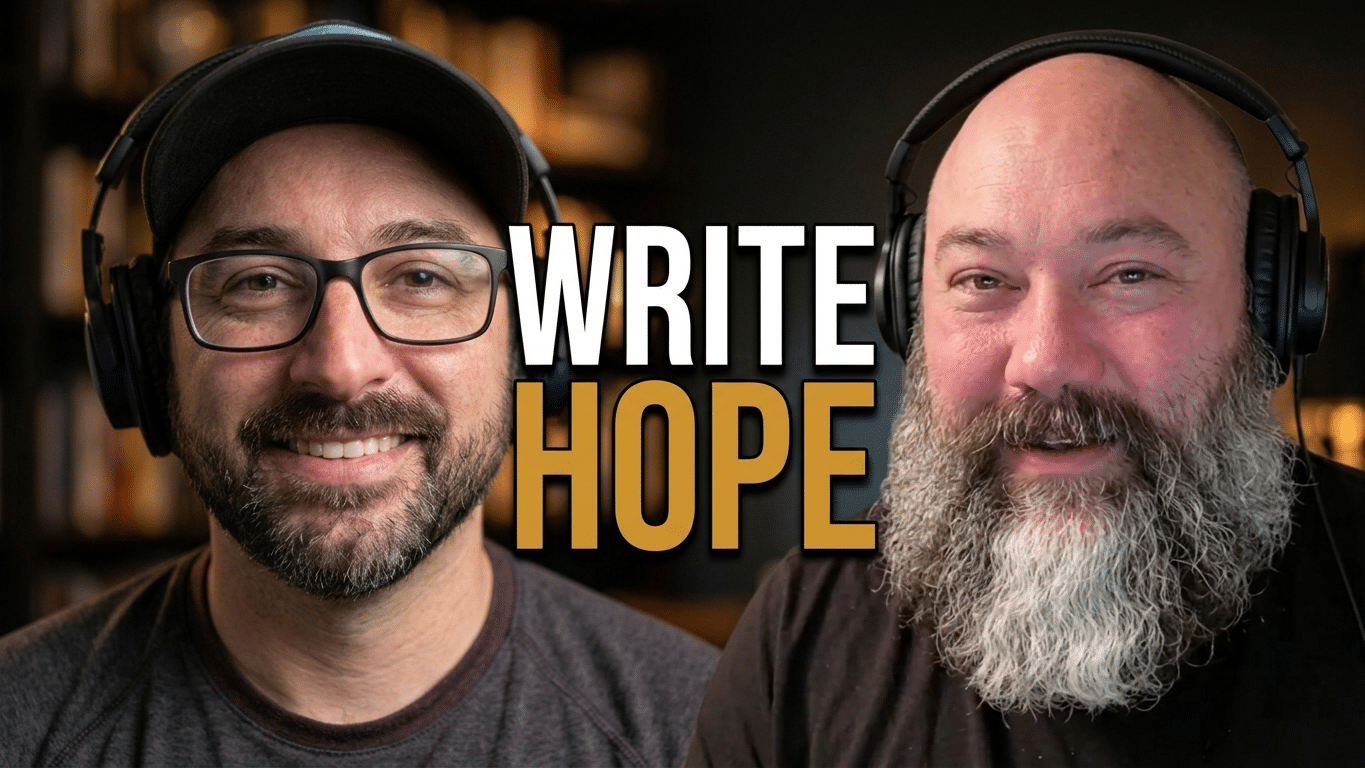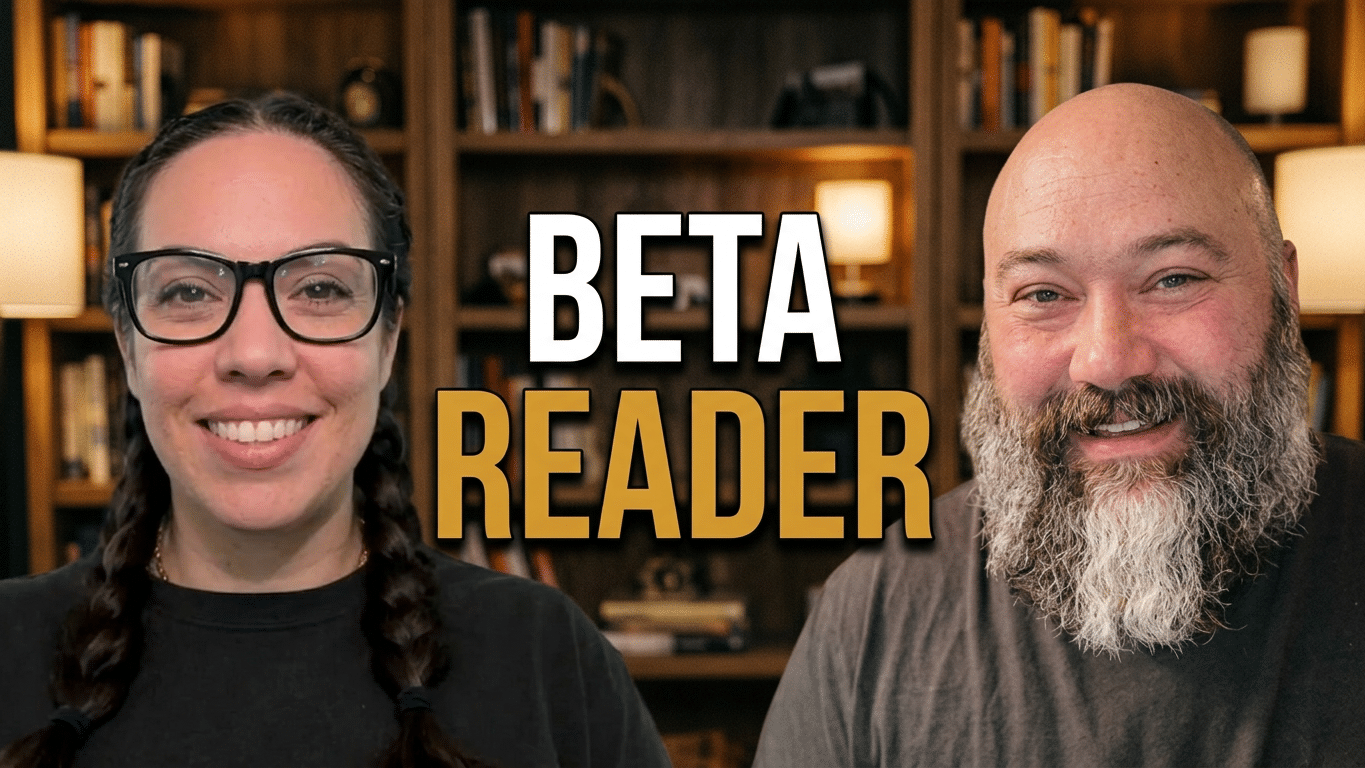
Welcome back to The Writing Coach podcast.
What if you lived in a world where everything has magic, except you? That’s where Rowan starts in Within, the debut epic fantasy from filmmaker Diego Lacort.
Diego was born in Chile, grew up in Mexico, and has worked in film since he was seventeen. After moving to the United States, he couldn’t work for two years while he waited on his paperwork, so he finally sat down to write the story he’d been carrying around since he was a kid: one hour a day, every day, for six months. The first draft ran 900 pages. Seven rewrites later, Within is a 620-page epic, and it’s out now.
In this conversation, we talk about what The Lord of the Rings is really about, why a novel can show what a movie never will, the five index cards Diego used to outline the whole book, the screenwriting habits he had to unlearn, the Mexican, Japanese, and Stoic influences behind his world, and a magic system tied to personality and emotion.
Check out the episode now:
Audio:
Video:
In this episode
- Discipline beats motivation. Diego wrote for one hour every day for six months, including the days when the writing was bad.
- The process of writing is the process of rewriting. His 900-page first draft took seven rewrites to become a 620-page novel.
- Outline with five cards: beginning, first pivot point, midpoint, climax and ending. Then fill in what happens between them.
- The midpoint is where things stop happening to your hero and your hero starts making decisions.
- Film shows action and sound. A novel can show what’s happening inside a character, so use it.
- Build your world from life. Diego drew on his own experience, Día de Muertos, Japanese culture and Stoicism.
- Tie your magic system to your characters. In Within, each person’s magic grows out of who they are.
- Your inner critic isn’t the enemy. In Within, it’s a character called the Wound.
The Writing Coach Episode #247 Show Notes
Get Within by Diego Lacort: Amazon | Publisher page
As an Amazon Associate I earn from qualifying purchases.
Follow Diego on Instagram for his storytelling videos: @lacortdiego
Mentioned in the episode: The Lord of the Rings by J.R.R. Tolkien, The Name of the Wind by Patrick Rothfuss, The Matrix, Coco and Final Fantasy X
Click the image below to grab your FREE copy of The Busy Writer Method:
The Writing Coach Episode #247 Transcript
Read the full transcript
Kevin Johns: Diego, welcome to the Writing Coach Podcast.
Diego Lacort: Thank you for having me.
Kevin Johns: So, you spent much of your childhood moving between Chile and Mexico. Tell me about how that international youth influenced your writing, if it did.
Diego Lacort: Oh, it definitely does. I think when you move from place to place, it influences everything in your life. With me, it’s not just that I was born in Chile and raised in Mexico. My father is from Argentina, and I have grandparents who come from Italy, Germany and Spain.
Kevin Johns: Wow.
Diego Lacort: And now I’m in the USA. When you have that much movement, that much mixture of cultures, you stop caring about where people are from, and you start caring about who they are.
It’s funny when people ask me, “Diego, where are you from?” I say, “Citizen of the world. Let’s leave it at that,” because it’s really hard to pin me down to one place. I do think I have more of the Mexican culture in me, because I moved to Mexico when I was five, and it’s a beautiful culture, don’t get me wrong. But my family has an Italian background, and the culture at home was very mixed. I have never been from anywhere. I’m from nowhere and from everywhere at the same time.
Kevin Johns: As a fantasy novelist, world-building is always a huge part of the genre. Do you feel like this citizen-of-the-world status helped you imagine a new world with new cultures in it?
Diego Lacort: I think it comes from a lot of places, but definitely. I think everything about being creative, about being a storyteller, comes from life. You have to learn to process whatever you’ve gone through, or whatever you’ve learned other people have gone through. Some people are smart enough to take something that didn’t happen to them, that happened to somebody else, and transmute it into something new.
So with world-building, it’s about: what do you know about the world? What do you like? What don’t you like? And how do you transform that into something else?
I see that everywhere. The Lord of the Rings is probably one of the best books ever written, and the best fantasy ever written for sure, and that world grabs a lot from human experience. Tolkien went to war, and I think that world speaks a lot about his experience of war.
I think a lot of people don’t understand The Lord of the Rings. Okay, yes, they’re trying to destroy the ring, and it’s the fight against Sauron. But what the book is really about is companionship. It’s a group of people from everywhere. You have an elf, you have the hobbits, you have Aragorn, who’s supposed to be the king but doesn’t want to be king, you have Boromir, who wants to be royalty but is just a warrior, and then you have Gimli, who is a… what’s the word?
Kevin Johns: A dwarf.
Diego Lacort: Exactly, thank you.
Kevin Johns: I look the most like a dwarf of that group, so that’s probably why it was top of mind.
Diego Lacort: But yeah, that’s what the book is really about: the companionship they create to fight evil. That’s the really intense message it has. Companionship, friendship, believing in each other.
Kevin Johns: The Lord of the Rings isn’t only one of the greatest books ever. It’s also one of the greatest film trilogies ever.
Diego Lacort: Oh, yeah.
Kevin Johns: And cinema is your background. Tell me a bit about working in film, and at what point did you decide to write a novel?
Diego Lacort: I love filmmaking. I have always loved filmmaking. I have a lot of family who work in film. One of my cousins works at Pixar, which is a great company to work for, the biggest animation company in the world, if you ask me. So I’ve always been in touch with that world, and I’ve always loved stories.
My belief is that everybody in the world is a storyteller. Storytelling is a muscle, and it’s part of being a human being. We’ve been telling stories since we learned to paint on walls. Look at hieroglyphics, or at what our ancestors did before us: they were telling the story of how we fought mammoths and panthers to survive. That’s storytelling in itself. Everybody forgets that they’re a storyteller. It just comes out in different ways.
For me, the name of the game is storytelling, and I think film and books run in parallel, but filmmaking is very specific. When you write for film, you’re writing audiovisually. You have to show images, and you have to think about sound. But books give you something film never will: you can write everything that’s happening inside the characters.
Like you said, I think The Lord of the Rings is an amazing adaptation. It’s the best trilogy ever made in cinema, by far. It won 17 Oscars. I mean, come on. But I think people who’ve watched the movies and haven’t read the books miss the point of why Frodo is the main character. Frodo’s fight is in his mind and his heart, and the book expresses that very clearly. You can’t translate that to the screen, or the movies would be 16 hours long. He’d be fighting Sauron the whole time, and all you’d have is Elijah Wood making faces for the whole movie, because that’s him fighting Sauron inside himself. He’s fighting what the ring does to him, and that’s why he’s the main character.
In the movies, everybody loves Aragorn, because he’s fighting wars, which is very audiovisual. It’s very easy to film a war and make him look like an amazing hero. So the two run in parallel, but they’re different.
You asked how I got to writing a book. I came to the USA three years ago, but I picked the wrong time, because Trump is president right now and it’s really hard to get your paperwork. It took me two years to get my paperwork, and that meant I couldn’t work, I couldn’t drive, I could basically do nothing. And that was driving me nuts. I’ve always been a creative. I love filmmaking, I love telling stories, I love doing something with my creative mind. I was going crazy. I needed something to pour that energy into.
And I’d had the idea for this book for probably 15 years: a story about a humongous monster that fights a wizard. It came from when I was very young, 12 to 15 years old. In those two years, I said to myself, “Okay, Diego, what’s the excuse not to write that book now? You have the time. Just pour it out.”
So I sat down. I think my superpower is discipline, man. Writing isn’t easy, but it’s a muscle, and a lot of people miss that. Discipline isn’t about doing it when you feel motivated. So I set a rule for myself: I had to sit down for at least one hour every single day, for at least six months. Every single day, I sat in front of my computer and wrote what I could write that day. Sometimes it was great, and I could write for longer. And sometimes what I wrote was shit, if we’re honest. You have days where what you write sucks. It’s just part of the process, in my opinion. You’re going to suck at some point, because it’s a muscle. You train, you get better, and you keep going and going, and eventually you have something.
It took me six months to have the first draft, but I rewrote the book seven times. I went at it again and again, because I had to craft it into what I expect of myself, into what I think a good book is. My first draft was just vomiting the idea onto the page, and from there, we craft. That’s something a lot of people don’t understand: the process of writing is really the process of rewriting. You have to go back to it. You have to see where you agree with yourself and where you think, “Oh, I can do better here. This isn’t polished yet.”
Kevin Johns: Did you go into the process knowing it would take multiple drafts, or did you discover that in the drafting and revising?
Diego Lacort: I went in knowing it somewhat, because screenwriting is a lot of the same thing. But a script is supposed to run one page per minute, and we never write more than 90 or 120 pages. My book is 620 pages, and my first manuscript was 900. When you go into something like that and have to rewrite all of it, you really see how much work it is. You think, “Oh my God, it’s 900 pages, and I have to recheck everything.” You have to read it all again.
As I read, I’d think, “I don’t like this passage. I don’t think this connects to what I wanted it to connect to 500 pages later.” Because you’re also trying to create good arcs and a good structure, so everything makes sense. And that usually doesn’t come to you in the first draft.
Kevin Johns: You mentioned that a screenplay page is a minute, and we have this very structured template for screenplays, with loglines and everything. Did you find it freeing to shift into prose, or was it overwhelming to be template-free?
Diego Lacort: No, I think it helped me a lot, because, as I said, it was a difficult stage of my life. The book was a transmutation of all the hardships I was going through, family-wise and personally. And listen, I’ve had a life where I’ve gone through pretty much everything. You can tell me what you’ve been through, and if I tell you my story, you’ll be like, “Oh, shit. Okay. You just need to go to war, and you’ll have done everything.”
So I transmuted a lot of my life into the book, and it was very freeing, because I was going through a psychological and emotional process in the book. On the first level, if I tell you what the book is about, okay, it’s about a young man fighting a humongous monster. But there’s meaning behind it, just like The Lord of the Rings. On the first layer, they have to destroy the ring, but that’s not really what the book is about. It’s about what has to happen for them to destroy the ring.
Kevin Johns: Right. Your novel is called Within, and I understand your protagonist lives in a world run by magic but isn’t magical himself.
Diego Lacort: At the beginning.
Kevin Johns: At the beginning. All right, tell us a little more about the story.
Diego Lacort: The story is about Rowan, a young man who lives in a world where magic is in absolutely everything. Plants have magic, stone has magic, and everybody can wield it. Every human being starts to notice their connection to magic around age five or six. Rowan hasn’t found his magic, and he’s twenty-something. He’s never been able to use any magic at all.
He’s from a little town called Horizon, and he gets called up to join the forces. There’s a test to find out whether he’s adept enough to be part of them. Rowan is insanely capable physically. He’s super smart, super capable. But he’s a rebel, and he’s the weird one in town because he’s never used magic, so he already feels like an outcast. So he thinks, “I’m not going to take that test. Why would I? I know they’re going to say no, because I have no magic.”
He tries to run, but they capture him and take him to the test. And funny enough, during the test, his powers awaken. But with the awakening of his powers, a humongous monster I call the beast wakes up too, and it destroys the mountain and the whole town and leaves his life in a mess. And Rowan’s power is the only one that everybody notices can hurt the beast.
So Aiden, the general of the town’s army, who is one of the best characters in the book, if you ask me, tells him, “The town will get rebuilt. Okay, the beast ran away, but your magic was the only thing that could hurt it, so you’re coming with me. I’m going to train you, and we’re going to hunt that thing and kill it, because it might come back.” And the book develops from there. It’s the mission of how Rowan becomes the sorcerer capable of fighting the beast.
Kevin Johns: People like Tolkien and C. S. Lewis were obviously pulling from British story traditions when they built their fantasy. What cultural traditions did you pull from when creating Rowan’s world?
Diego Lacort: I think it’s a mixture of so many things. As I said, I’m pulling a lot from my own life and from what touches me very deeply. Within is a book about integration, psychological integration: confronting your shadow, learning to see the darkness inside you, because that’s what transforms you and lets you see your light. Your shadow isn’t there trying to cover your light. It’s trying to show you where your light is.
I think everybody in the world has a little voice inside their head that talks shit to us, right? We all do. So I have a character in the book called the Wound, and that’s exactly what it is: a super mean little creature inside Rowan’s head that’s always talking back to him, telling him where he’s fucking up, where he’s making mistakes, what he’s not doing right. “You’re not capable. You’re trash. You’ve always been the weird one.” And the book is really about what he has to confront in himself to get where he needs to be.
There’s also a lot of Mexican culture in it. For example, Mexicans have Día de Muertos, which is such a different tradition for talking about death. In Mexican culture, death isn’t an ending. It’s a transformation into what comes next, and we can connect from this realm to that realm. I think that’s such a powerful and beautiful story. That’s where Pixar got Coco. It’s beautiful because it’s not an ending. It’s a continuation of your story in a different realm, where your soul evolves into something else. But you can still connect to it, and there’s something bigger than this realm, this life, this physical world. There’s a lot of that in there.
There’s a lot of my own story. There’s a lot of Japanese culture and Stoicism, because I love Stoicism, and I’ve been obsessed with Japanese culture all my life. And if I’m very honest, I think I grabbed a lot from my favorite video game series, Final Fantasy. Final Fantasy X has this humongous creature, and they’re fighting this huge monster, and I think I grabbed a lot from there. A lot.
Kevin Johns: I’m playing Doom Eternal right now, and it has this Sentinel planet with these giants. I don’t know if they’re statues or if the giants themselves have died, but anyway, it’s cool-looking stuff. I love the way fantasy can bring scale into storytelling. And I suspect you experience this in cinema: everything has a cost. There’s a budget, there are safety concerns. With a novel, you have an unlimited budget. The only thing holding you back is your own imagination.
Diego Lacort: Yeah. If I’m honest, this book is the first time I didn’t constrain myself, exactly for the reason you’re giving. Every time I made a movie, I was thinking, “Yes, Diego, you’re making a movie, but you grew up in Mexico, which doesn’t have the resources the United States has. You can’t think of something so humongous, because your budget will never allow it.”
Nowadays, with AI, I think there’s a chance, because it has shrunk those limitations by a very big margin. Now you can do very crazy things on a very low budget. But I always restrained myself before this book. When I wrote Within, I said, “I’m not going to restrain anything. It’s a book. Go crazy, Diego.” And I threw everything out there. And honestly, I would love to eventually adapt the book into movies.
Kevin Johns: Of course.
Diego Lacort: That would be great.
Kevin Johns: You mentioned the book being the result of the Trump government basically not letting you work. I imagine that’s a pretty frustrating experience. And to come to America during this time, with the rise of racism and conservatism and all these things, do you feel like any of that manifested itself in the story? Anything like the immigrant experience, or what it feels like not to be welcomed by a culture?
Diego Lacort: I think I did write about that, but it didn’t come from the move to the USA. It comes from my story, because I moved out of Chile to Mexico when I was five. So I know what it is to be a foreigner in a different country. I know what it feels like not to feel part of the world, and to feel tiny against a new culture. That happens to absolutely everybody who moves from anywhere to anywhere.
Even moving within the United States is kind of crazy. You move to another state, and everything changes. I live in Florida. I went to Oregon for a visit, and it was a completely different culture, a different landscape, different food, different kinds of people, different weather. Everything was different, and I loved it so much that I’m moving there now.
Kevin Johns: Where was that?
Diego Lacort: Oregon.
Kevin Johns: Oregon. Oh, wow.
Diego Lacort: It’s the state on top of California. It’s such a beautiful place, and it’s so different from Florida. If you like beaches and hot weather, Florida is your place. But that’s not my vibe. I don’t like the beach that much. I’m one of those weird people who goes to the beach, has fun, and then gets home and thinks, “How the heck do I still have sand right there? Goddammit.” That’s me every single time.
Kevin Johns: Let’s talk a little about the size of the novel. As you said, you were unrestrained in your imagination, and you mentioned a 900-page first draft. For the writers listening, do you have any advice? How do you tackle a project this big?
Diego Lacort: The way I tackle any story is what I learned in cinema. In cinema, we always create the skeleton of the story first, and I think that applies really well to writing books. What I did is I went to Home Depot and bought those little cards you use in school to make a presentation.
Kevin Johns: Yeah, index cards. The classic Hollywood pin-them-to-the-wall technique.
Diego Lacort: Yeah, I used that technique for the book. I knew I wanted to end with a humongous fight between this monster and this magician. That was my ending. So I thought, “Okay, you know where you want to end, but where do you begin?”
You need a main character. Storytelling is a craft, and we’ve been crafting stories for a very long time, so we have techniques. You have the three-act structure. You need a character who has a normal life, and something has to happen to that normal life for the story to develop.
So I knew my ending, and I created a beginning. It was going to be Rowan, a young guy who lives in a tiny town, in a world where everything has magic, because I like the underdog story very much. I like characters who go through hardship to get where they are, and that’s a very common trait of hero stories. Every Marvel movie has it. Iron Man is an insane underdog, for example. He’s a genius, but he’s an underdog.
So you have an ending and a beginning, and you know you’re going from here to there. From there, you create the point where your story changes and everything develops. That’s your first pivot point. From there on, you have a story. If that doesn’t happen, you have nothing.
From there, I created my midpoint. I think the midpoint is when things stop happening to your character, and your character starts making decisions that make things happen. The Matrix is a great example. At the beginning, everything is happening to Neo. They give him the pill, and he goes to the real world and understands that the Matrix is software, not real life. The story really starts developing when he meets Morpheus. That’s the first pivot. The midpoint is when the agents take Morpheus, and Neo decides, “I’m going to go save him.” That’s what changes. Things aren’t happening to Neo anymore, and he isn’t just getting taught. Now he’s deciding, “I’m going to fight the agents, and I’m going to save Morpheus.” That’s the midpoint.
Then you have the build to the climax. He’s making decisions, and that makes everything escalate and escalate until you get to the climax, which is your second pivot point. And then you have an ending.
Once you have those five points, the only thing you have to do is develop what happens between one and two, two and three, three and four, and four and five. So I did that on cards: chapter one is going to be this, chapter two is this, three, four, five, six. But the first thing I had was those five cards. Where do I begin? Where do I end? What are my two pivot points? And what’s my midpoint? That’s it. I think you can do that with absolutely any story you want.
Kevin Johns: Were there any techniques you’d used or were familiar with from screenwriting that didn’t carry over into prose fiction?
Diego Lacort: For example, my first manuscript was very action-oriented, and I had to develop so much of my characters’ voices and what was happening inside them. I think what makes a book interesting is that you, as the reader, can relate to the character, and action and sound don’t usually create that. That works in cinema because you’re watching the movie, so you can see the acting, and the acting tells you a lot about what the characters are feeling. But in a book, you have to put it on the page.
Kevin Johns: That goes right back to where we started the interview, when you said Frodo’s journey is really an internal journey. We experience it in the novel through his internal experience of battling darkness and evil.
Diego Lacort: Yes, exactly. It’s a completely different language, and I think that’s what we have to understand. They’re different languages. Some things run in parallel, and some things clash.
Cinema is action and sound. One of the rules I had to completely break: in a script, you never talk about how a character is feeling. You can never write, “He feels his stomach drop, and he looks pale.” You never write that, because it takes up space on the page, and that translates poorly into a page a minute.
Kevin Johns: Yeah.
Diego Lacort: In a book, you want to do exactly that, because it lets the reader imagine what’s happening to the character and actually relate to him or her. So it was completely the opposite. I don’t think any of the tools I had from filmmaking translated into the book. I had to develop a whole new way of writing to be able to write the book I wanted to write.
Kevin Johns: I wrote some articles last year about fantasy writing and magic systems, the rules of the magic in a fantasy novel. So I’m curious: how does magic work in the world of Within? Are there rules about who can do magic, and when? Are magical objects involved?
Diego Lacort: When we talk about fantasy, there are hard, cold magic systems, and there are warm, very lenient ones, right? Within leans more toward the second. There aren’t insane rules. I love The Name of the Wind, for example, and The Name of the Wind is insanely well crafted as a hard magic system. He can’t do whatever he wants without paying a price.
In Within, the rules are very simple. Magic flows in absolutely everything, but it’s completely and utterly linked to the life force and personality of things. When you grab energy from a tree, you’re stealing part of the tree’s life. Everything is energy, but energy can be transmuted into something else, and that’s what human beings do really well. Aiden, for example, is a fire sorcerer, because that’s what comes easily to him. He can grab energy from trees, rocks, water, anything, and turn it into fire.
One of the rules is that human beings have a limit. You can always grab energy from everything, but you have an energy core, and that core can only transmute so much before it’s completely depleted. So yes, you can be insanely powerful, but you have a limit.
In the book, there’s another culture, the Ancient Ones, a race that existed before human beings. The Ancient Ones had no limit on how much energy they could gather, but their energy was completely linked to their emotions, so it could be contaminated or corrupted by emotion very easily. That’s what created a lot of trouble for that generation. It destroyed their civilization, and they died out.
And this is kind of a spoiler, but not really, because I explain it throughout the book: Rowan has a link to the Ancient Ones. That’s why he couldn’t grasp his power when he was little. He has no limit on how much magic he can gather and use, which makes him much more powerful than any other sorcerer in the world by default, but it also makes it harder for him to control his powers.
So the rules work like that. My magic system is very, very crafted around who each character is. Rowan builds a whole group around him. You have Aiden, the teacher, who’s a fire caster. You have Nalani, his best friend, who’s a healer, because that’s what comes naturally to her. It’s completely linked to their personalities.
Kevin Johns: You mentioned the way emotion can pollute the magic. And earlier in the interview, you mentioned being a fan of the Stoics. Do you personally see emotion as something dangerous, something we need to be conscious and careful about letting affect us?
Diego Lacort: I don’t think of emotions as dangerous. I think emotions are signals. They always point to something deeper. The important part is to let emotions be and accept them, but don’t let them run the show. That’s how I see it, and I think that’s what the Stoics were really talking about. It’s not that you have to be emotionless. Emotions are there. You’re going to feel anger, for example. But anger shouldn’t run the show. Don’t make decisions while you’re angry, because anger is going to fuck up the decision, and you’re going to regret it. Don’t make decisions when you’re sad or desperate. Try to acknowledge, “Okay, I’m feeling this, and it’s going to create all these signals and states in my body, so I might not be in the best place to make this decision about money, about family, about my relationships.”
That’s what I think about emotions, and it’s a very big theme in my book. That’s why it’s called Within: everything is inside us. That’s my belief, and that’s the theme. Rowan’s problem is within himself. It’s about understanding himself, how to measure his own powers and his own inabilities, what his life has brought him and what he’s experienced, understanding his wounds and where everything comes from, and growing bigger than all of that so he can kill a humongous monster the size of a mountain. Because if he doesn’t, he won’t be able to.
Kevin Johns: Well, Diego, before we started recording, you mentioned that the ARCs are ready. So, what’s the launch plan for the book?
Diego Lacort: It’s planned to launch in mid-November, so we must be about 20 days away. We don’t have a specific date just yet, because they’re working on the perfect date. I’m actually waiting for my first copy right now. They sent it to me last week, so I’m waiting for the mail to be fast enough to get my first physical copy, which excites me so much.
Kevin Johns: Oh, it’s such an incredible experience. No matter how many books you put out, when that first proof copy arrives in the mail, it’s really something.
Diego Lacort: I’m pretty sure I’m going to cry.
Kevin Johns: Oh, yeah. It’s worth it. It’s like giving birth, right? You take it out of the package, and there it is. It’s real.
Diego Lacort: Yeah, it becomes real. It’s such a beautiful experience, but I’m also kind of terrified, because this is the first time the world is going to see something I created, and it’s very me. I know I’ve put in as much work as I can. This was two years of my life poured into it. I love my own book, but I’m responsible for the delivery, not for how people receive it and what they get from it. That’s the part that’s always super hard.
It’s the same with cinema. You make the movie the best you can, and some people like it, and some people might not, but that’s not your responsibility. That’s part of the process too. You’re going to feel a certain way about whether it’s received well, whether people think you’re a good writer, whether they like it. It’s going to make you feel things. But you’ve already done your craft.
I remember in college, I was the most hardworking guy among my peers. I know that for sure. But I wasn’t the best writer, the best director or the best editor. I always thought I was a so-so writer, and before this book, I didn’t think I could write. And after writing this book, I’m like, dude, you are a writer. You wrote a freaking 620-page book. What are you talking about?
Kevin Johns: Absolutely. I tell all my clients this: by the time you finish writing a book, you’re a much better writer than you were when you started. You learn along the way on every project, and you’re a much better craftsperson and artist at the end than you were at the start.
Diego Lacort: Yeah. And one of the funny things is that I liked writing the novel so much, and I have so many ideas, because I’ve been a professional storyteller for 15 years. I started working in cinema when I was 17. So now I’m halfway through my second novel.
Kevin Johns: Oh, great.
Diego Lacort: I decided, “You know what? I liked doing the first one so much that I’m going to keep doing it as a side hustle.” I still plan to make movies, but writing is such a powerful thing.
And if anybody hears this, I want people to know that writing books is also an amazing way into movies and other crafts, because 70% of the movies Hollywood makes are based on books. Seventy percent. So if you have a good idea, you own an IP, and owning an IP is such a powerful tool for cinema, for video games, for Netflix series, for whatever you want to make. The book is just the beginning of something much larger. You can make comics out of it, manga, video games, movies. So many things come out of a book.
So I also took it that way. I thought, if I write a book, maybe in a couple of years, when I’ve made a name for myself in cinema, I’ll be able to say, “Hey, I want to make a movie of my book, because I own the IP.”
Kevin Johns: Wonderful. Well, if people want to learn more about you and about Within, where can we send them?
Diego Lacort: You can always follow me on Instagram. My Instagram is great. I have 30 videos teaching people how to be a storyteller and what they need to know about storytelling, a lot of what we’ve been talking about here. It’s kind of a roadmap for becoming a better storyteller. My Instagram is @lacortdiego, my name backwards.
And if you want to find Within, you’ll be able to find it online. There’s going to be a landing page for the book, and it’s going to be on Amazon, Barnes & Noble, Apple Books, every single place that sells books. I’ll make sure of that.
Kevin Johns: Wonderful. I’ll be sure to link to it in the show notes for this episode. Diego, congratulations on the release of this massive project you’ve taken on, and I can’t wait to see where it takes you. As you said, it’s going to be an incredible book, but you’re also going to have an intellectual property that could take on a life of its own. And you’re in the middle of the second book. So, given everything you’ve got going on right now, thank you so much for taking time out of your day to join me on the Writing Coach Podcast.
Diego Lacort: No, it’s awesome. Thank you for giving me the opportunity, and for hearing me out. Not everybody does that. You’re awesome.