This coming November, I’m taking a small group of writers to Barbados. It will be five days on the island’s West Coast. Mornings are for writing, afternoons are for writers’ craft workshops, and evenings will take care of themselves. It is going to be structured enough to get real pages done and beautiful enough that you’ll want to come back.
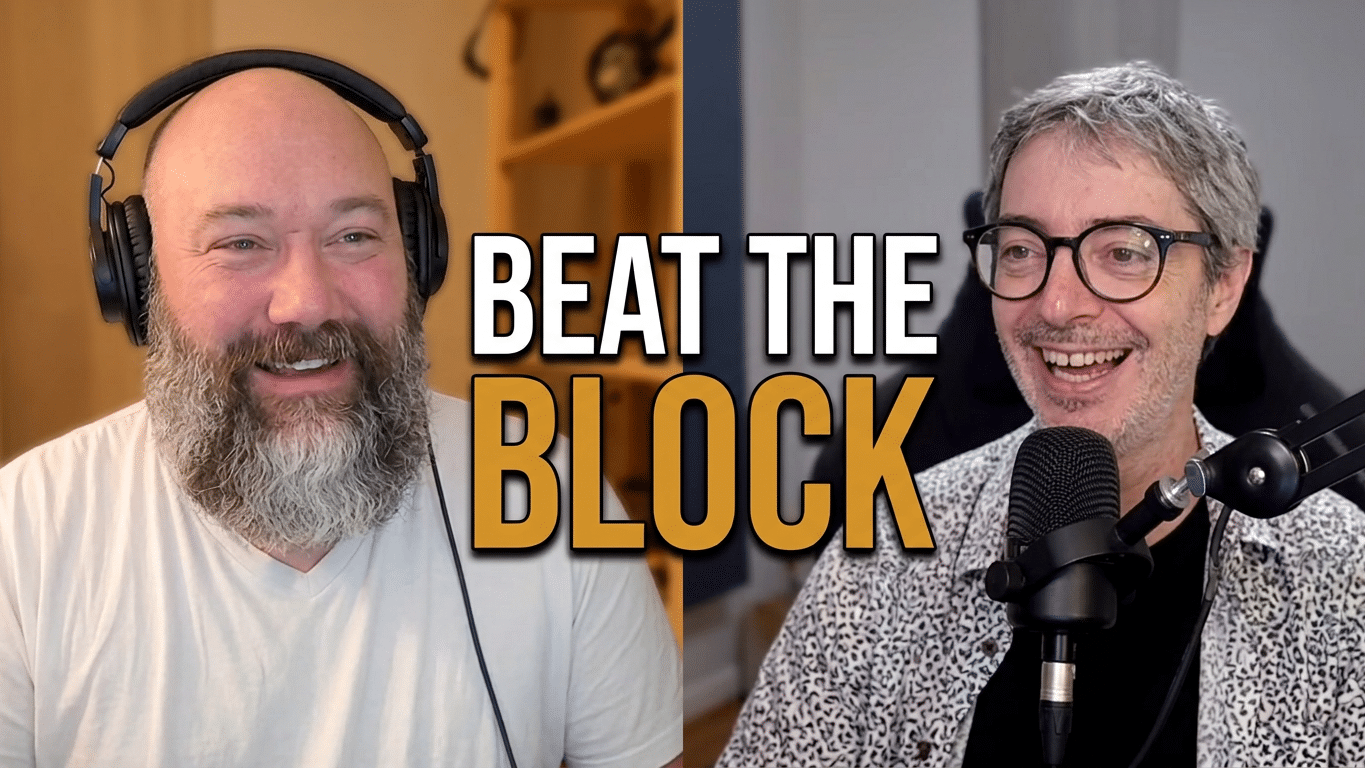
This week’s episode of The Writing Coach Podcast is your introduction to that retreat and, more specifically, to the person who is making it possible: my friend Nathan Lang.
Nathan and I have known each other for about forty years.
We grew up together in Ottawa, lost touch the way people do when life goes in different directions, and then found each other again when Nathan did something most of us only talk about: he bought a condo in Barbados in pre-construction, waited out the build, and eventually traded the snowbanks of Ottawa for the West Coast of a Caribbean island.
Who Is Nathan Lang?
If you’re picturing the kind of person who “moves to the Caribbean,” you’re probably picturing the wrong guy.
Nathan isn’t retired, and he isn’t a trust fund expat sipping rum punches by the pool. Before Barbados, he spent a decade in the Ottawa hospitality industry: culinary training at Algonquin College, years managing bars and restaurants, and eventually co-owning a pub. That hospitality instinct didn’t leave when he moved to the island.
Nathan now cooks with Slow Food Barbados, a charity that started during the pandemic when the island suddenly had an abundance of food, no tourists, and hundreds of service workers out of a job. The founder, Julie Hooper, mobilized those chefs and that food into a soup kitchen that was feeding 300 people three times a week within weeks of launch. Today they cook for 100 people every Monday, Wednesday, and Friday, using local produce and meat, with a slow-food ethos that treats the meal as something that matters. Nathan is there every Monday when he’s on the island.
He’s also a big reader. Terry Pratchett and Ian Rankin are among his favourites, but he’ll read anything up to and including the cereal box if nothing else is available. He is, in other words, the kind of person the writers at this retreat will actually enjoy talking to over dinner.
What We Talk About in This Episode
Nathan and I cover a lot of ground in this conversation:
The island itself.
Barbados is smaller than you think (about 20 miles by 15 miles) with 275,000 residents, direct flights from most major Canadian, American, and UK cities, and a safety record that makes it one of the easiest Caribbean islands to visit as a solo traveller. English is the language. November is the beginning of the dry season: sunny, warm, and far less crowded than the January rush.
The location.
The retreat is based at Nathan’s property in Mullins, Saint Peter, on Barbados’s West Coast, which the locals call the “Platinum Coast”. It’s a collection of brand-new condos with a shared pool, a rooftop deck (and I use the word “deck” loosely; Nathan calls it a rooftop deck; I’d call it a luxury backyard with a bar, a TV, a giant eating area, and couches), and a five-minute walk to Mullins Beach, one of the most photographed beaches on the island. The Sea Shed restaurant is right at the beach. Adrian’s Bar has live steel pan music once or twice a week. Speightstown is a four-minute drive north. Holetown, with restaurants, nightlife, and shopping, is ten minutes south.
The connectivity question writers always ask.
WiFi at the condo and the beach. Free WiFi at most bars and restaurants. Cell service that works across most major Canadian and American carrier plans, plus cheap eSIM options if you need them. You will not be cut off from civilization. (You’ll just be choosing not to engage with it.)
The Part of the Conversation I Wasn’t Expecting
Near the end of the episode, I found myself talking about Nathan’s childhood birthday parties where we stayed up all night playing Nintendo and watching horror movies. They were the kind of nights you have when you’re ten years old, and the world is still small enough to contain entirely within a living room.
I say on the podcast that I think my love of storytelling started there, at those parties, with that kid, in his family’s living room on the weekend.
Forty years later, we’re taking writers to Barbados.
Nathan sums it up better than I could: “I’ll provide the space. You provide the knowledge.”
That’s the retreat. That’s the partnership. That’s why I’m doing this.
What the Week Looks Like
For writers who want to know what they’re signing up for:
Monday, November 9 — Arrive. You land, you settle in, you meet the group. That afternoon, we run an orientation session: what you’re working on, what’s stuck, what you want to leave with.
Tuesday, Wednesday, Thursday — Full working days. Mornings are for writing: 8am to noon, every day. No workshops, no interruptions. You write. I write. The group writes. Afternoons are for craft: I run a focused workshop based on what the group is actually working through in their manuscripts that week. Evenings are yours.
Friday, November 13 — Close and depart. One final writing sprint in the morning. Then we close out: what did you accomplish, what do you fix next, what do the next 90 days look like?
You board your flight with more manuscript than you arrived with. That’s the goal.
What’s included: accommodation, airport transfers, morning writing sessions, afternoon craft workshops, a private one-on-one manuscript review session with me (you submit pages in advance; I review them before the retreat and we spend a focused hour on your work during the week), breakfast, lunch, snacks, and drinks daily.
Flights and dinner are on you.
Ready to Come?
The Barbados Writing Retreat runs November 9–13, 2026, at Mullins Beach, West Coast Barbados.
Spots are limited. You can reserve yours with a $500 deposit, fully refundable until October 15, 2026.
Get all the details and reserve your spot here.
If you’re not sure whether this is the right fit, whether the timing works for your manuscript, or whether Barbados is logistically possible for you, I’m happy to hop on a quick call.
Use this link to book a call.
Listen to the Full Episode
Nathan is exactly the kind of person you want running the logistics and the kitchen at a writing retreat: someone who’s been in hospitality his whole life, who knows the island better than most locals, and who genuinely loves taking care of people.
The episode will give you a better feel for him, the location, and what five days could look like for you.
Check it out now.
Audio:
Video:
In this episode
- Write from a private apartment with its own kitchen and bathroom, a pool and a rooftop deck, about a five-minute walk from Mullins Beach.
- Stay connected while you write: some beaches and many bars offer free WiFi, and a roughly $20 eSIM can cover your week.
- Expect a flexible week: you can write all day in an air-conditioned apartment overlooking the pool, or head out to restaurants and bars at night.
- Barbados is easy to reach: direct flights from Canada take five and a half to six hours, English is spoken, and Nathan calls it safe.
- Taste local food between writing sessions: Nathan recommends breadfruit, sea grapes, roadside fruit juices and the cafeteria-style lunch at Fisherman’s Pub in Speightstown.
The Writing Coach Episode #232 Show Notes
Join Nathan and Kevin in Barbados this November!
The Writing Coach Episode #232 Transcript
Read the full transcript
Nathan, welcome to the show.
Thanks, Kevin. Pleasure to be here, bud.
I know you’re a longtime listener. How does it feel to be a featured guest on the show that you’ve been listening to?
It’s pretty neat, you know. When I first heard your podcast, I thought, you know, someday Kevin’s gonna have to interview me. I didn’t think it would be about this, but this is great.
Last year in November, I visited you in Barbados. I think I was there for like five days or a week. You did not turn on the television once the entire time I was there, but you picked up a book almost every day. So tell me about your love of books.
Oh, geez, Kevin, my love of books started a long, long time ago. I remember going to the library in Bells Corners when I was a kid, the little round one on the way to school. Both my parents read voraciously—whatever that word is I’m supposed to be saying.
So reading, to me, has always been a comfort, a way to pass time, and I will pick up and read almost anything, to be very honest. Luckily, a love of reading has been in my life since a very early age.
I think one of the really interesting things about you as a reader is, as you said, you don’t have a particular genre. A lot of readers stick with a genre or stick with a genre for a period of time. But, I mean, you’ve said to me on multiple occasions you’re pretty much up to read everything. Why is that?
Again, I just kind of enjoy almost all aspects of things. I’m a very busy guy in my life, and I’ll kind of do here, there, and everything. I enjoy those things or finding out about them, and it’s kind of the same thing with reading.
Probably around COVID times, through one of the Kobo apps where you can get—you know, BookBub. They do good promotions for readers, for writers, and stuff like that, right? I’ve fallen into a few rabbit holes from that, getting the first edition free and then buying the next seven books or something like that.
Through that, I’ve discovered the cozy mysteries and all the formulaic ones where the middle-aged woman has a relationship problem, goes to the seaside to stay with her aunt, and murder is afoot. Those sorts of Hallmark movies, but in book form. I read a few of those a year, for sure.
Definitely police dramas, that sort of stuff. Rankin’s always been a longtime favourite of mine in that genre. But my love really is sci-fi and fantasy. Those are the books that, if I’m going to buy a book, 90% of the time that’s what I’m going to go looking for, or I’ll have that recommendation.
The joy and the awfulness of what Terry Pratchett did—and the awfulness being that he died and there’s no more books—but that Discworld saga, whatever you want to call it, was huge. I remember sharing that with different friends and all that. There’s got to be 30 books in that process, and they’re just all excellent, excellent, excellent.
So, yeah, here, there, and everywhere with the stuff. I really don’t enjoy a lot of nonfiction, I guess, beyond biographies. But, yeah, I definitely read biographies of lots of different people from different walks of life.
So, yeah, no, I just read. I read my cereal box like 14 times. You know, if I sit down to eat, I always want to have something, a book to read.
Well, food and books. Let’s use that as a segue into food. You’re really passionate about food and cooking. It’s not a hobby for you. It’s been a career, but it’s also something you’re personally interested in.
Oh yeah, very much so. At a relatively early age, I started working full-time, and it was at Lachlan’s Country Store in Hallville. It was one of those kind of convenience stores—well, corner stores, really. We did a little bit of everything.
When I was that age, we were doing just potato wedges and pizzas and stuff that go on that little spinny thing, but making sandwiches, doing all that sort of stuff. So in my young teens, I started with that, and then in my late teens, I started getting into the pizza business.
Before Mr. Mozzarella was Mr. Mozzarella, it was House of Pizza and Video to Go. So I started working there when I was 17 or 18, and I still kind of have my fingers in that business at this point in time.
From there, it led to some culinary training at Algonquin College after doing the bartending programme. The shame, somewhat, there—but again, probably a different path if it didn’t happen this way—was I did three and a half semesters of the chef training, cook training programme at Algonquin because I got too busy running a restaurant to go to school.
That led me into pretty much a decade of pub work, more or less. I worked in some fancier restaurants here and there, but mostly pubs down along Bank Street and Elgin in Ottawa.
But I guess to tie it into what I’m doing now with food, I cook for myself all the time. When I’m in Barbados, I work with a charity called Slow Food Barbados, and they do the Slow Food Soup Drive.
During COVID, everything in Barbados shut down right away. Small island, flights aren’t coming internationally, whatever. So they had a double-edged sword of a problem there, where they had all this food that was on the island because it was March—it’s high season when they shut everything down—and no tourists. So all this food is sitting in the hotels and wherever else on the island, and now there are all these chefs and service staff and all these people out of work.
So the lady who started Slow Food Barbados was smart, and they realized there was a need and an opportunity right there. They mobilized a lot of those chefs and the food and the restaurants there. Her name’s Julie Hooper, and within a short period of time, they were cooking for 300 people three times a week using that produce and stuff.
As COVID opened back up, or the island opened back up, they obviously backed off, and those chefs went back to work. But they saw a continuing need in the community.
So to this day—what day is it today? Wednesday. Yep. So Mondays, Wednesdays, and Fridays, the Slow Food Soup Kitchen cooks meals for 100 people. That is delivered by volunteers throughout the community, mostly elderly. But anybody who’s having a rough time, it doesn’t matter. There’s no criteria, per se. If you want food, we feed you.
And it’s very nice because, again, with the ethos of Slow Food, it’s the idea of slow food versus fast food. Use what’s local, that sort of stuff. Sustainability. We get a lot of our produce and stuff from the local plantations and farms. We try to buy the meat as well from Bajan-raised animals and that sort of stuff.
We have some great sponsors and support through this because it is entirely a charity, and we do have employees, or contract workers as well, so there are some costs associated with that. But, yeah, Massy Stores is basically the Loblaws of the Caribbean, to a certain degree. So they help us out quite a bit, and Chickmont Foods and a whole bunch of others.
It’s a really great programme. So I’m there every Monday when I’m on the island, and I cook. I’m kind of in charge that Monday to cook with Diane and Tash, who are the wonderful women who run that kitchen all the time.
Then they have some volunteers—people coming on vacation or people on the island who like to come in and help cook and do that sort of stuff, or cut up 100 pounds of sweet potatoes because that’s what we got that day, or whatever it might be.
So, yeah, I involve myself in that, and then just cooking for friends and family. I’ve got a couple of big events going on in the next couple of months—one here and one in Barbados—where we’re doing a big dinner-and-a-show thing.
In Barbados, it’s going to be a much higher-end scenario. We’re doing one at the South Mountain Agricultural Hall here at the end of September, and at the end of January we’re doing one at a gated community, I guess is the best term for it. Their clubhouse is called Sugar Hill, and they have this beautiful area around their pool. It’s multimillion-dollar houses up on the hill. It’s quite the locale, so it’ll be a very different calibre, to a certain degree.
But that one in January is going to be 100% fundraising for Slow Food Barbados, specifically the Slow Food Soup Drive.
COVID—obviously, every country was impacted, and everyone had their own challenges. But when you look at a country like Barbados, where the majority of its revenue comes from tourism, it must have been just crushing to have the country shut down for years. How did it come out of that?
It came out of it well. Again, “years” was a little bit much because there was international travel, and then there are always those people who are less COVID-cautious than some others.
I did travel there, I think, towards the end of ’21, early ’22, where you still had to stay in an isolation hotel after you got there. You had to fly with the tests and that sort of stuff.
But Barbados was very smart on a couple of ends. They recognized the digital nomads, and they introduced a new visa. Basically, if you could prove you could make $50,000 U.S. from offshore work that you could do online, you had a year-long visa that you basically just needed to reapply for every year. As long as you still had that job, you could continue.
So they were very smart in that aspect because it brought international people back, and ones that were going to stay and really spend in the community and become part of it, beyond the week-long, “We’re here for drunken beach fun,” which is fine too.
But during COVID, that really helped them move forward. So, no, there was a lot of impact, for sure, but luckily they bounced back pretty quickly and got the money back and used it in infrastructure and stuff.
The island has been a great, big popular destination for decades and decades, but they’re really expanding some of their flights and stuff. There are actually flights out of Halifax coming this fall, which is a big thing for Canadians because there’s always Montreal and Toronto—Toronto year-round, Montreal seasonally.
And there are a lot of points now in the States. If some of your listeners and some of your clients are American, there are a lot of direct flights from there now. Historically, of course, there are two or three flights that land every day from the UK. London, Heathrow—I think both fly down there—and it’s TUI, it’s BA, it’s Virgin. All the big carriers are there pretty much every day.
So it’s a really accessible island. And the nice thing, too, that I found with it, or one of the reasons we chose Barbados initially, is that its background is English as opposed to Spanish, and that’s just easier for me. Nothing wrong with Spanish. I just don’t know Spanish.
So that was a nice thing, and it’s quite a safe island too. There’s not any real crime, especially towards the expats or the tourists. Like any country, there are problems with drugs and aggressive young men, I guess, for lack of a better term. But it’s kind of isolated to that pocket.
I leave my stuff on the beach all the time, go for a swim, don’t worry about it, all that sort of stuff. We’re kind of in a nice area on the west coast of the island as well.
So you went through a period of time where you were travelling all around the world. You’re a huge fan of travel and seeing other cultures. What is it about Barbados that drew you to kind of settle down there, having seen so much of the world?
So Barbados, at the time we bought pre-construction—I keep saying “we” because I did this with my first wife, but it’s mine now.
Safety was the big thing. We’ve kind of covered a lot of the big points: the safety, the direct flights from Canada, easy access. It’s like five and a half, six hours down or up. One way is always a little bit further because of the flights. Well, you made the flights. You know.
Then the English base. And it made economic sense at that time too, because in Canada our real estate was doing this, and in Barbados their real estate was going like this.
So I was the first one in the development that I’m in that we’d be hosting this at. Putting that money forward at that time to start that project, there was some incentive for me financially at that point in time.
As all things go, you hope for the best outcome. It was definitely a longer process than had originally been anticipated. But as I said throughout this whole thing, if I’m complaining about how long it’s taken to finish my condo in Barbados, I surely shouldn’t be complaining about anything in life.
I get the impression, too, from my time with you there, that you seem to really resonate with the culture. It seemed like we couldn’t walk down the street without you shaking hands with someone who you knew or were doing something with. What is it about the people and the culture there that you enjoy so much?
They’re just very friendly, to be honest. You know, it’s very—it’s a Canadian thing to say, to a certain degree. Especially in that kind of area where there’s tourism, right? There’s a fake kind of pleasantness that you can get, but I’m beyond that. They understand that I’m living there and I’m actually involving myself in the community.
I’m a Lions member, so the Lions Club up here in Canada, and then I’ve also found the Lions Club near my home in Barbados. So I participate in that.
It’s just like anywhere. Everybody’s really, truly good underneath. You just have to treat them well in that way. So it’s a great place to be. Most people are truly friendly if you’re kind of friendly to them.
There is a bit of a—I say the English is what drew me, but there is definitely a patois or something of the English language that the Bajans speak. Sometimes I’ve got to get them to slow down and really listen or whatever. And, you know, sometimes when they’re a little further into their cups, it gets a little more slurry.
Yeah, you certainly had to translate English to English for me a couple of times.
Yeah, yeah, yeah, yeah.
While we’re talking Barbados, while we’re talking food, you introduced me to two things: breadfruit and the kind of sour apple with knives in the middle. Tell the listeners about these things that they might want to come to Barbados and taste.
So breadfruit, very diverse. I call them a tree potato. It’s a large fruit, or a large tree that produces these volleyball-sized fruits, vegetables, whatever they are, and they’re just basically a ball of starch. That’s what I call them—a tree potato.
The traditional way that the Bajans cook them is generally over an open fire, and they roast the whole thing so it blackens, and then it steams and cooks on the inside. You kind of have a mashed-potato-y type texture situation on the inside.
It’s a very diverse fruit too, because if you let it ripen, it’ll sweeten right up, and it’ll taste like all the fruits at the same time. I’ve done everything from making hash browns to nacho chips with it. There’s tonnes and tonnes of stuff you can do with it.
There’s breadfruit pie, which is basically like a cheesy baked potato casserole-type situation. You might have it at Thanksgiving or something along those lines. So, yeah, there’s tonnes and tonnes and tonnes of stuff that we do with it.
And then, yeah, the other one, I think it’s called green apple, which is maybe not the right name, but it’ll stab you in the mouth because basically the core has very sharp protruding spines, for lack of a better term. But if you know what you’re doing and you know how to cut around them, it’s quite a tasty one.
It’s very often used as a fruit juice. That’s something you get a lot of in Barbados. They juice almost anything, and they sell a lot of it on the side of the road for six Bajan dollars or, like, 15 for a two-litre jug or something along those lines. And it’s really good.
At different times of year, you get different ones, and they mix them in and whatever it is. So, yeah, there’s a lot of juicing and that sort of stuff. And again, it’s available from literally people who are doing this in their homes and then going out to the side of the road. The same people, day after day, and you get to know them and that sort of stuff—your juice boys or whatever, on this corner, that corner, different places. As I go through the island, I know where they are, and it’ll depend on what it is.
Sea grapes are something that I’ve never seen or had anywhere else. I’ve only known them in Barbados, and they’re these tiny little berries that look like grapes somewhat, and they’re about 80% pit, but they have a very interesting flavour. They grow in the brackish water along the coasts.
So at certain times of the year, you can see Bajans in there harvesting them all. And there are a few entrepreneurial people down there who have made sea grape jellies and cocktails and hot sauces and that sort of stuff.
I like to get it at the side of the road. It’s almost like a Pepto-y kind of pink by the time they make the juice out of it, which is very interesting.
So I won’t say it’s unique to Barbados because I feel like that word is overused very often. But it’s the only place I know where you can get sea grape.
And the pretty wild thing is, in our time together, you brought me to a food truck where I had, like, the best fish sandwich I’d ever eaten, and then we also had meals in not fine dining, but pretty high-end, delicious restaurants. So there’s the full gamut in terms of food experiences that you can have there.
And while you and I were filling our faces, my wife and kids were visiting a bunch of historical sites on the island. You and I visited a church as well, and for folks who are kind of interested in seeing the history of the island, there are tonnes of great opportunities and tourist destinations for that.
Oh yeah, very much so. So the few things you hit on there—that church is just north of a village called Holetown, and it is, I believe, the oldest Anglican church in the Western Hemisphere.
It was originally built in, like, 1623, and then it had a fire, and then they rebuilt it with stone in, like, 1680, and it’s still operational to this day. There’s usually a gentleman who will give you a little bit of a tour, show you the stuff, and there’s some stained glass that was actually donated from some of the Canadian Anglican Church—whatever that diocese of whatever it is. I can’t recall the exactness, but that was interesting.
And then dotted along the west coast, two of them are restaurants now, are the old forts that the British put up way back around that same time. I think it was Cromwell and them that were having a little bit of a tussle in England for control, and so whoever was in Barbados built those forts to kind of keep that for their side.
My dive shop that I’m affiliated with, kind of partnered with, is located beside what’s called the Fish Pot restaurant, which is quite a delicious spot, seafood-focused. It being right fronting on the ocean, that itself is one of the old forts, the old stone building that restaurant is in.
Then our dive shop is just along the boardwalk attached to it, and they have a wonderful hotel called Little Good Harbour—very exclusive, two-, three-bedroom apartments kind of situation.
Then the other one is right in Speightstown, which is the closest village to where I live. About a 25-minute walk or about a four-minute drive.
Fisherman’s Pub is located in what’s also one of the original forts, and that’s a very good—well, it’s called cafeteria style, where you line up, they have everything in trays, and you can pick whatever it might be that day. You’ve got some flying fish, you’ve got some cou-cou, you’ve got some pigtails, you’ve got all these different okras or whatever it might be.
So it’s a good way to experience local food at the Fisherman’s Pub, for sure. And again, you’re sitting right over the ocean. It’s just absolutely beautiful.
Let’s talk about the location. So where we are going to be hosting this writing retreat is at your home, which is a condo complex of private apartments. Tell us a little bit about the accommodations.
Yeah, for sure. So they’re brand new. What this developer did was he took an existing semi-detached home and split it into four units. So there are two two-bedrooms on the bottom. There are two three-bedroom units on the top.
Then he built a connecting entire three-story tower with seven one-bedrooms, a beautiful in-ground pool, and then on the roof we have a—
Can you hear the loon in the background?
Yeah, a little bit of Canadiana there for you folks.
Kind of neat.
Anyways, then we have a rooftop deck that’s got a barbecue and a restroom upstairs, and you can just relax and lots of stuff up there.
So yeah, all the one-bedrooms are slightly different configurations. Four of them face right onto the pool, and then there’s a few underneath. We have a few of those already secured as options for our attendees, and we’ll look at options as well for using the two- or three-bedrooms, depending on who’s coming and what it is.
We’re about 350 metres from Mullins Beach, which is one of the best beaches—or best highest-rated—all the beaches in Barbados are beautiful, but—
You need to talk American. People attending might be American. They have no idea what a metre is.
Oh, okay. Well, talking to the British then, so 350 is about 1,000 feet.
To get to the beach. So less than five minutes, or a five-minute walk to the beach.
Yeah, three-, five-minute walk, depending on how you’re walking and how many people you talk to.
The Sea Shed Restaurant is right there, which is one of the highest-rated restaurants on the island. We also have the wonderful Adrian’s Bar, which is a wonderful beach bar. Kevin enjoyed a few times there.
Quite often, once or twice a week, Chris Goodrich is a musician there. We have steel pan drums that go on. There are three different places you can rent beach chairs from.
Then if you just scooch up the road a little bit, on the opposite side of the road, there’s some really good local cooking during lunchtime at Hindzz—I think it’s H-I-N-D-Z-Z-Z-Z, or Z-Z-Z-Z for my Yankee friends.
He does, again, it depends on the day. There’ll be fish, chicken, baked—again, he’ll just scoop out whatever he’s got and give it to you.
A lot of the local contractors and that really appreciate that place for lunch, and it’s quite cost-effective because it can be very expensive to be in Barbados. It is a higher-end location.
It’s a very small island. It’s about 33 kilometres up and down and about 23 left to right. So for my Yankees again, what’s that work backwards to? I don’t know, about 20 and 15, something like that, roughly, in your miles.
And there are 275,000 Bajans who live there, plus all the people, the expats like myself who are there part-time, plus all the weekly tourists, the cruise ships, all those sorts of things.
So there’s a big demand, small geographic area. But at the same time, up where we are, it never feels that busy because we are kind of out of the action, to a certain degree.
We’re on the west coast, which, funnily enough, I always thought this was super pretentious. But hey, it’s not the Gold Coast—that’s in Florida. We have the Platinum Coast, where we are located up at Mullins Beach, where I am, Gibbs or Mullins Beach.
And the incredible thing about the beaches in Barbados is they’re public. The whole beachfront is lined with these giant, beautiful resorts that celebrities go to and whatnot, but there’s no fencing on the beach.
That’s right. You can walk along the coastline pretty much everywhere. There are a couple of places where they have break walls and stuff, which are a little tricky, but yeah, they cannot block the access.
Even that famous place, Sandy Lane. One Sandy Lane. Rihanna’s got a spot there, Simon Cowell, that sort of stuff. It’s, you know, the most exclusive residence on the island, to a certain degree, and right 20 metres beside it—or 60 feet—there’s a public beach access that goes right beside it, where you can cut right onto their beachfront.
They have their chairs out and that sort of stuff, but at the same time, it’s not theirs. The guys who rent chairs are there for a business, so of course they’re gonna keep their spaces. But at the same time, you can walk through, walk here and there, because, yeah, it’s beachfront.
That’s a nice thing too, because it’s really become a problem in Jamaica where they’ve sold it off, and the fisherfolk, the average Joe, does not have access to their own shoreline anymore. So it’s very nice that that’s not how it is in Barbados, for sure.
Yeah, I think this is going to be an incredible retreat because, as we’ve talked about, the restaurants, the tourist stuff, the beach is like a five-minute walk away. But at the same time, your condo, there is that privacy. And then even further, it’s like people aren’t getting hotel rooms; people are getting apartments. They have their own bathroom, their own kitchen.
Oh yeah, they’re fully stocked, and you’ve got all this stuff in the kitchen. If you want to make a snack at midnight or whatever, you don’t have to go down to the lobby and eat a crappy Kit Kat bar or whatever it might be. You can stock your place with a little bit of food, or we can help you out and bring something over or whatever.
So I’ll be there to help everybody and do that sort of stuff. That’s all good one way or another.
And yeah, the amenities are there, the pool’s there, and we’re actually right beside a vacant lot, a gully. So we have monkeys that come back and forth. Kevin can attest to that. We’ve got some nice birds, and there are frogs that go off at night and that sort of stuff. It is pretty peaceful where we are.
There has been some construction going on next door, but I think that’s going to be pretty well wrapped up by the time this is going on in November, which is lovely. And even if it is, it’s just a little bit in the morning, but they’re down to finishing work now.
So I’m getting constant updates. I have a really good community or group with the other owners, and usually at least one of us is down there, so we can get updates as to what’s going on and how that is. Or we just check in with our property manager, and he’ll give me that.
And, of course, my buddy Danny, the first guy you met when we drove back from the airport, and I just pulled over and handed him that bottle of liquor I had you bring down for me—my buddy Danny is still there day to day, and he’s still working next door, so he keeps me apprised as to what’s going on and if there’s anything I need to know about. So it’s great to have friends.
Yeah, I mean, I think this is going to be an incredible experience, especially for someone like me. You’ll go anywhere, talk to anyone. I don’t like to leave my hobbit hole. So going down there to check out the location and having you to guide me—you know the people, you live there, you know what to do and what not to do—and just having someone who lives there and knows the community to introduce you to people, pick you up from the airport, drive you there, and all of those things was so fantastic.
And also, like I said, all of the excitement of a tourist trip, but also all the privacy and quiet you could want. If you’re going down there to write and you want to sit in a beautiful air-conditioned apartment, look over a great pool, and write all day, you’re going to be able to do that. If you want to go out to a nice restaurant or a bar or whatever at night, you can do that too. There’s real flexibility in terms of how writers can approach this retreat.
Very much so. And there are a lot of wonderful natural spaces in Barbados too, where you can get Wi-Fi on the beach. The NCC, which is the National Coastal Commission or whatever it is, there are certain beaches where they have free Wi-Fi you can hook onto.
If you’re a headphones person, you can just chillax and get yourself situated. A lot of the bars or restaurants too—there are tonnes of bars and restaurants—they don’t mind if you buy a thing every little while and you’re using their Wi-Fi and doing whatever you want to do.
The cell service is actually pretty great in Barbados as well, and it’s pretty easy to either get an eSIM if you’re into that, or a lot of the Canadian—and I assume American—plans now offer things that cover the Caribbean.
My phone works. It’s from Telus now, and I just take my phone anywhere and it works just like it would at home, and it’s not that much more expensive. I still think I’m like 80 bucks a month or something like that for this plan.
So, you know, I’m over the days of doing the eSIMs, but some people find that more convenient. And again, it’s pretty easy. Twenty bucks will last your week, easy. You get the megabytes you need, and then you can pretty much work or do whatever you want to do anywhere.
But yeah, back at the resort, we’ve got room around the pool. It’ll depend on how many people are there and what’s going on, how busy that is. But again, the rooftop deck, there’s actually shade there the whole time, just depending on how the sun is. There is an area that’s always shaded because it is warm in Barbados. It will be hot. Always.
But that deck—you say rooftop deck. I don’t think you’re necessarily capturing it right. It’s like—I don’t even know—it’s like a backyard on a roof, with a bar and a TV and a giant eating area and couches. It’s like luxury. I don’t know what the proper word to capture it is, but we’ll have pictures of it on the sales page for the retreat, for sure.
I’m just so excited about it. I think this is going to be a really great event because we’re leaning into all of your great skills and knowledge, and then we’re able to lean into my skills and knowledge as well to give people this incredible experience. And so we seem like we’re going to be good partners. But it’s funny because, you know, I think we’re perfect partners for this event, but we’ve also known each other for like 40 years.
Yeah.
You know, I think I mentioned to you when I was in Barbados, some of my fondest earliest memories—and I think a lot of my life has been trying to recapture those moments—were these birthday parties that you would have, and we would stay up all night playing Nintendo and watching movies.
And I really think my passion for storytelling and books and film probably started with those birthday parties. And so, yeah, I don’t know if the listener cares, but for me, it’s really, really special to go four decades with someone and be able to do an event together. We started playing BMX—what was that Nintendo game we were playing? Excitebike—sitting on the living room floor. Forty years later, we’re taking people to Barbados and hopefully giving them a transformative writing experience. So I’m just excited to be doing this with you.
It’s pretty neat, for sure. Our life paths diverged for quite a while there, but we’ve found ourselves back together. And yeah, what you’ve done with your time and what I’ve done with my time really are symbiotic, to a certain degree, for exactly what we’re looking at here.
I’m the host, I’m the outgoing kind of person, and you have all this knowledge and base about writing and how to help people hone their craft and finish up this years-long project. Finally give them that little push to get things done.
I’ll provide the space, you provide the knowledge, and hopefully these writers can crank out some stuff and really just have time to focus on what they want.
And yeah, I love taking care of and hosting people. So yeah, the food, the drinks, all that stuff will be great, and it’ll be a thing.
Fantastic. Well, you know, I always say how busy people are, and I know you are busy, but you don’t look very busy right now. You look as chill as can be on a dock on a lake somewhere in Quebec. So I’m not going to say thank you for taking the time to join me. I’m going to say thank you for giving me some of your time, and I’ll let you get back to relaxing and enjoying a beautiful Canadian summer.
All right, appreciate that, Kevin. And, you know, I didn’t relax all day. We had a dock getting fixed. We went into town, BMR. I was up at like seven. Come on, dude.
Yeah, you do not know how to relax.
I do know how to relax, my friend. I just don’t need it as much as everybody else.
Well, thanks for joining me.
You’re very welcome. Thanks a lot, Kevin. Have a great night.