Welcome back to The Writing Coach podcast.
Today I’m talking with my friend and client Lorraine Johnston about her debut contemporary fantasy novel, The Call to Witchery.
We’re talking about a story that wouldn’t leave her alone, a world where witches are celebrities, and how to market a debut novel one reader at a time.
What do you do when a story shows up in your morning journal and refuses to leave?
For Lorraine, it started in 2016, during her Artist’s Way morning pages. Nearly ten years later, after years of learning story structure, a Story Grid developmental edit and more than a few rounds of revision, that story is The Call to Witchery: the tale of Abigail, a 35-year-old accountant who buried her magic after her parents died and now has to decide whether to claim it before it’s gone for good.
We get into how she blended magic with the everyday world by making witches celebrities, how she balances humor and darkness, the bespelled squirrel and blue jay who’ve been spying on her heroine for years, and how a career in tech both helped and hindered her creativity. And Lorraine shares how she’s marketing the book after launch, from a TikTok campaign to book clubs and word of mouth.
If you’ve got a story that won’t leave you alone, here’s Lorraine Johnston.
Audio:
Video:
The Writing Coach Episode #243 Show Notes
Learn more about Lorraine Johnston and The Call to Witchery: https://lorrainejohnston.com/
Get The Call to Witchery on Amazon
As an Amazon Associate I earn from qualifying purchases.
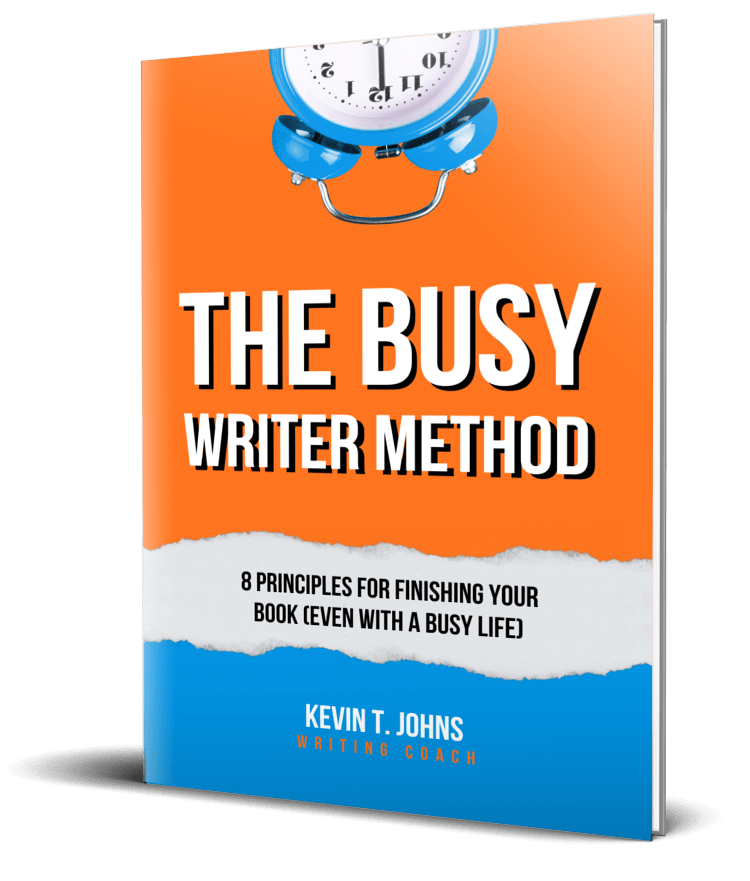
Click the image below to grab your FREE copy of The Busy Writer Method:
The Writing Coach Episode #243 Transcript
Read the full transcript
Kevin Johns: Lorraine, welcome to the show.
Lorraine: Well, thanks for having me, Kevin. It’s always a pleasure spending time with you.
Kevin Johns: Take me back to the very beginning of The Call to Witchery. How did this journey begin for you?
Lorraine: It was really weird. It started in 2016. Earlier that year, I had read Julia Cameron’s The Artist’s Way, where she says to write three pages a day in a journal. I had started that and had been doing it for about six months. Then one day I sat down to write in the journal about what was happening in my life, because that’s what I was writing about, and this story was just sort of taking over my brain, my focus. At the time my mother-in-law was sick, so there were some serious life things happening, and I ignored the story. For two weeks, every morning when I sat down to write, it was sitting there waiting for me. So finally, after two weeks, I gave up and I started writing it in my journal. I figured if I wrote half for the story and half for what was happening with my mother-in-law, I’d be good.
I did that for months. Eventually the situation with my mother-in-law passed, but the story wasn’t finished, so I kept writing. I just kept writing in my journal, and finally, at the end of it, I thought to myself, “I like this story.” So I typed it up and gave it to a friend who’s a serious fantasy reader. It took her two days, and she came back and said, “You have to publish this.” That was the first encouragement I got.
Of course, I’ve always known that if you’re going to go into a craft or become a creator or an artist, there are rules you have to follow, because you have to know which ones you can break. So that started my almost 10-year journey of learning how to craft a good story. In that journey, I went to the Write Practice, which is an online group for writers. They helped me a lot. Then I found you, and you and I spent quite a bit of time together. It’s actually you who taught me the structure of a good story. While we were working together, Shawn Coyne came out with Story Grid, so I started following that. Then you took me to the point where I could submit it to a developmental editor, and that’s what we did. She was a certified Story Grid editor. That was two years ago, and about a year ago I finished with her and sent it off to a copy editor.
Just before I was going to publish, I gave it to someone who’s very detail oriented and really goes through stories with a fine-tooth comb. She could work as an editor, but she’s not. She went through the book, and it took me a couple of months to fix the things she found. But once all of that was done, it was ready.
Kevin Johns: You mentioned that friend you shared the original first manuscript with. From what I recall, while you were working on the book, there was a friend you would often go for daily walks with and talk about the book. Is that the same friend?
Lorraine: Same friend. Yes.
Kevin Johns: Tell us about that experience, the walks and the sorts of discussions you would have with your friend, because I think that is such an invaluable tool that not everyone has.
Lorraine: Her name is Lucy. Lucy and I each had a dog, and we would take our dogs on their daily walks. During those walks, we would touch on the story. When I had trouble figuring out how to make something work, or this is the challenge I’m facing, Lucy had a wonderful imagination, but at the same time she was really grounded. So I would present her with the challenge, and she would give me ideas. She’d say, “Well, have you tried this? Or have you thought about this?” It became easier to move the story along as I was writing it, because I had somebody to bounce ideas off of.
Lucy and I have both lost our dogs, so I’m not in contact with Lucy as much anymore, and I miss our daily walks. I’m actually looking for someone I can do this with, because I really miss having that contact, someone to bounce ideas off of and to be just as creative with.
Kevin Johns: I love the casual nature of it, too. I run all these group coaching programs, and I think it’s so important for authors to come together and support each other and focus on the craft. But that’s also a very structured, focused environment. Whereas a walk is more like, “Talk about the book if you want to talk about it. If not, don’t.” There’s no pressure to it. I always thought it was such a great thing that you were able to meet with me and be really structured and craft focused, but also be really relaxed and free flowing and just chat about ideas with a friend. Just wonderful.
Lorraine: Like I said, I’m looking for someone I can do that with. There’s a lady down the street who’s very much a reader, and we’ve started going for walks, but she’s not really into fantasy, so we’ll see. I’ve actually shared my book with people who are not fantasy readers, and they absolutely loved it. Everybody brings their own take to it, and it’s amazing to see.
Kevin Johns: What do you think it is that allows people who don’t normally read speculative fiction to get into The Call to Witchery?
Lorraine: Do you know what they say to me? It’s the relationships. It’s the characters themselves. They identify so much with the characters and the way they are, and they like the different personalities. Because I made the book about the characters, their relationships and the challenges they felt, that’s what people are really connecting to. The magic isn’t secondary, but it supports what happens.
Kevin Johns: Something I suspect people also resonate with is the idea that this is a coming-of-age book for an adult. I think many adults want that for themselves. We want to reinvent ourselves. We want to discover new parts of ourselves, or unleash the power that we know we have within but have been holding back. So regardless of genre, I think that feeling speaks to an adult reader.
Lorraine: Yes, I agree. I know for myself, and Kevin, you and I have talked about this, for many, many years I worked in technology, which is very, very structured. For years I searched for how to be creative. When I retired, and even before I retired from IT work, the ability to write in the journal and let my imagination fly is really what drew me to this. We go through periods of transformation, and I call this my third career. It’s the one I’m most excited about.
Kevin Johns: For sure, as you should be. Tell me about the theme of the book, because you have a really nice balance between humor and lightness, but also real emotions and darkness. How did you find the balance between the light and the dark in the story?
Lorraine: I wanted to be sure there was laughter there, but we all know it’s pretty scary going through change. We all experience it. There are times when you really wonder whether this is what you should be doing, when you think, “I’m not sure I’m ready for this.” That’s what I wanted to bring to the page, and I do it by forcing Abigail to go through that change. Her magic ends up being triggered by her emotions, so sometimes she really has no control. Those emotions kick in and off it goes.
Then, as the book moves on, I went into a dark place. There’s always somebody who has to die in a fantasy book somewhere, and that can be really dark. So by balancing the zinginess of the humor with the theme of change, and the old persona having to die and all of that, it becomes a really good balance.
Kevin Johns: I don’t know if you’ve used the term “urban fantasy” in your marketing, but this is a fantasy book set in our world, right? People drive cars and watch TV.
Lorraine: Yes. The term is “contemporary,” is what I discovered.
Kevin Johns: Since you’re writing contemporary fantasy, how was it trying to find that balance between, as I said, people driving cars, but also harpies flying through the sky and that sort of thing?
Lorraine: The way I got it to work is that we live in our day-to-day world, so there are cars, and there are magical people and non-magical people. In the book, the magical people are celebrities. That brought me to this whole persona of celebrities, and the fact that their privacy is invaded, that you can see them anywhere, that they’re all over the newspapers and that sort of thing. I made it so Abigail’s parents were the ones who took the witching community from being practiced behind closed doors to people being aware of it. They know what witches are and all of that.
The thing is that there’s this sort of invisible wall between the non-magical people and the witches. Or rather, not a wall, a rule. The rule is: you don’t practice magic openly. “I understand you’re magical. I understand you do spells and all of that stuff, but don’t you dare scare me with it.” The witches have agreed to this, because then it’s a status quo. Everybody goes along in their business. That’s how I married the two worlds together.
Now, the harpies coming along breaks that rule. In order to keep things normal, that’s one of the things that causes Abigail to run, because she wants to be able to go back to the town that accepted her after her parents died.
Kevin Johns: Tell us about Abigail. Who is your protagonist, and what’s driving her in this story?
Lorraine: Abigail is a 35-year-old witch who has essentially buried her magic. In this world, the witches wear amulets, and the amulets are bonded to the witch. They reflect the innate magic within each person. To me, the magic represents the creative side of a person, the talent they have. Some people bury that talent and some people really expose it. That’s how I built the magic within each person, and the amulet just enhances the inherent magic of the witch.
Now, one of the limitations of the amulet is that it needs to be activated every 20 years. It needs to be recharged. Abigail never activated hers, but she had a 20-year window, and if she doesn’t do something about it within the next couple of years, she will lose her magic permanently. So it’s not as if she can just keep that amulet at the back of the closet. She decides at the beginning of the book that she will activate her amulet, because she wants the choice. Maybe she’ll change her mind in five years’ time, but she wants to have that door open. She makes that decision, and things go from there.
Kevin Johns: She ultimately ends up being matched with a teacher of sorts, which becomes our love-hate subplot in the book. I don’t necessarily want to call it the romantic subplot, but the mentor-mentee relationship in this book is rather dynamic. Tell us about that.
Lorraine: The potential love interest. What I decided to do with book one is make this a very slow-burn romance. There are hints at it, but technically there’s really no romance. That will come about in book two, book three.
Abigail’s grandparents decide they need help getting her trained, because her magic is very powerful and comes up at times when it really shouldn’t. So they reach out to a gentleman called Monet, who created what they call the Codex, which is the witches’ Bible of magic. It didn’t exist before he did the research. He went out and found all the folklore, spoke to all the different types of witches, and gathered everything in one place. He’s highly revered and respected for the work he did, so Abigail’s grandparents decide he would be the perfect one to teach her.
Well, he arrives and says, “I don’t teach,” and he calls her bluff and really, really makes her mad. Of course, that triggers her magic. In my mind it’s a really funny scene.
So he comes back and says, “Well, you will be confined to the house, and I suggest you learn not to get mad so that you don’t trigger anything.” Wrong thing to say to a woman. Wrong thing to say. So, without even thinking about it, she launches one of her knives at him. It misses him, but he takes that moment and actually has an idea, so they go out to the back garden and he starts to teach her. It’s a very funny moment.
Kevin Johns: Speaking of interesting, in addition to some of the more conventional witch and fantasy elements, you also introduce speaking animals. Tell us a little about the decision to include speaking animals in the book, and then how you went about handling those characters.
Lorraine: It’s a long time from when Abigail’s parents die and she goes to live with her grandparents to when she’s 35. Her grandparents always knew that her magic, despite the fact that she was denying it and tamping it down, would come out somehow, some way. They wanted to be sure that when it did, they would know. They also knew that as Abigail aged, she didn’t share everything with them. So I needed to figure out a way for them to know when her magic showed up.
The best way, her grandparents decided, was to bespell a squirrel and a blue jay. I picked those two because they’re two animals that are everywhere in the Canadian landscape. We don’t think twice when we see a squirrel or a blue jay. They’re just part of the landscape. So who better to have as their spies? That’s how I introduced the animals: they were bespelled by the grandparents. They had a mission to fulfill, and they could do it very easily. For years they spied on Abigail, and she didn’t know.
This was a huge bone of contention when she found out. How she found out is actually one of the funniest scenes in the book. She’s just had a major faux pas with her best friend and cousin, Jane, and Jane is cleaning up after Abigail, so she sends Abigail to the room where she’ll be staying that night. Abigail needs some fresh air, so she opens the window, and in pops Francesco the squirrel, whom Abigail can understand. All of a sudden it’s, “Oh my God, I can understand this squirrel.”
Then, of course, a squirrel being a squirrel in a room it’s never been in is going to go all over the place. Abigail just wants the squirrel gone, and as soon as she thinks that, with the frustration there, her magic helps her shoo the squirrel out the window in the form of arrows. And of course, things go from hell to handbasket real fast.
Kevin Johns: You mentioned you had a long career in basically technology, and that’s where a lot of your expertise lies. As someone who spent so much time working in tech, did that assist you in your writing, or was it a challenge to move into this more artistic mindset?
Lorraine: Both. It was hard to be extremely imaginative and solve issues creatively, because in technology there’s always cause and effect, X leads to Y. It’s so structured and so logical. To be unstructured in creativity was a challenge for me, because at times I just couldn’t think of solutions to the creative problems I was facing. And yet the structure actually helped me figure out how to structure a really good story and what a story needs. Now that I understand how to do the structure, it becomes so much easier to be creative. It’s really an anomaly. It’s bizarre the way it happens.
Kevin Johns: Right before we hit record, we were talking about book two. Book one is out. Tell me a little about your experience at my writing retreat last year, where we worked on the outline for book two.
Lorraine: I didn’t know what book two was going to be when I went to the retreat, but figuring it out was the goal. I knew I’d have access to you for three days, and I knew that with you we could develop something that would work. I had no idea what book two was going to look like. I had come up with some last-minute ideas, but nothing structured in any way.
When you and I started working on the outline for book two, one of the tools we had available was ChatGPT, which was relatively new, having been released the previous fall, so we used it as an experiment to help us figure out the outline. On top of that, you have a course that shows authors how to develop an outline. The combination of you, your course and ChatGPT gave me a really good working outline. I walked away from your retreat with something in hand that I could work with, that I could spend a year thinking about, trying to figure out, “Okay, is this going to work? Is this not going to work?” I’ve already made adjustments to the outline, and there’ll be more coming.
That outline also led me to doing the psychological work for each of the characters involved in book two, and that’s been fun. I’ve gone back to Abigail. She’s not the same person at the end of book one as when she started, as you said, so I’ve done another profile on her. By doing the profiles, story ideas come up, and I get to know how the relationships can unfold and how each character reacts to something that’s going to happen. It becomes easier to pull the story together.
Kevin Johns: That’s such a great point. When you’re getting story ideas inspired by character analysis, it means it’s character-driven storytelling. It’s not “and then God reached down and blew something up.” Instead, the actions, the plot, the things that take place come from within these characters, who they are, how they see the world and what they want out of it.
Lorraine: As you know, I’m a big supporter of AI, and one of the things AI cannot do is what you just described. It can do the action. It can do amazing things when it comes to creating action-sequenced stories. But really good stories are character driven, and it can’t do that, not with any degree of expertise. That’s why I can always tell when a story’s been written by AI: it’s really flat. It’s very flat.
Kevin Johns: While we’re talking about the challenges of writing, I find with many of my clients who finally get their debut novel out and start working on book two, they suddenly realize they’re not just writing a book anymore. Now they’re writing a book and marketing a book. How have you started to approach the fact that you now have two jobs: write the next book, but also help spread the word about the great first book in the series?
Lorraine: I started the marketing for book one a month and a half before it was released. I work with Kim. You know Kim. She helped me build the brand I have through LorraineJohnston.com and AI Magic for Authors, and she has her finger on the pulse of what’s happening out there. She said TikTok seemed to be the place where there were a lot of very active readers, and she suggested I start putting little videos and carousels on TikTok.
Well, Kevin, you know I’m not a huge social media person, and TikTok, absolutely not. But TikTok is sales, and when I thought about sales, I thought, “Okay, yes, I need to bite the bullet.” But at that time you’re in the middle of planning all the marketing that has to happen for the launch. So I hired someone to run the TikTok campaign. I found her through the person who did my cover for book one, Zizi. She lives in Indonesia, and I’ve found that Indonesia is a really good place for writers to find support with things like cover design, TikTok campaigns, all of that kind of work. Zizi recommended a lady by the name of Bella, and it was the best decision I made.
For the first four weeks on TikTok, I got followers, but not many. As of today, I’m almost up to 1,000, 900 to 1,000, which over two months is apparently amazing.
I also have my own website, so I send emails out to people. I’m on Substack, so I send emails to those folks, and Substack has a little feature called Notes, which, as someone described it, allows people to see who you are. So I posted the cover there, and I did the same thing on LinkedIn. And then I talked to people. I started telling people I’m a writer, and they’d ask for the name of the book, and I’d give it to them. It was just this continuous thing. Then the launch happened, which was great, this month.
The funny thing, which I didn’t realize, is that even though I chose my categories on Amazon really well, I didn’t make bestseller. And yet when I think about it, I think of the book Theo of Golden. Are you familiar with that book?
Kevin Johns: Not sure.
Lorraine: It’s by a fellow named Allen Levi. A debut novel. It was a good story. He planned just to sell a few hundred copies, and it took him many years to write. Finally it got launched. His daughter did the outreach. They put it on Facebook. He did local book signings. It wasn’t anything big, not much social media, that sort of thing. Then word of mouth started up. It’s been out three years now, and I think he hit bestseller two and a half years after the launch.
Kevin Johns: Okay, great.
Lorraine: So in my mind, this is what’s going to happen with this book, because this is what I’m going to do. I’m going to hit the pavement. I’m going to reach out to book clubs, which is one of the things Mr. Levi did. He talked to book clubs. One of the things I’m going to put on my website is questions for book clubs, and I’ll go talk to them about the book and how it came about and all the rest of it. It will be an ongoing thing, but it won’t be the big, huge planning and delivery that happened around the launch. Call it this: the constant drip.
Kevin Johns: I think that’s a great approach. You attended my book launch party recently. Thank you so much for that. It was a co-launch with my friend and client Suzanne Leon, and that’s actually the approach she has chosen as well. She’ll post some stuff on social media, but she’s like, “I want to go places. I want to talk to people. I want to have events.” For outgoing, well-spoken people like you and her, I think that’s such a great way to go. Even at that small book launch party, I sold more books than I would have if I had published seven posts a day for that entire week on social media. People want to see that there’s a real person behind it. They want to be able to get you to sign their book, and all of those things.
Of course, social media is so important and can’t be ignored these days. At the same time, and I say this in my book marketing program, the core of all book marketing is word of mouth. Most people buy a book because they heard someone else tell them it was good, and everything we do is just trying to supplement or support word of mouth. And who tells people about books? People who met you. People who say, “I met this amazing author. She signed my book. You’ve got to read it.” So I think getting out there in the real world is wonderful, and you’re also going to get such cool experiences out of it. You’re going to go places and do things and meet people in a way you just don’t when you’re sitting behind a computer making yet another social media post.
Lorraine: Two things to that. Whenever I go to an event, the nerves hit. I look as if I’m truly an outgoing person, but all writers are basically introverts at their core. So yes, the anxiety is there before I step into the room, but once you step in, it becomes much easier. If there’s a word of advice for other writers, it’s: do it. Do it anyway. Yes, it can be really scary, and your mind does all these wonderful tricks. But once you’re there, it’s such a joy to meet readers who really appreciate your stories.
The other thing is that, after COVID, people want to see people. So I’m going to find those people, and I’m going to give them my book.
Kevin Johns: Well, it’s out now. Congratulations!
Lorraine: Thank you.
Kevin Johns: Where can you send folks to learn more about the book and about you?
Lorraine: I have a website, LorraineJohnston.com, which talks about the book and talks about witchy stuff. It’s a really cool website. I really, really like it, and there’s some fun stuff there. The book is currently available on Amazon, and I’m in the final stages of having it distributed by IngramSpark, so it will be available at Chapters and Barnes & Noble and all of the other stores. That’s coming. And then my next challenge will be to create the audiobook for it. That’ll be fun.
Kevin Johns: Absolutely. Well, Lorraine, thank you so much for taking some time out of your day to join me on the Writing Coach Podcast.
Lorraine: Thank you, Kevin. It was such a pleasure.