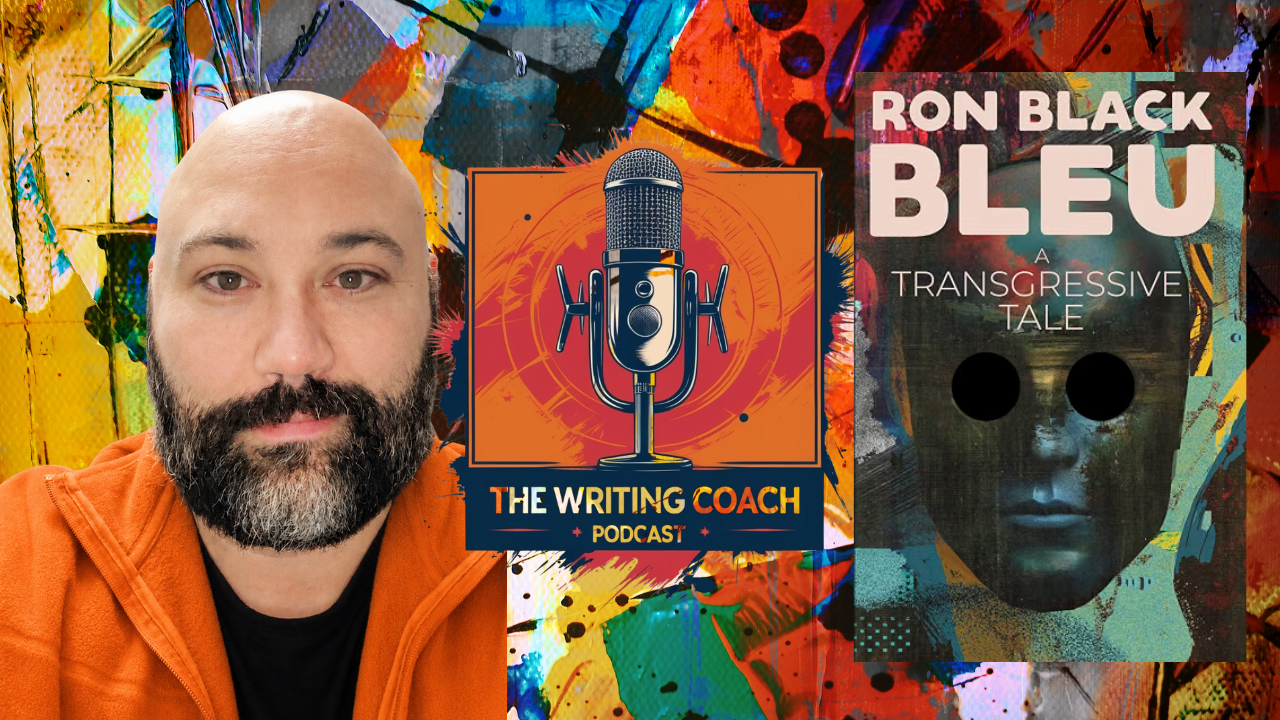
My guest on this episode of The Writing Coach podcast is my client, author Ron Black. His debut novel Bleu: A Transgressive Tale follows Anthony, a struggling artist in a version of Ottawa most Canadian fiction doesn’t go near — squats, addiction, an art world he doesn’t feel he belongs in, and a marriage where the violence runs in a direction fiction rarely lets it run. Ron’s been my client for years, so this one’s personal for me too.
We get into why an unlikable protagonist doesn’t need to be a likable one — just an understandable one — what it costs a first-time novelist to write a character this broken, and the doubt that follows you even after the book is out in the world. We also talk about the cover design process, why Ron chose not to include trigger warnings, and why he thinks most of our lives are a lot closer to Bleu than they are to Saved by the Bell.
Check out the episode now!
Audio:
The Writing Coach Episode 237 – Show Notes
Purchase your copy of Bleu: A Transgressive Tale by Ron Black now.
Learn more about the Barbados Writing Retreat:
Grab your FREE copy of The Busy Author Method:
The Writing Coach Episode #236 Transcript
Kevin Johns: Today on The Writing Coach podcast, I have my client Ron Black. Ron, welcome to the show.
Ron Black: Thanks for having me, Kevin. Appreciate it.
Kevin Johns: Congratulations on the publication of your book. I am always thrilled to have one of my clients on the show when their book sees the world, because I get that amazing behind-the-scenes experience of seeing the heartache and the hard work and the blood, sweat, and tears that people put into their books. So I couldn’t be more honoured than to have you on the show celebrating the release of Bleu.
Ron Black: It was a long time coming. I didn’t think I would get it out, but it’s actually really exciting. It’s a real weight off my chest.
Kevin Johns: Absolutely. Before we hit record, I was talking about how I just finished my trilogy this summer, and there’s a sense of relief. There’s this feeling when you’re working on a book project that you’re pushing a rock up a hill for a long time, and part of the celebration of finishing it is saying, “I don’t have to push that particular rock anymore. I can move on to another one.”
Ron Black: That’s just it. I was starting to feel like — I don’t think it’s called imposter syndrome, but I was starting to feel like a fraud telling people I was actually going to write and publish a book.
Kevin Johns: Sure. It’s like newlyweds when they get married and people are constantly asking, “So when are you having a baby?” It’s the same when you’re telling people you’re writing a book — “Is it done yet? Is it done yet?” Nope, still working on it.
Ron Black: Yeah, that’s exactly the experience.
Kevin Johns: When did it all start for you? When was the moment where you decided to take on this project and write this novel?
Ron Black: It was either 2016 or 2017. I was working a night job, kind of like a custodian, and I had a lot of downtime to think. My mind landed on a prompt, and that’s what got it started. It’s kind of dark — I don’t know how much dark stuff I can mention on the podcast.
Kevin Johns: We could go dark. Go for it.
Ron Black: Okay — a painter shoots himself through the mouth, the blood hits a canvas, and it makes a work of art. That was the prompt that started it. I pitched it to a friend, and he said, “That sounds really cool, I’d love to read something like that.” And it went from there. The really hard part was getting into the habit of writing — writing a few words a day until eventually it became habitual. That was the first big hurdle.
Kevin Johns: Something really interesting about the book is that it’s set in Canada, but it explores quite a bit of urban decay — the kind of thing we might associate with 1980s New York, or very poverty-stricken neighbourhoods, which I don’t feel like we see as much in Canadian fiction. What was your take on bringing that grittiness of urban poverty to a Canadian-set book?
Ron Black: I almost didn’t give it a location. Someone suggested I should, so I set it in Ottawa. I know that’s a bit lazy, to be honest — I mainly wanted to be grounded somewhere. I actually thought maybe I should have tried a little harder to incorporate more of Ottawa specifically, but I was mainly trying to set it somewhere I knew.
Kevin Johns: Well, I always experience any work of art as a reality slightly next to the one we’re existing in. So I think the Ottawa this book is set in is perhaps not the Ottawa of my reality, but it feels like maybe if my life took a couple of turns, if I turned down the wrong street, I might find my way into the world of your book, in the city I live in.
Ron Black: Yeah — I live on Bank Street, so there’s a lot of inspiration there. There’s a lot of poverty in those parts, a lot of homelessness. It’s got its negatives, but it’s also fun.
Kevin Johns: The book touches on poverty and drug addiction, as we’ve talked about, and it also touches on domestic violence, which I want to get into a little later. But on top of all of those things — which I’d characterize as conventions of transgressive fiction — you also have this unique layer where it’s about the art world, the fine art world. What intrigued you about taking a form that’s often thought of as snooty or snobby and mixing it with the grimy underbelly of addiction and poverty?
Ron Black: A few things. Once I decided that was going to be the prompt, I knew it had to be about artists, so I had to learn a bit about that world. But it’s also the interesting contrast of artistry — you have the refined, high-class artists, and then the more urban artists, and it speaks to both worlds at once.
Kevin Johns: I think that leads perfectly into something else I wanted to talk about — the way the book moves between these different worlds. We get this squatters’/addict world, but also this middle-class life, and then this avant-garde artists’ world. What was your interest in exploring these different classes of society all functioning alongside one another, and yet all so different?
Ron Black: That’s a good question. I think it comes down to Anthony himself — whether he really feels he deserves any of this — and I explore his insecurity more and more by contrasting him with these other worlds. It starts with him at the bottom as an artist, but as it goes on, it explores his artistry through what he’d deem “proper” artistry, through museums, and it also contrasts him with his wife, who doesn’t care about art at all. So it’s really exploring his insecurities around being an artist, but also his insecurities around masculinity, around deserving fame, and around feeling unloved.
Kevin Johns: You’re also a fan of graphic novels, and you’ve done some work in that world. There’s a lot of inspiration from Breaking Bad, too, isn’t there?
Ron Black: There is — the idea of a suburban dad turned drug dealer was always a really compelling concept to me, and I wanted something similar: a lowly man who isn’t as much of an artist as he’d like to be, stepping into a world way above his head.
Kevin Johns: Fascinating — and in all the time we’ve worked together, I don’t think we ever talked about Breaking Bad, did we?
Ron Black: That’s interesting, because it was a big inspiration. The relationship between Anthony and Liza is meant to mirror Walt and Jesse — two opposite worlds colliding.
Kevin Johns: That makes perfect sense. I think you put such a unique spin on it that I didn’t even make that connection, despite having read the book multiple times.
Ron Black: I appreciate that — and thanks for reading it a bunch of times, actually.
Kevin Johns: It’s my job, and it’s also my absolute pleasure and honour to work with writers like you and support you on this challenging journey of getting these stories into the world. I think a book like this is perhaps more challenging at times than a fantasy or horror novel. I often talk about the idea of monster as metaphor — when I write about vampires or dragons, I’m using them as metaphors for real life. But in this book, the metaphors are stripped away, and what you’re left with is character — these people, the actions they take, and the consequences they face.
Ron Black: That’s kind of why I respected reading stuff like American Psycho and Lolita — books that give you some really grisly characters. Trainspotting showed the opposite end of transgressive, where it’s less craziness and more lowliness.
Kevin Johns: You’ve mentioned Lolita, Breaking Bad, American Psycho, and Trainspotting — all outsider stories about broken or bad people. Many first-time authors I work with want to write about themselves, and their protagonist is almost always a thinly veiled version of themselves. Because of that, they’re hesitant to make that character flawed, since it might mean admitting flaws in themselves. You chose to write about a character who’s a complete wreck — deeply insecure, and making decisions that are morally suspect if not reprehensible. What gave you the confidence, as a first-time novelist, to write a character who’s so broken?
Ron Black: Funny you should say that — I’ve actually been thinking recently that I regret pulling my punches too many times. There are parts of the book I wish I’d gone darker with. I’m so used to mainstream storytelling that I kept thinking, “I can’t do that, it’ll make him too unlikable.” I realize now that’s something I wish I’d done more of. In the beginning, I didn’t really understand what I wanted out of him. Eventually, when people told me he wasn’t very likeable, I leaned into that — maybe he doesn’t need to be likeable, maybe he just needs to be understandable. That was something my editor said that really clicked for me. I used to think an unlikable main character doesn’t work, because that’s what a lot of people say. What my editor hinted at is that a character doesn’t have to be likeable — we just have to understand them, understand their behaviour. That’s why I started adding more backstory for Anthony, to make him not necessarily more sympathetic, but at least more understandable. I’ve also been watching BoJack Horseman recently, and it does such a good job of this without pulling its punches. There’s an episode where I thought, “Wow, you actually had the nerve to go there.” Through shows and books like that — and especially through American Psycho — I realized you can go there with this genre. The more I read in this genre, the more I understood that’s the point of it: there are stories where the characters are just basically unlikable. Lolita and American Psycho are the two best examples I can think of — those people are awful. Patrick Bateman is one of the most evil characters I’ve ever read, and it’s one of the most unsettling books I’ve ever read. It’s crazy. So, sorry — I’m getting a little long-winded, but that’s the idea of it.
Kevin Johns: You know me, I love this stuff. I’d argue another show that’s straight-up transgressive about horrible people is It’s Always Sunny in Philadelphia — now the longest-running live-action sitcom in the history of television. I think that speaks to the fact that we don’t mind watching bad people if it’s interesting, if it’s funny, and if we understand why they’re doing what they’re doing, as your editor said. Mainstream culture plays it too safe. One of the things we appreciate as fans of transgressive fiction — reading a Bret Easton Ellis book, or watching Always Sunny or BoJack — is that someone was willing to give us something fresh, surprising, and, dare I say, uncomfortable.
Ron Black: That’s just it. I understand it’s a risk, and it’s easy to tell other people to take risks when I’ve struggled with that myself, both with this book and the new thing I’m writing. I regret pulling certain punches. That’s kind of my thing with vigilante characters — I always know where they’re going to stop, and sometimes that’s good, and other times I think maybe you should have gone through with it. I remember watching one of the newer Halloween movies, where Michael Myers looks down at a crying baby and just walks on. I get it — no one wants to see someone kill a baby — but at the same time, this is an evil, depraved lunatic; I feel like he probably would have done it. I get why they didn’t go there, but moments like that make me notice patterns in mainstream media where I know exactly where a story is going to stop, what lines it isn’t going to cross. I’m not saying you always have to cross those lines, or that I dislike these characters otherwise, but it starts to feel a little predictable. That’s part of the draw for me in writing these kinds of stories — trying to see what lines I can cross, and whether I can justify crossing them.
Kevin Johns: With all that said — I bought a copy of the book, and I don’t recall if I looked at the front matter. Where did you land on trigger warnings? Did you include any, or choose not to?
Ron Black: I chose not to, because someone told me — I don’t remember if it was you or my editor — that calling a book “transgressive” is supposed to be the trigger warning. That’s the bread and butter of the genre, so presumably that’s enough.
Kevin Johns: It’s a debate — we talk about this in my writing group sometimes. Usually younger people are more in favour of trigger warnings, and think they’re really important, while older folks tend to say, “deal with it.” But I think you’re spot on when it comes to transgressive fiction — you have that right on the cover of the book. I think people understand that to read a transgressive tale is to read something that’s going to make you uncomfortable, and make you look at things you might not want to look at or face.
Ron Black: I’m not sure my book will ever be on shelves in a store — maybe at the library. There were certain choices that were a fifty-fifty toss-up, like the title. I changed it to just the French word for “blue.” I wanted to keep the W at the end, but I was worried that would be too confusing and too hard to search for. A friend recently told me I should have kept the W, since without it, the title looks more generic and runs together with all the other books called Blue. I did my best as a new author — I’m hoping I don’t trigger anyone, I don’t want to hurt anyone, but that’s part of being new at anything. You make a few mistakes and hope for the best.
Kevin Johns: I believe it’s in Save the Cat Writes a Novel, by Jessica Brody, where she talks about how, most of the time in a story, it’s the character who changes, though sometimes it’s the world that changes. I believe she was talking about thrillers — something like Silence of the Lambs — and she said that in those stories, it’s actually the reader who changes, because these stories show us how dark life can get, and the depths a person can fall to. I think that’s part of why we’re drawn to these stories — in some way, they help us be less naive about how cruel the world can be. Reading these tales can be harrowing, but I think it also strengthens us for the times in our lives that don’t go like a sitcom — that are much more like the things that happen in a transgressive novel. In fact, I’d argue that most people’s lives are a lot more like Bleu than they are like Saved by the Bell.
Ron Black: I can see that. That makes sense.
Kevin Johns: You mentioned digging into your protagonist Anthony’s backstory, and a major component of that is domestic violence. You bring an interesting spin on it, though — the depiction of domestic violence in this book is the wife abusing the husband. Was it important to you to show that the sorts of violence that can happen within marriages aren’t always husband-on-wife, but that it can go the other way too?
Ron Black: Yes, that’s a very important concept to me. I feel like it’s not touched on enough, or not with enough seriousness. Male-on-female abuse is, of course, also a very serious issue, and I don’t want to undersell that — I just also want to show it can happen the other way around. I feel like female-on-male abuse commonly gets swept under the rug. Men’s pain in general is often either downplayed, played as a joke, or treated as punishment for something they did. To the point where I’ve actually wondered whether making her as physically aggressive as I did might be to the detriment of that part of the story — whether I made her too aggressive, to the point it becomes a little farcical. That’s one of those things I’ve debated in my head over and over. Maybe I shouldn’t have made her as physically aggressive; maybe I should have made her more subtly aggressive, since a lot of female abuse is said to be more emotional, among other things. So that’s been an ongoing debate for me. I’m hoping I didn’t undercut what was supposed to be a serious part of the story that I want people to think about and take seriously. In general, though, it’s a concept that matters a lot to me — I feel like it happens a lot in society.
Kevin Johns: I think this interview has done a fantastic job of digging into something every novelist deals with — that constant tightrope walk, that push and pull of, “I think I held back too much here,” or “I think I went too far there.” Ultimately, that’s for the reader to decide. As artists, all we can do is aim for what we think will work. It’s a tightrope walk, and maybe we don’t always land in the perfect position, but that’s what it is to tell a story. There are a million directions you could go, and you go with the one you think is best at the moment — and then it’s up to the reader to decide whether it works. Once it’s out in the world, it becomes its own thing.
Ron Black: I guess that’s really what it comes back to — the same as what you said before. I shouldn’t worry too much about upsetting people, or how many copies sell, or whether the quality is exactly right. You make it the best it can be, put your best foot forward, and keep trying and improving.
Kevin Johns: Absolutely. As soon as I saw the cover for the book, I thought, “This is perfect.” Getting to see those covers is always one of the most exciting parts of book creation. Tell me a little about your cover artist, and how you came across this designer.
Ron Black: It’s funny — that wasn’t the design I was imagining at all. I initially tried working with a friend on it, and then I started using ChatGPT to break down positioning, spacing, how to place images, and so on. At a certain point, it hit me: this is way more of an art form than I realized. Everything matters — how big something is, where you position it, how you colour it. Eventually I realized I needed a professional, so I went on Reedsy. I really like Reedsy — it’s got a lot of resources, and they’re not always cheap, but you get what you pay for. I’m glad I paid what I paid for this artist, because he did such a good job. I was searching through different artists’ portfolios — it came down to him and two others, and I went with him because I really liked his design work on other covers. When he showed me the prototype, I spent several minutes just looking at it. He’d read the book first, and told me he really appreciated getting to read it and found it interesting. Then, after he designed it and sent the prototype, I thought, “You perfectly captured this book in a way I couldn’t have imagined.” It works so well for the genre, and for capturing the characters — the face covered in landscape, the splatters beside it representing Liza, the face as empty holes. It’s brilliant. He’s such a talented designer. I put his name in the book, and he said that was fine.
Kevin Johns: Sure — the name’s in the book, so folks can look for it there too.
Ron Black: Exactly. He’s a very talented artist with a huge portfolio of covers, so anyone looking for a cover designer might want to give him a try after seeing the credit in the book. He was very professional, very patient, and the cover is more beautiful than I could have imagined — to the point that I started getting insecure again, wondering if the cover was too good for the book.
Kevin Johns: Oh, the book is great, the cover is great, and you can’t separate the two — they’re one and the same. Sometimes the cover is the final piece of the puzzle, and I think that’s what happened here; it really brought everything together. It was so great working with you on this project. Do you recall how we crossed paths, how we ended up working together?
Ron Black: A few years back — I’m trying to remember how I got your information. Was it through Reedsy?
Kevin Johns: I’m on there, but I don’t think that’s how it happened. Who knows — the stars collided, and we got to work together. It’s been such a pleasure watching you put so much passion into this story, and it’s exciting to see it out in the world and to celebrate that with you. Now that Bleu is out, where are your creative energies focused? What’s on the horizon?
Ron Black: Right now I’m in the middle of writing a graphic novel — a biblical fantasy that touches on racial issues within Catholicism. I’m writing the rough draft and thinking about how to handle such touchy subject matter — not too on the nose, not too in-your-face, but also not offensive. It’s tricky. I’m just going to write the drafts and figure it out as I go, maybe cut certain elements. It’s also challenging because there’s a lot of graphic-novel-specific lingo I need to learn around describing shots and panels. Once I’ve finished the script, I’ll need to hire an artist.
Kevin Johns: You mentioned it touches on race, and I don’t think race is something we talked about much in the creation of Bleu, or in our time working together. Did race play a role in this novel, or was it something that didn’t have much of a place in this particular story?
Ron Black: No — this one was fully Caucasian North Americans. I didn’t feel race had a place in this particular narrative. It’s more a story about toxic masculinity, insecurity, the rise to fame and how it doesn’t fulfill you the way you think it will, gender norms between men and women, and of course drug abuse and artistry.
Kevin Johns: Absolutely. If someone’s listening and thinking, “I’m looking for my next great transgressive read,” where can they go to learn more about the book and pick up a copy?
Ron Black: It’s on Amazon — Bleu, spelled the French way, B-L-E-U, with the subtitle A Transgressive Tale. I’m hoping to soon get information up on Goodreads too, though I’ve never used it to promote a book before. Otherwise, people can find a website, a TikTok, and an email in the book — all still in their infancy, so I’d say email is the best way to reach me for now.
Kevin Johns: We’ll be sure to post the contact information in the show notes, so folks can find it there.
Ron Black: That would be great — I’d rather point people to the source in the book than risk getting the details wrong here.
Kevin Johns: No problem at all. Ron, it was such a pleasure catching up with you. So exciting to see the book out in the world. Thank you so much for taking the time to join me on the Writing Coach Podcast.
Ron Black: Thank you for having me, and thank you again for all your help. I couldn’t have done this without your patience, your resources, and your years of experience — you’ve been an enormous help. You taught me the basics of structuring a story, and you were a confidant when I was at my lowest. Thank you for the interview, and for the months, if not years, of help along the way. I look forward to working with you again, Kevin.
Kevin Johns: Hey — you’re a transgressive author. If you didn’t offend anyone, you’re not doing your job.
Ron Black: For sure.
Kevin Johns: Thank you for such kind words. I can’t wait to work with you on another project. Take care.
Ron Black: Likewise. Thanks for having me.
—
Kevin T. Johns is a writing coach, editor, and author who helps writers strengthen their craft, find their voice, and build stories that truly connect with readers. Through coaching, courses, and The Writing Coach Podcast, he shares practical, encouraging guidance for writers at every stage of the journey. Need help finding more time to write? Grab his free guide: THE BUSY AUTHOR METHOD.
Podcast: Play in new window | Download
Subscribe: Apple Podcasts | RSS
